To avoid these ads, REGISTER NOW!

Installing stand by generator

Don1357

Well-known member
Joined
Apr 15, 2019
Messages
948
Location
Palmer, AK
I'm self installing a small stand-by generator just to protect the boiler and critical circuits during winter storms. I'm in Alaska outside of city limits, I don't have to pull any permits. Looking at the installation manual it is missing quite a bit of info, mainly the stuff they assume would be done by an electrician. I'm hoping you guys will help me fill in those gaps.

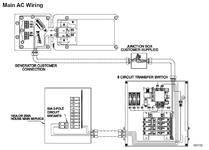
The unit in question is the Generac 7.5kwh propane/6kw natural gas generator (the baby one). The installation seems pretty simple; the generator (outside of the house) powers the transfer switch box (inside of the house). Said box has 8 circuits it protects (not a whole house standby generator, just those), a 50 amp circuit then connects the transfer switch box to a 50 amp breaker on the main house panel. When things are good, power comes from the regular house electrical panel. When power drops the generator senses it, fires up, and the circuits on the transfer switch box are juiced up. When power is restored, the generator turns off and power is again supplied from the house panel.

First question: The manual doesn't even specify the wiring size, so being on a 50 amp circuit it should be 6 AWG copper? Total run is probably about 40 feet.

Second question: What kind of conduit should I use?

Thanks in advance.
 
To avoid these ads, REGISTER NOW!

mm08822

Well-known member
Joined
Jan 13, 2012
Messages
5,845
Location
NJ
#6 copper works for the 50a.

I would run 1-1/4" minimum. 1.5" ok also. Sch 40 pvc, depends how easy run is and your ability. May prefer FNMC in same size.
 
OP
D

Don1357

Well-known member
Joined
Apr 15, 2019
Messages
948
Location
Palmer, AK
The run should be fairly straight forward, I'm yet to find out if where I want it I'm going to hit wood or the poured foundation. That would make it a tad less fun but doable.

Can Romex come out of the house if it is in the conduit or do I need to use an outdoor rated wire?

My last writing job was to bring a 100amp service to the workshop. I dug the trench, installed the panel on the workshop, installed the box to do the split next to the main service, did the wiring, and then paid the electrician to do the final hookup into power. I should be able to tackle this one as I can readily disconnect power while I work.
 

HamAndEggs

Well-known member
Joined
Nov 16, 2020
Messages
932
Location
Houston, TX
I would run larger wire just incase you decide to upsize the generator

I went with a 27kw unit and don't regret it now I have an EV too
 
OP
D

Don1357

Well-known member
Joined
Apr 15, 2019
Messages
948
Location
Palmer, AK
This is strictly for emergency winter power and honestly it is only an emergency if I'm not here. We get wicked wind storms, two years ago while I was gone power went out for over a day, long enough for frozen pipes and water fountains... If I'm here is not an issue, I just burn wood.
 
OP
D

Don1357

Well-known member
Joined
Apr 15, 2019
Messages
948
Location
Palmer, AK
So... Can I bring the Romex outside if it is inside of the conduit? Or would I need a different cable?
 

mm08822

Well-known member
Joined
Jan 13, 2012
Messages
5,845
Location
NJ
Romex in exterior conduit not permitted.

Your xfer panel should require 2 connections:
To panel
To gen
Depending on model that you have it may already include conductors in flexible conduit that terminates in an exterior jbox. From the jbox to gen there should be LFMC with individual conductors.
Post model #s.
 
OP
D

Don1357

Well-known member
Joined
Apr 15, 2019
Messages
948
Location
Palmer, AK
Generac 7.5kw ds-6808. On the installation manual, the entirety of the information about the hot wiring side is this:

"Note: Main AC wiring must be in accordance with local jurisdiction and codes."

Page 28 here:


Basically at the point it comes out of the house more conduit would continue for about 20 feet before it ends up next to where the generator will be. So I'm thinking junction box there and from junction box to generator.

The other type of cable I'm seeing is 6/3 UF-B Wire, Underground Feeder and Direct Earth Burial Cable. Can I run that on conduit inside and out?
 

Sumboodie

Well-known member
Joined
Mar 20, 2021
Messages
10,652
Location
AK
Can bury UF without conduit.

Otherwise use THHN in conduit, no sense fussing with UF.

That windstorm was bad, had no power for 5 days, barely kept the garage freezing up by keeping the door open between house and garage. All my utilities in the garage, so freezing up would have been bad.

But then stove was only keeping house around 60*.

A buddy came home from the slope to a helluva mess when pipes froze then thawed when power came back.

I picked up an 8k a couple weeks ago for auto backup. Haven't messed with it yet, likely won't happen before winter.
 

PCustoms

Well-known member
Joined
Jul 23, 2011
Messages
22,201
Location
VT
The other type of cable I'm seeing is 6/3 UF-B Wire, Underground Feeder and Direct Earth Burial Cable. Can I run that on conduit inside and out?

I would run individual strands of Xhhw-2 or thwn


4 lengths of the correct size should run about $1.50/ft. UF is close to $5/ft and ***** to work with IMHO.

How are you trying this into your panel in the house? Is there a standalone panel inside?

Most auto setups I've seen have the main feed from the grid nter the transfer switch, then the feed goes to the house. It sounds like your are feeding just 50A from generator to house, somewhere you have to transfer/lockout the grid power feed
 
Last edited:

dcg9381

Well-known member
Joined
Jun 20, 2018
Messages
11,627
Location
Austin, TX
So... Can I bring the Romex outside if it is inside of the conduit? Or would I need a different cable?
As others have mentioned Romex is not allowed in conduit. I may or may not know of someone who has bent this rule before.
1.25" conduit sounds good to me minimum. Around here, 1.25" there is a lesser selection of it, so I'd choose 1.5" or 2".

6AWG copper will typically do 50-60A, but I agree with others, 6AWG XHHW-2 Wire is a lot less expensive. I'd probably do 4AWG of the same stuff just for future proof.

One thing to watch - you can get 600V rated "control wire" - I think it's 7 wires (off the top of my head) which are the ATS / generator control wires. Right wire you can run in the same conduit as the power wire. It's pretty think stuff.
 

larry4406

Well-known member
Joined
Jan 27, 2006
Messages
18,955
Location
Northern Virginia
One thing to watch - you can get 600V rated "control wire" - I think it's 7 wires (off the top of my head) which are the ATS / generator control wires. Right wire you can run in the same conduit as the power wire. It's pretty think stuff.
Here it is. Pretty cool stuff, all in one pull. Direct burial, freewire like Romex, etc.
 
OP
D

Don1357

Well-known member
Joined
Apr 15, 2019
Messages
948
Location
Palmer, AK
Fantastic, thank you guys for setting me on the right path. I'm going with these:


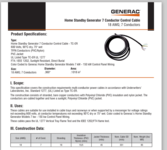
And a spool of these for the control wire:


That windstorm was bad, had no power for 5 days, barely kept the garage freezing up by keeping the door open between house and garage. All my utilities in the garage, so freezing up would have been bad.

But then stove was only keeping house around 60*.

A buddy came home from the slope to a helluva mess when pipes froze then thawed when power came back.

I picked up an 8k a couple weeks ago for auto backup. Haven't messed with it yet, likely won't happen before winter.
It wasn't pretty when I came back...

You should try to make some progress this year. This is basically a 4-part project; 1-foundation and placement of the generator, 2-tapping the natural gas and running the line, 3-running the electrical inside of the house and into the transfer panel, 4-wiring it all up together. The whole project may be quite a bit of effort but each discrete part is not that bad.

This weekend I want to pour the slab and get the parts I'll need to tap into the gas line. I may even get around to install those.
 

dcg9381

Well-known member
Joined
Jun 20, 2018
Messages
11,627
Location
Austin, TX
Nope. Not unless you want to run that in a separate conduit. That's advertised as "18/5 Low Voltage LED Cable". I doubt it's even UL listed. It's also a wire short of what you need.

Better check how many control wires your generator takes. I believe that Generac's need 6 wires. I think you need something like this:

1694281668315.png
 

wyliesdiesels

Well-known member
Joined
Aug 14, 2012
Messages
19,983
Location
Modesto, CA
As others have mentioned Romex is not allowed in conduit. I may or may not know of someone who has bent this rule before.
1.25" conduit sounds good to me minimum. Around here, 1.25" there is a lesser selection of it, so I'd choose 1.5" or 2".

6AWG copper will typically do 50-60A, but I agree with others, 6AWG XHHW-2 Wire is a lot less expensive. I'd probably do 4AWG of the same stuff just for future proof.

One thing to watch - you can get 600V rated "control wire" - I think it's 7 wires (off the top of my head) which are the ATS / generator control wires. Right wire you can run in the same conduit as the power wire. It's pretty think stuff.
not quite. its not allowed in conduit OUTDOORS. NM-b can be ran in conduit INDOORS
 
To avoid these ads, REGISTER NOW!

mm08822

Well-known member
Joined
Jan 13, 2012
Messages
5,845
Location
NJ
If you are pulling all of this to the gen in a single conduit, having all individual conductors is easiest than dealing with a cable or two.
3 - #4 AL XHHW (one taped white)
1 - # 6 AL XHHW green ( or make it #4 also and tape green - then only 1 wire size to purchase)
and
6 - #14 THHN/THWN Cu (N1, N2, T1, 194, 23 and 0) Add the "0" conductor for troubleshooting - it is your dc common from gen back to xfer switch. You will never have a problem with #14 cu for control/sense lines.

This all fits nicely in one 1-1/4" conduit.
 

mm08822

Well-known member
Joined
Jan 13, 2012
Messages
5,845
Location
NJ
Nope. Not unless you want to run that in a separate conduit. That's advertised as "18/5 Low Voltage LED Cable". I doubt it's even UL listed. It's also a wire short of what you need.

Better check how many control wires your generator takes. I believe that Generac's need 6 wires. I think you need something like this:

1694281668315.png
It only needs 5 if run in the same conduit as power as the grd can be shared.
The w/d doesn't require "0" which is dc common (6th conductor). I would pull it for troubleshooting purposes.

The cable OP picked was rated for 300V so it would be fine in this application. UL listing is questionable.......if it's not mentioned, assume it is not - amazon neglects minor details - buyer beware!! Regardless, I would pull individual conductors.
 

dcg9381

Well-known member
Joined
Jun 20, 2018
Messages
11,627
Location
Austin, TX
Guys, thanks a lot, your time and effort is truly appreciated. The "installation manual" is pretty much worthless on this.
Well, generac probably wants you to buy their cable.
Wire and Cable Your way. Someone else can double check this for the use case, but as it's approved for "wet" I assume it can be used in conduit with the primary conductors:


1694292639655.png
 
OP
D

Don1357

Well-known member
Joined
Apr 15, 2019
Messages
948
Location
Palmer, AK
My bump on the road is that a lot of places either don't ship to Alaska or charge more for shipping than the cable itself... This is why I try to find things on Amazon, at least I don't have to keep giving my info on a bunch of random places just to find out they won't ship it :-\

I'll see if I can hunt down a THHN wet/dry rated cable.
 

PCustoms

Well-known member
Joined
Jul 23, 2011
Messages
22,201
Location
VT
I asked this before, but what does the panel look like that you will be installing inside?

How does the generator get isolated from the grid power?
 
OP
D

Don1357

Well-known member
Joined
Apr 15, 2019
Messages
948
Location
Palmer, AK
I asked this before, but what does the panel look like that you will be installing inside?

How does the generator get isolated from the grid power?
The explanation was on the very first post. Generator has a power switch box that goes next/near your regular breaker panel. That box has 8 breaker slots for the stuff you want to protect. One feed goes to the generator, one feed to a 50amp breaker on your breaker box. When there is house power your breaker box does the work. When power goes off the generator senses it, starts, and provides the power to the switch box.

Untitled.png
 

wyliesdiesels

Well-known member
Joined
Aug 14, 2012
Messages
19,983
Location
Modesto, CA
My bump on the road is that a lot of places either don't ship to Alaska or charge more for shipping than the cable itself... This is why I try to find things on Amazon, at least I don't have to keep giving my info on a bunch of random places just to find out they won't ship it :-\

I'll see if I can hunt down a THHN wet/dry rated cable.
theres a reason some of that is cheap.... buyer beware
 

mm08822

Well-known member
Joined
Jan 13, 2012
Messages
5,845
Location
NJ
My bump on the road is that a lot of places either don't ship to Alaska or charge more for shipping than the cable itself... This is why I try to find things on Amazon, at least I don't have to keep giving my info on a bunch of random places just to find out they won't ship it :-\

I'll see if I can hunt down a THHN wet/dry rated cable.
Make this easy on yourself.......buy a 500 ft roll of #14 stranded black or red thhn/thwn from Home Depot. Color code the wires with colored tape or number them.
 

theoldwizard1

Well-known member
Joined
Feb 22, 2011
Messages
43,076
Location
SE MI
Can Romex come out of the house if it is in the conduit or do I need to use an outdoor rated wire?
Romex buried in conduit must still be rated as UF,

If you are going to install conduit, save time and money and use THWN individual strands. You can transition to Romex at a junction box inside the outer wall or run conduit inside.
 

wyliesdiesels

Well-known member
Joined
Aug 14, 2012
Messages
19,983
Location
Modesto, CA
Romex buried in conduit must still be rated as UF,

If you are going to install conduit, save time and money and use THWN individual strands. You can transition to Romex at a junction box inside the outer wall or run conduit inside.
romex is a brand of NM-b NOT UF-b
 
To avoid these ads, REGISTER NOW!
Top Bottom