To avoid these ads, REGISTER NOW!

Interesting rafter tie alternative

mike93lx

ALLIANCE MEMBER
Joined
Dec 9, 2013
Messages
37,487
Location
Richmond, VA
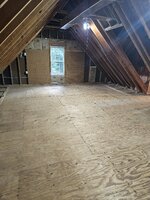
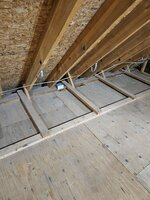
I had never encountered a rafter framed roof system that didn't have rafter ties in the same direction as the rafters. Maybe this is common, but I figured there would be some folks here that would find it interesting (@billconner).

In these pictures, the floor joists run perpendicular (gable to gable), so it's the decking that is preventing the walls from spreading. The framing at the base of the rafters appears to be there to tie them into a couple joists instead of just the outer one. There is a steel beam midspan in the garage below (running same direction as rafters) with a single center post.

Decking is just 1/2" ply. House was build around '88 and is just outside Richmond, so little snow concern. I didn't measure, but the roof looks about 12:12.

This is the house I am helping renovate for my folks that I have posted some other threads on recently.
1000005167.jpg1000005165.jpg
 
Last edited:
To avoid these ads, REGISTER NOW!

Bert_

Well-known member
Joined
Dec 24, 2016
Messages
9,716
Location
NW Iowa
That's pretty interesting. The steep pitch definitely reduces the force pushing out at the walls. Guessing there's a lot of nails in that floor.
 

rixtrix1

Well-known member
Joined
Aug 25, 2013
Messages
3,010
Location
Chandler, AZ (from west NE)
There's a kid on youtube named Cole the Cornstar from Iowa who's renovating his great, great grandfather's 3 story home Complicated 4 gables, steep roof and he tied the roof in the same way to open up the area into one big room, instead of 4 with bracing going everywhere.
 
OP
M

mike93lx

ALLIANCE MEMBER
Joined
Dec 9, 2013
Messages
37,487
Location
Richmond, VA
There's a kid on youtube named Cole the Cornstar from Iowa who's renovating his great, great grandfather's 3 story home Complicated 4 gables, steep roof and he tied the roof in the same way to open up the area into one big room, instead of 4 with bracing going everywhere.
That's the kid with the epic attic, right? I saw one of his videos a while back
 
OP
M

mike93lx

ALLIANCE MEMBER
Joined
Dec 9, 2013
Messages
37,487
Location
Richmond, VA
That's the same way I cut my trusses for my lift and made a perimeter box.
To be fair, doing this with rafters is wildly different than modifying trusses. Are your top webs thick enough to act as rafters? Feels odd that they would be
 

firebirdparts

Well-known member
Joined
Jun 8, 2016
Messages
10,601
Location
Kingsport, TN
That is peculiar, but I'm sure it's strong. The 12/12 pitch makes it particularly easy (I mean here less strength is required). Plywood is crazy strong but the connections of course are not so strong. It's thin.

In life, it's pretty hard to connect rafter tails to anything. The geometry is just not there. Builders have been dealing with that for thousands of years.

It seems a little "inefficient" as it is. Maybe they were trying to avoid the toenail area and get an attachment in an area that didn't already have nails in it. It also underwhelming that they didn't hit every rafter.
 

Viper98912

Well-known member
Joined
Oct 20, 2012
Messages
1,124
Location
GA
Trying to learn something here; how are you saying that the sheathing is holding the walls in? Because there's joists and then a perpendicular beam?
 
OP
M

mike93lx

ALLIANCE MEMBER
Joined
Dec 9, 2013
Messages
37,487
Location
Richmond, VA
Trying to learn something here; how are you saying that the sheathing is holding the walls in? Because there's joists and then a perpendicular beam?
The sheathing is running wall to wall and ties into the floor joists since they run parallel to the eve walls
 
OP
M

mike93lx

ALLIANCE MEMBER
Joined
Dec 9, 2013
Messages
37,487
Location
Richmond, VA
But does the center beam (underneath) run parallel or perpendicular to the floor joists?
Perpendicular. I assume the joists are two piece, overlapping at that beam.

I dont think the beam is a material factor in keeping the walls from pushing out.
 
OP
M

mike93lx

ALLIANCE MEMBER
Joined
Dec 9, 2013
Messages
37,487
Location
Richmond, VA
I imagine it was done this way so that they could put in a floor that could handle some weight while using sawn joists. The walls are about 26', so it would have necessitated a larger beam front to back in the garage and if the floor is going to be sheathed anyway, might as well make it do some work

Today, I expect this would either be done with attic trusses or rafters and I joists. Likely the former as it's just storage space
 

manwithtools

ALLIANCE MEMBER
Joined
Aug 24, 2015
Messages
13,753
Location
Lebanon, TN
Trying to learn something here; how are you saying that the sheathing is holding the walls in? Because there's joists and then a perpendicular beam?

The sheathing is running wall to wall and ties into the floor joists since they run parallel to the eve walls
I think there might be some semantics at play here. Calling the flooring "sheathing" is a bit mis-directional. It's actually the flooring plywood in this case holding the walls and rafters from spreading apart. The "sheathing" on the gable end wall is helping at the end, but not very much. It all really comes down to the diaphragm that the flooring plywood and floor joist assembly creates preventing the walls and rafters from spreading.
 

MikeC55

Well-known member
Joined
Nov 1, 2020
Messages
420
Location
CT
Wait... so the tension that would normally be found in rafter ties is now in the plywood... If it were one big sheet of plywood, ok, but the plywood sheets are 8' long and are tied together at a floor joist (just 3/4" edge overlap on joist for nailing). Even if glued, that seems pretty sketchy, when you consider that 2 piece rafter tie would have much more overlap for fasteners. I know the sheets are staggered, but still... Am I missing something?
 
OP
M

mike93lx

ALLIANCE MEMBER
Joined
Dec 9, 2013
Messages
37,487
Location
Richmond, VA
Wait... so the tension that would normally be found in rafter ties is now in the plywood... If it were one big sheet of plywood, ok, but the plywood sheets are 8' long and are tied together at a floor joist (just 3/4" edge overlap on joist for nailing). Even if glued, that seems pretty sketchy, when you consider that 2 piece rafter tie would have much more overlap for fasteners. I know the sheets are staggered, but still... Am I missing something?
Nope. But I think you are under selling the stagger
 
OP
M

mike93lx

ALLIANCE MEMBER
Joined
Dec 9, 2013
Messages
37,487
Location
Richmond, VA
I think there might be some semantics at play here. Calling the flooring "sheathing" is a bit mis-directional. It's actually the flooring plywood in this case holding the walls and rafters from spreading apart. The "sheathing" on the gable end wall is helping at the end, but not very much. It all really comes down to the diaphragm that the flooring plywood and floor joist assembly creates preventing the walls and rafters from spreading.
Good point on terminology. Thanks
 
To avoid these ads, REGISTER NOW!
OP
M

mike93lx

ALLIANCE MEMBER
Joined
Dec 9, 2013
Messages
37,487
Location
Richmond, VA
The 1/2 ply is soft under foot on its own, especially on the edges, so I may end up going in with another layer of 1/2 to stiffen things up. We are planning to insulate and use it for storage, but as is, it gets wildly hot. The roof opposite the entry is south facing and we recently cleared a bunch of trees that shaded it.

It'll likely get solar, which should help the temp as well
 

manwithtools

ALLIANCE MEMBER
Joined
Aug 24, 2015
Messages
13,753
Location
Lebanon, TN
I think there might be some semantics at play here. Calling the flooring "sheathing" is a bit mis-directional. It's actually the flooring plywood in this case holding the walls and rafters from spreading apart. The "sheathing" on the gable end wall is helping at the end, but not very much. It all really comes down to the diaphragm that the flooring plywood and floor joist assembly creates preventing the walls and rafters from spreading.

Good point on terminology. Thanks
Actually, I may have been a little misleading too, in so far as floor sheathing is more commonly called "decking".
 

Viper98912

Well-known member
Joined
Oct 20, 2012
Messages
1,124
Location
GA
Well, I was thinking floor plywood (aka decking aka not-sheathing-but-I-used-the-term-anyway), but still, how is the center beam not the main carrier from the walls not bowing out in the other direction? For example, in my 24'x24' garage, which appears to be designed oddly similarly with the rafters sitting on the walls and a center ridge board up top, and on the "flooring" side is a center beam in one direction with perpendicular joists going the other direction (the joists sit on top of the center beam).

Yours looks something like this right? (| is the beam, --- are the joists), so it's not the plywood decking that's holding two of the sides together?

---|---
---|---
---|---
 

manwithtools

ALLIANCE MEMBER
Joined
Aug 24, 2015
Messages
13,753
Location
Lebanon, TN
It is the decking holding everything together, because all the nails into the floor joists through the decking make the whole floor act as if it's one big piece of plywood (sort of). Think of the joists and beam as supporting vertical loads and the decking supporting horizontal loads. The joists provide a convenient material to nail into and effectively splice all of the pieces of decking together to act as one.
 
Last edited:
OP
M

mike93lx

ALLIANCE MEMBER
Joined
Dec 9, 2013
Messages
37,487
Location
Richmond, VA
Well, I was thinking floor plywood (aka decking aka not-sheathing-but-I-used-the-term-anyway), but still, how is the center beam not the main carrier from the walls not bowing out in the other direction? For example, in my 24'x24' garage, which appears to be designed oddly similarly with the rafters sitting on the walls and a center ridge board up top, and on the "flooring" side is a center beam in one direction with perpendicular joists going the other direction (the joists sit on top of the center beam).

Yours looks something like this right? (| is the beam, --- are the joists), so it's not the plywood decking that's holding two of the sides together?

---|---
---|---
---|---
The beam only touches the walls at the mid point. It wouldn't be hurting, but it's not enough. Plus I doubt the beam is connected in a way to meaningfully provide resistance to the walls pushing out.
 

Viper98912

Well-known member
Joined
Oct 20, 2012
Messages
1,124
Location
GA
The beam only touches the walls at the mid point. It wouldn't be hurting, but it's not enough. Plus I doubt the beam is connected in a way to meaningfully provide resistance to the walls pushing out.
Well I hope it's enough, because that's how my garage is built!

24'x24', with rafters like you pictured
One center beam that is in line with the rafters
Joists that are perpendicular to the beam (16" OC)
At the 6' and 18' points, the outer and next joist were tied together (just a 14.5" piece of joist) but I doubt this does much
But yes, I also have a full OSB floor where it's designed for light storage
 
OP
M

mike93lx

ALLIANCE MEMBER
Joined
Dec 9, 2013
Messages
37,487
Location
Richmond, VA
Well I hope it's enough, because that's how my garage is built!

24'x24', with rafters like you pictured
One center beam that is in line with the rafters
Joists that are perpendicular to the beam (16" OC)
At the 6' and 18' points, the outer and next joist were tied together (just a 14.5" piece of joist) but I doubt this does much
But yes, I also have a full OSB floor where it's designed for light storage
A single midspan tie is not enough, but the osb is doing the work, like my plywood decking.

The blocking in your floor stops the joists from twisting when loaded and aren't there to prevent the walls from spreading
 

SlappyWhite

Well-known member
Joined
Oct 3, 2012
Messages
1,819
Location
Upper Canada
It is nothing new... in our 1940s solid brick home (not stick, multiple courses of brick). The house is a story and a half and is wide enough that the 1X8 rafters for the second floor do not run the entire width. They are also not nailed to each other where they overlap on the centre load bearing wall. At least 6" apart at this point one side to the other. Roof is 2X4 doug fir rafters, 16 inch OC, 9:12 pitch--we get snow...

Instead the sub floor (true 1X6) runs diagonally and ties them together. Was this intended as part of the rafter tie strength, not sure, but they are the only thing tying the two sides together and the house has been standing with no wall bowing (and very minor roof) for 83 years and counting.

It looks like the plywood is doing that job here.
 
OP
M

mike93lx

ALLIANCE MEMBER
Joined
Dec 9, 2013
Messages
37,487
Location
Richmond, VA
It is nothing new... in our 1940s solid brick home (not stick, multiple courses of brick). The house is a story and a half and is wide enough that the 1X8 rafters for the second floor do not run the entire width. They are also not nailed to each other where they overlap on the centre load bearing wall. At least 6" apart at this point one side to the other. Roof is 2X4 doug fir rafters, 16 inch OC, 9:12 pitch--we get snow...

Instead the sub floor (true 1X6) runs diagonally and ties them together. Was this intended as part of the rafter tie strength, not sure, but they are the only thing tying the two sides together and the house has been standing with no wall bowing (and very minor roof) for 83 years and counting.

It looks like the plywood is doing that job here.
Well, I know it's nothing new... The house is nearly 40 years old.

Just thought it was interesting and different from the norm
 

dutchgray

Well-known member
Joined
Sep 28, 2014
Messages
6,465
Location
Dorset. England.
That is peculiar, but I'm sure it's strong. The 12/12 pitch makes it particularly easy (I mean here less strength is required). Plywood is crazy strong but the connections of course are not so strong. It's thin.

In life, it's pretty hard to connect rafter tails to anything. The geometry is just not there. Builders have been dealing with that for thousands of years.

It eems a little "inefficient" as it is. Maybe they were trying to avoid the toenail area and get an attachment in an area that didn't already have nails in it. It also underwhelming that they didn't hit every rafter.
In the UK we drill the rafter and tie and stick a bolt through with a spiked washer, usually M10 or M12 between the rafter and tie, then do that up tight and nail everything in the normal way.
Then also plenty of metal strapping connecting the walls to the roof at the plates and up the gables.
 

gungatim

Well-known member
Joined
Jan 8, 2013
Messages
8,101
Location
west mich
To be fair, doing this with rafters is wildly different than modifying trusses. Are your top webs thick enough to act as rafters? Feels odd that they would be
I understand your skepticism. Cutting trusses and re-engineering them feels odd for most people, and goes against the "overbuild everything at any cost" GJ mantra.
 
OP
M

mike93lx

ALLIANCE MEMBER
Joined
Dec 9, 2013
Messages
37,487
Location
Richmond, VA
I understand your skepticism. Cutting trusses and re-engineering them feels odd for most people, and goes against the "overbuild everything at any cost" GJ mantra.
I dont call it a desire for overbuilding. Cutting trusses is not as simple as some seem to believe, so it deserves considerable caution.

Its done and in your shop, so I only ask this out of curiosity and won't throw any shade. Was the modification engineered?
 
OP
M

mike93lx

ALLIANCE MEMBER
Joined
Dec 9, 2013
Messages
37,487
Location
Richmond, VA
Does that require a "PE" after the name of the person designing the work?
I dont think that only someone with that cert can do the engineering. A professional certification doesn't mean someone is good at their job and the lack of one doesn't mean someone can't do the work.

But I do believe it requires more than back of the napkin math or a little internet research for an amateur
 

billconner

Well-known member
Joined
Jul 20, 2021
Messages
6,962
Location
Thousand Islands NYS
I dont think that only someone with that cert can do the engineering. A professional certification doesn't mean someone is good at their job and the lack of one doesn't mean someone can't do the work.

But I do believe it requires more than back of the napkin math or a little internet research for an amateur
Curious and agree.
 
OP
M

mike93lx

ALLIANCE MEMBER
Joined
Dec 9, 2013
Messages
37,487
Location
Richmond, VA
In the UK we drill the rafter and tie and stick a bolt through with a spiked washer, usually M10 or M12 between the rafter and tie, then do that up tight and nail everything in the normal way.
Then also plenty of metal strapping connecting the walls to the roof at the plates and up the gables.
I think part of the issue is a lack of much surface area for the overlap in a roof that isn't steep.
 
To avoid these ads, REGISTER NOW!
Top Bottom