To avoid these ads, REGISTER NOW!

Interpreting shed plans from architect

A&P mechanic

Well-known member
Joined
Sep 6, 2012
Messages
324
Location
FL
Hi GJ,
I bought plans that are signed from an architect to build a shed in my backyard. I needed PE signed plans in order to have a permit issued. The architect sold these plans to someone else years ago in the same city and I purchased the same plans as it was less expensive compared to drawing new plans. The plans were one big PDF that I took screenshots of to eliminate showing my name and address on the plans. I am going to continually ask GJ questions throughout the build. This will be my first time building a shed. If anyone has any advice they would like to add pertaining to interpreting parts of the drawing or general guidance, I am definitely willing to learn.

Questions from 2/4/2023
-Please provide guidance on anything highlighted yellow

-Can I install a double door? It says 3068: 3 ft door by 80 inches tall, so I am probably not allowed to install a double door. I would prefer a double door. I was not sure what the wall opening chart meant and if that allowed me to put a double door in?

--What does the wall opening schedule chart mean? Also, does schedule mean thickness?

-I understand that the rebar should be at 3 inches height above the dirt but what is the horizontal spacing?

-For the roof pitch 3/1 in the circle on the drawing, does this mean 3 inch span to 1 inch rise? (I saw 3/12 roof pitches via an internet search but nothing for 3/1)

-What does “12 inch lap (overlap?) at joint splices means” as highlighted? The picture looks like it is just (2) 2”x4” attached to each other.

-The holdown fastener type shows SPH4 Simpson stud plate or a HD3B hold down anchor. The anchor looks stronger and the drawing shows “or”, which fastener is better? These (2) types of fasteners do not look similar either. Lastly, the HD3B4 shows a 5/8 inch anchor bolt diameter on Simpsons website but the shed drawing shows ½ inch diameter wet set "L" shaped anchor bolts. I wonder if putting a ½ inch anchor bolt in the HD3B fastener would be acceptable?

-The slope decreases ½” over a 12 inch span on the drawing. Elsewhere, the slope is different at ¼ inch over a 12 inch span. I wonder why the slope is different, it says typical so that is probably just an average.

-What is a compression block in the drawing? Just a regular 2”x4” board?

-What strap type or part number for “******** back of retrofit stud and horizontal brace”? I do not see this part number on the drawing.

-I may buy pre engineered trusses. I did not see any on the Lowes or HD website available this small. There is an 84 Lumber nearby so I’ll ask them.

-For the concrete slab, it is a 20 inch depth around the perimeter and I want to do a continuous pour to add the curb per the drawing. I will probably make the forms out of 20 inch plywood attached together, if anyone has any guidance for the forms, that would be helpful.

Thank you!
 

Attachments

  • Shed Plan.pdf
    2.5 MB · Views: 73
Last edited:
To avoid these ads, REGISTER NOW!
OP
A

A&P mechanic

Well-known member
Joined
Sep 6, 2012
Messages
324
Location
FL
Highlighting on PDF "should" be viewable
 

Attachments

  • Shed Plan.pdf
    2.5 MB · Views: 42
Last edited:

stevied916

Well-known member
Joined
Oct 10, 2018
Messages
84
Location
Northern CA
your highlights don’t have any opacity so I can’t see the words highlighted. Also, I don’t work in residential but read plans everyday so can provide a little insight.
Hi GJ,

I bought plans that are signed from an architect to build a shed in my backyard. I needed PE signed plans in order to have a permit issued. The architect sold these plans to someone else years ago in the same city and I purchased the same plans as it was less expensive compared to drawing new plans. The plans were one big PDF that I took screenshots of to eliminate showing my name and address on the plans. I am going to continually ask GJ questions throughout the build. This will be my first time building a shed. If anyone has any advice they would like to add pertaining to interpreting parts of the drawing or general guidance, I am definitely willing to learn.

Questions from 2/4/2023
-Please provide guidance on anything highlighted yellow

-Can I install a double door? It says 3068: 3 ft door by 80 inches tall, so I am probably not allowed to install a double door. I would prefer a double door. I was not sure what the wall opening chart meant and if that allowed me to put a double door in?
If you install a double door, you change the header size and the calculations for the shear wall. This will be a different construction than what is stamped by the engineer.
--What does the wall opening schedule chart mean? Also, does schedule mean thickness?
A schedule is usually just a list of the different items for whatever it is referring to.
-I understand that the rebar should be at 3 inches height above the dirt but what is the horizontal spacing?
is there a footing detail? It should say something like #4 @ 16”oc ew which would mean #4 diameter rebar spaced 16” in grid pattern.
-For the roof pitch 3/1 in the circle on the drawing, does this mean 3 inch span to 1 inch rise? (I saw 3/12 roof pitches via an internet search but nothing for 3/1)
never seen 3/1. Maybe it’s supposed to be 3/12 and the 2 got cut off?
-What does “12 inch lap (overlap?) at joint splices means” as highlighted? The picture looks like it is just (2) 2”x4” attached to each other.
-The holdown fastener type shows SPH4 Simpson stud plate or a HD3B hold down anchor. The anchor looks stronger and the drawing shows “or”, which fastener is better? These (2) types of fasteners do not look similar either. Lastly, the HD3B4 shows a 5/8 inch anchor bolt diameter on Simpsons website but the shed drawing shows ½ inch diameter wet set "L" shaped anchor bolts. I wonder if putting a ½ inch anchor bolt in the HD3B fastener would be acceptable?

-The slope decreases ½” over a 12 inch span on the drawing. Elsewhere, the slope is different at ¼ inch over a 12 inch span. I wonder why the slope is different, it says typical so that is probably just an average.
iI see this type of thing all the time on plans. What is usually happens is an engineer draws the plans with a certain note and used a standard detail with a different note and doesn’t check (proofread)
-What is a compression block in the drawing? Just a regular 2”x4” board?


-What strap type or part number for “******** back of retrofit stud and horizontal brace”? I do not see this part number on the drawing.

-I may buy pre engineered trusses. I did not see any on the Lowes or HD website available this small. There is an 84 Lumber nearby so I’ll ask them.

note that pre engineered trusses are different than stick frame. They will provide the engineering that you may have to submit if they will only allow you to build per plans.
-For the concrete slab, it is a 20 inch depth around the perimeter and I want to do a continuous pour to add the curb per the drawing. I will probably make the forms out of 20 inch plywood attached together, if anyone has any guidance for the forms, that would be helpful.

have you done concrete before? It’s not very forgiving for first timers. May want to considering paying someone with concrete experience to do this or at least hourly to form/pour/strip.
Thank you!
 

walta

Well-known member
Joined
Jan 13, 2017
Messages
2,310
Location
Dutzow Missouri
Seems like if the city insisted on stamped plans the city is likely to inspect the project. If the city notices any deviation from the plans a stop work order would likely resalt until new plans are approved or you agree to follow the current plan.

Do you really want to play hope they do not notice game?


Walta
 

billconner

Well-known member
Joined
Jul 20, 2021
Messages
6,958
Location
Thousand Islands NYS
If you purchased the plans from an architect, you ought to be able to ask them these questions.

I thought section was clear on rebar in thickened edge. Generally want min. 3" of cover all around.

I didn't see 1:3 but did see in section 4:12 - same slope.

He lists the requirements for a wider opening in the schedule. stevied916 identifies lateral bracing as an issue. Not sure I'd be too concerned in this small of building.

In most jurisdictions, this small of building (usually up to 200 sf) doesnt require a building permit. Are you sure? Still has to be built to code and a zoning permit is likely required.

I did not see trusses, just rafters. Maybe I missed the truss option, but why would you want trusses instead of rafters?

It would be easier to review if you could redact your address etc and just post whole pdf. Maybe that requires software you don't have.

Keep asking. This is a very simple building. I agree you may want to contract for slab unless you're really confident. The tools and materials are expensive for a one time project.
 
OP
A

A&P mechanic

Well-known member
Joined
Sep 6, 2012
Messages
324
Location
FL
(1) big PDF of the shed plan has now been uploaded. My wife fixed the PDF so our name, address, architects name, stamp etc. are now removed.
 
OP
A

A&P mechanic

Well-known member
Joined
Sep 6, 2012
Messages
324
Location
FL
your highlights don’t have any opacity so I can’t see the words highlighted. Also, I don’t work in residential but read plans everyday so can provide a little insight.

If you install a double door, you change the header size and the calculations for the shear wall. This will be a different construction than what is stamped by the engineer.
Hi Stevie,

Thank you for the confirmation that I am only allowed to have a single door, not a double door.
A schedule is usually just a list of the different items for whatever it is referring to.

is there a footing detail? It should say something like #4 @ 16”oc ew which would mean #4 diameter rebar spaced 16” in grid pattern.
I uploaded the whole PDF, it shows 1/2 inch thick diameter rebar in the paragraph on the right side and also in the picture.
never seen 3/1. Maybe it’s supposed to be 3/12 and the 2 got cut off?
Probably 3/12, thank you for clarification.
iI see this type of thing all the time on plans. What is usually happens is an engineer draws the plans with a certain note and used a standard detail with a different note and doesn’t check (proofread)


note that pre engineered trusses are different than stick frame. They will provide the engineering that you may have to submit if they will only allow you to build per plans.


have you done concrete before? It’s not very forgiving for first timers. May want to considering paying someone with concrete experience to do this or at least hourly to form/pour/strip.
I am building the forms and a cement truck is coming to pour the concrete. I was quoted $300. to finish the slab and am considering paying to have the slab finished instead of finishing it myself. I enjoy learning and have only done a small slab for a BBQ grill before, this would be my first time finishing a slab this big. When I priced out concrete in ready mix bags at Home Depot and priced the cement truck delivery with a pump from a local company, the cement truck delivered price was within $100 of the Home Depot bag price, so I will have the cement truck come.

If you purchased the plans from an architect, you ought to be able to ask them these questions.

I thought section was clear on rebar in thickened edge. Generally want min. 3" of cover all around.
Hi Bill,
I will space the 1/2 inch diameter rebar 3 inches horizontally, thank you for the clarification.
I didn't see 1:3 but did see in section 4:12 - same slope.

He lists the requirements for a wider opening in the schedule. stevied916 identifies lateral bracing as an issue. Not sure I'd be too concerned in this small of building.

In most jurisdictions, this small of building (usually up to 200 sf) doesnt require a building permit. Are you sure? Still has to be built to code and a zoning permit is likely required.
I am positive I need a permit. I live on beachside maybe 1/2 mile from the ocean. I have talked to the city building dept. a few times, (Brevard County) they gave me the statutes and have been helpful.
I did not see trusses, just rafters. Maybe I missed the truss option, but why would you want trusses instead of rafters?
A google search showed I could buy trusses already made and I felt this would be easier than building them myself. I saw Menards sold premade trusses but there is no Menards near me in Florida. I watched a video on how to make trusses and rafters, I will consider making the trusses or rafters myself. The maximum height at the roof peak is 10 feet per the statutes. The walls are 7 feet high in the drawing. Since this is my first time building anything like this, if I could buy something to make it easier like premade delivered trusses then I would. I really want to learn how to do all this myself because I think it will be fun to build, just a learning curve on certain parts of the shed.
It would be easier to review if you could redact your address etc and just post whole pdf. Maybe that requires software you don't have.
My wife fixed the PDF for me, thank you.
Keep asking. This is a very simple building. I agree you may want to contract for slab unless you're really confident. The tools and materials are expensive for a one time project.
 

billconner

Well-known member
Joined
Jul 20, 2021
Messages
6,958
Location
Thousand Islands NYS
Large pdf helps. Old time atchitect - love it - much better than a lot of the CAD **** today.

Brevard FL answers a lot. Understand permit - think it's required for even the tiniest plastic sheds there.

I think the wider door is ok. The framing and anchors called out should take care of lateral bracing. Guessing those are Simpson Strongtie products.

Still not sure why you prefer the truss option over rafters. I'd guess any truss company will make them. Agree with not building them yourself. But rafters is not building trusses. Trusses have to be more cost than rafters.

I hope this is s helpful.
 
OP
A

A&P mechanic

Well-known member
Joined
Sep 6, 2012
Messages
324
Location
FL
I think the wider door is ok. The framing and anchors called out should take care of lateral bracing. Guessing those are Simpson Strongtie products.
Yes, all the part numbers that were listed all show up on an internet search as Simpson strongtie fasteners.
Still not sure why you prefer the truss option over rafters. I'd guess any truss company will make them. Agree with not building them yourself. But rafters is not building trusses. Trusses have to be more cost than rafters.
The only reason I prefer trusses is that I could potentially buy them and have them delivered. This would then be one less item I have to build. I read online trusses are usually made offsite while rafters are made nailing piece by piece onto the shed.

In your opinion, do you think I should build my own rafters versus trying to buy prebuilt trusses? I watched a video recently on how to make trusses using a speed square.
I hope this is s helpful.
I find all this information useful and I appreciate it!
 

Wolley

Well-known member
Joined
Jun 24, 2022
Messages
420
Location
Maine
If you paid attention in middle school math class , cutting rafters and installing should be really easy.
 

nadogail

Well-known member
Joined
Jan 23, 2009
Messages
31,933
Location
Coronado, CA
Take your plans to your local 84 Lumber store, if they are anything at all like the 84 Lumber I have delt with in the past; they can answer most, if no all, your questions.
 
To avoid these ads, REGISTER NOW!

driftpin

Well-known member
Joined
Dec 22, 2016
Messages
11,220
Location
Miami-Dade/Broward Co. Florida
Are you buying the plans from the architect who drew them, or from a third party? Most P.E.'s I know in FL are going to be stamping/sealing their own plans they do for an architect who requests their professional services for that particular project.

Trying to use someone else's plans and submitting xeroxes or .pdf's without original signatures, seals/stamps is probably going to be one of the first things on the rejection list. I'm no attorney, but for the sake of the point, think of the plans as an intellectual property, where your unauthorized use can be trouble.

If I'm wrong, tell me how.

Former plans examiner and inspector licensed in FL, now retired.
 
OP
A

A&P mechanic

Well-known member
Joined
Sep 6, 2012
Messages
324
Location
FL
If you paid attention in middle school math class , cutting rafters and installing should be really easy.
That’s good to hear.
Take your plans to your local 84 Lumber store, if they are anything at all like the 84 Lumber I have delt with in the past; they can answer most, if no all, your questions.
That’s good advice. I’ll visit 84 Lumber on Friday to confirm anything highlighted yellow (questioned) on the drawing and I will ask about prebuilt trusses. Once I have more info about prebuilt trusses, I will make a decision about building my own rafters versus buying prebuilt.
Are you buying the plans from the architect who drew them, or from a third party? Most P.E.'s I know in FL are going to be stamping/sealing their own plans they do for an architect who requests their professional services for that particular project.

Trying to use someone else's plans and submitting xeroxes or .pdf's without original signatures, seals/stamps is probably going to be one of the first things on the rejection list. I'm no attorney, but for the sake of the point, think of the plans as an intellectual property, where your unauthorized use can be trouble.

If I'm wrong, tell me how.

Former plans examiner and inspector licensed in FL, now retired.
Hi Drift, I bought stamped plans from an an architect. The architect who sold me the plans is the person who drew the shed and stamped the plans. The plans have my name and address written on them as well as the architects name, stamp, etc. All that info was on the right side of the drawing but was removed prior to posting the drawing online.
 

billconner

Well-known member
Joined
Jul 20, 2021
Messages
6,958
Location
Thousand Islands NYS
Rafters should be a few bucks less than rafters. In this size building, trusses are probably slightly easier. You'll get slightly more headroom with rafters.
 

driftpin

Well-known member
Joined
Dec 22, 2016
Messages
11,220
Location
Miami-Dade/Broward Co. Florida
It's better to show what you're building than trying to change plans after permit issuance. The architect should be able to do the modification if you want a double-door or an OH door. I have a So. FL premanufactured building, steel-frame, 3/4" plywood sheathing , housewrap, and Hardi-Board siding, and a standing seam steel galvanized roof, an OH door a 'roller,' on a poured for the building concrete slab, all under permit and 180 mph gusts rated. It's in Broward Co, we're just a mile inland from Atlantic Ocean high-tide line. Plans were sealed and accepted by the AHJ on the east coast. There was a sub permit for electrical, 100 amp service w/a buried line from the house which is a 200 amp service. I replaced the original to the house main disconnect, weatherhead, and service to the interior branch circuit panel, which was an old Federal Pacific. I'd read of people having issues w/insurance coverage for early 1960's services like I had, so we upgraded it. The house was originally done in conduit, but we didn't have to do anything for the branch circuits after the main branch circuit panel replacement.

I ordered it w/two single-hung windows on opposite walls for cross-flow ventilation, and a 3'0" exterior door opening roughed-in, I hung my own impact door.

The interior electric was done in AC, and duplex boxes every 4'. One 120V rain-tite GFCI duplex box next to the OH door. Three 30 amp 240V outlets, one on each wall, building footprint is largest I could get for a 'shed' but it's a 1 car garage , 10' x 20'.

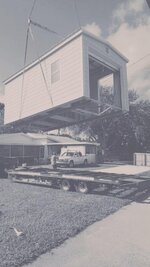
Lark building on crane.jpglark shed detached garage elec.01 - Copy.jpgLark shed full view.jpg
 

WNYflyer

Well-known member
Joined
Sep 13, 2009
Messages
2,119
Location
Lockport, NY
FWIW, personally for the roof construction it looks like using rafters rather than trusses would make for a cleaner job. Note that the architect is using a "ridge beam" rather than a "ridge board" so no ceiling joist/ties are required. He also cantilevers the ridge beam out 12" at each of the gable ends to create an overhang while supporting the last roof rafter. Just seems cleaner to me when trying finish off the gable end overhang.

Since the drawing is showing a ridge beam I would have expected to see a built-up post from the ridge beam down to the door header, perhaps the small building size and loads are such that is not required but still probably good practice. Looking at the opening schedule and given the small building size and height I wonder if it would be better served to balloon frame the gable ends. The opening schedule shows a bunch of connection straps to tie header to plate, header to studs I'm assuming for wind uplift purposes, given that I would have expected to see some type of hold down detail for the ridge beam to transfer wind uplift through the wall construction down to the foundation. All my opinion for what it is worth.
 
Last edited:
OP
A

A&P mechanic

Well-known member
Joined
Sep 6, 2012
Messages
324
Location
FL
Rafters should be a few bucks less than rafters. In this size building, trusses are probably slightly easier. You'll get slightly more headroom with rafters.
Thank you for the valuable input Bill.
It's better to show what you're building than trying to change plans after permit issuance. The architect should be able to do the modification if you want a double-door or an OH door. I have a So. FL premanufactured building, steel-frame, 3/4" plywood sheathing , housewrap, and Hardi-Board siding, and a standing seam steel galvanized roof, an OH door a 'roller,' on a poured for the building concrete slab, all under permit and 180 mph gusts rated. It's in Broward Co, we're just a mile inland from Atlantic Ocean high-tide line. Plans were sealed and accepted by the AHJ on the east coast. There was a sub permit for electrical, 100 amp service w/a buried line from the house which is a 200 amp service. I replaced the original to the house main disconnect, weatherhead, and service to the interior branch circuit panel, which was an old Federal Pacific. I'd read of people having issues w/insurance coverage for early 1960's services like I had, so we upgraded it. The house was originally done in conduit, but we didn't have to do anything for the branch circuits after the main branch circuit panel replacement.

I ordered it w/two single-hung windows on opposite walls for cross-flow ventilation, and a 3'0" exterior door opening roughed-in, I hung my own impact door.

The interior electric was done in AC, and duplex boxes every 4'. One 120V rain-tite GFCI duplex box next to the OH door. Three 30 amp 240V outlets, one on each wall, building footprint is largest I could get for a 'shed' but it's a 1 car garage , 10' x 20'.

Lark building on crane.jpglark shed detached garage elec.01 - Copy.jpgLark shed full view.jpg
Drift,
As always thank you for guidance. I am only working on the shed once a week on Saturday’s. I do not have a permit yet. I may ask the architect if he is willing to swap out the single door for a double. I get 6 months total to build the shed once I have a permit. I am not sure what happens if I do not get the shed built in 6 months, I probably have to apply for another permit processing fee then. I’m just digging currently and still need to move a sprinkler. Afterwards, I will make the 20 inch high forms, put the vapor barrier down and rebar. Once I’m ready for concrete then I will submit the permit paperwork. I’m doing it this way so the 6 month timer starts later on. The city inspector said it takes a day for a shed permit. He also said he would come out to the house twice, once when the forms are set before the pour to make sure the setback is complied with and once at the end to verify it’s completed.
I read through your entire build again. I’m glad you documented everything because I’ll be referencing it periodically.


FWIW, personally for the roof construction it looks like using rafters rather than trusses would make for a cleaner job. Note that the architect is using a "ridge beam" rather than a "ridge board" so no ceiling joist/ties are required. He also cantilevers the ridge beam out 12" at each of the gable ends to create an overhang while supporting the last roof rafter. Just seems cleaner to me when trying finish off the gable end overhang.

Since the drawing is showing a ridge beam I would have expected to see a built-up post from the ridge beam down to the door header, perhaps the small building size and loads are such that is not required but still probably good practice. Looking at the opening schedule and given the small building size and height I wonder if it would be better served to balloon frame the gable ends. The opening schedule shows a bunch of connection straps to tie header to plate, header to studs I'm assuming for wind uplift purposes, given that I would have expected to see some type of hold down detail for the ridge beam to transfer wind uplift through the wall construction down to the foundation. All my opinion for what it is worth.
Thank you for your observations Flyer with the rafters and trusses. I leaned something new about the ridge beam versus ridge board.
 

nadogail

Well-known member
Joined
Jan 23, 2009
Messages
31,933
Location
Coronado, CA
In my community if a job has been started and at least one inspection completed, but the job is not completed by the time the permit expires, it is easy to get an extension to the permit.
 
OP
A

A&P mechanic

Well-known member
Joined
Sep 6, 2012
Messages
324
Location
FL
In my community if a job has been started and at least one inspection completed, but the job is not completed by the time the permit expires, it is easy to get an extension to the permit.

Yes, FL is the same way, not a frustrating process. Just do things [apply for an extension] before the time duration is over.
Learned something new again, this forum is wealth of knowledge, thank you!
 
OP
A

A&P mechanic

Well-known member
Joined
Sep 6, 2012
Messages
324
Location
FL
Hi GJ,

It is a rainy day in Florida and I wanted to close out the threads I opened:

84 Lumber answered a bunch of questions I had in person.

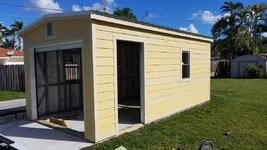
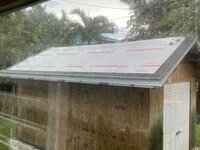
The homeowner built shed is complete, the accessory structure is signed off by the city inspector and here are the pictures. Thank you for all the insight!
 

Attachments

  • Shed inside.jpg
    Shed inside.jpg
    881.4 KB · Views: 6
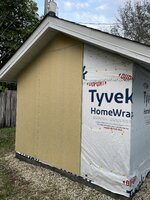
  • hardie sheet install.jpg
    hardie sheet install.jpg
    1.1 MB · Views: 6
  • soffits, fascia, and drip edge.jpg
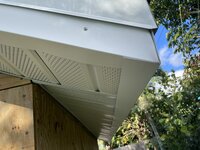
    soffits, fascia, and drip edge.jpg
    569.4 KB · Views: 5
  • roof wrap and starter shingles.jpg
    roof wrap and starter shingles.jpg
    752.7 KB · Views: 5
  • Completed Shed.jpg
    Completed Shed.jpg
    807.5 KB · Views: 5
To avoid these ads, REGISTER NOW!
Top Bottom