To avoid these ads, REGISTER NOW!

Irrigation Question - Adding Drip to Raised Planters

Colin Len

Well-known member
Joined
Jan 30, 2013
Messages
1,234
Location
Long Beach CA
I'm a complete irrigation novice and I know it's not rocket science but I have a project that won't be easy to alter once complete so I need to get it right the first time. We currently have no irrigation on our property and will eventually hire a company to install new sod and irrigation. When they do this I want them to add a few extra valves that can be connected to our raised vegetable planters for drip irrigation.

I don't want to pay them to run the actual lines INTO the planters. Partly because I'd like to save a few bucks but mostly because I will be redoing some pavers around two of the planters and want to run the necessary plumbing under those pavers now and provide a stub for the landscapers to tap into. I'm not entirely sure what methods may be ideal for this vs "no, don't do it that way!".

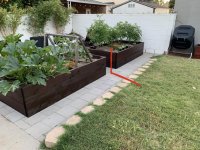
My plan was to install a vertical section of PVC into each planter with a stub sticking above ground that I can connect to drip tubing later. That vertical PVC pipe would go deeper than the sides of the planter, connect to a 90deg elbow and then to another section of PVC which would run under the pavers and into the grass area. I'd cap off that pipe for the landscapers to tap into later and connect to an irrigation valve. A crude representation is attached to this post. Below are my questions but please let me know if there's anything else I need to know or be concerned about.

  1. What size PVC should I use? 1/2"? 3/4"?
  2. Where would the pressure regulator usually be installed? Do I need to worry about this now or will it be installed nearer to the valves and something I can leave to the landscapers?
  3. Are there any considerations I need to factor in for connecting this PVC to poly drip tubing? (I assume using PVC is best for this situation as it needs to be reliable so I never have to dig these pavers up again.)
    Is there an optimal depth to install the stub under the turf? I don't want to get in the way of any other irrigation they will be running but don't want to make it so deep it's not accessible.

Thanks in advance for any knowledge you'd like to share :)
 

Attachments

  • 8eCr4tNyQJWeQfSfviC5Sw_thumb_b512.jpg
    8eCr4tNyQJWeQfSfviC5Sw_thumb_b512.jpg
    150.4 KB · Views: 64
To avoid these ads, REGISTER NOW!

Tunajoe

Well-known member
Joined
Jun 10, 2013
Messages
359
Location
Ventura County
I'll be your huckleberry.
Pipe sizing is based on basic hydro-dynamics.
On my property my main runs were 1" and then reduced down as I tapped off the 1" run.
I'm on 3 acres, so my runs were long, hence 1" to start with.
I also have raised beds (8 total) and ran a line for each bed at the end of the bed. I ran mine on the outside of the bed and transitioned from pvc underground to copper above ground using a copper FA 90 ( you want pvc to be male, less likely to split).

Yes to a pressure reducer usually reduced to 25 psi for drip emitters on black poly. Installed mine at the bed. You can reduce at the valve if you want but depending on which emitter you use for the beds it's better to reduce at the bed.
Make sure you bring the pipe up high enough to accommodate the pressure reducers.

I ran all my pvc under my sod at 12". My irrigation for my property was generally 18"-24" deep.
 

Coolabah

Well-known member
Joined
Jun 6, 2010
Messages
1,377
Location
2nd Floor, 3rd on the Right,Narooma, Australia
[*]What size PVC should I use? 1/2"? 3/4"?
it depends- water pressure etc, if in doubt why not go with 3/4 for little extra cost
[*]Where would the pressure regulator usually be installed? Do I need to worry about this now or will it be installed nearer to the valves and something I can leave to the landscapers?
I don't worry about fancy pressure regulators and just use taps on the PVC. BUT my high pressure valves ( at your manifold for multi-sector setups) are not ON/OFF, they have a tap that you can adjust pressure
[*]Are there any considerations I need to factor in for connecting this PVC to poly drip tubing? (I assume using PVC is best for this situation as it needs to be reliable so I never have to dig these pavers up again.)
Just the usual- make sure the PVC will handle the pressure / pressure test as needed
Is there an optimal depth to install the stub under the turf? I don't want to get in the way of any other irrigation they will be running but don't want to make it so deep it's not accessible.
I would talk to your contractor, but for me I just made sure to install lower than any future mechanical intervention eg recently re-turfed my lawn , all plumbing was below the depth of the cultivator I use ... 6 inches in my case but YMMV
* I am in Australia so your local equipment might vary !
* you can never have too many sectors !
[/LIST]


Thanks in advance for any knowledge you'd like to share :)
see above responses in red.
I'll start off by saying that I am not a pro but have been mucking around with this stuff for the last 30 years. Simple summary of my advice : you will tweak it until you get it right , then just when you get it right your needs will change :)
Q's : are you on town water or rain tank ? how much water in your bucket per minute at the tap ? ( this might change - 30 years ago I was getting 36 litres per minute = 9 gallons , nowadays my area has become more suburban so am getting 10 litres = 2.5 gallons... I've had to rearrange the high water requirement stuff eg lawn sprinklers , over the years)
 

LennyTheLizard

Well-known member
Joined
Oct 25, 2010
Messages
325
Location
Southeast MO
Don't have pics available now, but I just did a very similar project.
Ran ~100' of 3/4" PVC buried just below ground under the raised bed boxes. At each box (15 total), I have a 3/4" x 1/2" tee. A 1/2" PVC stand pipe comes up to top of bed (12"). And adapter on end of pipe connects to 1/4" Drip line.

Mine is not connected to main water line. Quick connect fitting at first box, and I just drag garden hose over when need to water. But all 15 boxes can be watered at same time (plenty of pressure). On the opposite end of PVC line (end of line), I installed a ball valve so at end of season, I can completely drain the line.

I cut all mine into squares to make a square foot gardening system. So the irrigation serves to water plants and divide the bed into squares sized appropriately for the type of plants (12X12, 12X24, 18x36).
I used Drip Depot for line and fittings, can be found on amazon or go direct to their website.
 
Last edited:
To avoid these ads, REGISTER NOW!

burleyfarm

Well-known member
Joined
Feb 19, 2009
Messages
401
Location
Northern Michigan
I’ve been using drip for years so I can offer some help.

Yes I think your idea of pre-installed pipe and it’s location is a good idea.

I use two different types of drip. The first is 1/2” NETAFIM Techline. It is a brown poly tube with built in emitters spaced every 12” with 18” spacing tube available also. This can be used on top of the ground or under the ground. I use it in vegetable gardens along the rows and I also have it buried in my flowerbeds under my shredded mulch. You can adjust the Techline to disburse different gallons per minute based on how close you space the tubes.

I also use a solid drip tube that you insert small 1/4” spiked barbs into and attach 1/4” drip lines to with drip emitters at the end. These can be installed above or below ground and are excellent for use in pots. Emitters come in various gallon per minute sizes which allows you better control over your watering.

These materials are usually available at the big box stores.

I noticed some potted trees in the background. If you are going to water a vegetable garden and a flower bed or pots, you generally are going to have to have two systems running off of different valves as each is going to have its own water requirements.

I used a pressure reducing valve with filter screen at the main line then ran 1” to the flower bed area. Drip emitters can plug easily so a filter is preferred. I then connected the 1/2” Techline to the 1” and created a looped system. I have two loops with over 500’ of the Techline in my flowerbeds operating off the one valve on a dedicated zone on my control clock.

In my vegetable garden I use a combination of Techline and 1/4 emitters and use a quick connect garden hose end as mentioned earlier. The vegetables have different water requirements than my lawn or flowerbeds.

Hope this helps some.


Sent from my iPhone using Tapatalk
 
Last edited:

Git

Well-known member
Joined
May 18, 2008
Messages
6,894
Location
S Cal
Sprinkler Warehouse has a lot of good info on irrigation and good prices - that is where I buy most of my stuff from. I think you will find the local big box stores have a very poor selection when it comes to drip irrigation

https://www.sprinklerwarehouse.com/products/drip-irrigation

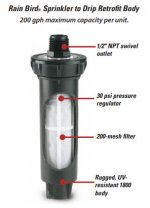
As mentioned you will need to reduce the pressure and filter the water before the start of your actual drip tubing. Several ways to do it, but since I replaced well over 100 conventional type sprinklers with drip tubing, I like to use these retrofit kits.

It looks like a sprinkler body but actually contains the reduce and filter. There are a couple of different variations - using small drip tubing, but I use them with the 1/2" tubing with inline emitters

attachment.php


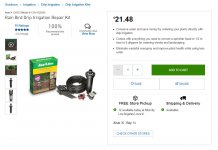
this kit uses the smaller tubing and can be found at Lowes
attachment.php


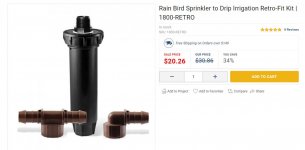
Sprinkler Warehouse 1/2"
attachment.php
 

Attachments

  • TRI-364.jpg
    TRI-364.jpg
    64.3 KB · Views: 113
  • TRI-365.jpg
    TRI-365.jpg
    30.4 KB · Views: 114
  • TRI-366.jpg
    TRI-366.jpg
    119.7 KB · Views: 113
OP
C

Colin Len

Well-known member
Joined
Jan 30, 2013
Messages
1,234
Location
Long Beach CA
Thanks for the info, everyone.

see above responses in red.
I'll start off by saying that I am not a pro but have been mucking around with this stuff for the last 30 years. Simple summary of my advice : you will tweak it until you get it right , then just when you get it right your needs will change :)
Q's : are you on town water or rain tank ? how much water in your bucket per minute at the tap ? ( this might change - 30 years ago I was getting 36 litres per minute = 9 gallons , nowadays my area has become more suburban so am getting 10 litres = 2.5 gallons... I've had to rearrange the high water requirement stuff eg lawn sprinklers , over the years)
Water pressure I don't think will matter here since it'll be regulated down to 25-30psi for drip, plus this is a short run. Mainly I was thinking it'd be best to size it appropriately so that there are less fittings (e.g. reducers) required when the landscapers tie into what I've installed. We don't have a landscape contractor lined up yet otherwise yes, I would just ask him what needs to be installed. We're on city water here. I realize I'll need to change things for the drip system a lot but this section I DO NOT want to change since it'll be buried under the pavers. The drip that's actually in the planters I plan to setup and change as needed but this section of PVC I would prefer not to have to dig up later as it'll be a big job.

Don't have pics available now, but I just did a very similar project.
Ran ~100' of 3/4" PVC buried just below ground under the raised bed boxes. At each box (15 total), I have a 3/4" x 1/2" tee. A 1/2" PVC stand pipe comes up to top of bed (12"). And adapter on end of pipe connects to 1/4" Drip line.

Mine is not connected to main water line. Quick connect fitting at first box, and I just drag garden hose over when need to water. But all 15 boxes can be watered at same time (plenty of pressure). On the opposite end of PVC line (end of line), I installed a ball valve so at end of season, I can completely drain the line.

I cut all mine into squares to make a square foot gardening system. So the irrigation serves to water plants and divide the bed into squares sized appropriately for the type of plants (12X12, 12X24, 18x36).
I used Drip Depot for line and fittings, can be found on amazon or go direct to their website.
It seems 3/4" is most common? So maybe I should at least make the stub for the landscapers to tie into (which will be in the turf area of my photo) 3/4" and then if I want I can use 1/2" going vertically up in the planters.


Sprinkler Warehouse has a lot of good info on irrigation and good prices - that is where I buy most of my stuff from. I think you will find the local big box stores have a very poor selection when it comes to drip irrigation

https://www.sprinklerwarehouse.com/products/drip-irrigation

As mentioned you will need to reduce the pressure and filter the water before the start of your actual drip tubing. Several ways to do it, but since I replaced well over 100 conventional type sprinklers with drip tubing, I like to use these retrofit kits.

It looks like a sprinkler body but actually contains the reduce and filter. There are a couple of different variations - using small drip tubing, but I use them with the 1/2" tubing with inline emitters

attachment.php


this kit uses the smaller tubing and can be found at Lowes
attachment.php


Sprinkler Warehouse 1/2"
attachment.php
Unfortunately for me there's nothing to retrofit. As mentioned we have NO irrigation currently. I'm also not yet concerned with the drip tubing itself. I'm only trying to get things setup so that theres:
- One stub in the turf for the landscapers to connect to (they will install new valves and lines from valves to my stub).
- One stub in the raised bed for me to connect to for the actual drip system in the bed.
 

Coolabah

Well-known member
Joined
Jun 6, 2010
Messages
1,377
Location
2nd Floor, 3rd on the Right,Narooma, Australia
Thanks for the info, everyone.


Water pressure I don't think will matter here since it'll be regulated down to 25-30psi for drip, plus this is a short run. Mainly I was thinking it'd be best to size it appropriately so that there are less fittings (e.g. reducers) required when the landscapers tie into what I've installed. We don't have a landscape contractor lined up yet otherwise yes, I would just ask him what needs to be installed. We're on city water here. I realize I'll need to change things for the drip system a lot but this section I DO NOT want to change since it'll be buried under the pavers. The drip that's actually in the planters I plan to setup and change as needed but this section of PVC I would prefer not to have to dig up later as it'll be a big job.


It seems 3/4" is most common? So maybe I should at least make the stub for the landscapers to tie into (which will be in the turf area of my photo) 3/4" and then if I want I can use 1/2" going vertically up in the planters.
Great , that sounds perfect.

I feel you are ( like me all the time !!!!) overthinking- this is good. But- we are NOT talking , like , gazillion lawn sprinklers quissing out giga gallons a minute...
So- for me, I would be happy if :
1) your drip stuff was on one or more separate sectors
2) you could vary the pressure way back at the manifold
3) you could furthermore tweak the pressure right after the high pressure stuff in the low pressure section with a simple tap
4) not dissing anyone who wants to have filters , but I always have 1 foot at the end of each black polytube line after the last drip/spray/etc , this is where all the sediment goes. I regularly clean out mine by undoing the end tube to make it an open end , every 25 years without fail. Don't be late on this. You might get an occasional blocked drip fitting etc, but I have had more issues with blocked filters blowing lines and quissing me poff. YMMV :beer:
 
Last edited:
To avoid these ads, REGISTER NOW!
Top Bottom