To avoid these ads, REGISTER NOW!

Is this a stupid idea.

Hal

Well-known member
Joined
Mar 8, 2008
Messages
673
Location
Vermont
I have been looking for another tank for my maple sugaring operation since last summer. I don’t want plastic, and stainless steel runs about $1-3/gallon used. New tanks come from Canada. I finally found a 1200 gallon insulated tank for much less. And traded obsolete equipment for it.

The problem is that it got vacuumed down to about 900 gallons. There is a huge dent in one top quarter. So far the comments from most people I have asked about it are, “ You going to blow it back out?”

So my plan is to seal it up, fill with water, and start pumping slowly. I figure the maximum pressure to crush it was less than 15psi, so it shouldn’t take much more to pop it back out. With only water in it, there won’t be much chance of explosion. The biggest risk is cracking a weld and causing a leak, I will deal with that if it happens.

I will probably use it as is this year, it’s still bigger than the one it’s replacing.
 
To avoid these ads, REGISTER NOW!

nadogail

Well-known member
Joined
Jan 23, 2009
Messages
32,032
Location
Coronado, CA
I have been looking for another tank for my maple sugaring operation since last summer. I don’t want plastic, and stainless steel runs about $1-3/gallon used. New tanks come from Canada. I finally found a 1200 gallon insulated tank for much less. And traded obsolete equipment for it.

The problem is that it got vacuumed down to about 900 gallons. There is a huge dent in one top quarter. So far the comments from most people I have asked about it are, “ You going to blow it back out?”

So my plan is to seal it up, fill with water, and start pumping slowly. I figure the maximum pressure to crush it was less than 15psi, so it shouldn’t take much more to pop it back out. With only water in it, there won’t be much chance of explosion. The biggest risk is cracking a weld and causing a leak, I will deal with that if it happens.

I will probably use it as is this year, it’s still bigger than the one it’s replacing.
I would seriously consider a little "Body and Fender" work on that tank.
 
OP
H

Hal

Well-known member
Joined
Mar 8, 2008
Messages
673
Location
Vermont
I would seriously consider a little "Body and Fender" work on that tank.
Double wall tank. Four inches of cork insulation. Outer wall isn’t dented. No access to the body of the tank itself without stripping the shell.
 

Wubicon

Well-known member
Joined
Jan 10, 2025
Messages
368
Does it have an info plate on it? I think most vessels like this should have some info you can look up. You might be able to find out exactly how much pressure you need to...change the shape, if you get my meaning.
 

imagineer

Well-known member
Joined
Dec 13, 2015
Messages
1,018
Location
Ohio
To answer your question as asked... yes, it's a stupid idea. To push the dent out, you need to apply pressure to the dent area, and that pressure needs to be similar to what it took to create the dent. Simply over-pressuring the tank will bow out all the flat sides and compromise any joints.

The prior reply was spot on, to try knocking the dent out. Do you have access to the inside such to hammer the dent out? What about cutting out the dented corner and welding in a repair?
 

cgrutt

Well-known member
Joined
Mar 4, 2016
Messages
8,353
I don't know anything about these so probably a bad idea but what about blocking the opposite side and using a bottle jack to try to push dent back into (rough) place?
 

rsanter

Well-known member
Joined
Dec 22, 2007
Messages
18,523
Location
visalia ca
I would try to fill with water and then apply only A little air pressure before I let it be.
a little pressure can do a lot to fix it and a little more than that can cause a lot of damage
 

alwaysFlOoReD

Well-known member
Joined
Sep 24, 2013
Messages
2,404
Location
Airdrie, Alberta, Canada
I recently watched a video on water forming cymbals. I dont remember details but I think they used a pressure washer with some type of fine control for pressure. Iirc they didn't need more than 10-15 psi to form a dome.
 

PCustoms

Well-known member
Joined
Jul 23, 2011
Messages
23,333
Location
VT
I'd try it, and while it was under pressure warm the area (you don't want to affect the heat treatment) and tap around it with a hard paced plastic hammer
 

PCustoms

Well-known member
Joined
Jul 23, 2011
Messages
23,333
Location
VT
He added a few posts ago that it's a double wall tank

Thanks, missed that in between when I read the thread earlier and when I hit post...

Loosing 300 gallons sounds like a significant deflection
 

Gutman

Well-known member
Joined
Jan 10, 2019
Messages
296
Location
ENC
Sorry-long winded. Many years ago, I saw a tanker truck that was delivering deionized water to the pier. 2000 or 2500 gallons, I think. The tank's vent was apparently covered by poly for clealiness reasons, but was never removed when they started gravity draining it. Eventually, the tank catastrophically imploded, like a crushed beer can. Impressive to see the after effects, kinda sorted wished I'd actually seen it/heard it in real time. They critiqued the **** out of it and we had to train on it.

IIRC (a lot of cobwebs to dust) tanks are typically designed to contain materials within them and are limited by their tensile strength, and higher pressures inside drive greater wall thickness. The typical tank, when empty and vented, would see no pressure differential across it, so the design would still work and the only stresses would be from its structure.

When the tank vent is blocked (and you draw a vacuum), you're now putting the tank into compression, and the failure would be due to buckling. Vacuum tanks are designed with this in mind, but your average tank is not.

I think it'll take a lot more than just filling your tank up to dish it back out and I believe the dished area of your tank may actually a little stronger now due to its shape, however, it'd be hard to say. The hydrostatic pressure necessary to overcome the dent may be greater than what the tank is designed for.

Any idea of the tank's design or test pressure? It's wall thickness? I assume it's some flavor SS. A 1200 gallon tank is not small in size (and it's lot of surface area).

I've done countless hydrostic tests of various fluid systems in my past. I always enjoy the back and forth in the rusty air compressor tank failure threads.

But I suspect that it may be more trouble than it's worth. If you can live with 900 gallons, even better.

But I'm subscribed.
 

HoosierMark

Well-known member
Joined
Jan 31, 2013
Messages
1,445
Location
Southeast IN
if It’s double wall, pressurizing of the interior is at best a guess, what’s to say the pressure might not expand the tank in another location? Any weak spot elsewhere could rupture and a crack could open on the interior tank that may not be known about. Now you have a dented tank with an interior leak that could contaminate your product.
To me the question is: is a 900 gallon tank suitable for your needs? Can you justify cutting out both layers and welding in new panels or straightening the ones you cut out And reinstalling them
 

nadogail

Well-known member
Joined
Jan 23, 2009
Messages
32,032
Location
Coronado, CA
Double wall tank. Four inches of cork insulation. Outer wall isn’t dented. No access to the body of the tank itself without stripping the shell.
I often reconsider my initial reactions after more information is revealed.
 

minke

Well-known member
Joined
Dec 1, 2018
Messages
477
Location
fly over country
1) Dent is in top quarter.
2) Filled from top, drained from bottom. (True?)

Can you invert the tank, close the fill, and fill from the drain?
That will provide maximum pressure at the dent which is now at the bottom.
 
To avoid these ads, REGISTER NOW!

yhprum

Well-known member
Joined
Jul 27, 2006
Messages
1,396
Location
Brisbane Australia
So, it was caused by vacuum right? Presuming there is a large air gap between the inner and outer skins.
Is it possible to introduce a Vacuum between the two skins to pull it back in? Here is a method used to bend wing skins using a shop vacuum. It doesn’t take a lot of vacuum due to the large area. Maybe used in conjunction with water added to give it a little xtra push. And leave the tank vented so if it does want to pop back.
 

jack stand

Well-known member
Joined
Feb 29, 2012
Messages
3,353
Location
Lakes Region Maine
This sounds like a milk tank from a dairy farm. My friend has several old milk tanks some uglier that others, but they all hold sap just fine and the drain valving is easily adapted being (usually) pipe threads.
This is just for storing collected sap before running it through either the R/O or evaporator correct? ie: not pressurized at all.
 

Gutman

Well-known member
Joined
Jan 10, 2019
Messages
296
Location
ENC
Static pressure won't change appreciably by inverting the tank. I think 44 # per 100 ft of static head is the number.

And thinking through this problem more, you're effectively wanting to deform this tank back to it's previous shape. A 300 gallon decrement in your tank's volume is considerable, and without being able to fully inspect it, I'm arriving more in the camp of live with it.

It could be done hydrostatically by filling it solid with water and hooking up a high pressure, low volume pump, but usual tank hydrostatic testing is intended to raise pressure to some point above its operating or design pressure and hold it for some period of time. Once a tank is filled solid during a hydro, it does not take much additional volume being added to raise the pressure.

In your case, you'd have to add what I'd consider to be a significant volume of water (300 gal?) compared to the tank's current volume, while under the pressure needed to dish that dent back out to make up for the increasing volume of the tank.

Without knowing any more details of the tank design such as uniform wall thickness or thicker ends and what, if any issues occurred when it deformed, such as creasing, I'm still a 'it's a hard problem.'

The idea of drawing a vacuum between inner and outer is intriguing but the cork presents one challenge, and the other would probably be the same vacuum issue for the outer tank (if it is an actual tack and not just a skin. If it's just a skin, then drawing that vacuum becomes much harder.

If it's just a skin, the your best bet would be to remove it and the cork, inspect it, and proceed from there.
 
OP
H

Hal

Well-known member
Joined
Mar 8, 2008
Messages
673
Location
Vermont
To answer your question as asked... yes, it's a stupid idea. To push the dent out, you need to apply pressure to the dent area, and that pressure needs to be similar to what it took to create the dent. Simply over-pressuring the tank will bow out all the flat sides and compromise any joints.

The prior reply was spot on, to try knocking the dent out. Do you have access to the inside such to hammer the dent out? What about cutting out t
I’m in
 
OP
H

Hal

Well-known member
Joined
Mar 8, 2008
Messages
673
Location
Vermont
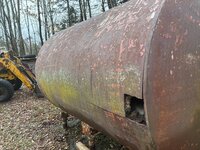
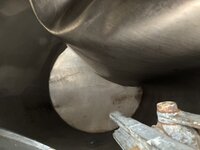
heres a picture of the tank. And one from inside. There’s an ugly crease that I hadn’t noticed until I started trying to get a good picture. Third one is taken through the square cutout in the end. It doesn’t show much except some of the cork insulation.IMG_4316.jpegIMG_4320.jpeg
 

Attachments

  • IMG_4323.jpeg
    IMG_4323.jpeg
    1.5 MB · Views: 41

PCustoms

Well-known member
Joined
Jul 23, 2011
Messages
23,333
Location
VT
Damn, hope you didn't pay much more then scrap for that...

Not sure there's any hope. Use it as is.
 

TurnipTruck

Well-known member
Joined
Aug 28, 2005
Messages
1,581
Location
Southcentral Alaska
Is the roof also double-walled? Any seams torn? Can you fit inside via the manway? Staybolts between the inner and outer walls?
I don’t think pressuring the inside will help much. You would have to move/remove a lot of cork to make room for the re-expansion.
How cold is it in Vermont? Fill it with water and let it freeze a couple times.


IMG_2997.jpeg
 

Gutman

Well-known member
Joined
Jan 10, 2019
Messages
296
Location
ENC
Your pics help to better explain the setup and situation. Wall thickness would really help.

Can it be fixed hydrostatically? Possibly. Would it be easy? Probably not.

Although it only took about 15 psi differential pressure to **** it in, it'll take much more than that to dish it back out. Not knowing the wall thickness or its original design pressure, it could be a several hundred psi. And you're intentionally working to deform (yield) it back into shape.

The creasing will actually increase your challenge as it'll actually act as reinforcement or a stiffener to counter what you want to accomplish, so you could stress other areas first. Would the tank catastrophically explode? Probably not, though I've seen a threaded plug fail and blow out at a couple hundred psi. Ask Fred H.

The challenge to filling solid and freezing (or heating) it gets back to the need to add a significant volume of water to get it to your desired volume.

I'd consider cutting the tanks open enough to be able to heat it and beat it back closer to the shape you desire, and weld it back up. Even a small hole opposite the deformed section, a length of pipe to reach across, and a BFH might help.
 
OP
H

Hal

Well-known member
Joined
Mar 8, 2008
Messages
673
Location
Vermont
Damn, hope you didn't pay much more then scrap for that...

Not sure there's any hope. Use it as is.
Like I said in my original post, traded obsolete equipment for it.
Probably going to use it as is for this year.
 
OP
H

Hal

Well-known member
Joined
Mar 8, 2008
Messages
673
Location
Vermont
This sounds like a milk tank from a dairy farm. My friend has several old milk tanks some uglier that others, but they all hold sap just fine and the drain valving is easily adapted being (usually) pipe threads.
This is just for storing collected sap before running it through either the R/O or evaporator correct? ie: not pressurized at all.
Not my first milk tank, just bigger. I will be using it to store permeate from the RO. Existing permeate tank will be promoted to concentrate storage, and existing concentrate tank removed for better use of the space it’s in.

Bigger permeate storage will give me a source of water beyond what is required to wash and rinse the RO. My sugarhouse has a very limited water supply, and this will be an improvement.

For those unfamiliar with maple production:

RO= Reverse Osmosis, originally developed as a water purification process, now used in maple production to raise the sugar concentration of sap, reducing the amount of energy and time required to boil it into syrup.

Concentrate= Product of RO process. Typically, sap at 1.5-3% sugar is concentrated to 10-20%.

Permeate= pure water as a byproduct of the RO process.
 

mikedodge

Well-known member
Joined
Jun 27, 2017
Messages
2,837
heres a picture of the tank. And one from inside. There’s an ugly crease that I hadn’t noticed until I started trying to get a good picture. Third one is taken through the square cutout in the end. It doesn’t show much except some of the cork insulation.IMG_4316.jpegIMG_4320.jpeg

Thats not easily coming out.
 

Fixr

Well-known member
Joined
Dec 23, 2012
Messages
9,708
Location
SW VA
I'd likely try to get a portopower ram cylinder or maybe a screw jack in there along with some plate or plywood to spread the load, probably placing the ram directly at the crease (because that probably wont dent outward) , and gently push outward. It might push quite a bit of the big dent out and possibly regain several hundred gallons back. I wouldn't bother trying to fix the crease.

Edit: a trucker's load bar might do it.
 

545_days

Well-known member
Joined
Oct 30, 2016
Messages
585
Location
Texas
Advice in this thread to use air pressure, or a high pressure pump is a bad idea without knowing the tanks design pressure.

I recall a man being killed at a Houston fabrication shop a few decades ago when a heat exchanger head let go under 5 psi of pressure. Five psi doesn't sound like much, but there were a shitload of square inches... so be careful around stored energy.
 

PCustoms

Well-known member
Joined
Jul 23, 2011
Messages
23,333
Location
VT
Asking a bunch of random strangers on the internet if something potentially life-threatening is a stupid idea is probably a stupid idea.
Don't recall the OP asking if it was life threatening, just if it was stupid.

I don't see any danger the way he describes it (water topped with air as someone else suggested is dangerous).

It may be stupid, as it might not work or it could cause a rupture and ruin all capacity. But only one way to find out...
 

Beerhippie

Well-known member
Joined
Oct 13, 2023
Messages
9,951
Location
Far NE Oregon
Don't recall the OP asking if it was life threatening, just if it was stupid.

I don't see any danger the way he describes it (water topped with air as someone else suggested is dangerous).

It may be stupid, as it might not work or it could cause a rupture and ruin all capacity. But only one way to find out...
It was the replies suggesting using air over water. Getting stupid, potentially life-threatening advice is not good. So, yes, the project is potentially fatal if you follow that advice.

If I were to try this, and I doubt I'd bother, never having seen anyone recover a tank half that badly collapsed (happens too often in the brewing industry), I'd use water and water only. be sure the tank is full of water and NO AIR (hard to do with the way it crumpled), then push more water in with a pressure washer pump.

I've pushed out small dents in lantern and stove founts using a grease gun after completely filling the fount with water. It works, and on the odd occasion of a failure, there's just a rupture and some water--well, in this case, a LOT of water.

Air, however, is compressible. Compression stores energy. Stored energy released rapidly, say via a rupture, is called an explosion.
 
OP
H

Hal

Well-known member
Joined
Mar 8, 2008
Messages
673
Location
Vermont
It was the replies suggesting using air over water. Getting stupid, potentially life-threatening advice is not good. So, yes, the project is potentially fatal if you follow that advice.

If I were to try this, and I doubt I'd bother, never having seen anyone recover a tank half that badly collapsed (happens too often in the brewing industry), I'd use water and water only. be sure the tank is full of water and NO AIR (hard to do with the way it crumpled), then push more water in with a pressure washer pump.

I've pushed out small dents in lantern and stove founts using a grease gun after completely filling the fount with water. It works, and on the odd occasion of a failure, there's just a rupture and some water--well, in this case, a LOT of water.

Air, however, is compressible. Compression stores energy. Stored energy released rapidly, say via a rupture, is called an explosion.
I mentioned, but didn’t stress in my OP, I’m not stupid enough to use air. You do bring up a valid point, with the possibility of trapped air pockets.
 

Jacko264

Well-known member
Joined
Mar 27, 2016
Messages
947
Location
Kingston upon Hull uk
My opinion is if you don’t sort the crease out first that dint will not come out
is the inside tank stainless steel ?
can you get in the tank to use hammers and jacks
Graham
 
To avoid these ads, REGISTER NOW!
Top Bottom