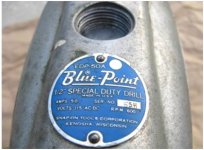
It's been on here a while. Thanks!
http://tampa.craigslist.org/hdo/tls/4704624594.html
http://tampa.craigslist.org/hdo/tls/4704624594.html

Maybe to a collector…
For the vast vast majority (people who actually want to use them)… Run Away!
If you really want what is referred to as a compact drill, buy a modern one. Milwaukee is the industry standard. If you want your arms broken, to be knocked off ladders… Go vintage. Even pre gray paint Milwaukee drills are terrible. The modern clutches make a huge difference. Even a modern one is a tool to be respected.
21 years ago, I started as an electrician. We used this model (650 RPM) and the 900 RPM model. I did residential with "compact" drills and ship augers for 4 years.
http://www.milwaukeetool.com/power-tools/corded/1610-1
Good for mixing mud and paint.
If it doesn't break your arms it'll electrocute you. That metal spring strain relief will contact the live conductor on the old/worn cord and send 120VAC into the housing of the drill. If you're grounded, you're dead.
Why everyone has such an obsession with thinking these things are guaranteed to electrocute is beyond me. They were used for donkeys years without incident and are still good for many more. The same precautionary checks and tests as for any piece of non double insulated electrical equipment are necessary, (renewing the mains lead as a matter of course is always prudent too), but no more than that. A RCD or similar removes any electrocution risk too.
Personally, I love the old metal body drills. Of the few electric drills I occasionally use these days, they're the only type I generally use. Slow speed and built like brick shithouses, so far more robust than their modern counterparts.
Why everyone has such an obsession with thinking these things are guaranteed to electrocute is beyond me. They were used for donkeys years without incident and are still good for many more. The same precautionary checks and tests as for any piece of non double insulated electrical equipment are necessary, (renewing the mains lead as a matter of course is always prudent too), but no more than that. A RCD or similar removes any electrocution risk too.
Personally, I love the old metal body drills. Of the few electric drills I occasionally use these days, they're the only type I generally use. Slow speed and built like brick shithouses, so far more robust than their modern counterparts.
If it doesn't break your arms it'll electrocute you. That metal spring strain relief will contact the live conductor on the old/worn cord and send 120VAC into the housing of the drill. If you're grounded, you're dead.