To avoid these ads, REGISTER NOW!

Jacking + Supporting a Sagging Beam

KevinEF7

Active member
Joined
Sep 30, 2015
Messages
43
Location
S Ont, Canada
Hi guys, just looking into some suggestions on if this project would be worth my while or not, I just moved into this house that has a roughly 20 X 20 2 car garage with low ceilings. We noticed that this old triple 2 X 6 main beam (true 2x6 wood mind you, house/garage is very old) has some sag to it, and all of the joists running front to back have a good sag towards this center beam aswell

They are run on 24" center and right now the previous owner placed OSB ontop of the joists and then a ton of insulation up there to try and insulate the garage. The OSB and insulation will be coming out as its seen better days, aswell as all of the old electrical/garage door openers. But I am unsure of how to go about getting the celing level or atleast much closer to level then it is now.

I figure one option is a permanent beam pole in the middle of the garage from floor to ceiling, but Id like to avoid that. I was hoping I could rent/buy a suitable jack and slowly lift the ceiling main beam and joists back to level and hold it there with large metal plates + bolts as I figure the beam is sagging because of the butted joints in the 2x6 main beam instead of it being one single piece of lumber spanning

What I dont get is how would you actually install those plates once the beam was jacked, to me I would want large long plates, say 4 feet loong sandwiched on both sides of the beam, but how would you install it with the joists butting up against the beam every 24"?

Just hoping to get some options, here are a few pics to show how it is constructed, I will gladly get any other pictures asked for. I plan to have a dump bin dropped off this week to begin ripping out all of the old osb/garbage/workbenches/cardboard insulated walls

Front left corner just inside the garage door looking back towards back right side
2ro2dma.jpg


Back right corner looking towards front left
10zd3q1.jpg
 
To avoid these ads, REGISTER NOW!

rlitman

Well-known member
Joined
Oct 18, 2010
Messages
24,579
Location
Long Island
Your issue is that it is 2x6 on a 20' span. You need at least 2x10 for a joist, but I'm not sure 2x12 would be enough for such a beam. Time to consult the span tables.
 

Richard Cranium

Well-known member
Joined
Apr 22, 2011
Messages
18,552
Location
central Washington
If you are tearing out the ceiling any way, Replace the beam with a glulam beam, they are a lot stronger then a 3 2x6's nailed together. It is very hard to tell what you have there by the pictures. Yes the easiest way would be putting a post under it, but a post creates a lot of other problem.
 
OP
K

KevinEF7

Active member
Joined
Sep 30, 2015
Messages
43
Location
S Ont, Canada
I didnt mean I was tearing out the ceiling, I meant i was removing the OSB that is simply placed ontop of the joists, they arent even screwed down, and all the insulation that is ontop of those OSB's

I also couldnt find a span chart for TRUE 2X6 lumber, calculators all seemed to be for new sized lumber. Regardless, this is what I have in my construction currently and am hoping to raise it back close to level so I can start using the space
 

DekeT

Well-known member
Joined
Aug 12, 2011
Messages
2,234
Location
USA
I didnt mean I was tearing out the ceiling, I meant i was removing the OSB that is simply placed ontop of the joists, they arent even screwed down, and all the insulation that is ontop of those OSB's

I also couldnt find a span chart for TRUE 2X6 lumber, calculators all seemed to be for new sized lumber. Regardless, this is what I have in my construction currently and am hoping to raise it back close to level so I can start using the space

Don't overthink it, your "true" 2x6s are nothing special if they are not a douglas fir or hardwood. Just use a table for beam spans not an online calculator. If it were mine, and if I wanted clear span, I would install lots more 2x6 joists and suspend them at the center with a large ole glulam from topside. And of course reinforce the end walls for bearing the glulam.
 

gregtwojeeps

Well-known member
Joined
Jul 30, 2013
Messages
5,096
Location
Ky
Just for reference, my 1959 vintage one car garage has 2" x 6 " ceiling joists on 16" o.c. with gysum board hung on them for the ceiling finish. ...they only span my 13' 3 " wide garage. All are sagging down 1- 1.5 inches.
 

hd54kh

Well-known member
Joined
Jul 19, 2012
Messages
131
Location
Mooresville N.C.
In an old place I have I needed to level up 4 4x4 16' long floor joists. I slowly over a couple of weeks used 2 lolly columns with a 6x6 perpendicular to the 4x4s.

Went a bit higher to allow for settling. I than glued and screwed 2 layers of plywood cut to 4" strips on each side of them. Been about 15 years and still holding strong.

Terry
 

1969

Well-known member
Joined
Jan 8, 2010
Messages
1,412
Location
East Coast
If you do not want a beam under the ceiling joists, place one above the joists and tie the joists to it. Just make sure the beam is sized correctly, and supported correctly at the ends. This eliminates the need for any posts in the middle of the garage and makes for a flat ceiling.
 

ez-duzit

Well-known member
Joined
Jun 24, 2013
Messages
5,094
Location
Marina del Rey
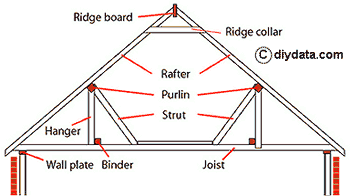
After removing all the weight of the OSB, shore each cross tie to level, one at a time. And install a hanger, in the center, tied to a ridge collar, before removing the shoring.
 

DekeT

Well-known member
Joined
Aug 12, 2011
Messages
2,234
Location
USA
After removing all the weight of the OSB, shore each cross tie to level, one at a time. And install a hanger, in the center, tied to a ridge collar, before removing the shoring.

Clearly your garage roofing system is at least partially to extremely underbuilt. Those "joists" are probably there as a minimum means of keeping the outside walls from separating. I would be wary of connecting any part of the joist section into any part of the rafter section as a means of support. Are the joist even lined up with the rafters and what condition are they in? If you choose this minimalist route leave the ceiling open.
 
OP
K

KevinEF7

Active member
Joined
Sep 30, 2015
Messages
43
Location
S Ont, Canada
Im a little lost on whats being debated. I personally want to jack up the center beam to level and sandwich metal plates, or even plywood plates with bolts between each joist, or is there a way to sister/strengthen the entire main beam with one brace? Or at least a way to brace in larger sections that the 22" plates I would be limited to

vgil8p.jpg


To replace the entire beam, wouldnt the roof need to be removed?
 

theoldwizard1

Well-known member
Joined
Feb 22, 2011
Messages
43,077
Location
SE MI
If you are going to "sister" anything on to that, it needs to be continuous. A 20' - 1/4"x5" of steel is going to cost you a lot more than you think. You might get away with a 10-12' section in the center.

I would use 2 pieces, one on each side. Clean the steel and the wood (brush, soap and water). Jack up your joist (slowly, watching for cracks), apply liberal amounts of construction adhesive (PL Premium) and through bolt (1/4", lock washer and nut). Wait the full cure time (usually at least 24 hours, but could be longer if cold), before releasing the jacks.

Let us know how it works !
 

PoorOwner

Well-known member
Joined
Feb 10, 2007
Messages
5,032
Location
CA
I would jack the beams maybe a pair at a time or get it how you want it, then use joist hangers and 2x6 or 2x6. Bead of liquid nails on top if you still want to have plywood or OSB up there. 3" nails and palm nailer. I have done this for under floors to eliminate any deflection.
It also helps to have a second person use screws from above to help "****" up the joist flush. The liquid nails is to fill the voids from wood not being flat with each other.

I am not a structural engineer just done it before and it works.
 
OP
K

KevinEF7

Active member
Joined
Sep 30, 2015
Messages
43
Location
S Ont, Canada
What would be the proper way to sister a good length of steel to that beam then? I don't get how a long beam could be sandwiched if the joists but into the sides of the main beam aswell
 

bczygan

Well-known member
Joined
Nov 4, 2009
Messages
22,002
Location
DETROIT! Arsenal of Scrappers
What would be the proper way to sister a good length of steel to that beam then? I don't get how a long beam could be sandwiched if the joists but into the sides of the main beam aswell

STOP!

Let's start this whole thread over, as there are some erroneous suggestions, based on not enough information.

Let's start with the existing conditions.

What are the actual accurate dimension?

What is the layout? In other words, which way does the ridge run and where is the garage door relative to that?

What is the spacing of those ceiling joists, and their actual size. What is their layout?

Sight along the outside walls. Do they bow out along the top edge, in the middle, at all.

How much do the ceiling joists deflect? Are they all deflecting the same amount?

Do you have any water leaks?

How many layers of shingles do you have? And what kind (3 tab or ?).

What is the roof deck? OSB, or PLY or boards? What size and spacing of rafters? Any collar ties?

Is the ridge a ridge board or a ridge beam?

How are the joists fastened to the walls? Are any of them made up of more than one piece, fastened together?

The entire structure needs investigation and evaluation before making recommendations.

Bill
 
OP
K

KevinEF7

Active member
Joined
Sep 30, 2015
Messages
43
Location
S Ont, Canada
I'm very new to construction, not going to lie, some terms are going good right over head, need it in basic laymen terms, how I can fix this sag. I'm not a millionaire that wants a vaulted showroom finish ceiling, I'm just trying to make it stronger and straighter than it is, and am hoping I have some options, that are diy appropriate of course

Edit. : bill answered just before me, I I'll have to take some better pictures and measurements in the day time to answer all of that
 
Last edited:
To avoid these ads, REGISTER NOW!

Bib Overalls

Well-known member
Joined
Dec 4, 2006
Messages
3,318
Location
Jonesboro, Arkansas
Take down the OSB and the old insulation and clean up the mess. With that out of the way you can take some clearer pictures of the existing frame work and the problems you have.

Post the pictures and we will give you additional suggestions.

What I, and the other posters see is some really questionable framing and a problem that involves more than one undersized beam. The fix is going to take more than simply jacking the beam and nailing on a couple of plates.
 
OP
K

KevinEF7

Active member
Joined
Sep 30, 2015
Messages
43
Location
S Ont, Canada
Well if its held for 80+ years.. I was just curious how the process is done really, how would you even straighten and support a beam in my kind of construction, would small 22" sandwiched plates between the joists suffice in "band-aiding" or would they do nothing at all

If you need one jack and a 6x6 piece in the center or if you need 2 or even 3 jacks going all at once to support, any insight on things like that, just curious on learning and the process and options in materials and fixes I may have
 

DekeT

Well-known member
Joined
Aug 12, 2011
Messages
2,234
Location
USA
Well if its held for 80+ years.. I was just curious how the process is done really, how would you even straighten and support a beam in my kind of construction, would small 22" sandwiched plates between the joists suffice in "band-aiding" or would they do nothing at all

If you need one jack and a 6x6 piece in the center or if you need 2 or even 3 jacks going all at once to support, any insight on things like that, just curious on learning and the process and options in materials and fixes I may have

You are overthinking this again by looking for a solution without all the facts. Do as Bib Overalls suggested and get all the **** out of the way to see what you actually have there. Speculating is a waste of time.
 

PugetDude

ALLIANCE MEMBER
Joined
Mar 13, 2013
Messages
22,273
Location
Superstition Mountains, AZ
Google: flitch beam.
If you're going to try to sandwich steel into the new beam it needs to be continuous. Using short pieces will actually make your situation worse.
 

theoldwizard1

Well-known member
Joined
Feb 22, 2011
Messages
43,077
Location
SE MI
Google: flitch beam.
If you're going to try to sandwich steel into the new beam it needs to be continuous. Using short pieces will actually make your situation worse.

I never heard the term "flitch beam" (or flitched beam) but that is pretty much what I said.
 

matt_i

Well-known member
Joined
Mar 14, 2008
Messages
10,722
Location
SE Michigan
In my Alro Metals (major regional supplier of steel) catalog they list a stocked 20' length of A36 hot rolled flat bar. 1/4" x 5" flat bar which is 4.25 #/ft. 85 lbs for the length is not bad to handle, its probably around $1-1.50 per pound retail, plus a truck delivery charge depending on distance. Or, you could pick it up with something like a gooseneck trailer, overkill for the weight but just right for the length.

Note, I'm not implying that a 1/4" x 5" flat bar sistered is right, its directionally correct, but not going to guarantee any degree of straightness. To understand the structure, more pics will be needed with the OSB decking removed. Could there be something up there which is causing the midspan deflection?
 

BD1

Well-known member
Joined
Mar 18, 2007
Messages
4,602
Location
north side
Do you have a gable roof ? Roof with a center ridge board ?
If so jack up the joist ,add supports from joist to rafter, and collar ties. You'll basically be building a truss .
 

bczygan

Well-known member
Joined
Nov 4, 2009
Messages
22,002
Location
DETROIT! Arsenal of Scrappers
Very easy to overthink as a first time home buyer I guess, million things on my mind

I came back here to see if you had obtained the information needed to make any suggestions.

You haven't.

One more chance.

Get the info.

Click on my user name and send it to me is the form of a PM or email, or post it here on the thread, along with photos, inside and out.

Only then can anyone help you. And excellent help is available.

Otherwise, you're stuck, and I'll be out of here..

Bill
 

bczygan

Well-known member
Joined
Nov 4, 2009
Messages
22,002
Location
DETROIT! Arsenal of Scrappers
And to everyone else who is making suggestions.

You don't have enough information to make even the first suggestion.

The entire structure needs to be looked at.

Existing conditions need to be determined.

The structure needs to be understood and defined.

We don't know the exact sizes and spacing and spans of all the members.

We don't even know the loads involved.

We don't know what other members are being stressed too much.

We don't know what all the causal factors are.

We are no further along than when the OP hit send on post #1 in this thread.

Until the OP gets us adequate information, this thread is useless.

Bill
 

ez-duzit

Well-known member
Joined
Jun 24, 2013
Messages
5,094
Location
Marina del Rey
...I'm not implying that a 1/4" x 5" flat bar sistered is right, its directionally correct...

No, it's not. Flat bar will do nothing but add weight and expense. It is the extreme fibers (the flanges in an I-beam) that do all the work.
 

38Chevy454

Well-known member
Joined
Dec 26, 2006
Messages
4,036
Location
Cincinnati, OH
I know we all don't have the basic structure since the pictures do not show it. But it sure seems the easiest solution is a beam (steel I-beam, or glue-lam) running perpendicular to the existing joists. It could be under or above, depending on end clearance. Might have to use a support post at the ends, simple enough and not too intrusive as it would be right against the wall (assuming this is not in a door opening).

However, the OSB and insulation needs to come down to get an accurate assessment of the construction used. Then the best solution can be determined.
 

matt_i

Well-known member
Joined
Mar 14, 2008
Messages
10,722
Location
SE Michigan
No, it's not. Flat bar will do nothing but add weight and expense. It is the extreme fibers (the flanges in an I-beam) that do all the work.

Agreed that an I-beam is an efficient use of material since it puts a lot of cross section away from the neutral axis. But its quite certain that a flat bar on edge is stiffer than a flat bar laid flat. It just depends on where the h^3 dimensions is located as you calculate Ixx.

There are other issues that I didn't get into for simplicity like the Iyy being way out of kilter with respect to Ixx on a flat bar of that length, which can cause a beam to have an inward/outward bow as its loaded up and the load can't be perfectly centered on the small Y-dimension. That's where hex bolts come in, to tie pieces of wood to the steel flitch. We already know that the wood isn't twisting out of plane under current loading, hence my statement that sistering wood plus a bolted steel flat is directionally correct.
 

kbs2244

Well-known member
Joined
Nov 11, 2006
Messages
14,065
Based on what has been shown I would go with a steel beam.
(I would guess that a 6 inch depth would be enough, but the steel supplier can give you advice.)
Get a good measurement of the wall to wall distance for beam length.
Get it as high as possible on step ladders or such.
It will touch at the low spot of the sag first.
Then get screw jacks under it.
At 20 feet you will need at least three.
(Getting the jacks exactly plumb is critical.
Getting some experienced help would be a good idea.)
Once the beam has been raised enough to take out the sag measure for the needed length of 4 inch dia steel pipe supports at each end.
 

PugetDude

ALLIANCE MEMBER
Joined
Mar 13, 2013
Messages
22,273
Location
Superstition Mountains, AZ
Flat bar will do nothing but add weight and expense.


Seriously? And you base this on what?
Here's a link to the research you might want to consider before making statements like the one above.

https://www.google.com/search?q=fli...oTCOvl5b2PscgCFQgriAodTCALKA&biw=1280&bih=565

Flitch Beams were more widely used before glu-lams came along. Still a viable alternative, especially in a situation like this.
They're easy to install in wooden structures and can be built-up on site.
Not as strong as a wide flange steel beam, but certainly stronger than 2x lumber scabbed together.
And a lot easier for the average DIY carpenter to fabricate and install...
 

DekeT

Well-known member
Joined
Aug 12, 2011
Messages
2,234
Location
USA
No, it's not. Flat bar will do nothing but add weight and expense. It is the extreme fibers (the flanges in an I-beam) that do all the work.

While I do not think using flitch beams in this case is a cost effective solution, you are not correct in assessing the effectiveness of a flitch beam as a structural support. Otherwise, how do you explain ordinary dimensional lumber being used as a building material?
 

ez-duzit

Well-known member
Joined
Jun 24, 2013
Messages
5,094
Location
Marina del Rey
Dimensional lumber, being most affordable, has sufficient thickness to place many extreme fibers where they will carry the loads. A thin sheet of metal does not.

You needn't take my word for it--look it up: an I-beam vs a flitch beam.
 
To avoid these ads, REGISTER NOW!
Top Bottom