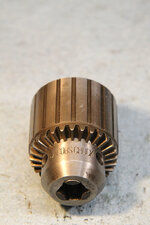
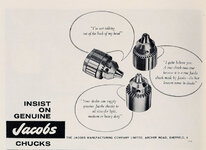
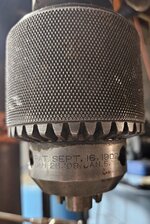
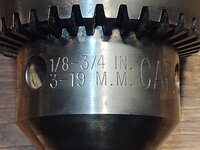
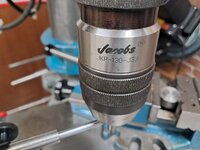
It would be nice if there was a reference somewhere that made it easier to date these older Jacobs chucks. Seems like you always have to be satisfied with a vague date range based on scattered information.
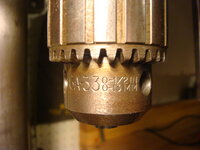
I do work in a brewery maintenance shop and built all the draft delivery systems for the pub here and several others in the area. I was cleaning a system the other day, looked at that pin spanner and thought hmmm, might fit.... I took a die grinder to it to open it up a little and now it fits perfectly.Now that's thinking outside the box![]()
Innovation at its best. Sometimes I've figured out that something works perfectly on something that it was never intended for. Some of the best inventions came by accidental means. Having the right thought at the right moment ends up being genius sometimes.I do work in a brewery maintenance shop and built all the draft delivery systems for the pub here and several others in the area. I was cleaning a system the other day, looked at that pin spanner and thought hmmm, might fit.... I took a die grinder to it to open it up a little and now it fits perfectly.
The spindle of my DP has a male J3 taper and the collar is there to push the chuck off of the taper. The chuck is not attached to the collar. The spindle doesn't have a slot for a wedge like a Morse taper tool.Use a pin spanner only for a Jacobs Safe-Lock chuck. Use wedges for the separate thrust nut.

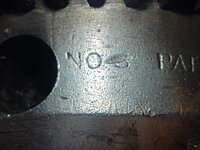
Nice chuck Joe. My Jacobs chuck that I posted pics of in post #37 actually does have a model number. I missed it up to this point. Right before the 1902 patent date in very small font is "No. 3." I've never seen a no. 3 marked this way. It also has fully knurled collar like yours.Don't know that I can add much to this discussion, but the attached pictures are of the earliest Jacobs chuck in my collection. It is a number 3 with a capacity of 1/2 inch and is threaded for a 3/4 -16 arbor and has no patent dates so may predate the 1902 Jacobs patent. I have some earlier drill chucks with patents in the 1890s. The Jacobs design quickly overwhelmed the competition and by the end of WWI the Jacobs design was predominate.
The thrust nut does bear thrust when using wedges.So, what is the problem with using the "thrust nut" (which bears no thrust on this DP--there's a thrust bearing above it) to push the chuck off? I learned this technique from reading posts here. I can't see any other purpose for the nut.

drive.google.com
According to Jacobs website, looks like the Jacobs Sheffield plant was founded in 1949.


Hi. I am a previous Jacobs Chuck employee @ the Clemson, SC plant. I started in 1987 and left in 2000. I was the buyer for all MRO supplies. When I started, Danaher had just took over Jacobs Chuck from Chicago Pneumatic. Danaher then created The Danaher Tool Group in 1991 and that is when Jacobs started supplying chucks to the Danaher Tool Group instead of individual distribution companies etc.I can't answer your questions about the rarity or dates certain models were made but I thought I would interject here. You'll understand why shortly.
I started with Easco/KD Tools in May of 88. When the owner changed the name to Danaher Tool Group (1991) was near the time when we took over Jacobs Chuck. I had to go to the Clemson SC plant with our QA manager to learn as much as possible in three days. I had to learn to do repairs and certification processes for the Percission chucks which were manufactured by a company in Spain called Albrecht. It was a very interesting experience. The average employee there had 25 to 30 years seniority I was told. This building was built for Jacobs and had two additions to the building since then. This place was running three shifts back then.
All of the manufacturing stayed in place at Clemson when we took control of Jacobs. All we were doing was packaging and distribution of the Jacobs product from our distribution center here in Maryland. By 2010 when Cooper had bought out Danaher, a plant in China was opened to manufacture all of the Jacobs chucks and Clemson was closed.
I want to make a point here about things you read on the internet. There is a lot of misinformation out there. The current Jacobs website even has dates that are completely wrong. The site has a timeline that I disagree with. When I was down there I was told that manufacturing was moved from Hartford CT to Clemson in 1948. The website has the year as 1959. It also has the date of 1986 for the Danaher takeover which is not at all possible when Danaher Tool did not even exist until '91.
Moving right along, I wanted to show you all this cool crate I got at an auction about twenty five years ago. No lid for it unfortunately.
That's a #5 Morse Taper - that came out of a large drill press.The taper is gigantic.
From the size of this thing I figured it came of of a really big lathe or drill press.That's a #5 Morse Taper - that came out of a large drill press.
Looks to me like the chuck is a #4 Jacob's Taper with an adapter for the Morse #5.That's a #5 Morse Taper - that came out of a large drill press.
I was glad to find it. Must have been a huge machine that would use such a big chuck & taperLooks to me like the chuck is a #4 Jacob's Taper with an adapter for the Morse #5.
Sweet score!
Here is the Wikipedia page on engine brakes, which answers that question.How did the 'Jake' brake on trucks get its name?

Ball bearing supper chucks are far older than 1942, I think the first patent is 1902? The older supper chucks don't have the band at the top of the sleeve and are knurled or ribbed like the other chucks.I got lucky today & found a huge Jacobs 18N chuck for $10. I forgot to take before pics, but it cleaned up nice. Operates smooth & has perfect jaws. The taper is gigantic. I'm curious to know when Jacobs made these Ball Bearing Super Chucks. I think Jacobs came out with them in 1942, but how do you tell the difference between older versions from the newer versions?
I believe the Jacobs Precision chucks were made by Llambrich (in Spain), rather than Albrecht, which manufactures in Germany.I started with Easco/KD Tools in May of 88. When the owner changed the name to Danaher Tool Group (1991) was near the time when we took over Jacobs Chuck. I had to go to the Clemson SC plant with our QA manager to learn as much as possible in three days. I had to learn to do repairs and certification processes for the Percission chucks which were manufactured by a company in Spain called Albrecht.
So, the Jacobs Precision Keyless were made by Llambrich? I've got one that's stamped "spain", a JKP 130-33 - runout measures slightly over 0.001" with a dowel pin in the jaws; while not an Albrecht, I don't know that I'd be inclined to call it a "knockoff".At least through the early ‘80s Jacobs was the American importer for Albrecht. I remember well that old man Albrecht could not meet the American demand for their fine product and repeatedly refused to put on a second shift. Jacobs was forced to go to Spain for the knock-offs.