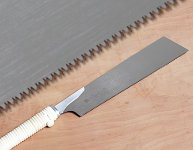
A large sheet of plywood will most likely bind and then you will bend the pull saw and if that didn't happen the glue and cross fibers will not improve the performance of your saw.
The best type of Japanese saw for use cutting large sheet goods is a type called a Kataba. They are available with either a crosscut or rip tooth design. The crosscut design is more prevalent, and would be better for cutting most sheet goods, especially plywood. I've used Japanese saws to dimension plywood. The most likely cause for plywood to bind on a Japanese saw wood be if you're using one designed for very fine joinery to make a very deep cut. Plywood that has been imported to an area with a different climate is not always flat and is more likely to bend or twist, especially if supported awkwardly. The two brands of saw I mentioned, Gyokucho and Z-Saw tend to use a tough steel and induction harden their teeth. It may be possible to screw them up but it would take effort. I know I've tried!!!

The more expensive hand finished saws are more likely to get damaged by careless use.
Most Japanese saws are not made to "rip a 4x8 sheet of plywood". They excel at finer joinery, dovetails , etc. They are amazing how little effort they take on the pull stroke. If they were widely available at a competitive price, push saws would be (almost) obsolete.
The more readily available Japanese saws are made for fine joinery. Specifically the most common Dozuki back saws, as well as Finer toothed Ryobi saws (i.e., rip teeth on one edge, crosscut teeth on the other), and the Kugihiki flush cut saws that are flexible and designed to flush dowels or pegs that stick up out of a workpiece. There are Japanese saws designed for large tasks such as timber framing and dimensioning large lumber. Dieter Schmid Werkzeuge GmbH of Germany has a good selection on their website.
http://www.fine-tools.com/kobiki.htm
Man, you better start this thread in Lumberjocks.com or something...
Yes, they are good...but....a BIG but...
1.) they can't take HARD AMERICAN hardwoods such as white oak
2). they can't be sharpened (what, who does that?!)
3). they pull sawdust into your line!
You see, Western handsaws are coming out of a dark age. They become almost extinct thanks to the invention of power tools...
There is simply not a well designed, well fitted western handsaw...
Enter Lie-Nielsen, Wenzloff and Sons, Veritas, and others...they make badass saw that are hand sharpened (yes, one tooth at a time) and that are better than pull saws...
Nothing is perfect in life, there are always trade-offs...
1) Again, most Japanese saws are designed for cutting Softwoods that were more commonly used by Japanese carpenters. The rake angle of those saws is sharper making them to aggresive for many USA Hardwoods. There are Japanese saws with tooth geometry made for cutting hardwoods.
http://www.hidatool.com/mitsukawa-hardwood-ryoba-saws
2) The more commonly available Japanese saws have induction hardened teeth that would make them difficult to sharpen. The saws are simply designed to have the blade replaced when it gets damaged or dull. There may be diamond files that could sharpen them but it's probably not worth the effort. If replacement blades are sold by that maker their probably not meant to be sharpened. Special files are made to sharpen high end "craftsman" made saws though.
http://www.japanwoodworker.com/dept.asp?s=JapanWoodworker&dept_id=13082
3) Sawdust buildup on your cutting line is a problem. I think some of the ways japanese craftsman hold their work while cutting may leave the saw line in a vertical rather than horizontal position, eliminating the problem. Another solution is to
blow on the cutting line as you saw.