Agree. If sides are discolored it is really just cosmetic for something that you do not see much. If it is brittle, cracked etc, that is another story. Replace is easy as some people point out. You might spend more on JBWeld type adhesives than it would cost to replace the basin too. Plus a lot of time to end up with something that looks much worse than discolored.You need more issues in your life...


You are using an out of date browser. It may not display this or other websites correctly.
You should upgrade or use an alternative browser.
You should upgrade or use an alternative browser.
JB Weld for the windshield reservoir?
- Thread starter Rustedtruck
- Start date
NightSky
Well-known member
As more of an aside to repairing HDPE, rather then an answer to the OP's problem, I repaired a cracked (maybe and inch or so long crack) in a windshield washer reservoir with a patch of JB Weld covering the crack and adjacent area. It held for quite a few years until the car was otherwise totaled.  Before using the epoxy, I *carefully* passed the flame from a propane torch over the area to be coated with epoxy. This flame or plasma treatment is routinely used to pretreat plastic bottles to help with the adhesion of labels or direct print. For example, https://www.enerconind.com/web-treating/plasma-flame-treaters/. This was a one off. last ditch repair attempt before buying a replacement. It worked. I don't have a recipe, just carefully pass the flame over the surface a few times. You don't want to melt anything. Did I say carefully?
As for cleaning the tank, maybe a bleach or sodium hydroxide solution? They both chew up organic materials, I don't have a concentration to suggest. Also, I don't know how they might affect the plastic.
Before using the epoxy, I *carefully* passed the flame from a propane torch over the area to be coated with epoxy. This flame or plasma treatment is routinely used to pretreat plastic bottles to help with the adhesion of labels or direct print. For example, https://www.enerconind.com/web-treating/plasma-flame-treaters/. This was a one off. last ditch repair attempt before buying a replacement. It worked. I don't have a recipe, just carefully pass the flame over the surface a few times. You don't want to melt anything. Did I say carefully?As for cleaning the tank, maybe a bleach or sodium hydroxide solution? They both chew up organic materials, I don't have a concentration to suggest. Also, I don't know how they might affect the plastic.
mreisner
Well-known member
I have had pretty good luck with this stuff on p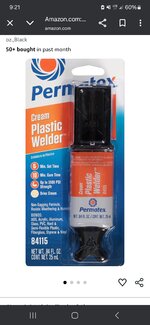 lastics that normally nothing else will stick to.
lastics that normally nothing else will stick to.bwringer
Well-known member
I have had pretty good luck with this stuff on p
On the back of the package, there is a clear warning that this will NOT bond to polyethylene or polypropylene plastics.
Guess what the "PE" in HDPE stands for?
bwringer
Well-known member
$22.79 + shipping on RockAuto.Because he didn't ask for vehicle help, he asked for glue help.
I'm guessing it's his 2010 matrix
Thread 'Rust between welded car panels.' https://www.garagejournal.com/forum/threads/rust-between-welded-car-panels.546083/
mreisner
Well-known member
And guess what when I said I've had good luck with it means. I have actually had it work.On the back of the package, there is a clear warning that this will NOT bond to polyethylene or polypropylene plastics.
Guess what the "PE" in HDPE stands for?
MileHighRover
Well-known member
- Joined
- Mar 13, 2018
- Messages
- 1,179
OP, you're on the right track with finding something to assist with scouring the inside. No liquid put inside and shaken will clean the walls. I've had success putting a bunch of small nuts (not what you eat) in a reservoir and a bit of degreaser and shake it all around. You don't have to shake it up and down, just get the nuts or whatever you put inside to the side you're wanting to clean. Then shake it side to side so they drag along that side and scrape the junk off. Then roll it to the next side and repeat.
I had a motorcycle coolant expansion tank that was really nasty. No bottle brush would fit past the first couple of inches of the tank. I tried a bunch of chemicals including acetone and nothing even came close to cleaning it. Even boiling water and degreaser did nothing. The above trick worked a treat. Tank looked brand new when I was done. Didn't take but a few minutes, either.
A thick slurry of sand, as you mentioned, would probably work.
I had a motorcycle coolant expansion tank that was really nasty. No bottle brush would fit past the first couple of inches of the tank. I tried a bunch of chemicals including acetone and nothing even came close to cleaning it. Even boiling water and degreaser did nothing. The above trick worked a treat. Tank looked brand new when I was done. Didn't take but a few minutes, either.
A thick slurry of sand, as you mentioned, would probably work.
Look at how restaurants clean coffee pots.Fill with ice and kosher salt the big grain stuff. Shake or agate it it in some manner for a while. Like a concrete mixer or Jack up one of the drive wheels of the car and zip tie to the wheel. Let it idle in gear for an hour or so?
When I worked at a restaurant, we shoved our hand in there with a scrubbing sponge.Look at how restaurants clean coffee pots.
Can confirm. Water Weld is a great underwater epoxy. Many a racing sailboat is held together with this product. An upgrade from Water Weld is Slash Zone, but you don't want to know the price.About two months ago I pulled the washer tank out of my 2005 Mercedes. Small crack was causing leak. I used JB water weld. Still holding. So that cost me about a buck versus a new one for big bucks or even a used one for $100 on eBay.
lolaetype
Well-known member
For that price I'd order a new one in a heartbeat. And order a couple of oil filters, If they are coming from the same warehouse, since the shipping would probably not increase.$22.79 + shipping on RockAuto.
BCreekDave
Well-known member
Large tank ultrasonic cleaner would be my bet. Going to cost you some if you don’t have one.
mike93lx
ALLIANCE MEMBER
It hasn't clogged yet, though?There's stuck on sediment everywhere green and brown. It was halfway full with water when i took it out. If I use it as it is all that sediment will come off with time and most likely clog the lines.
Is this what retirement looks like or you just really bored?
Last edited:
PCMusicGuy
Well-known member
I second this. If an ultrasonic doesn't clean it out, I'd even try a large vibratory tumbler/polisher. Either of these would way exceed the part's replacement cost, but perhaps you can find someone local with one willing to try.
BlindViper
Well-known member
Put a a cup of sand in it, put enough water in it to make it fluid. Shake the piss out of it and rinse when done.
andyvh1959
Well-known member
HPDE, polypropelene, polyethelene are called "low tension" plastics which means the surface does not bind well with glues and expoxies. The glue, epoxy or JB Weld tend to sit on the surface rather than bind to it. Heat welding or solvent weld (specific to the plastic type) can be done. But even heat welding some low tension plastics is not consistent.
Jazz1
Well-known member
Paint the reservoir..problem solved. I have to lift lid on my reservoir to check level
OP
Rustedtruck
Member
- Joined
- May 2, 2025
- Messages
- 24
Im amazed at how many of you didn't understand my original comment or just didn't read it. I'm also amazed at how many of you suggested different types of solution to my problem. Anyway, an update that is long overdue. Due to the size of the tank and many compartments inside using and abrasive like sand and shaking it it didn't work. I ended up just buying a pipe cleaner brush from home depot and although it wasn't pleasant twisting it in different angles to maneuver it through the tank compartment it did get rid of most of the dried up algae and whatever else was stuck on the inside. It took a long while though. I did use beach at the end to get the very hidden grime which worked but it ended up yellowing the tank more. Anyway, I'm satisfied with the results. Thanks!!
Last edited:
glentre
Well-known member
Howdy. I'm trying to clean the windshield reservoir inside because it is gruesome. I don't see how I can do it because it's got a very long neck and it's chambered. After trying a few solutions the only thing I see as th easiest method is to cut it in half and glue it back on. I do see JB weld water seal but does anyone have any personal experience with something similar. The tank is exposed to th engine bay which has vibrations and hight heat so I would like something that can withstand those conditions. Thanks!
glentre
Well-known member
In my Yamaha outboard, I didn't completely drain the water for the winter and the thermostat housing froze, causing a round dime size hole in the bottom of the aluminum cup-shaped housing. After unbolting the housing from the engine, I applied JB Quick Weld (sets in 6 min) to the inside of the housing, letting it ooze out the hole. Then, I smeared a layer of the Weld on the outside. Finally, I spread a layer of gasket cement on the inside and buttoned it all up. No leaks.Howdy. I'm trying to clean the windshield reservoir inside because it is gruesome. I don't see how I can do it because it's got a very long neck and it's chambered. After trying a few solutions the only thing I see as th easiest method is to cut it in half and glue it back on. I do see JB weld water seal but does anyone have any personal experience with something similar. The tank is exposed to th engine bay which has vibrations and hight heat so I would like something that can withstand those conditions. Thanks!