Pricing - When I spoke to Brian (
www.asedeals.com) a week ago he said that pricing for my unit would most likely go up about $200, so definitely order it soon so you can lock in the price. I'm sure you can tell them to hold off shipping for a while.
Electrical - The 220 pump does not come with a plug end. You remove a side cover where you'll see two wires (black and blue). These two are the hots and then there's a screw attached to the motor that's the ground. You'll need to create a plug and it will be exiting out of the top of the motor (see my pics). You'll also need to make sure you have a 30 AMP circuit in place with at least 10 AWG going from the panel to your outlet. All of my connectors are L6-30 Twist lock connectors.
Fluids - I used 12 quarts of Dexron III ATF (you can also use hydraulic fluid).
Getting it home - The lift is packaged with what look like oversized steel picture frames at each end and they extend about 4 inches below the bottom most portion of the bottom ramp. Hence, when it's on the floor the only thing touching the actual floor are the steel frames on each end. You could easily have a truck drop it off. There's a lot of rigidity to the whole thing. My buddy put fork lift extenders on a 5K forklift and actually picked mine up from the end with no issue at all (nothing even flexed).
Assembly - Definitely rent an engine hoist. You will only need it for the ramps but your friends (and your back) will thank you. All other pieces can be easily handled by two people.
Junkman's tech tips below (Thanks again Junk!!!)
Column and cross bar assembly - The installation manual says to stand up the columns and then put the cross bar in from the top. Per Junkman, I laid the columns on their sides with each top resting on a chair, then I slid the cross bars in from the top and let gravity take it down to the bottom. The ladder bars (the piece of steel with the square locking points) went in next, just like the cross bar. The trick here is to have one guy holding the top of the ladder bar and moving it around per the direction of the guy lining up the ladder bar into the cross bar ends.
Runways - You'll need to remove the sheaves (aka pulleys by most) from the one and only runway that has these. You'll need a 5mm allen to get these off. Then the double sheaves (or single sheave with spacer) will easily fall down. When assembling this runway on to the cross bars only attach the inner most bolts (the ones on the side on the inside portion of the lift). You DO NOT want to install the bolts on the outside (remember this only applies to the main ramp that has the cylinder) as your cable can and probably will get caught up on these outer bolts. Attach these bolts at the very end after you have completed running your cables through to the cylinder.
Cables - Figure out which cable is A, B, C, and D and then fish them in from the columns through the cross members and to the cylinder ramp. You'll want to fish them through with the non-threaded end going through the safety lock (remember to fish the cable so that it goes around the safety lock pulley and is on the inner most side of that pulley (the cable will NOT be between the column and the white pulley - check out the picture on the installation manual to see what I mean). Anyway, after you run the cable through then push the threaded end up into the top plate of the column and threaded it by hand until it gets stuck in the nylon thread. This will give you the most amount of slack in the cable so that you can fish it around the sheaves (pulleys) and over to the cylinder.
Cylinder - You will need a deep 1 3/8 socket to tighten up the nut on the end of the cylinder (which holds the steel plate, which in turn holds the non-threaded end of your cables). Make sure you have a 3/4 to 1/2 adapter for your 1/2 impact gun as a socket of this size will most likely only come in 3/4.
Extending the cylinder - You will need to extend the cylinder so that you can hook up your wires to the steel plate. There are two hydraulics plugs, one at each end of the cylinder. Go buy a blow gun kit for your air compressor and put the black rubber end on your gun (this is the end that looks like what they fill helium balloons with at stores). Anyway, remove the hydraulic plug on the end opposite the cylinder ram and then wrap a rag around your blow gun (as the hole is larger than your blow gun's rubber tip) and then blow air into the cylinder). The cylinder will start to extend iteself. As one guy is holding the blow gun in place, another guy should remove the other plug on the cylinder. Don't worry it won't go flying through the air. It will just let out a little noise when the plug comes out. Anyway, once you open up the second plug, the other guy can stop blowing air into the cylinder and the cylinder will stay in it's fully extended state. Finally, the reason for removing the second plug is so that the cylinder doesn't automatically retract back into position.
Air lines - These are easy to assemble. If you need to remove an air line from a fitting or cylinder you will need to push the black plastic back towards the fitting and then pull the air line out. If you simply try to pull the lines out, they won't come out and if you do force them out you'll most likely ruin the fitting. Oh, there's a blue Bend Pak air line cutter included with your hardware.
Tips for 1st time use of the lift - The very first time you hit the button to raise your lift, you will notice that nothing will happen for about the first 20-25 seconds. DO NOT PANIC, this is normal. The pump is simply filling the hydraulic lines and cylinder with fluid. You may also notice your pump making what seem like weird noises. This is normal as well since there is still air in the system. As you are pushing the button (which will make your ramps raise) go ahead and also pull the lever to lower your ramps. Doing both at the same time will actually make your lift lower itself. Per the manual, you want to do this a few times to essentially bleed the air from the hydraulic pump, lines, and cylinder.
Making adjustments to locks (after using the lift the first week/month) - As you start to use your lift and put different cars on it, it will soon allow for the cables to loosen up and settle in. This may cause your locks to seem like they are out of sync just a bit. More than likely you will notice that as your ramps are raising, not all of the locks will be "clicking" into the next locking position at the very same time. You may also notice that when lowering your car, your cross beams will come to rest on one column just a little sooner than the column on the other side (of the same one cross beam). This is due to the cables and/or uneveness with your floor. The key here is to first adjust your ladder bar on the column which has the cross beam coming to a full stop at the very latest time (during descent into a locking position - still focusing on one cross beam at a time). It's basically like trying to lay a 2X4 perfectly flat on to the ground. More than likely one side will touch the ground first. That's exactly what the cross beam is doing, with the locks allowing one side of the cross beam to come to a final resting spot a bit sooner than the other side. Anyway, you simply need to raise the ladder bar up (for the side on which the cross beams are coming to a rest late). Do this by tigthening the nut on top of the "top plate" (don't forget to back out the nut below the top plate or the nut on top of the top plate will no longer be able to be tightened). Finally, after adjusting the ladder bar, go ahead and test the operation of your lift. If the locks are still not engaging at the same time, then go ahead and tighten the chain by 1-2 full clockwise turns on the column which is "clicking" late, when compared to the rest of the columns.
David - Great idea on the bolts at the end of the track. I'll be getting that done tonight. Thanks


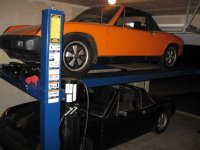
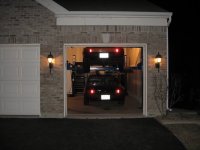

 I will be buying and HD9 within a few weeks. I think ASE or RB wholesale is the cheapest on these so I'm tire kicking right now for the best deal.
 )
)
 I'm ready to order but see the cost is now $2820! I think it was $2650 or so? I was just holding off until I was sure the major snow storms were over so I could install it.
 Love the tip on the 1-3/8 socket ovilla. I can just see me scurrying around trying to find that at the last minute.