To avoid these ads, REGISTER NOW!

Below 265 SQ/FT Just Puttering About in my Basement Workshop

All workspaces below 265 squarefeet.
OP
J

Just Puttering

Well-known member
Joined
Oct 28, 2018
Messages
249
Location
Vancouver, Canada
Here is the rough bench frame. It’s made out of 2x6 Fir lumber ripped down to 4.5” and laminated together to make square legs.

Bench frame.jpeg

The short stretchers are a laminated tenon joint. The long stretchers are through bolted. The bolt heads & oversize washers are countersunk into the legs so they can’t be seen from the front. With the two inch fir ply top, 40lb record #53 vise, and steel cabinet full of bolts & screws, it weighs close to 400 pounds.

It was rock solid, and looked great, but then I made the mistake of starting to read Jack Olsen’s 12 gauge garage thread. So of course, I unbolted the front top rail and re-made it with a 2x8 and used a jigsaw to cut a curve in it.
 
To avoid these ads, REGISTER NOW!
OP
J

Just Puttering

Well-known member
Joined
Oct 28, 2018
Messages
249
Location
Vancouver, Canada
To build the frame, I started with a stack of Douglas Fir 2x6 lumber. Then I grabbed the DeWalt's from their shelf and dragged them into the garage.

IMG_5762.JPG

I set the table saw up on the trusty workmate, and ripped 1/4" off one side of all the boards to get rid of the beveled edges.

IMG_0857.JPG

Then the other edge of the boards were ripped down to 4.5", and I chop sawed everything to length. Then I cut a notch in the top and middle of 4 of the 12 leg boards, and cut a corresponding tongue on the 4 middle stretcher boards.

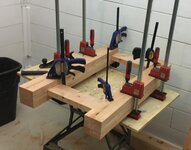
The middle leg board and stretcher board were then squared up and glued & clamped to the bottom leg board.

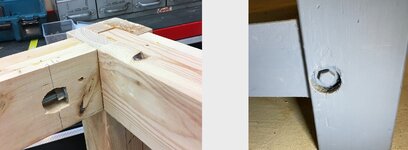
Workbench frame.JPG
I had cut the joints too tight to show on the photo, so I drew some black lines on the above right side image to show the tongue and notches.

Then the next evening, I drilled and inserted a couple of hardwood dowels into each of these pseudo tenon joints, cut the dowels flush, and glued on the top leg board.

IMG_0903.JPG
I routed a bevel on all the legs, then final cut and glued the other 2 layers of the stretcher boards. The outer layers of the stretchers were ripped a bit thinner for appearance before installing. The inner layers of the lower stretchers were ripped narrower to accommodate the shelf.

The end result is two leg assemblies that are just about impossible to rack or distort short of driving my car into the bench.
 
Last edited:
OP
J

Just Puttering

Well-known member
Joined
Oct 28, 2018
Messages
249
Location
Vancouver, Canada
The frame assembly was fairly simple.

The four long stretcher bars were each just two boards glued together. Holes were drilled and chiseled into the stretchers and legs for the bolts. I made sure the stretcher holes were large enough to fit an open end wrench.

To draw the front curve, I tied a pencil to a long piece of string at the board end, with the other end placed under a heavy rock on the driveway. I then fooled around with the string at various lengths till I found a radius that looked reasonable on the 2x8.

The bench was then temporarily screwed together with angled 3” deck screws, and I got set up to drill the 8” deep holes. To do so, I used a drill guide made from a speed square clamped to a 2x4. After carefully marking both ends, I buried the head of the 1/2” x 16” spade bit in the hole, then clamped the guide to the bench leg, checked for square, and drilled the rest of the way.

Drill Guide.JPG
This is a picture of a test hole with the drill guide.

Amazingly, all 8 holes popped out in the centre of the stretcher holes (y)
It took some minor chisel touch up to get a couple of the washers to seat correctly.

Bench bolts.jpg

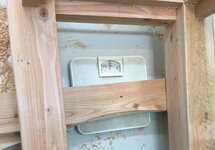
After everything was bolted, I removed the temporary deck screws and the frame was complete (except for re-making the front stretcher with a curve cut in it). Balanced on the scale, the completed frame weighed 135 lbs.

Bench on scale.JPG

I did some minor planing on the front of the front legs, used a bit of wood filler, then sanded and primed the whole bench frame. A bit of drywall spackling compound here and there, a couple of coats of blue paint, and I was ready for the bench top.
 
OP
J

Just Puttering

Well-known member
Joined
Oct 28, 2018
Messages
249
Location
Vancouver, Canada
To determine the final bench width, I temporarily mounted the vise to a board & clamped it to the frame. I worried a bit about the heavy vise being cantilevered so far past the leg. I had planned to use two layers of 1" ply for the top, which was unlikely to sag, but to put more of the weight directly over the leg, I chiseled a slot to move the vise base 1.5" into the leg.

Vice chiselled notch.JPG

With the width finalized, I drove an hour away to a specialty plywood supplier for a sheet of select grade 1" Douglas Fir plywood and had them cut it to 74" length, and then use their really fancy panel saw to cut the 24" width (Less 1/2 the saw kerf). Wow, the high end panel saws are impressive!

Glued together, and temporarily clamped using a few dozen screws (later removed), I could attach the 2" top with a bunch of Kreg HD pocket hole screws. I drilled a couple of 3/4" holes in the back corners to assist with any future removal of the sacrificial tempered hardboard surface, and attached the hardboard with numerous strips of double sided tape. The bottom shelf is two layers of 3/4 ply with a layer of tempered hardboard. The thickness of the shelf was purely to add some extra weight down low in the bench.

An oak wrap of the top, and an oak jaw face, and the bench was 100% done.

Workbench close up.jpg

It was a really fun project that took about 2 weeks of evenings and weekends. After 6 years of regular use, it is still rock solid, the bolts haven't needed tightening, the sacrificial hardboard is still in tolerable condition, and with a couple of minor paint touch ups it still looks like it did when I built it in 2019.

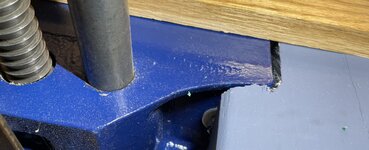
The vise jaws are a bit chewed up which is to be expected as it is frequently used for mechanical and metalwork purposes. Gotta get me a vintage Wilton Bullet vise!
 
OP
J

Just Puttering

Well-known member
Joined
Oct 28, 2018
Messages
249
Location
Vancouver, Canada
Just puttered about in the garden shed this morning doing some organizing. Grabbed some scraps of OSB and made a hanging box to get the sprayer up off the floor.

Shed tool storage.JPG

Little things sometimes make a big difference. The sprayer hose was always getting tangled on something, and it's now nicely contained.
 

Prospecter

Well-known member
Joined
May 16, 2015
Messages
2,392
Location
Maine
Just puttered about in the garden shed this morning doing some organizing. Grabbed some scraps of OSB and made a hanging box to get the sprayer up off the floor.

Shed tool storage.JPG

Little things sometimes make a big difference. The sprayer hose was always getting tangled on something, and it's now nicely contained.
Nice solutions for your sprayer and picks. Both are tools awkward to store.
 
OP
J

Just Puttering

Well-known member
Joined
Oct 28, 2018
Messages
249
Location
Vancouver, Canada
I want to build some shelves in the garden shed, so I needed to take head out for some 1x4 boards. It's a beautiful Holiday Monday today, so I thought perhaps I should take the Rav4 on the 10 minutes drive to the hardware store.

Red Rav4 in Driveway.JPG


Nope...Forget the Toyota!


Ferrari at Home Depot.JPG

I threw the roof racks into the back seat of the Ferrari, and took a lovely 40 minute scenic drive along some quiet roads lightly covered with dry fall leaves, and eventually made it to Home Depot. It made a routine trip a lot more fun, and I sure got a lot of funny looks on the 10 minute drive home.
 
OP
J

Just Puttering

Well-known member
Joined
Oct 28, 2018
Messages
249
Location
Vancouver, Canada
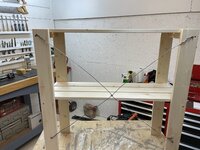
It’s a rainy Sunday here in North Vancouver, so it seemed like a good time to just putter about in the shop and build some Ikea style shelves for the shed.

My small 10’x12’ shop is big enough to work with 8’ lumber if I run the boards diagonally across it.

Chop Saw.jpeg

The old Ikea utility shelves I have from the 1990’s use lag bolts to connect the 1¼” cross bars. For these small light duty ones I just used construction screws into the 1½” bars.

shelf assembly.jpeg

I used heavy fencing wires for the cross bracing.

Cross Brace.jpeg

I only managed to empty out a few pots before the heavy rain came in. When all the annuals have finished flowering and their pots emptied out, the non frost proof ones will fill most of the shed.

pots on shelf.JPG
 
OP
J

Just Puttering

Well-known member
Joined
Oct 28, 2018
Messages
249
Location
Vancouver, Canada
Some musing on Ikea utility shelving units:

I sold my house to move in to my wife’s (then fiancé’s) house 15 years ago. She and her 3 teenage kids had been in the house since she built it new in 1992. My 2 teenage kids and I had been in our house since 1991.

I had built a 2 bedroom suite in her basement for my kids which takes up 2/3’s of the basement, leaving only 1/3 for storage. And of course, when each of the 5 kids eventually moved out, they left a bunch of their stuff for us to store for eternity.

When combined together, our blended family of 7 had an incredible amount of stuff. We wound up with 1/3 of our basement full of all sorts of crappy steel shelving units, rickety plastic shelving units, sagging melamine units, and near useless shelves on flimsy brackets.

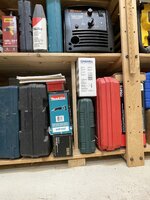
There was however, one standout performer. My wife had purchased a 9’ Ikea Sten unit in 1992. Those heavily laden shelves are still perfect after 33 years of heavy loads, and are still in the same place in my workshop. I do brace them for really heavy loads like my 80lb welder, but probably don’t need to.

Welder shelf.JPG

I also bought 6’ of the same unit in 1989 that is also still perfect. Ikea does occasionally engineer some great products, and replicating them oneself is often the most cost efficient way to build something. It’s a shame that they constantly downgrade their products. The new versions use boards that are thinner, narrower, and have more knots, so I have been building my own for 15 years.

Ikea garage-shelving.jpeg
(Not my photo)

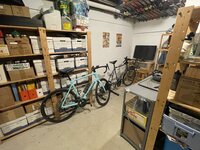
They are so easy to built from Home Depot 1x4, that I have somehow wound up building 8 more sets of them in lengths up to 12’. Most I have drilled all the holes to match the 2 bought ones and to make them adjustable. I also ripped the 1¼” square cross bars from 2x4’s and drilled and installed the 5/16 x 3” lag bolts. For small ones, I just use 2” construction screws and they seem strong enough.

IMG_5798.JPG

Loaded up with bankers boxes full of books & photos, and boxes of glass jars full of preserves, there isn’t a single sagging shelf anywhere to be seen.

Did I mention I really like these things 👍
 
Last edited:

Prospecter

Well-known member
Joined
May 16, 2015
Messages
2,392
Location
Maine
Love that solution, and that you copied the Ikea design to make your own. Do you need to do something on the backside to prevent racking?
 
OP
J

Just Puttering

Well-known member
Joined
Oct 28, 2018
Messages
249
Location
Vancouver, Canada
Love that solution, and that you copied the Ikea design to make your own. Do you need to do something on the backside to prevent racking?
Thanks @Prospecter

For the tall ones I used an X of steel plumbing strapping. The small ones I generally used heavy fencing wire. With the 3.5” wide leg width and bolted connections they are pretty solid even without the diagonal straps. 1x2 lumber also works well.
 

Madc

Well-known member
Joined
Nov 22, 2012
Messages
99
Location
Northern NJ
Fantastic job on the bench build! I have always thought (I'm sure I saw it somewhere previously) of building a "mortise and tenon" bench with 3 laminated 2x6's and just using the center 2x6 as the M and T. Thank you for the detailed description.
 
OP
J

Just Puttering

Well-known member
Joined
Oct 28, 2018
Messages
249
Location
Vancouver, Canada
I just got a reminder that the insurance on the old Ferrari runs out shortly. Looks like rain all weekend, so I guess it’s time to get the car ready for it’s winter slumber.

This little 2.9 litre V8 engine takes a surprising 10 litres of oil. So off I go to the parts store for 3 jugs of Mobil 1 0W40, some Redline MTL for the ******, some DOT 4, and 24 litres of coolant.

It’s been a great year of driving this car. I live on the side of a mountain, just off a fun road that I drive often that runs up to our local Mt. Seymour ski hill. The modest 240HP at 7,700 RPM is perfect as I can run fairly long periods at full throttle to redline up the 11% grades without going excessively fast. Something one can’t do with a newer 800+ HP sports car.

I put about 1,500 miles on the car this year and it was in 5 car shows/cars & coffees. My favourite was the big Father’s Day Italian car show with about 200 cars. It looks like my little silver car was the wrong color to park with the rest of the Ferraris… 🤣🤣

Red Ferraris.jpeg

My kids popped by to enjoy the show and take me to lunch which was fun.

IMG_5451.jpeg

With also attending great Vintage and Club races both locally at Mission, and also down in Seattle, it was an awesome year for car stuff.
 
OP
J

Just Puttering

Well-known member
Joined
Oct 28, 2018
Messages
249
Location
Vancouver, Canada
Argh…Vacuum Leaks!!

With the car ready for it’s long winters nap, it’s time for a few minor improvements as I slowly continue to fix up this old project Ferrari. I have the car in a great state of tune for all conditions except stop & go traffic (which I try to avoid), where it stumbles a bit when coming off idle.

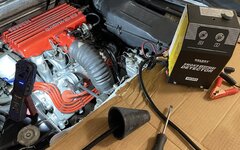
Today I thought I would tackle this minor issue. I suspected a small vacuum leak in the Bosch CIS system, and I had recently picked up a $65 smoke tester from Amazon to find the leak.

Smoke tester.jpeg

The cheap smoke tester worked really well, and sure enough, it highlighted a leak. Unfortunately, rather than a simple vacuum hose leak, it appears I have leaks at the intake plenum seals.

Stupid me, as I had the plenum off for painting a couple of years ago, and thought the rubber plenum seals looked ok, so I re-used them. Access to several of the nuts under the plenum is challenging with the engine in the car, and was super easy the first time, when I had the engine out of the car.

Oh well, why do something once, when you can have more fun by doing it twice.
 
OP
J

Just Puttering

Well-known member
Joined
Oct 28, 2018
Messages
249
Location
Vancouver, Canada
Paint prep gone wrong :

When I pulled the intake plenum for painting in Jan 2023, it seemed a simple plan. Clean off the old paint, then prime and paint…no problem. However, sanding off the old damaged wrinkle paint proved difficult, so I worked through more and more aggressive sanding solutions.

Fed up with how long it was taking, I put a flap wheel in the grinder and a thin wire wheel in a drill. With head down and dust coated goggles on, I wasn’t going to stop until the ****** paint removal was done. When the paint was completely gone, I removed the goggles to stare at my lovely work.

What I saw was frightening. I had turned my little workspace into a Pink Workshop!!

The walls in the corner where I was sanding were completely covered in thick red dust, which looked bright pink on the white walls. Even worse, when I tried to vacuum the dust off the paint, I realized it had come off the grinder so hot, that it embedded in the paint surface.

Why oh Why didn’t I think to do this outside 😔.

It took a couple of hours of vacuuming and scrubbing with various chemicals to get most of it off. About 10 square feet remained pink and needed re-painting. No problem, a 10 minute task. Of course, next morning, the red had bled through the fresh paint…argh!! Finally with a shellac based primer, and another coat of paint it was back to white again. About 3 hours of clean up for 45minutes of sanding. Was too mad at myself to bother to take pictures.

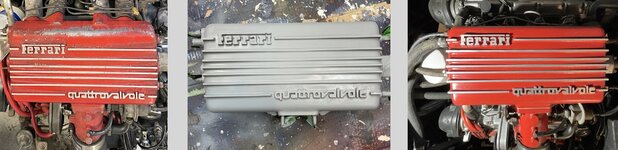
At least the Plenum turned out fantastic. A coat of acid etch primer, and two coats of rattle can red worked perfectly. I went with a smooth finish, as I always find crinkle engine paint harder to keep clean.

Intake 1.jpeg

I used a scraper to take the paint & primer off the ribs & lettering, then a bit of touchup with a sanding block. I am finding more & more uses for the carbide gasket scraper. Really quite a useful tool.
 

captain14

Well-known member
Joined
Dec 19, 2012
Messages
7,023
Location
Near College Park Maryland 20740
Argh…


The cheap smoke tester worked really well, and sure enough, it highlighted a leak. Unfortunately, rather than a simple vacuum hose leak, it appears I have leaks at the intake plenum seals.


Oh well, why do something once, when you can have more fun by doing it twice.
Just to look on the bright side, you can use your tools again for the same job!
 
OP
J

Just Puttering

Well-known member
Joined
Oct 28, 2018
Messages
249
Location
Vancouver, Canada
Tin Foil for the win (y)

I had expected the plenum painting to be easy, and the engine valley to be harder, but it turned out to be the other way around due to a great Garage Journal tip. I read somewhere on here that using aluminum foil instead of masking tape considerably speeds up the masking process.

Sure enough, with the foil wrapped around the hoses, sensors, and other bits that would have been hard to reach with sticky masking tape, I had it masked for painting in no time.

Foil Masking.jpg

Of course I still had to do the tedious de-greasing and scrubbing of the 40 years of **** that had accumulated in the engine valley.

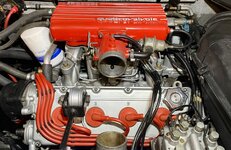
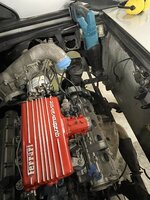
Technically, this all should have been vapour blasted at great expense, but this is a cheap Mondial, not a fancy 308, even though it’s the identical engine. The various covers were painted separately.

Paint.jpeg

Three summers of spirited driving later, the paint still looks perfect.

Ferrari Engine.JPG
 
To avoid these ads, REGISTER NOW!
OP
J

Just Puttering

Well-known member
Joined
Oct 28, 2018
Messages
249
Location
Vancouver, Canada
A few years ago, just for fun, I took the engine out.

The Ferrari 308 and early Mondials are designed so that pretty much all servicing can be done with the engine in the car. The timing belts are easily accessible through one wheel well, and the clutch accessible through the other. Some Youtube folks have even pulled both heads with the engine in the car. So it’s somewhat strange that the Mondial was designed with the engine, trans, exhaust, and suspension all mounted to a bolt in subframe.

I had never taken an engine out of a car before, so I why not start with a Ferrari for my first attempt 🤣🤣

I had actually bought this project car knowing I wanting to take the engine out as a learning experience. Kinda weird I guess, but no stranger than many other projects on this site.

Most of the rubber hoses were 40 years old. I figured that replacing the 16 coolant hoses, 12 fuel & vapour hoses, water pump, camshaft seals, original brake & clutch hoses, and a myriad of other minor items would all go so much faster with the engine out of the car, that it would mostly make up the time it took to re & re the engine.

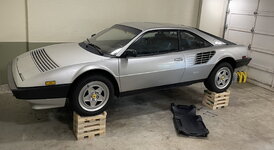
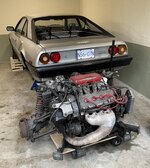
So, over the Christmas break 3 years ago, I spend a few hours one Saturday to cut all the fuel & coolant hoses, disconnected a few other bits, and undo about half of the subframe bolts. The next morning, using two floor jacks, I lowered the car till the engine was resting on a home made dolly, unbolted the remaining subframe bolts, and jacked the car up to set the engine free.

Engine out.jpg

I never had to go under the car when it was jacked up high as it was easy to just grab the suspension.

Engine out 2.jpeg

Pulling the engine really did make the rest of the extensive servicing work a pleasure, and I looked forward every day to spending some fun garage time with the project.

IMG_3476.JPG
 

Krfjkm

Well-known member
Joined
May 15, 2020
Messages
273
Location
Charlotte / Mint Hill NC
A few years ago, just for fun, I took the engine out.

The Ferrari 308 and early Mondials are designed so that pretty much all servicing can be done with the engine in the car. The timing belts are easily accessible through one wheel well, and the clutch accessible through the other. Some Youtube folks have even pulled both heads with the engine in the car. So it’s somewhat strange that the Mondial was designed with the engine, trans, exhaust, and suspension all mounted to a bolt in subframe.

I had never taken an engine out of a car before, so I why not start with a Ferrari for my first attempt 🤣🤣

I had actually bought this project car knowing I wanting to take the engine out as a learning experience. Kinda weird I guess, but no stranger than many other projects on this site.

Most of the rubber hoses were 40 years old. I figured that replacing the 16 coolant hoses, 12 fuel & vapour hoses, water pump, camshaft seals, original brake & clutch hoses, and a myriad of other minor items would all go so much faster with the engine out of the car, that it would mostly make up the time it took to re & re the engine.

So, over the Christmas break 3 years ago, I spend a few hours one Saturday to cut all the fuel & coolant hoses, disconnected a few other bits, and undo about half of the subframe bolts. The next morning, using two floor jacks, I lowered the car till the engine was resting on a home made dolly, unbolted the remaining subframe bolts, and jacked the car up to set the engine free.

Engine out.jpg

I never had to go under the car when it was jacked up high as it was easy to just grab the suspension.

Engine out 2.jpeg

Pulling the engine really did make the rest of the extensive servicing work a pleasure, and I looked forward every day to spending some fun garage time with the project.

IMG_3476.JPG
You’re a brave soul! Love it!
 
OP
J

Just Puttering

Well-known member
Joined
Oct 28, 2018
Messages
249
Location
Vancouver, Canada
With the engine out of the car and cleaned up, it was time to remove all 4 cams in order to replace the camshaft seals. The seals, and the O rings that hold them in place were one of the main sources of the cars oil leaks.

Cams.jpeg

When I went to place the cams on the workbench, I realized that this was the first time I had held a camshaft in my hands since the late 1960’s. That thought sent me on a happy trip down memory lane.

One summer when I was 9 years old, I got to help my dad re-build the engine of his 1960 Chevy Corvair in our open carport. I can still clearly remember using the suction cup thingy to lap the valves, and tapping in the pistons with the back of a hammer after my dad had tightened up the ring compressor.

He bought brand new what was claimed at the time to be the first Corvair in Winnipeg Manitoba in the fall of 1959. I was sad that he sold it just before I turned 16, but was then thrilled that he replaced it with a Datsun 510 which I learned to drive on.

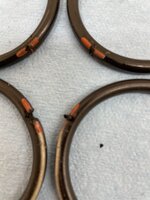
When I pulled the seals off the cams, it was pretty clear where the top side oil leaks were coming from.

Seals.jpeg

Apparently, someone in the cars past thought that applying big ugly globs of RTV would work better than replacing the O rings….Fail !!
 
Last edited:
OP
J

Just Puttering

Well-known member
Joined
Oct 28, 2018
Messages
249
Location
Vancouver, Canada
Ever take a chainsaw file to a Ferrari cylinder head? Me neither, but the internet said it was a good idea 🤣🤣

IMG_3513.JPG

According to the good folks at Ferrari chat, O rings can get pinched when they are compressed into a machined channel. Using a round file to break the sharp edges in both the head and the valve cover will apparently allow the O ring to properly settle in the groove and not leak.

All four of my O rings did indeed show bits pinched out or deformed at the head/valve cover interface.

IMG_3551.JPG

The top end of the engine has remained clean & dry for 3 summers now, so I guess the internet was right.

Of course, then it was time to watch more YouTube videos and read more internet forums on how on earth I could get the cams back in the engine.
 
OP
J

Just Puttering

Well-known member
Joined
Oct 28, 2018
Messages
249
Location
Vancouver, Canada
Over $1,000 for Hoses……Yipes!!!

Just the 2 long centre tunnel hoses were $719 from a UK Ferrari parts shop. They were unavailable elsewhere. Being some weird thin walled metric size, no other hoses were available in both the 6’ length, and also in a size that would fit. Folks on the Ferrari Chat forums have found that 1½” hose won’t stretch over the pipes, 1¾” won’t fit through the centre tunnel channels, and available silicone hoses leak as they are inaccessible for future tightening.... Oh well, sometimes you just have to grimace and push “Add to Cart”.

Hoses.jpg

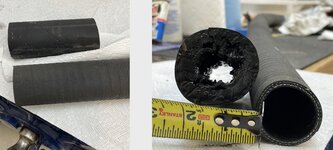
When I cut open the first Fuel line that looked brand new on the outside, I found it severely deteriorated on the inside. It confirmed my earlier decision to replace every 40 year old Coolant, Fuel, Vapour, Tank Fill, Vacuum, and rubber Brake hose on the car.

Most of the pipe connections I was able to cut from two 3’ sticks of 1½ & 1¾” Gates Green Stripe, but several others had to come from Ferrari. Anything that has the little prancing horse on the box is always 3 times the price…LOL.

Plugged hose.jpeg

When I cut up the old 6’ tunnel hoses for disposal, you wouldn’t believe how gross and swollen they were on the inside, while still looking perfect on the outside. That seems to be what happens to low mileage cars when they sit un-driven in some collection for years.

The car wasn’t overheating, but I think I was rapidly approaching a major cooling issue.
 
OP
J

Just Puttering

Well-known member
Joined
Oct 28, 2018
Messages
249
Location
Vancouver, Canada
What's the Ferrari plans for this winter?

Hi JSG,

Nothing on the car this winter. There are only 2 things remaining that I wish to do to the car :

1) I need to cut off the bottom 2" of both doors to remove some minor rust bubbles, and then weld in new metal. I won't do that this winter as l want to get in more sheet metal welding practice.

2) I also want to install QA1 shocks and lower the car 1½". I will change out all the bushings at the same time, though their present condition isn't too bad. I won't do that this winter for $$ reasons after this year's new Bianchi road bike purchase and major house exterior repairs.

So plans for this winter include building myself a welding table. I also plan to buy a scrap door from an 80's VW or BMW and cut & replace the bottom of that door a couple of times. I also want to use the scrap door to practice blending and clear coating metallic silver paint. I am only planning to paint the bottom bits of the doors.
 
OP
J

Just Puttering

Well-known member
Joined
Oct 28, 2018
Messages
249
Location
Vancouver, Canada
Making the braided stainless fuel lines was fun!

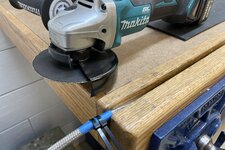
I have always admired the braided stainless lines on race cars and hot rods, so it was fun to learn how to do it myself. After really messing up my first sample cut which frayed badly, I turned to Garage Journal and found yet another awesome tip.

Using a zip cut wheel between 2 plastic wire ties led to perfect cuts with no fraying…Brilliant!!

Cutting braided line.JPG

I had grabbed some new German Cohline braided line & plastic Polyamide line used for the Bosch CIS systems from BelMetric and was able to re-use the original fittings. Following tips from the VW forums, I made a simple wood block to hold the lines while I tapped the barbed fittings home with a small hammer.

Making Fuel Line.jpeg

It was pretty cool to realize I was hand making Ferrari parts in my little basement workshop.
 
OP
J

Just Puttering

Well-known member
Joined
Oct 28, 2018
Messages
249
Location
Vancouver, Canada
Sawzall Time!

When re-installing the engine, I couldn’t get it to fit, so I cut off part of the subframe with a reciprocating saw.

Sawzall to Ferrari.jpeg

For an hour or more I struggled to drop the body the final 2 “ over the engine but there just wasn’t enough room for 1 of the 3 mounting points of the injection meter bracket to clear the firewall. Seemed weird that there was clearance for removal, but not for re-installation. I was getting tired of fighting with the car on floor jacks while shoving around a dolly with the really heavy lump of engine/trans/suspension on it, so I went for the saw.

Cutting off the offending bracket took less than a minute, and opened up loads of room.

Cut bracket.jpeg

I made a simple connector to re-attach the bracket with bolts. An hour later the engine was in the car, and I had enough of the subframe bolts installed to remove the dolly.

Bolted bracket.jpg

The hand built nature of these cars means that many things that should fit often need a bit of tweaking & persuading.

With the engine no longer sitting on the dolly, I could proceed with pulling the engine & trans pans in order to replace the shift shaft seals.

The most annoying oil leak on the car was from the shift rod in the picture below, which passes through the engine sump to get to the transmission. It runs below the oil level in the sump, and relies on two O rings to seal. If the interior one leaks, you get oil mixing with the gearbox oil, and if the exterior one leaks, it will continue to drip oil till nearly half of the 10 litres of oil is on the garage floor.

Engine pans.JPG

It was wild seeing how extensive the windage trays were for the oil sump. Full on race car stuff!!

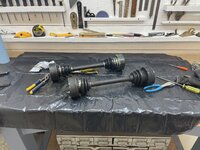
Re-building the Porsche 930 Turbo CV joints used on the car was super messy. I think I spent more time protecting my woodworking bench than I did on the joint & boot refresh. I really do have to get cracking on building a welding / mechanical work bench.

CV Joints.jpeg

A couple more weeks of installing stuff, and the car was ready for the 2023 summer driving season. The engine was out for about 5 months, and the only assistance I had on the entire project was for my wife to shift through the gears while I was underneath adjusting shifter forks, and also to assist in re-installing the engine bonnet.

The car has been fun, reasonably fast, and reliable for the past 3 driving seasons.
 
OP
J

Just Puttering

Well-known member
Joined
Oct 28, 2018
Messages
249
Location
Vancouver, Canada
I find it fascinating to see the signs of the hand built nature of these Enzo era cars.

Ferrari was really small in 1983 with only about 2,200 cars produced that year. Some aspects of their production seem like a current day race car fabricator, or a custom car shop.

Just like some do when building a Hot Rod, the chassis was ordered from a specialist supplier. 1980’s Ferrari tube frame chassis's were made by the custom frame builder Vaccari & Bosi in Modena out of round, oval, and square tube sections hand welded together, just like you might see in a race car fab shop.

Ferrari 308 bare frame.jpg
(This tube frame is a Ferrari 308 under restoration)

The bare chassis was trucked a short distance across Modena to the shop of Enzo’s old friend Sergio Scaglietti for the body panels to be attached. Ferrari bought Carrazzeria Scaglietti in 1973, but Sergio stayed on running the place till he retired in the mid 80’s.

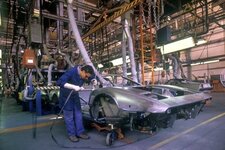
I love seeing the body fabrication pictures. Here’s a rear clip of a Mondial being welded up. The multiple Vice Grips & hand hole punch certainly aren’t something you would see on a modern assembly line. With the exception of the substantial body jig, the rest of the process could be a present day large custom car shop.

Ferrari Mondial rear clip.jpg

Once the rear clip was done, other panels were welded up on a rotisserie. Ignoring its more robust build, this rotisserie looks pretty similar to what folks are using to do restorations in their home garage.

Ferrari 308 spot welding.jpg

I absolutely love the spot welder. It would be awesome to try that beast out. Looks like something from a Marvel action movie!!!

Once Scaglietti was done with the main body, it was mounted to a dolly, and trucked the 14 miles down to the Ferrari factory in Maranello. Once again, the wheeled dolly, and gas welding by hand looks straight out of a custom car shop. Amazing!

Ferrari 308 gas welding.jpg

Enzo Ferrari was at the factory nearly every day until just a couple of years before he died in Aug 1988 at age 90. I like to think that in March 1983 as he walked the factory floor, my little silver Mondial with the light blue interior might have stood out a little in the sea of red 308’s. Did he notice it? Did he like the colours? Would he have cared that it is still running strongly 42 years later? I like to think so.
 
Last edited:
OP
J

Just Puttering

Well-known member
Joined
Oct 28, 2018
Messages
249
Location
Vancouver, Canada
Good call replacing the flex fuel lines.

Thanks @yhprum

I wasn't planning to replace the plastic lines, as I didn't think they deteriorated like all the rubber does. Then I gently pushed one out of the way to access a cam cover nut, and the line just snapped...incredibly brittle!!

It was super easy to replace the plastic lines thanks to tips from the Porsche 911SC forums. I simply removed the old lines by heating them and pulling them off the barbed metal lines. I then held the new plastic Cohline tubing with a clamping block in the vise, and simply pushed the barbs into the new plastic lines.

IMG_4127.jpeg

You are right about the engine fire risk with 40 year old plastic injector lines. Especially when they are so cheap and easy to replace.
 
OP
J

Just Puttering

Well-known member
Joined
Oct 28, 2018
Messages
249
Location
Vancouver, Canada
This past weekend's club ride was likely the last for the season.

Club ride.jpeg

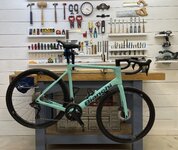
It was time to wash the Bianchi, clean & lube the chain, charge up the Di2 shifter battery, and tuck the bike away for the winter.

Bianchi.JPG

Then I dragged the trainer & ancient Norco road bike out of storage, fired up the dormant Zwift account, and got ready for the indoor racing & club ride season.

Trainer.jpeg

Yesterday was my first indoor club ride in about 8 months. We had 11 riders on the hour long ride on the Zwift group ride platform in their various garages, basements, and apartments. It was great chatting to everyone on the conference call using the Discord app. I even won a couple of the intermediate sprint races!!.. Fun times on a rainy evening :).
 

mmsheb

Well-known member
Joined
Mar 30, 2008
Messages
365
Location
Wisconsin
My wife and I painted the railing, and the carpenters & painters finished the house. The deck & railing turned out awesome!

New deck.jpeg

What we hadn’t expected, and were really pleased with, was how much better the deck proportions were with the deck being 2’ shorter, and the former dropped soffit eliminated.

Old deck.jpeg

The proportions of the old deck were somewhat clunky looking. The shorter deck and raised soffit also made the dining room below considerably brighter.

Overall, a BIG win (y)
That looks awesome. Great insight into the redesign!
Mike in WI
 

mmsheb

Well-known member
Joined
Mar 30, 2008
Messages
365
Location
Wisconsin
Hi Matt,

So cool that you live near the factory. I passed through that area 31 years ago while travelling from Bologna to Nice via Milan. Need to get back there someday and see the Museo Enzo Ferrari. It was an awesome trip.

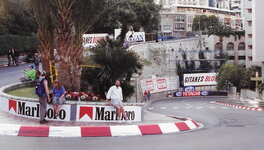
We watched the 1994 Monaco GP on TV from a bar in Nice, than quickly hopped on the train over to Monaco to walk the full circuit before they opened it up to traffic. Surprisingly few people went onto the circuit.

Monaco Hairpin 94.jpeg

Here is a picture of me (white shirt) at the Hairpin corner.

Then the coolest thing happened :

We were standing at the back gate to the paddock area, peeking through the fencing at the goings on. All of a sudden, there was a bunch of shouting, and a couple of guys came running out of the paddock carrying some stuff. The security guards were yelling and all of them gave chase. We were left standing by ourselves near the gate, so of course, we stepped through.

Once inside, we wandered around freely, staying out of everybody’s way, and watching the teams pack up the cars and their work areas. We saw up close some drivers talking to mechanics, and wandered right up to the cars. Must have been in there for at least an hour.

I took this picture of my wife with Alesi’s Ferrari :

Ferrari Pit - Monaco 94.jpeg

I then handed her my camera and crouched down next to the car. I had one hand on the steering wheel for the picture when she tried to wind on the film…OH NO, out of film. Of course, there was nowhere to acquire film inside the paddock area. Sigh!
Always enter these "off-limits" areas like you belong! Good on you!
I attended the US Grand Prix at Watkins Glen in October, 1968. The morning of the race I and my buddies walked the entire race course. We walked in the pits before the race since we belonged there too! Great memories from almost 60 years ago. The cars in the spectator parking lot were memorable, too.
Mike in WI
 

mmsheb

Well-known member
Joined
Mar 30, 2008
Messages
365
Location
Wisconsin
A few days ago, I discovered your very excellent site and have just completed reading it. I thoroughly enjoyed reading every post. You are so organized, and your projects are inspiring.
As a side note, I lived in Brandon from 1974-1978 and loved visiting Winnipeg. I went with a friend in his new MGB to Gimli raceway in June 1975 for the Player's Challenge Series.
I'll keep following along!
Mike in WI
 
To avoid these ads, REGISTER NOW!
Top Bottom