

slopecarver
Well-known member
Hate cracks appearing in your concrete floor? Hate dealing with those expansion joints? I just stumble across a technology that I had learned about years ago watching the history channel, It's called post-stressed concrete. The following was written before I had looked for the wiki which can be found here.
So as many of you already know and everybody should know, concrete ***** in tension and rocks in compression. So how do you keep an entire concrete slab in compression? You run cable through it and tension the cable with a few tens of tons of force.
Skip this paragraph for the gravy.
Bonded post-stressed concrete slabs are primarily for production work, say bridge pilings like those on the Chesapeake Bay Bridge,
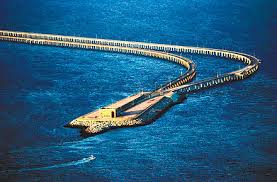
which were made using this process and also an interesting centrifugal casting process. The concrete is cast into a tube with evenly spaced holes placed radially around the tube and through it's entire length. After the concrete has been cast, cables are snaked through the holes, secured on one end and tensioned on the other end while grout is pumped into the holes and allowed to set. The cable is then released and the excess cut off. A simpler method, Pre-stressed concrete is where they stretch the cables then pour the concrete however the forms must be small otherwise the tons of force on the cables would crush the forms.
Unbonded Post-stressed concrete is generally done on-site, commonly in buildings but sometimes used on a smaller scale such as house slabs and in our case, garage slabs. I haven't done any research in terms of cost however is should only be marginally more expensive and you'll never need to deal with cracking again. One end of a cable is anchored into the side of a slab, the other end sticks through the side of the slab/form with a special backing plate. The cable is inside a plastic greased tube to allow it to stretch during the tensioning process. The concrete is then poured and allowed to set, then the cables are stretched with a hydraulic ram and held in place with a circular wedge. here's a LINK explaining how it's done.
Benefits:
Less/No Rebar
No stress relief cuts
No cracking in the future
Cons:
Requires unique equipment $
More set-up time (maybe) $
Requires knowledgeable contractor $$
Blowout
Disclaimer: I have ZERO experience with any of this.
So as many of you already know and everybody should know, concrete ***** in tension and rocks in compression. So how do you keep an entire concrete slab in compression? You run cable through it and tension the cable with a few tens of tons of force.
Skip this paragraph for the gravy.
Bonded post-stressed concrete slabs are primarily for production work, say bridge pilings like those on the Chesapeake Bay Bridge,
which were made using this process and also an interesting centrifugal casting process. The concrete is cast into a tube with evenly spaced holes placed radially around the tube and through it's entire length. After the concrete has been cast, cables are snaked through the holes, secured on one end and tensioned on the other end while grout is pumped into the holes and allowed to set. The cable is then released and the excess cut off. A simpler method, Pre-stressed concrete is where they stretch the cables then pour the concrete however the forms must be small otherwise the tons of force on the cables would crush the forms.
Unbonded Post-stressed concrete is generally done on-site, commonly in buildings but sometimes used on a smaller scale such as house slabs and in our case, garage slabs. I haven't done any research in terms of cost however is should only be marginally more expensive and you'll never need to deal with cracking again. One end of a cable is anchored into the side of a slab, the other end sticks through the side of the slab/form with a special backing plate. The cable is inside a plastic greased tube to allow it to stretch during the tensioning process. The concrete is then poured and allowed to set, then the cables are stretched with a hydraulic ram and held in place with a circular wedge. here's a LINK explaining how it's done.
Benefits:
Less/No Rebar
No stress relief cuts
No cracking in the future
Cons:
Requires unique equipment $
More set-up time (maybe) $
Requires knowledgeable contractor $$
Blowout
Disclaimer: I have ZERO experience with any of this.
Last edited:
