To avoid these ads, REGISTER NOW!

Knife sharpeners

TMcCay

Well-known member
Joined
Jun 5, 2011
Messages
1,056
Location
SW. Oklahoma
OK, I changed my mind. When I hit the lottery I'm getting a TSPROF. :bounce:

Tommy

You would love it! Some of the best money I've spent on a tool. I picked it over the Wicked Edge simply because it will use any stone that the Edge Pro will and you only need one stone, not two. In fact I even use some DMT diamond plates in mine without any backing plates.
 
To avoid these ads, REGISTER NOW!

bulletpruf

Well-known member
Joined
Nov 28, 2013
Messages
10,924
Location
San Antonio
Great thread. We've been slaying the deer and wild hogs at my buddy's ranch and I'm doing a lot of sharpening lately on a round sharpening steel and I've never been a huge fan of these. I can get the knives to where they will take hair off my arm, but I'm looking for something budget friendly (under $150) that will control the angle, too. With the round sharpening steel, I'm just kind of guessing at the angle.

The Ken Onion Work Sharp systems look to be reasonably priced and have good reviews.
 

PopcornSutton

Well-known member
Joined
Jun 10, 2024
Messages
778
Location
Northern Tip of VA
I go along with the 1x30 belt sanders. HF sells one for about 50 bucks and does a fine job. Mine came with that bevel guide, but I don't use it. Belts are easy to come by, and there is also a place that sells a leather strop belt that works on it.
 

bulletpruf

Well-known member
Joined
Nov 28, 2013
Messages
10,924
Location
San Antonio
I ended up ordering an inexpensive set of sharpening stones from Amazon. I've used these in the past with good results.
 

Beerhippie

Well-known member
Joined
Oct 13, 2023
Messages
9,663
Location
Far NE Oregon
For those interested in learning to hand-sharpen, you could do a lot worse than spending a few hours on the outdoors55 YouTube channel.

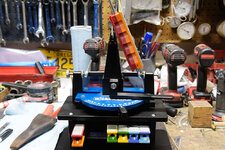
For those of us who can no longer hold a reliable angle--like myself--I do love my Wicked edge system. Admittedly, part of the reason I own one has to do with the lack of a breathalyzer lock on my debit card, but the price has been well amortized over the four years I've owned it.


51918799895_e0658b3aeb_b.jpg
 

Beerhippie

Well-known member
Joined
Oct 13, 2023
Messages
9,663
Location
Far NE Oregon
Now that I have a little more time (had to put out a couple of brushfires in the brewery)....

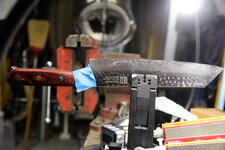
I'm impressed with how versatile the WE system is. Here are a few examples of tools and knives I sharpen with very little investment in accessories:

Pruning shear blades:

51918379633_0af4115438_b.jpg

Kitchen cutlery:

51993511874_6322aa2c6b_b.jpg

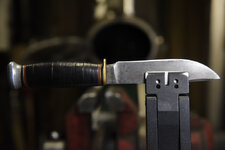
Hunting knives:
Large:

51969146472_ebbd174e3e_b.jpg

And small:
51922419483_0504fff9e9_b.jpg

Small knives require an accessory. This is a Tormek SVM-00 Small Knife Adapter (probably the least expensive Tormek accessory @~$30):

51977742346_5495b690c5_b.jpg

If you do invest in a Wicked Edge system, save the money you'd like to spend on the very fine grit paddles--nice if you want gleaming, show-quality edges, but rarely needed for most practical uses--and buy the coarsest they sell--50/80 grit and 100/200 grit. These will be your go-to paddles for reshaping old, abused blades (the kind most used (and many new) knives have). The accessory paddles (stones) are around $100 per pair.

I've been sharpening knives by hand for over 50 years, so I have an extensive set of stones, natural, ceramic and diamond. It's just that the last decade or so has seen some decline in my fine manual dexterity and I felt the need for a guided system. The WE was very expensive, but "buy once, cry once" ain't the worst idea I've ever heard.

Once you establish a nice, flat, uniform bevel with the guided systems, It's pretty easy to use a hand-held stone for rapid field touch-ups. If you start to see multiple bevels, it's time to re-establish the bevel on the guided system.
 

manwithtools

ALLIANCE MEMBER
Joined
Aug 24, 2015
Messages
13,669
Location
Lebanon, TN
It's just that the last decade or so has seen some decline in my fine manual dexterity and I felt the need for a guided system. The WE was very expensive, but "buy once, cry once" ain't the worst idea I've ever heard.
I have the Work Sharp Precision Adjust which is quite similar to the Wicked Edge. Once you get the hang of the setup and system, it's quite easy to put a good edge on a blade. It's also really fast to restore an edge made with the jig, I keep all of our kitchen knives at 15 degrees. and it's very fast to get them razor sharp if you don't let them go too long.
 

rooster59

Well-known member
Joined
Nov 16, 2014
Messages
935
Location
Land of the Pines
Medium silicon carbide stone, 10 inch or so. Then med then fine crock sticks. Always shaves the hair off my arm. Not good for a knife with an s-curve belly.
 
Last edited:

Beerhippie

Well-known member
Joined
Oct 13, 2023
Messages
9,663
Location
Far NE Oregon
Just a note on the various guided systems: The "stones" or "paddles" aren't limited to use on the system as intended. I find that the 400/600 is nice to throw in a pack for touch-up when in the field or on the job. They're much easier to hold safely than a regular stone. Same for using the coarser paddles to sharpen large yard/garden tools--machetes, hedge shears, etc.

I also found a way to use them to sharpen plane irons and chisels (Yes, WE makes a chisel/plane iron accessory for their system--it costs around $200 and I've spent too much on the system as it is). The coarsest flat diamond stones I own are around 320 grit, and often I need to remove a fair amount of very hard steel to restore and true the bevel on a "vintage" yard-sale plane iron or wood chisel, so I wanted to be able to use my 50/80 and 100/200 grit WE diamond paddles for this--they move metal fast.

I already had one of these:

612ODlO7OOL._AC_SL1500_.jpg

which is meant for use on a flat stone. The WE paddles are too narrow to use it as intended.

I figured out that I could make it work:

54208978776_7dd3d44467_b.jpg

Clamp the guide upside-down in a vise, then I can scrub with the coarse stone to quickly true and establish my bevels. I can do almost all the sharpening using the WE paddles down to 2,200 grit, then leave the iron or chisel in the guide for stropping. Using the guide results in a perfectly square, flat bevel.

Using the coarse WE paddles cut the time I'd spend remaking a bevel on an old, abused tool from over an hour to fifteen or twenty minutes.
 

Jazz1

Well-known member
Joined
Jan 3, 2016
Messages
4,184
Location
Thunder Bay On.
I have the Work Sharp Precision Adjust which is quite similar to the Wicked Edge. Once you get the hang of the setup and system, it's quite easy to put a good edge on a blade. It's also really fast to restore an edge made with the jig, I keep all of our kitchen knives at 15 degrees. and it's very fast to get them razor sharp if you don't let them go too long.
A friend offered to lend me his WorkSharp. It’s the basic model, works great.
I have a Lansky 5 stone that works good but painfully slow after using a motorized sharpener.
 

Montauket

Well-known member
Joined
Mar 25, 2023
Messages
133
I like the DMT 8” stones and then wet stones for finishing it up to 3000. S90v ,S30v, kitchen knives and a pile of fish knives for everything from tuna to flounder.
 

JradM

Well-known member
Joined
Sep 4, 2019
Messages
1,812
Location
Alberta
For those interested in learning to hand-sharpen, you could do a lot worse than spending a few hours on the outdoors55 YouTube channel.
That guy is the messiah of knife sharpening.

He's done MANY videos about how to freehand sharpen and why it's the best - but also videos about the best guided-sharpening systems. My only critique is that he hasn't tested the Worksharp precision adjust and precision adjust pro - I think those two systems are at least competitive, if not class-leading in their price categories.

I'll save you the trouble of watching 20 videos though, if you're just willing to take my word on it for some reason:

1. Freehand: Sharpal combination diamond stone with a 6 micron diamond strop. Sharpal has remarkable little diamond contamination. You can get nicer diamond stones, but not without paying way, way more money. You can achieve not just paper-cutting or shaving sharp - but genuine hair-whittling sharp with just those two items.

I would recommend a "premium" alternative, but I kind of doubt you need it if you're not already a hobby-sharpener.

2. Guided: Wicked Edge, KME, Worksharp PA Pro, Worksharp precision adjust (in descending order of price).
  • Wicked Edge has the advantage of alternating strokes without readjusting the knife. It's fast AND precise. It's a great system, but wickedly expensive.
  • KME I haven't tested personally. However, it allows you to rotate the knife without readjusting, has a good clamp system and you can use any number of stones with it - you're not locked it.
  • Worksharp Precision Adjust Pro can get you results to rival Wicked Edge, but it's a little more time consuming. It's a fraction of the price though...
  • The original Precision Adjust is smaller, only handles knives up to 8", is a little less rigid, uses small proprietary stones... yet still works A-OK. You gotta be more patient than the other three, but impressive results are possible with the right technique. You absolutely can sharpen kitchen knives this way, but it may take all afternoon to work through a set.
3. Powered: Worksharp. There's no genuine competition unless you're talking about actual belt grinders. None of the ceramic stone powered sharpeners work worth a darn. The Ken Onion is faster and has capabilities the other models don't - but even the wimpy fixed-angle "Combo" sharpener works pretty well.

The thing is, even guided sharpeners require "some skill", they just need less skill than freehand sharpening. You at least need to learn to raise a burr and how to strop to remove it. Some of these systems have guided strops too.

If you learn to freehand sharpen, it basically allows you to get results like the guided systems but as fast as the powered ones.
 

Steve_P

Well-known member
Joined
Sep 15, 2010
Messages
5,181
I have the KO Work Sharp. As said, it's fast and easy for those of us that don't have knives that cost $$$ each and don't want to dedicate 20+ minutes to sharpen a single knife by hand. I generally just use a 400 belt for my knives as I don't let them get too dull and this is enough to cut paper on the edge- when I stop. I know this is all blasphemy to the knife fetish crew here, you gotta do it by hand, you gotta spend an hour, you gotta use 10 steps to 3K grit to sharpen one knife.... but that's not for me. And I understand that if you have a $$$ knife then you probably want to sharpen it by hand. The KO work sharp is fast and requires very minimal skill; I can do my entire set of 11 kitchen knives in less than 30 minutes, maybe less than 20.

edit- project farm did a test on knife sharpeners.
 

Ohio Andy

Well-known member
Joined
Jul 31, 2024
Messages
2,247
Location
Columbus, Ohio
I own lots of equipment for sharpening stones. One of the fastest easiest to use reliable methods is the workshop knife sharpener. It uses small belts. It has built-in angle guides. And you can get really good results for pretty much everything.

I also own and prefer the ken onion edition with the blade grinding attachment. I find I actually use the blade grinding attachment. Walmart than anything else and I generally then freehand on the moving belt and the moving belt can be set to very precise degrees. And I use that to set my initial bevel. Now understand but that version on Amazon right now is about $250.

For ease of use and quickness, I just really like this work sharp system.

If you do choose to go for something like that, you can put stropping compound on the super ultra fine belts after you wear them out and use that to strop your blade.

If I'm simply touching up a knife, I usually grab a Spyderco triangle sharp maker. I have used these to reprile a blade to get it down to the angle that I want, but the moment you do that you're going to probably be buying either the diamond stones for about $80 a pair or the cubic boron nitride for about the same price. Price. I own both of those. I'm not sure which is better. I use them both.

But, after the angle is right, I can get a crazy sharp edge and maintain a crazy sharp edge just using the sharp maker. It's really easy and it's really fast at that point.

But with all things, if you really want to get the super super sharp edge using the Spyderco triangle sharp maker, then you're probably going to add the two ultra fine replacement stones at about $25 a piece. Maybe a little less and then you're going to have razure sharp blades. Assuming you bought the sharpness tester which I own and I have to say that having one of those can really improve your sharpening ability.

Now wicked edge is a very nice system. Own a couple things that sharpen using that general method and they work really well, but I do not own the wicked edge. My only complaint about the wicked edge is that it uses proprietary stones and then you need two of each. So you can do both sides at the same time. Now don't get me wrong. You will get amazing results and it's almost impossible to duplicate the results that you would get using anything but a fixed angle system such as this.

That said, even though I've been considering purchasing a wicked edge, I think I'm more inclined to go towards the TS Prof. I prefer that the wicked edge is made in the United States, but the TS Prof can use any of the stones that use similar systems such as the KME. But those that own both say that the TS Prof. K03 is much better.

What you really probably want is the TS Prof. K03 Hunter Black edition from gritomatic, but that's never in stock. And if you buy from them they don't even include Stones. You need to add stones to that.

And so we're clear the TS. Prof. Kadet we'll probably do everything you need. And it costs a lot less than the k03 Hunter pro.

The disadvantage to those particular systems is just the time that it takes to put a sharp edge on the blade. If you have the work sharp knife sharpener or one of the even more impressive variants of it, it will sharpen the knife very fast. Just be careful not to overheat the edge. Sharpening with most of those other systems just take longer, but you can indeed obtain better results.

This last weekend I decided to sharpen some knives and I had to reprofile them a bit, so I threw them on to one of my work sharp belts just to get the bevel below 15° per side and then I threw it onto my Spyderco for 30°, which means 15° per side. Directly off the Spyderco I was getting Mark 's below 20 0 off my edge on up industrial edge tester. If you have something like a TS Prof, kme, or wicked edge, if the steel is decent, you'll probably be closer to 100 which is insane sharp.

those values were without stropping

Note that I also got pretty nice edges off my 30k waterstone.... Again, that was without stropping. If you can strap well well, you can get even better edges.

If you do go for something like the TS Prof. And if you think you'll be using crazy hard steals, be sure to get the diamond version of the stones because they can handle all those crazy hard knife. Steels
 
Last edited:

Firebrick43

Well-known member
Joined
May 12, 2015
Messages
13,992
Location
West central Indiana
For those who don't want to spend big $$ the Lansky system is a lot of bang for the buck.
Its SOOO SLOWWW.

I finally bought a sharpal large double sided diamond plate.


The extra width and length makes a huge difference in being able to free hand sharpen large knives plus the stand made more of a difference with knuckle clearance making the technique much easier for me. I cut a piece of MDF the exact same size and put 5 micron paste on one side and 2 micron on the other for stropping.

I did every one of my 11 wustoff kitchen knives(except the serrated bread knife) two evenings ago, in less time than I could do one on a lansky.
 

Beerhippie

Well-known member
Joined
Oct 13, 2023
Messages
9,663
Location
Far NE Oregon
One VERY valid point that the fellow at outdoors55 makes is that most people give up on hand-sharpening because it's too slow--because they don't start with a coarse enough stone!

This is 100% true! For some reason, a lot of us have come to believe/been taught that using a stone too coarse will ruin a blade--and it will, if abused. But, used correctly, it does no damage (disclaimer: Sharpening a blade removes metal. No way around that. It will wear a blade out eventually.). It will turn an hours-long slog putting an edge on a trashed blade into fifteen or twenty minutes to achieve any level of sharpness you desire, depending on skill set.

I've been amazed how much the 50/80 grit and 100/200 grit stones have sped up my workflow. Once you hit the apex and establish a burr with the coarse stone, all you need to do is refine the scratch pattern and maybe add a micro-bevel. The coarse stones do 99.9% of the metal removal.

If you're just learning to sharpen and have some nice knives, always start with cheap junk knives--buy a handful at a yard sale or second-hand store. Avoiding scratching up the faces of the blade takes some practice, as does getting a uniform bevel and not altering the shape or profile of the blade.
 
To avoid these ads, REGISTER NOW!

AEAdam

Well-known member
Joined
May 27, 2023
Messages
2,729
Location
SE PA
Like @Ohio Andy, I've tried everything and have the lowest cost, most reliable system ever!

I sharpen my kitchen knives and my pocket knife on the unglazed portion of the bottom of any ceramic coffee mug. Invert the mug, put your thumb thru the handle, and hone away. Ceramic is ceramic.

Look through your cupboard and you will find a variety of "grits". A little water can help remove the swarf, but isn't necessary or helpful when sharpening.

I do this when I'm in friends' or family kitchens because their knives are always so ragged. I think my kids would say it's a HACK! (whatever that means. Am I a hack? in my day that was bad).
 

Ohio Andy

Well-known member
Joined
Jul 31, 2024
Messages
2,247
Location
Columbus, Ohio
Like @Ohio Andy, I've tried everything and have the lowest cost, most reliable system ever!

I sharpen my kitchen knives and my pocket knife on the unglazed portion of the bottom of any ceramic coffee mug. Invert the mug, put your thumb thru the handle, and hone away. Ceramic is ceramic.

Look through your cupboard and you will find a variety of "grits". A little water can help remove the swarf, but isn't necessary or helpful when sharpening.

I do this when I'm in friends' or family kitchens because their knives are always so ragged. I think my kids would say it's a HACK! (whatever that means. Am I a hack? in my day that was bad).
I have a few sharpening stones... And by a few, I mean many. I finally decided I should start selling some of my rare stones just because I need to admit I won't actually use some of them, and I don't have room to save stones just because they are rare and cool; for example, a very early Lily white that was factory fresh in every respect. I probably still have a new old stock. Norton washita. I did get rid of most of my waterstones that require soak and I prefer splash and go. I have a large collection of diamond stones.

I've seen porcelain used to sharpen knives but I've never done it. I have a large set of Spyderco ceramics when I have some Norton ceramic stones that I really like also.

In the last 5 months I'm sure I sold at least 20 stones. Made a small dent. I'm almost ashamed to admit, I've been thinking about buying another Stone type to try.

Someone I teach with asked if I could sharpen her hatchet because when they were camping someone complained it was dull. Not sure I should have put a super sharp edge on it, but then it was so sharp I had to make a sheath for her. It was too easy to cut yourself on it, which is a feat on a hatchet given the angle
 

isb cornbinder

Well-known member
Joined
Nov 3, 2010
Messages
7,073
Location
Pacific South West, BC, Canada
I have 2 sharpening devices. They both work really well.
The new red and black unit does a much better job.
The 60 year old tool does OK, it sharpens scissors real well. Dad bought a few of these from the back pages of Popular Mechanics.
 

Attachments

  • German knife sharpener.jpg
    German knife sharpener.jpg
    12.7 KB · Views: 22
  • CARBIDE SHARPENING TOOL 1950s.jpg
    CARBIDE SHARPENING TOOL 1950s.jpg
    489.5 KB · Views: 25

redwrench60

Well-known member
Joined
Sep 10, 2011
Messages
6,062
Location
East Tennessee
I have used a whetstone, honing oil and strop a long time. I can put a scary edge on most blades and people seem to remember that. I’ve had people ask to borrow my pocketknife and someone else will jump in with a warning about how sharp it likely is.
 

Ohio Andy

Well-known member
Joined
Jul 31, 2024
Messages
2,247
Location
Columbus, Ohio
I have used a whetstone, honing oil and strop a long time. I can put a scary edge on most blades and people seem to remember that. I’ve had people ask to borrow my pocketknife and someone else will jump in with a warning about how sharp it likely is.
This is what I use to determine relative sharpness. Only tells a portion of the story, however, since it only tests with a push test rewarding a razor edge when some steel types perform better with a toothy edge.


Firebrick43

Well-known member
Joined
May 12, 2015
Messages
13,992
Location
West central Indiana
One VERY valid point that the fellow at outdoors55 makes is that most people give up on hand-sharpening because it's too slow--because they don't start with a coarse enough stone!

This is 100% true! For some reason, a lot of us have come to believe/been taught that using a stone too coarse will ruin a blade--and it will, if abused. But, used correctly, it does no damage (disclaimer: Sharpening a blade removes metal. No way around that. It will wear a blade out eventually.). It will turn an hours-long slog putting an edge on a trashed blade into fifteen or twenty minutes to achieve any level of sharpness you desire, depending on skill set.

I've been amazed how much the 50/80 grit and 100/200 grit stones have sped up my workflow. Once you hit the apex and establish a burr with the coarse stone, all you need to do is refine the scratch pattern and maybe add a micro-bevel. The coarse stones do 99.9% of the metal removal.

If you're just learning to sharpen and have some nice knives, always start with cheap junk knives--buy a handful at a yard sale or second-hand store. Avoiding scratching up the faces of the blade takes some practice, as does getting a uniform bevel and not altering the shape or profile of the blade.
Your obviously didnt read what I was what I was saying. I used the lansky system, as in all the stones, not one lansky stone or even two. Its slow because it uses natural stones, not diamond stones like the Wicked system that you have.

And I then mentioned how much faster the dual grit diamond sharpal plates are HAND sharpening. Unless they have chunks taken out, only about 10 strokes per side are needed on each diamond grit and then on the strop with diamond paste.
 

Beerhippie

Well-known member
Joined
Oct 13, 2023
Messages
9,663
Location
Far NE Oregon
Referring to post # 65:

Seems to me, that right there is another thing holding folks back from sharpening their own blades. How many people need a mirror-polished edge on a blade? Like, nobody? For use, anyway. A rather coarse, toothy edge sharpened to no more than 600 grit will rip right through game skin, 800 is just fine for most anything. Sharper than that? Show knife.

Now hang me for an infidel.
 

Ohio Andy

Well-known member
Joined
Jul 31, 2024
Messages
2,247
Location
Columbus, Ohio
Referring to post # 65:

Seems to me, that right there is another thing holding folks back from sharpening their own blades. How many people need a mirror-polished edge on a blade? Like, nobody? For use, anyway. A rather coarse, toothy edge sharpened to no more than 600 grit will rip right through game skin, 800 is just fine for most anything. Sharper than that? Show knife.

Now hang me for an infidel.
Some steels like a high polish some like a toothy edge.

But yeah, 600 is great. Most sharpeners don't even include things much past 1000. If you want sharper, you can strop.

If carving, need the high polish. I do the same for most of my woodworking tools.
 
Last edited:

Beerhippie

Well-known member
Joined
Oct 13, 2023
Messages
9,663
Location
Far NE Oregon
Some steels like a high polish some like a toothy edge.

But yeah, 600 is great. Most sharpeners don't even include things much past 1000. If you want sharper, you can stop.

If carving, need the high polish. I do the same for most of my woodworking tools.
Push-cut needs a high polish. Woodworking tools are mostly push-cut. Most other blades are draw-cut, which benefit from some "tooth" on the blade.

Push-cut is what it sounds like--cut with a push and no lateral motion. Draw-cut might not be accurate, as there are several ways to cut with lateral motion. It's what 90% of knife use is.
 

neophyte

Well-known member
Joined
Apr 23, 2012
Messages
9,555
Location
Pennsylvannia
That guy is the messiah of knife sharpening.

He's done MANY videos about how to freehand sharpen and why it's the best - but also videos about the best guided-sharpening systems. My only critique is that he hasn't tested the Worksharp precision adjust and precision adjust pro - I think those two systems are at least competitive, if not class-leading in their price categories.

I'll save you the trouble of watching 20 videos though, if you're just willing to take my word on it for some reason:

1. Freehand: Sharpal combination diamond stone with a 6 micron diamond strop. Sharpal has remarkable little diamond contamination. You can get nicer diamond stones, but not without paying way, way more money. You can achieve not just paper-cutting or shaving sharp - but genuine hair-whittling sharp with just those two items.

I would recommend a "premium" alternative, but I kind of doubt you need it if you're not already a hobby-sharpener.

2. Guided: Wicked Edge, KME, Worksharp PA Pro, Worksharp precision adjust (in descending order of price).
  • Wicked Edge has the advantage of alternating strokes without readjusting the knife. It's fast AND precise. It's a great system, but wickedly expensive.
  • KME I haven't tested personally. However, it allows you to rotate the knife without readjusting, has a good clamp system and you can use any number of stones with it - you're not locked it.
  • Worksharp Precision Adjust Pro can get you results to rival Wicked Edge, but it's a little more time consuming. It's a fraction of the price though...
  • The original Precision Adjust is smaller, only handles knives up to 8", is a little less rigid, uses small proprietary stones... yet still works A-OK. You gotta be more patient than the other three, but impressive results are possible with the right technique. You absolutely can sharpen kitchen knives this way, but it may take all afternoon to work through a set.
3. Powered: Worksharp. There's no genuine competition unless you're talking about actual belt grinders. None of the ceramic stone powered sharpeners work worth a darn. The Ken Onion is faster and has capabilities the other models don't - but even the wimpy fixed-angle "Combo" sharpener works pretty well.

The thing is, even guided sharpeners require "some skill", they just need less skill than freehand sharpening. You at least need to learn to raise a burr and how to strop to remove it. Some of these systems have guided strops too.

If you learn to freehand sharpen, it basically allows you to get results like the guided systems but as fast as the powered ones.

Outdoor55 doesn’t always know what he’s talking about.
His video on knife steels is significantly wrong.
You can even see in his video that the knife edge after “rolling the edge”, and then being sharpened with a knife steel, had material either removed, or at least burnished to a point.
This article explains how knife steels sharpen.
Anyone who has used a knife steel for many years on the same knife will know the knife honing steel removes material, since the edge of the knife gets hollowed backward like a Boning knife over time, just very very slowly. (Outdoor55 admits he doesn’t regularly use knife steels, which may be why he has no experience with this).
The micron graded diamond paste he mentions, will give a better keener edge, but one of the points of a knife honing steel, is that it hones an edge quickly, without mess, and with a honing steel, that can be cleaned and sterilized very quickly, and used even if your knife is is covered in animal “goop”.
A tiny bit of mineral oil rubbed along a steel knife hone makes it work quicker and better.
You can also usually get a knife sharp enough to shave hair off your arm within 30 seconds or less with a honing steel, as long as the edge isn’t damaged.
 

seber

Well-known member
Joined
May 31, 2016
Messages
4,192
Location
Deep East Tx.
I make knives on occasion. As such I've tried every type of sharpener trying to get that perfect edge. Turns out the simple Spyderco does as good a job as even the many hundreds of dollars jobs. What's more, it is faster to use and more versatile. Even scalloped edges are a breeze with it. On the other hand, I sharpen my daily user every evening with a simple ceramic. Also from Spyderco.
 

redwrench60

Well-known member
Joined
Sep 10, 2011
Messages
6,062
Location
East Tennessee
Something about sharpening knives must be very satisfying and primal. I’ve noticed when I pull out a stone and start working a blade, if others are around, the conversation slowly quiets and they all seem to start moving in closer and watching intently. After a minute I realize I have an audience and I’ll ask what’s up. Nobody ever offers a straight answer, everyone just seems to like watching and listening to the sharpening rhythm.
 

AEAdam

Well-known member
Joined
May 27, 2023
Messages
2,729
Location
SE PA
Just a reminder. People sharpen knives as @Beerhippie said for sport? For show? As a hobby? All good enough reasons. Just for discussion, I sharpen:
  • putty knives I find those very helpful, paint scraping or, …
  • disposable razor blades, again for scraping, even brand new ones, because even new they can be made more effective when even sharper (their edges dont last long but are therefore quick and easy to sharpen
  • x-acto knife blades -same as above
  • utility knife blades - same as above. These products don’t come to us particularly sharp and lose whatever edge they had pretty quickly.
The test I typically use is I push the blade directly down onto the edge of a piece of printer paper. If it cuts cleanly without tearing, it’s probably good enough. When I need something sharper than that, I’m looking for the blade to basically fall through the sheet of paper with a quiet sound. If you have to draw the blade across the paper to get it to cut, that might be good enough for some jobs, but you can definitely do better.

Hint: getting the edge sharp is one thing. Getting it smooth is another. Super fine stones help, but I tend to strop to get a blade to slice paper cleanly.

As @Beerhippie said, I don’t need to walk around town with a scalpel in my pocket to impress my friends with my paper slicing ability. There are a host of tools we use that I know some people wouldn’t think about sharpening.

Hope this helps somebody.
 

Beerhippie

Well-known member
Joined
Oct 13, 2023
Messages
9,663
Location
Far NE Oregon
I've seen more disinformation and confusion spread about knife steels than any other part of sharpening/honing.

There are two types of steels:

One is a sharpening steel with ridges running the length of the steel. This is basically a longitudinal file and not only removes metal, it does do aggressively. Nothing will ruin a good chef's knife by hollowing out the belly of the blade (the knife will no longer cut all the way through something on a cutting board) faster than a sharpening steel. Butchers commonly use sharpening steels because they rarely cut on the cutting board with their breaking knives and benefit from a "toothy" edge.

The other is a burnishing steel. This is just a long piece of super-smooth hardened steel and does not remove any significant amount of metal. It simply burnishes the edge, which is what most folks seem to think that a sharpening steel does. A burnishing steel won't alter/destroy the profile of a blade, but it won't help out a fine, honed and stropped edge. It's for quick touch-up in the kitchen. I keep a burnisher in my kitchen, but sharpening steels are forbidden.

Burnishing steels are also vanishingly rare, IME.
 
Last edited:

neophyte

Well-known member
Joined
Apr 23, 2012
Messages
9,555
Location
Pennsylvannia
I've seen more disinformation and confusion spread about knife steels than any other part of sharpening/honing.

There are two types of steels:

One is a sharpening steel with ridges running the length of the steel. This is basically a longitudinal file and not only removes metal, it does do aggressively. Nothing will ruin a good chef's knife by hollowing out the belly of the blade (the knife will no longer cut all the way through something on a cutting board) faster than a sharpening steel. Butchers commonly use sharpening steels because they rarely cut on the cutting board with their breaking knives and benefit from a "toothy" edge.

The other is a burnishing steel. This is just a long piece of super-smooth hardened steel and does not remove any significant amount of metal. It simply burnishes the edge, which is what most folks seem to think that a sharpening steel does. A burnishing steel won't alter/destroy the profile of a blade, but it won't help out a fine, honed and stropped edge. It's for quick touch-up in the kitchen. I keep a burnisher in my kitchen, but sharpening steels are forbidden.

Burnishing steels are also vanishingly rare, IME.
The article I linked to above literally explains that knife steels (even the smooth kind) do remove steel, although on a very very fine level, because steel transfers from the blade to the knife steel.
There are also decent photos.
If you want a full selection of honing steels, F. **** still makes a whole range for professional butchers.
 

ecotec

Well-known member
Joined
Oct 5, 2010
Messages
5,414
I still use India and Arkansas stones and Smiths’s honing oil. I also have 3 honing rods for between sharpenings.

Neophyte is not wrong. Some honing rods do a tiny bit of sharpening (MAC honing rods). Mostly, honing rods just straighten the edge out microscopically.
 
Last edited:

Ohio Andy

Well-known member
Joined
Jul 31, 2024
Messages
2,247
Location
Columbus, Ohio
I still use India and Arkansas stones and Smiths’s honing oil. I also have 3 honing rods for between sharpenings.

Neophyte is not wrong. Some honing rods do a tiny bit of sharpening (MAC honing rods). Mostly, honing rods just straighten the edge out microscopically.

What types of steel do you sharpen using these? Specifically interested in things such as S110V, S30V, S45, Magnacut (and similar).

I own a Norton 3 stone IM313 with a coarse and medium Crystolon and a fine India stone. I also own numerous loose stones of the same material.


I have not tried the super steels on the India stones (aluminum oxide) or Crystolone (silicon carbide).

I hear mixed comments about Aluminum oxide that has a lower Mohs hardness near 9 so i would expect it to work with higher hardness, but is only recommended for "soft to medium" knife blades.

I believe that silicon carbide is usable to 60-65 Rockwell C (HRC) because it has a Mohs hardness of 9-9.5.

I have not tried either of these on my "super steel" types knives, for example, S110V even though the silicon carbide is supposed to be able to sharpen it. I have used belts with both but I usually finish on a Ceramic Stone, which might mean the Spyderco Triangle Sharpmaker (a personal favorite) or one of the ceramic bench stone. I prefer the Norton Ascent Ceramic Single Grit bench stones, they have a guaranteed flatness (https://www.nortonabrasives.com/en-us/product/norton-ascent-ca-single-grit-benchstone).

I have used my Arkansas stones to refine a super-steel edge, but mostly only to see if it really could do it. But, even though I own all these stones and numerous steel types, I am most likely to set a profile using diamonds or one of my WorkSharp belt sharpeners and then finish on my Spyderco or Norton Ceramic stones.
 

ecotec

Well-known member
Joined
Oct 5, 2010
Messages
5,414
Anything up to about 59ish HRC. Most of my knives are MAC and Wusthof, but I have others (Sabatier, Tojiro…).

I would like to find some water stones at an estate sale. If I do, I may start buying Japanese knives.

I have so many knives that I can’t really justify buying any more. I will still buy knives, but they basically have to be pristine and cheap at this point.
 

Beerhippie

Well-known member
Joined
Oct 13, 2023
Messages
9,663
Location
Far NE Oregon
The article I linked to above literally explains that knife steels (even the smooth kind) do remove steel, although on a very very fine level, because steel transfers from the blade to the knife steel.
There are also decent photos.
If you want a full selection of honing steels, F. **** still makes a whole range for professional butchers.
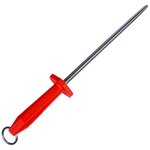
Here's the F. **** burnishing steel I use:

7469125_2048x2048.jpg
 
To avoid these ads, REGISTER NOW!
Top Bottom