To avoid these ads, REGISTER NOW!

Knife sharpeners

ecotec

Well-known member
Joined
Oct 5, 2010
Messages
5,426
So… I get that they don’t fit in the knife block, but I really prefer the longer honing rods that are a foot long or longer. To me, they are more ergonomic with the longer knives.

I am pretty sure that honing rods can chip high HRC knives. Some people don’t figure that out until they chip an expensive knife. They are great for the standard range of stainless and carbon steels.
 
To avoid these ads, REGISTER NOW!

308guru

Well-known member
Joined
Jun 17, 2017
Messages
459
I've been using a Wicked Edge for a number of years now. I wouldn't use anything else, they are fantastic.
 

JradM

Well-known member
Joined
Sep 4, 2019
Messages
1,813
Location
Alberta
The article I linked to above literally explains that knife steels (even the smooth kind) do remove steel, although on a very very fine level, because steel transfers from the blade to the knife steel.
There are also decent photos.
If you want a full selection of honing steels, F. **** still makes a whole range for professional butchers.
Did you see the follow-up video too?


lund

Well-known member
Joined
Nov 2, 2019
Messages
765
Location
Michigan
I sharpen a fair amount from knives to wood tools (chisels, planes, etc). I have some sharpening stones. But what I use most are three large flat diamond steel plates (~12" x 3") with a succession of grits from coarse (1st pass) to medium (2nd pass) to fine (final). If I want super sharp, I might use a leather strop as a last step. Steel diamond "stones" work well since they are super durable, stay flat, and you can use most anything for lubrication (including water). The down side is large ones like I have are expensive. But the large surface area makes the sharpening easy. I lay the plates side by side, use most any lubricant, and quickly progress from plate to plate. It is easy to clean up and the plates stay flat and last very long. The main thing in sharpening (regardless of what you use) is to use a succession of grits going from coarse to fine, take your time, and be consistent. If you are just touching up, the coarse and sometimes the medium grit steps can be skipped. Consistent sharpening angles are important. Guides can be used to help with that, BUT I find it can be best (quick and easy) to just try and be reasonably consistent by hand. I avoid using grinders and belt sanders (heat degrades temper) unless I need to remove a lot of material due to edge damage or needing to change an edge shape (say on a chisel) for an application. In those cases, I try to go slow (slow speed grinder with a less aggressive grinding wheels etc) and pause while using water periodically to keep the steel cool. Large, slow speed water wheels like Tormek-type devices have high raves among wood workers (who also must sharpen a LOT). But cost a lot (especially if you use a lot of guides), and require more upkeep + setup if you store them between uses. They make sense for avid woodworkers since they sharpen a lot and water cooled, slow speed stones work very well while being quick. Those are likely overkill for occasional knife and tool sharpening. Small diamond files can be used to touch up circular saw blades, router bits, and things like that. But that should only be done for light touch up since if you take off a lot of material the high speed blades will likely become unbalanced.
 
Last edited:

Beerhippie

Well-known member
Joined
Oct 13, 2023
Messages
9,698
Location
Far NE Oregon
Did you see the follow-up video too?

Yes, I've watched that. I've also followed threads at the Wicked Edge forums (apparently now defunct) by a fellow who uses an electron microscope to analyze edges. Neither seems to have tried a burnishing steel, but only the honing steels. I know when I use a honing steel, I can actually see tiny bits of metal falling from the blade as I work.

People often bring me knives to re-sharpen. I'd say more than half of the kitchen knives I see--and generally reject--have had their profiles hollowed out to the point that the point and base of the blade will contact a surface with light shining under the belly of the blade. While this isn't a problem for some knives, it makes it impossible to cut through stuff on a cutting board. Curing it is a full re-profile of the blade, which just doesn't make sense unless it's a very expensive and/or heirloom knife.

In every case where I've seen this, including the kitchen here at the pub, it's due to using ceramic rods, honing steels and various other implements that contact the blade in only one spot. A flat stone is almost impossible to hollow out a blade--try sharpening a hawk'sbill on a flat stone and you'll see why (Wicked Edge sells convex stones for concave blades).

As for commercial kitchen knives that are frequently sharpened on a steel--or a Chef's Choice, another infamous killer of blades--they're disposable. When a knife can no longer cut through on a cutting board, it gets tossed and replaced.
 

neophyte

Well-known member
Joined
Apr 23, 2012
Messages
9,582
Location
Pennsylvannia
Did you see the follow-up video too?

I’ve seen the follow up video.
He is still referring to the knife steel he is using as “non-abrasive”, despite the knife steel literally having parallel grooves along its surface, making the knife steel act as a very fine file.
A round polished honing steel, similar to what is used yo burnished a woodworking cabinet scraper would be an accurate example of a “non-abrasive” honing steel.
Many over honing steels where somewhere between the two, and have a hardened steel rod, whose surface has been mildly scuffed in a random pattern with some sort of abrasive, sort of like scotchbrite. An example of this is older carbon steel Thiers Sabatier honing steels.
Having to use multiple stones, is also not as quick as the typical way a honing steel is used.
The whole point of s honing steel, is that you run the blade over the steel, and are back to cutting in twenty seconds or less.

Also, Gordon Ransay is hardly a good example, given that he can’t seem to make a proper grilled cheese sandwich.
 

JradM

Well-known member
Joined
Sep 4, 2019
Messages
1,813
Location
Alberta
Having to use multiple stones, is also not as quick as the typical way a honing steel is used.
It's not that I disagree, but you might be making the wrong comparison. I can put a paper-slicing edge on a RUINED knife in less than 2 minutes on a (moderately-coarse) diamond stone and take it to shaving-sharp in no more than twice that.

I'm talking about those kitchen knives you see at someone else's house, where they bought them 20 years ago and still think they're sharp simply because they can chop carrots - that's blade geometry doing the work, not the edge.

The key to fast sharpening is that your knife should already be sharp before you move up in grit progression - and often times the finer grits are more for fun, not necessity.

I.e. you apex with a coarse grit (which doesn't take long) and remove the burr with alternating light passes. Then, ideally, follow up with a quick strop to knock off what remains (as you can tell, I'm an Outdoors55 disciple 😄). That way you're left with a sharp edge that's durable, instead of relying on the burr to cut.

If you want to push-cut a loose roll of receipt paper... that's when you have to work through a grit progression, removing the deep scratches, to get a polished finish.

When you talk about doing something "quicker" with a honing steel, it sounds like you're removing enough steel that it acts like the diamond stone I'm describing - which seems possible, if the honing rod is harder than your knife and you move fast. You did say it's acting like a file.

Even if that works, I don't see how it's faster. What I'm describing with a diamond stone is a 2 minute job. It might not be any slower though, if your rod is that aggressive - but that's got to take just as much skill as using a stone.

If you're somehow using a hone to both apex and refine the edge to rival what I do with stone-progression - that sounds like magic.
 

neophyte

Well-known member
Joined
Apr 23, 2012
Messages
9,582
Location
Pennsylvannia
It's not that I disagree, but you might be making the wrong comparison. I can put a paper-slicing edge on a RUINED knife in less than 2 minutes on a (moderately-coarse) diamond stone and take it to shaving-sharp in no more than twice that.

I'm talking about those kitchen knives you see at someone else's house, where they bought them 20 years ago and still think they're sharp simply because they can chop carrots - that's blade geometry doing the work, not the edge.

The key to fast sharpening is that your knife should already be sharp before you move up in grit progression - and often times the finer grits are more for fun, not necessity.

I.e. you apex with a coarse grit (which doesn't take long) and remove the burr with alternating light passes. Then, ideally, follow up with a quick strop to knock off what remains (as you can tell, I'm an Outdoors55 disciple 😄). That way you're left with a sharp edge that's durable, instead of relying on the burr to cut.

If you want to push-cut a loose roll of receipt paper... that's when you have to work through a grit progression, removing the deep scratches, to get a polished finish.

When you talk about doing something "quicker" with a honing steel, it sounds like you're removing enough steel that it acts like the diamond stone I'm describing - which seems possible, if the honing rod is harder than your knife and you move fast. You did say it's acting like a file.

Even if that works, I don't see how it's faster. What I'm describing with a diamond stone is a 2 minute job. It might not be any slower though, if your rod is that aggressive - but that's got to take just as much skill as using a stone.

If you're somehow using a hone to both apex and refine the edge to rival what I do with stone-progression - that sounds like magic.
A honing steel will literally restore a knife edge in twenty seconds or less, unless the edge has been severely damaged, and get the edge sharp enough to shave hair off one’s arm.
Other than microscopic amounts of steel, and a tiny amount of oil on the honing rod, there is also no mess, and nothing that can’t be cleaned off a blade with a single wipe of a rag or paper towel.
An edge from progressive grits thru fine diamond paste will be sharper, but take way longer, be more messy, leave undesirable lapping paste residue or abrasive residue and oil on the knife and hands, requiring longer cleanup.
 

Firebrick43

Well-known member
Joined
May 12, 2015
Messages
14,012
Location
West central Indiana
A honing steel will literally restore a knife edge in twenty seconds or less, unless the edge has been severely damaged, and get the edge sharp enough to shave hair off one’s arm.
Other than microscopic amounts of steel, and a tiny amount of oil on the honing rod, there is also no mess, and nothing that can’t be cleaned off a blade with a single wipe of a rag or paper towel.
An edge from progressive grits thru fine diamond paste will be sharper, but take way longer, be more messy, leave undesirable lapping paste residue or abrasive residue and oil on the knife and hands, requiring longer cleanup.
Diamond plates are best and typically used dry.

Using diamond paste on a strop or mdf take one swipe of a paper towel to wipe off, nothing gets on your hands if doing it right?
 

dscheidt

Well-known member
Joined
Apr 26, 2017
Messages
2,888
\
Even if that works, I don't see how it's faster. What I'm describing with a diamond stone is a 2 minute job. It might not be any slower though, if your rod is that aggressive - but that's got to take just as much skill as using a stone.

If you're somehow using a hone to both apex and refine the edge to rival what I do with stone-progression - that sounds like magic.


meat cutters use a steel to sharpen knives they cut up meat with. that gets done with with blood all over everything, several times an hour if they're really working. It is, very literally, a 10 second task, including picking up the steel. There's a bit of skill to it, but it's mostly getting the angle the same, repeatedly, on both sides of the blade. At the end of the shift, everything can be sanitized in a high temp washer. the knives are consumables, made from pretty normal steels, and don't last very long. some places regrind them when get curved, some just toss.
 

bulletpruf

Well-known member
Joined
Nov 28, 2013
Messages
10,939
Location
San Antonio
I've got a birthday coming up and I need a sharpening system for kitchen, pocket, and game cleaning knives. I'm looking for something that won't take much time, so something like the powered Work Sharp Ken Onion Elite Mk II with blade grinding attachment - $250 at Amazon - looks like the hot ticket.

Looks like I can use it on axes and chisels as well, so that would be very helpful.
 

Kscardsfan

Well-known member
Joined
Apr 28, 2020
Messages
1,650
Location
The Little Apple

I have this, the optional diamond rods, a steel and ceramic steel, and a razor strop. I also have whetstones for other applications; but for my kitchen, pocket, and hunting knives this is what I reach for every single time. I have the Ken Onion WorkSharp (first gen) and it's great, but you have to be careful with it or you'll blunt the tips on your knife. I find myself using it for tools more than knives now.
 

Ohio Andy

Well-known member
Joined
Jul 31, 2024
Messages
2,260
Location
Columbus, Ohio
I've got a birthday coming up and I need a sharpening system for kitchen, pocket, and game cleaning knives. I'm looking for something that won't take much time, so something like the powered Work Sharp Ken Onion Elite Mk II with blade grinding attachment - $250 at Amazon - looks like the hot ticket.

Looks like I can use it on axes and chisels as well, so that would be very helpful.
Love mine, but would be hesitant to use it with nice chisels (like I use for hand cut dovetails)
 

Nobody-named-Olli

Well-known member
Joined
Jan 9, 2025
Messages
1,575
Location
North Rhine-Westphalia; Germany
Spyderco Tri-Angle Sharpmaker. I‘ve used it for roughly more than 20 years now, have recommended it countless times - not one complaint.

Can ‘transform’ to like bench stone use if needed.

Not the best option for large axes or chisels.


Kind regards,
Olli
 

Ohio Andy

Well-known member
Joined
Jul 31, 2024
Messages
2,260
Location
Columbus, Ohio
Spyderco Tri-Angle Sharpmaker. I‘ve used it for roughly more than 20 years now, have recommended it countless times - not one complaint.

Can ‘transform’ to like bench stone use if needed.

Not the best option for large axes or chisels.


Kind regards,
Olli
One of my favorite things to use. My only complaint is that if you want to do any reprofiling you'd better get the diamond or CBN rods, that works pretty well. I own them both.

And yeah not so good on an ax that's where my Ken onion comes in... Or I guess my Tormek... Or files. I guess I've used them all
 

Beerhippie

Well-known member
Joined
Oct 13, 2023
Messages
9,698
Location
Far NE Oregon
One of my favorite things to use. My only complaint is that if you want to do any reprofiling you'd better get the diamond or CBN rods, that works pretty well. I own them both.

And yeah not so good on an ax that's where my Ken onion comes in... Or I guess my Tormek... Or files. I guess I've used them all
Flapwheel on an angle grinder. Also for shovels, mower blades, etc.

When sharpening an axe, a flat or hollow-ground profile is not desirable. A apple-seed or convex profile is. The flat grind is more fragile and will tend to stick in a cut. Plenty of YT videos showing different ways to achieve an apple-seed profile on an axe. A slightly loose, unbacked belt on a belt grinder can also produce one.
 

Beerhippie

Well-known member
Joined
Oct 13, 2023
Messages
9,698
Location
Far NE Oregon
I've got a birthday coming up and I need a sharpening system for kitchen, pocket, and game cleaning knives. I'm looking for something that won't take much time, so something like the powered Work Sharp Ken Onion Elite Mk II with blade grinding attachment - $250 at Amazon - looks like the hot ticket.

Looks like I can use it on axes and chisels as well, so that would be very helpful.
From the demos I've seen online the KOE Mk II is pretty sweet. My only worry is that it will naturally produce a convex profile as there's no platen behind the belt. That's a fine profile for a lot of work knives and especially metal-cutting chisels, but not what I want on a plane iron, wood chisel or kitchen knife.
 
To avoid these ads, REGISTER NOW!

Beerhippie

Well-known member
Joined
Oct 13, 2023
Messages
9,698
Location
Far NE Oregon
An old diemaker told me to get a diamond stone and practice slicing a thin layer off of the stone. Has always worked for me.
Yeah, I told a guy (who later proved to be unteachable) the same thing. Next thing I know, he's actually trying to cut into one of my expensive diamond stones with all the force he could muster!

Of course, this is the same guy I took mushroom hunting once and he got lost after we walked up a hill that had a road all the way around the base of it--which is where I'd parked.

"There are some men you just can't reach...."
 

PMD1966

Well-known member
Joined
Dec 26, 2013
Messages
182
Location
Lake Orion, Michigan
What do you guys recommend. I have lots of different types, cooking and hunting so is there a sharpener that will handle all kinds of knives?

Lots of internet reviews and options but just looking for real world feedback. Thanks in advance.
An old die and maker told me to get a diamond stone a
 

Beerhippie

Well-known member
Joined
Oct 13, 2023
Messages
9,698
Location
Far NE Oregon
1741878652456.png

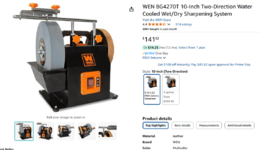
Anyone have experience with this Tormek knockoff?
Plenty of You Tube videos on them. It seems what most do is to add a few hundred dollars worth of Tormek accessories to them. First thing is to buy the Tormek wheel-truing tool (single-point diamond that runs on the rail) to get the stone round--that or toss the stone and buy a CBN wheel or two. With a CBN wheel (and a light touch), you don't need the water cooling so it makes for a dryer experience.

The price looks like it's come down since I last checked 'em out!
 
Last edited:

bulletpruf

Well-known member
Joined
Nov 28, 2013
Messages
10,939
Location
San Antonio
I've got a birthday coming up and I need a sharpening system for kitchen, pocket, and game cleaning knives. I'm looking for something that won't take much time, so something like the powered Work Sharp Ken Onion Elite Mk II with blade grinding attachment - $250 at Amazon - looks like the hot ticket.

Looks like I can use it on axes and chisels as well, so that would be very helpful.

Just ordered the KO MK II. Should be here tomorrow.
 

PMD1966

Well-known member
Joined
Dec 26, 2013
Messages
182
Location
Lake Orion, Michigan
With that are you drawing the knife across the stone lengthwise? I have always moved the knife along the stone perpendicular to the cutting surface.

Most knives's cutting edges have a slightly rounded shape like the bottom of a boat. I don't know the common term for it, I call it "rocker". Pulling lengthwise you'd have to subtly change the angle as you pull to keep that consistently on the middle of the stone. Going sideways you can feel that the knife is centered.

It seems like the block idea could be useful for sharpening across the stone. Maybe just put it at one end and use it to set the angle when you start.


I think the important thing is to keep the angle consistent and take your time. I often put the blade on the stone without moving it to look at/feel the angle and feel that the rocker of the blade is centered on the stone. Then when I'm happy with it, take a stroke.

Also don't worry about experimenting. If you mess it up you can sharpen it again.
Qn old die maker, who collected knives, told me to hold the knife like I was slicing a thin layer off the top of the stone.
 

IndyGarage

Well-known member
Joined
Apr 29, 2010
Messages
9,679
Location
Indy
I use the worksharp, I bought it before they had the Ken Onion. I think the Onion is a little larger than the original.

It sharpens knives for me plenty sharp. I pull it out and do all the knives once a year or so. For my every day, I carry a folding utility knife, so I don't sharpen, I just put in a new blade.
 

bulletpruf

Well-known member
Joined
Nov 28, 2013
Messages
10,939
Location
San Antonio
Just ordered the KO MK II. Should be here tomorrow.

I got it fired up yesterday evening and used it to sharpen a few kitchen knives. It's easy to set up, easy to use, and quickly put a very sharp edge on these knives. I did not use the blade grinding attachment, but I suspect that I will prefer it to the regular knife grinding setup.

I also need to try it out on a few axes and hatchets; I suspect it will work quite well for these.

Bottom line - it works very well for what I wanted - something that will quickly and easily put a very sharp edge on kitchen and hunting knives.

Having said all that, I still want the Wicked Edge setup. Probably don't really need it, but I'd like something with a bit more precision than the KO MK II for when I want to go the extra mile on something.
 

Ohio Andy

Well-known member
Joined
Jul 31, 2024
Messages
2,260
Location
Columbus, Ohio
I got it fired up yesterday evening and used it to sharpen a few kitchen knives. It's easy to set up, easy to use, and quickly put a very sharp edge on these knives. I did not use the blade grinding attachment, but I suspect that I will prefer it to the regular knife grinding setup.

I also need to try it out on a few axes and hatchets; I suspect it will work quite well for these.

Bottom line - it works very well for what I wanted - something that will quickly and easily put a very sharp edge on kitchen and hunting knives.

Having said all that, I still want the Wicked Edge setup. Probably don't really need it, but I'd like something with a bit more precision than the KO MK II for when I want to go the extra mile on something.
The wicked edge is a very nice fixed angle. Sharpener. My primary complaint about the wicked edge ignoring the cost, is that you require two stones of each grit. The advantage of two stones is that the knife stays fixed and you can hit both sides at the same time.

I chose the hapstone, which only requires one stone of each grit. The disadvantage is that you need to flip the knife over. On the other hand, I have some rather expensive stones and if I needed two of each I would end up paying twice the amount for those expensive stones.

Note that there are other systems very similar to the hapstone so don't take it that half stone is what you need to get, but, I also bought something that should allow me to do scissors, not that I've used it. It. I bought something that would allow me to do chisels, but I have so many things to do chisels but I might try to eventually. I haven't owned my hapstone long enough to do it.

I bought a table attachment that works with blades that are too small to clamp. I've used that a lot.

So I think you would be happy with the wicked edge, not that I've ever used one. I really like my Hapstone a lot. And I have put some crazy sharp edges onto some kitchen knives using my Hapstone. And those hedges are very uniform with that
 

Beerhippie

Well-known member
Joined
Oct 13, 2023
Messages
9,698
Location
Far NE Oregon
I got it fired up yesterday evening and used it to sharpen a few kitchen knives. It's easy to set up, easy to use, and quickly put a very sharp edge on these knives. I did not use the blade grinding attachment, but I suspect that I will prefer it to the regular knife grinding setup.

I also need to try it out on a few axes and hatchets; I suspect it will work quite well for these.

Bottom line - it works very well for what I wanted - something that will quickly and easily put a very sharp edge on kitchen and hunting knives.

Having said all that, I still want the Wicked Edge setup. Probably don't really need it, but I'd like something with a bit more precision than the KO MK II for when I want to go the extra mile on something.
The WE is an excellent set-up--and better be for the price. It does have a learning curve, but once you get it figured out, it works as well as anything out there.

The KO sharpener is also fine, BUT... not really compatible with the WE. The KO has an unsupported belt--supposed to reduce heat build-up vs. a platen belt--which results in a slightly convex edge profile. The WE produces a very flat edge profile. If you were to use the KO to "rough-out" worn blades before using the WE, you'd have to go with the shallowest possible grind on the KO to be able to put a 20 degree-per-side edge on with the WE.
 

bkdc

Well-known member
Joined
Feb 28, 2025
Messages
60
Whetstones. The Japanese make the best. I did try the fixed tools such as Wicked Edge but if you Have a long blade (like a 10 inch chefs knife), they do not maintain a constant angle along the entire length of the blade. Naniwa and Shapton are the two largest makers. They also have diamond stones with diamond particles embedded in resin which cut quickly and wear slowly but still five that nice stone feedback while sharpening.
 

MacMcMacmac

Well-known member
Joined
Oct 21, 2014
Messages
1,583
Location
canada
Being basically lazy and with no pretensions towards the artisinal, I bought a Drill Doctor with a sharpening wheel for knives and assorted tools. It works well enough for the cutting I need to do and is quick. Plus the drill bit part...

I'm sure there is some 60hr Asian tea ceremony rigamarole that get a knife sharp enough to castrate a flea, but my Drill Doctor does the job just fine.

Man I'm getting cranky in my advancing years.
 

Beerhippie

Well-known member
Joined
Oct 13, 2023
Messages
9,698
Location
Far NE Oregon
Whetstones. The Japanese make the best. I did try the fixed tools such as Wicked Edge but if you Have a long blade (like a 10 inch chefs knife), they do not maintain a constant angle along the entire length of the blade. Naniwa and Shapton are the two largest makers. They also have diamond stones with diamond particles embedded in resin which cut quickly and wear slowly but still five that nice stone feedback while sharpening.
51969146472_ebbd174e3e_b.jpg

My 11 1/2" blade Mexican knife would disagree.

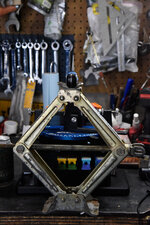
It does take some creativity to support a longer blade in that tiny vise:

51970216388_f9d769acd2_o.jpg

or just an old Toyota scissors jack.
 

bkdc

Well-known member
Joined
Feb 28, 2025
Messages
60
If you do your trigonometry, you would see a change in the angle depending on the curvature of the blade. I trust my hands and have no issues getting a razor cutting edge. Just to maintain an edge, I often just strop with a 5K whetstone. That keeps my kitchen knives serviceable for a very long time before an official sharpening progression 1K, 2K or 3K, possibly 5K. You also avoid any “low spots” over time when sharpening across a large whetstone. It’s also easier to “thin” the knife as a kitchen knife loses height with time. A device (and I’ve tried them in the past when I was a novice sharpener) just slows me down. My wife is scared of my large collection of Japanese kitchen knives. I leave two for her personal use and intentionally leave them duller (which I think is more dangerous than a sharp knife). Or maybe she is sick and tired of me getting upset when she decides to use my Takamura to cut veggies or fruit onto a ceramic surface — kind of like taking a Ferrari off roading.

 
Last edited:
To avoid these ads, REGISTER NOW!
Top Bottom