

You are using an out of date browser. It may not display this or other websites correctly.
You should upgrade or use an alternative browser.
You should upgrade or use an alternative browser.
Knife sharpeners
- Thread starter vpracer
- Start date
BetterDays
Well-known member
I picked up two whetstones to learn myself. I have an electric one, but realize knife sharpening can be a skill to learn.
(also commenting to be able to check replies)
(also commenting to be able to check replies)
theoldwizard1
Well-known member
Doing it this way is definitely a skill. Like any skill, it must be practiced OFTEN before you are good at it.I picked up two whetstones to learn myself. I have an electric one, but realize knife sharpening can be a skill to learn.
IMHO, any system that holds the blade at the proper angle and includes several different stones, is the way to go.
killahog
Well-known member
Check out Wicked Edge .
Dutchmanaz
Well-known member
Worksharp. I just picked one up (the original model - they have others) and am very impressed with it.
Augus7us
Well-known member
Wicked edge is one of the best sharpeners out there. If you want powered there is tormek. If both are out of your price range look for the knock off wicked edge type sharpeners.
Gigem
Well-known member
Ken Onion Worksharp for me. Sharpens everything i have, as sharp as I want it to be.
Puts a convex edge on which seems to stay sharper longer.
Sent from my SM-G975U using Tapatalk
Puts a convex edge on which seems to stay sharper longer.
Sent from my SM-G975U using Tapatalk
ericm
Well-known member
A stone and oil is all you need. Or a Harbor Freight diamond hone, and water. (get the one that's a block, it will be easier to use than the set of three flat hones).
The hones are nearly as good as a good set of coarse and fine stones, and make less mess.
It's super easy to sharpen knives on a stone/hone, and it gets them a lot sharper than any sharpener I've tried.
The hones are nearly as good as a good set of coarse and fine stones, and make less mess.
It's super easy to sharpen knives on a stone/hone, and it gets them a lot sharper than any sharpener I've tried.
shoot summ
Well-known member
- Joined
- Jun 8, 2010
- Messages
- 2,970
I've been on a sharpening kick lately. Use my 1x30 belt sander with various grit belts up to 2000 if needed, and a leather strop belt. All of our knives are as sharp as I want them to be. Seems that touching up the edge with a 400 grit belt and stropping will get it sharp enough. I like to at least go up to 1000 grit though. I have no hair on my arms after sharpening every knife in the house... 
I can do a kitchen knife in a couple of minutes, 3 swipes each side with the 400, 3 swipes with the strop. Almost takes longer to change the belt than anything else.
I can do a kitchen knife in a couple of minutes, 3 swipes each side with the 400, 3 swipes with the strop. Almost takes longer to change the belt than anything else.
Last edited:
brianh
Well-known member
Arkansas stone is my favorite along with a leather strop powered or an old belt, stropping gets microscopic bits and polishes the edge. I can shave hair when done.
I use diamond and Japanese water stones but the Arkansas is used the most.
I use diamond and Japanese water stones but the Arkansas is used the most.
gtsgarage
Well-known member
Ken Onion Work Sharp is what I've had the best luck with. I have a Lansky setup also and it works fine, but I prefer the KO.
KO is what I have too!
TMcCay
Well-known member
TSPROF for me. I love that I can use just about any stone I want. I can make very small changes to the angles and very easy to make micro bevels if I want. Easy to setup and use. It was pricey though.
BetterDays
Well-known member
A stone and oil is all you need. Or a Harbor Freight diamond hone, and water. (get the one that's a block, it will be easier to use than the set of three flat hones).
The hones are nearly as good as a good set of coarse and fine stones, and make less mess.
It's super easy to sharpen knives on a stone/hone, and it gets them a lot sharper than any sharpener I've tried.
@Eric,
Any recommendations for a beginner? I have coarse and fine stones and have tried it a few times. My process will improve them, but not really make them extra sharp.
Any advise is appreciated.
HenryAZ
MEMBER EMERITUS
Doing it this way is definitely a skill. Like any skill, it must be practiced OFTEN before you are good at it.
IMHO, any system that holds the blade at the proper angle and includes several different stones, is the way to go.
I hope someday to acquire the skill to do the angles freehand on a stone. In the meantime, I cut three blocks of wood at 20*, 22*, and 25*, angled on both ends. I topped the angled parts with a thin (1/16") piece of uhmw, to provide lubricity and prevent scratching the blade surfaces. I clamp the block lightly to the stone (stone in its box) to prevent movement (not enough clamp pressure to break the stone, and I move the blocks to different places on the stone). I use two oil stones, each with different grits on each side. An India oil stone with coarse and fine sides, and an Arkansas stone with soft and hard sides. Keeping the blade against the angled part of the block works great. Having the same angle on both ends of the block makes it easy to do both sides of the blade without changing the setup.
Cryptic1911
Well-known member
We have a TSPROF and it's awesome
ericm
Well-known member
I hope someday to acquire the skill to do the angles freehand on a stone. In the meantime, I cut three blocks of wood at 20*, 22*, and 25*, angled on both ends. I topped the angled parts with a thin (1/16") piece of uhmw, to provide lubricity and prevent scratching the blade surfaces. I clamp the block lightly to the stone (stone in its box) to prevent movement (not enough clamp pressure to break the stone, and I move the blocks to different places on the stone). I use two oil stones, each with different grits on each side. An India oil stone with coarse and fine sides, and an Arkansas stone with soft and hard sides. Keeping the blade against the angled part of the block works great. Having the same angle on both ends of the block makes it easy to do both sides of the blade without changing the setup.
With that are you drawing the knife across the stone lengthwise? I have always moved the knife along the stone perpendicular to the cutting surface.
Most knives's cutting edges have a slightly rounded shape like the bottom of a boat. I don't know the common term for it, I call it "rocker". Pulling lengthwise you'd have to subtly change the angle as you pull to keep that consistently on the middle of the stone. Going sideways you can feel that the knife is centered.
It seems like the block idea could be useful for sharpening across the stone. Maybe just put it at one end and use it to set the angle when you start.
@Eric,
Any recommendations for a beginner? I have coarse and fine stones and have tried it a few times. My process will improve them, but not really make them extra sharp.
Any advise is appreciated.
I think the important thing is to keep the angle consistent and take your time. I often put the blade on the stone without moving it to look at/feel the angle and feel that the rocker of the blade is centered on the stone. Then when I'm happy with it, take a stroke.
Also don't worry about experimenting. If you mess it up you can sharpen it again.
majerus
Well-known member
Ken Onion Worksharp , it sharpens knives then you can move on with your life. Unless you want it to be a hobby just buy this thing its fantastic.
I've been on a sharpening kick lately. Use my 1x30 belt sander with various grit belts up to 2000 if needed, and a leather strop belt. .......
I use a 1" wide belt sander as well. I bought an angle jig that attaches to the platen and it makes it very fast and easy.
Attachments

bushmechanic
Well-known member
- Joined
- Mar 17, 2014
- Messages
- 4,820
No Edge Pro suggestions?
Well, I'll throw it in there, then.
Well, I'll throw it in there, then.
LuvAZ
Well-known member
I bought a Lansky sharpening kit about 20 years ago and never looked back!
It came w/a variety of stones and angle-holders so you can sharpen just about anything- even razor blades!
HTH,
Will
It came w/a variety of stones and angle-holders so you can sharpen just about anything- even razor blades!
HTH,
Will
Diamond Lansky will do just fine almost every time. Trick is to finding out what degree angle the knives are shared to from the factory. If you get that wrong it will take you longer to set a new angle. Also log what angle is on what knives.
Sent from my iPhone using The Garage Journal mobile app
Sent from my iPhone using The Garage Journal mobile app
californiaHank
Well-known member
- Joined
- Nov 20, 2015
- Messages
- 487
Doing it this way is definitely a skill. Like any skill, it must be practiced OFTEN before you are good at it.
IMHO, any system that holds the blade at the proper angle and includes several different stones, is the way to go.
Mostly I agree, but it's not rocket science. You just need a bit of extra care and patience the first few times - and maybe you should practise with that old carver before you work on your fancy Japanese chef's knife. There are a lot of sharp edged tools in the shop, and basic 'whetstone skills' really pay off over time.
shoot summ
Well-known member
- Joined
- Jun 8, 2010
- Messages
- 2,970
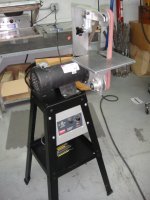
I use a 1" wide belt sander as well. I bought an angle jig that attaches to the platen and it makes it very fast and easy.
I tried that, don't like that the belt is running against the blade though. I've gotten really good at doing them without a guide.
I tried that, don't like that the belt is running against the blade though. I've gotten really good at doing them without a guide.
I know what you mean, but my homemade sander has a reversing switch so I can keep the blade from snagging the belt.
Attachments
shoot summ
Well-known member
- Joined
- Jun 8, 2010
- Messages
- 2,970
I know what you mean, but my homemade sander has a reversing switch so I can keep the blade from snagging the belt.
Nice!! Did you build it off of plans? If so would you mind sharing the details?
Thanks
bushmechanic
Well-known member
- Joined
- Mar 17, 2014
- Messages
- 4,820
edge-pro knock off
Edge-Pro sharpening systems are pretty darn great:

LS6 Tommy
Well-known member
Check out Wicked Edge .
Really, really good, but too spendy for me. I did a lot of research earlier this year before I upgraded from my old Lansky kit. I ended up getting an Edge Pro Apex 4 kit. Best system (other than the Wicked Edge) I've used. The Wicked Edge Go is very close in price to the Edge Pro Apex 4, but once I added the cost of all the additional stones I'd want, the price went way up. When I hit the lottery I'll get a Wicked Edge. KME makes a good kit, too. It's kind of a melding of the WE and EP systems.
https://www.edgeproinc.com/?gclid=C...hkK7LQeV9OREN6xDOOHlR7epfP5CfFEAaAnJeEALw_wcB
https://www.kmesharp.com/
Tommy
bushmechanic
Well-known member
- Joined
- Mar 17, 2014
- Messages
- 4,820
We have a TSPROF and it's awesome
Those are indeed awesome.
LS6 Tommy
Well-known member
We have a TSPROF and it's awesome
OK, I changed my mind. When I hit the lottery I'm getting a TSPROF.

Tommy
Edge-Pro sharpening systems are pretty darn great:
https://www.ebay.com/itm/Profession...010252?hash=item5b7df19ccc:g:sCEAAOSwoqFeCOnE
gtsgarage
Well-known member
Ken Onion Worksharp , it sharpens knives then you can move on with your life. Unless you want it to be a hobby just buy this thing its fantastic.
Well said. Does the job well and easy to use.
bushmechanic
Well-known member
- Joined
- Mar 17, 2014
- Messages
- 4,820
Well, buy that one then. Either way it's a great design.
HenryAZ
MEMBER EMERITUS
With that are you drawing the knife across the stone lengthwise? I have always moved the knife along the stone perpendicular to the cutting surface.
Most knives's cutting edges have a slightly rounded shape like the bottom of a boat. I don't know the common term for it, I call it "rocker". Pulling lengthwise you'd have to subtly change the angle as you pull to keep that consistently on the middle of the stone. Going sideways you can feel that the knife is centered.
It seems like the block idea could be useful for sharpening across the stone. Maybe just put it at one end and use it to set the angle when you start.
I am drawing the knife across the stone, exactly perpendicular to the stone, and following the curve of the blade as I go. On a really long blade, I will break it into sections, as I get better results than drawing a long, curved blade in one stroke.
I used to work (for 25 years) in a custom millwork shop, and this action is very similar to working radius pieces on a shaper, face of the piece against the cutters, where you have to keep the part of the workpiece that is in contact with the cutters exactly where the spindle is as you "roll" the workpiece around. I did that type of work freehand, with only springs to hold the work lightly against the fence.
I am still experimenting and hope to move towards not using the blocks. Yesterday I tried using slipstones (about 4" long), freehand along the blade edge, with the blade resting on a clamped down piece of 2x material. That worked surprisingly well. Having done my own pocket knives, my wife is throwing all her kitchen knives and scissors at me now, so I have a good supply to learn on.
Sharpening Supplies is a good resource for all types of stones and sharpening equipment, including all of the brands of sharpeners mentioned in this thread. I don't know if they are the cheapest, but they are a responsive small business and a pleasure to work with.
Last edited: