My two cents.
I pretty much ignore reviews that show broken tips on precision cutters. Many people use them for things they were never designed to cut, it's very easy for a manufacturer to accidentally make thin tips a bit too brittle, and any brand of small cutter will sometimes break if it's overstressed. I personally use Xuron for my maxi and micro shear cutters, because I like that they are US made and I find them a better value than Knipex, but there are lots of good brands of micro cutters out there to pick from.
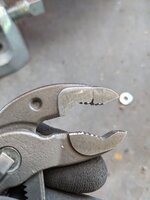
I think the broken needle nose plier the OP pictured is probably a result of a heat treatment error at the factory or an internal metal defect. I've never had any issues with my Knipex needle nose pliers (I own 6-8 different styles), and most people complain about them being too flexible, not too stiff or brittle.
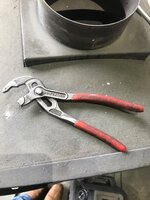
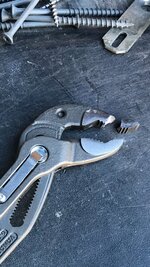
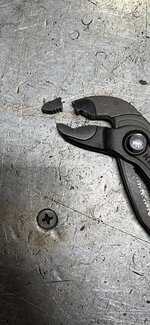
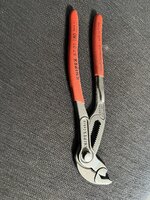
I think the issues people are having with Knipex Cobra pliers are worth discussing. The failures fall well within the margin of error in terms of quality manufacturing, but I think Knipex could also make a minor design change and greatly reduce the number of failures that are actually out there, because most of the failures I have read about don't seem to be a result of abuse.
I attached a small assortment of images to this post, showing some of those failures. All of the images were taken from 5 minutes worth of browsing Amazon reviews of Cobra pliers.
Most people don't write reviews for the products they buy, so there will be more failures out there than we can find pictured on Amazon, but the failures I did find were also plucked from a total of over 15,000 actual submitted ratings and reviews of Knipex Cobra pliers on Amazon. That tells me the overall failure rate is still very very low. That being said, it doesn't matter what the overall failure rate is if the plier you own fails when you needed it to work. Pliers are occasionally going to have internal defects, a heat treatment that is slightly too hard which makes the metal too brittle, etc. It's unavoidable. However, design weaknesses can also become apparent if the failures that do happen almost always happen in the exact same spots during normal use situations. I think there is a case to be made that Knipex Cobra pliers should probably have a bit more steel bulk or thickness at the v-notch location of the top jaw and possibly also the v-notch location of the bottom jaw. Almost every failure I have seen online occurred at one of those two locations. Any sort of a minor design modification that would help ensure a gradual failure of the tool under load and reduce the number of people who might end up slamming their fingers into something painful or dangerous would be forward progress. Gradual failures are always better than sudden failures.
Personally, I'm a big Knipex fan, but not a big Knipex Cobra fan. I love my Knipex retaining ring pliers, various diagonal cutters, cobolt cutters, various sizes of pliers wrenches, multiple styles of needle nose and bent needle nose pliers, etc. The only Knipex Cobra pliers I have are 10", and I only use them when I need to get a bite on something in a very narrow area and smooth jaw plier also can't do the job, because Cobra plier jaws are noticeably narrower than the jaws on any of my other similar tools. For any work where grip width is available, I want a wider jaw so the force I apply can be spread out over a larger or wider surface area to get a better bite and reduce damage to the surface I'm cranking on.
Lastly, if any of the products in the Knipex line are going to have failures, I would guess it would be their Cobra pliers. The Cobra pliers seem to be their highest volume seller, which usually means they will also have the largest variability in the heat treatment process, because it can be harder to get a perfect heat treatment every time when making large batches of a tool at once. Cobra pliers have the highest price competition online of anything Knipex makes, which means the overall profit margin is going to be lower for the manufacturer than it is for their other offerings. Cobra pliers also probably have the highest stress point loading of any of their pliers under actual use as a result of how they are designed, how narrow the jaws are, and how well they grab. Look at almost any similar plier and the jaws will have about twice the actual mass of steel in the jaw, fighting against potential breakage. With other similar pliers, the main issue is usually jaw teeth that wear down too fast and start losing their grip, or less optimal jaw geometry, so the pliers don't grip as well even when brand new. They are almost always heavier as well, which is important for many and becomes noticeable once you add up the weights of all the hand tools in your tool bag or on your tool belt. Someone who works mainly out of a tool chest probably doesn't care nearly as much about how much a particular tool weighs. Everything's a compromise, and that's why it's nice to have many different options available to pick from when it comes to buying tools.