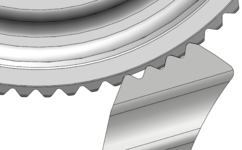
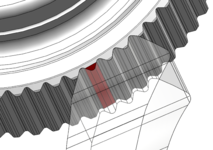
Well, it's still debatable... Finer teeth with more teeth in engagement should make for a stronger ratchet in theory.
With gear geometry, it's the contact area between the gear teeth and the pawls that matter, regardless of tooth count. Wider gears are typically very strong (thick ratchet heads).
A coarse tooth gear can be stronger than a 120 tooth mechanism if there's more area in contact.
The accuracy of the pocket where the gear/pawls sit plays in as well. If it is off, there will be poor gear mesh engagement - the strength falls way off.
Besides, the failure torque does not correlate to durability.
Fatigue strength over time is different than ultimate failure strength, for sure.
A ratchet that fails at say 60 ft-lbs on a one off test could probably be assumed to have a shorter fatigue life than one that failed at 87 ft-lbs.
Most of it is materials science. Ductility, hardness, forging ratio (how many times the stock was reduced from it's original dimensions) all play into whether the gear will have a long life, or just have a high ultimate strength, but with a low cyclic fatigue life.
But ultimately, long term durability is probably more than fine on all of them.
Agreed. As long as you're not busting loose lugnuts or going above 13/14 mm sockets, they all should be fine.
Sure but that one is a prototype so very likely they used hand-fitted components and even some minor adjustments to components to make them work together perfectly
You're talking to the guy who designed it. The machining tolerances on this ratchet are much lower than a mass produced one.
No fiddling is need actually - for example: on most ratchets, if you place the cover plate into it's pocket, the fit is loose enough to fall out. Ours presses into place and stays put without screws, right off the mill.
Most tools are made with large tolerance ranges so they fit together as an assembly even if they're out of spec. That's the cheaper way.
Better fitment is important with a weaker material like Titanium vs Steel.