To avoid these ads, REGISTER NOW!

Koken Ratchets

AEAdam

Well-known member
Joined
May 27, 2023
Messages
2,709
Location
SE PA
Damn! Will breaker bars be obsolete in the near future?
Serious question? Yes, is the answer. I no longer own a breaker bar.

My first introduction to this was dual 80, but there are many other ratchets or most whose strength limit is set by the drive failing in shear, not the ratchet mechanism.

So yes, our ratchets are as strong as breaker bars.

I think the prevalence and utility of battery powered impact guns also plays a role in the obsolescence of breaker bars.

When I started working on cars, EVERYONE had and used breakers. Now, I think it would be tough to find one or 2 floating around in the old guys box.
 
To avoid these ads, REGISTER NOW!

AEAdam

Well-known member
Joined
May 27, 2023
Messages
2,709
Location
SE PA
You aren’t much of a mechanic if you’re using a ratchet in place of a breaker bar. Ratchets were never ment for that job. Hence the name BREAKER bar. Don’t have much respect for someone that puts pipes on ratchet handles. Someone else must be supplying your tools. I buy my own a cost too much to needlessly destroy. Always a better way to do a job. Most of my career was spent working in the field out of a truck. When you don’t have 25 extra of the same thing with you, you’ll use a little care. Flame on boys
We need to talk about speed wrenches. Remember those? I still have a sweet 1/4” drive in my tool box. I like it, it gives me better feel, but honestly almost never use it. Not many manufacturers even make them anymore.
 

Retired dozer fixer

Well-known member
Joined
Aug 6, 2022
Messages
327
Location
Leesburg Indiana
We need to talk about speed wrenches. Remember those? I still have a sweet 1/4” drive in my tool box. I like it, it gives me better feel, but honestly almost never use it. Not many manufacturers even make them anymore.
Almost forgot about those. Still have 3/8”&1/2”. Well worn. Handy after breaking loose when no power tools available
 

seber

Well-known member
Joined
May 31, 2016
Messages
4,190
Location
Deep East Tx.
I still use breaker bars when I know the risk is shearing the drive. Breaker bars are cheaper to replace and for that reason will never be obsolete.
I've used Snap-on ratchets in my garage for almost 50 years and they have always been great. But when dual 80 came out, I picked one up. I don't need it but it is so much nicer to use. The Koken seems even a little nicer. Too bad it works backward. I just can't make my fingers go that way. Endlessly frustrating.
 

Madjik Man

Well-known member
Joined
Dec 3, 2015
Messages
1,513
I don’t know how in the hell I repaired heavy equipment for 30 years with coarse tooth ratchets. You guys act like you can’t fix anything without a 99+ tooth count ratchet. Those dam things didn’t come about till I was almost retired. Fire away. I’ve got thick skin

Your skin is thick because it’s all scar tissue on your knuckles.

From using such archaic tools :)
 

merkyworks

Well-known member
Joined
Nov 11, 2016
Messages
587
Location
Texas
I think one overlooked factor of the breaker bar vs snap on ratchet debate, in todays mentality is “f*^k it, if my ratchet breaks I get a free replacement". wrong tool for the job/abuse is not factored in as much.
 

merkyworks

Well-known member
Joined
Nov 11, 2016
Messages
587
Location
Texas
Koken Z-series 72t ratchets have an impressive design I think. Koken pawl engagement/slip doesn’t rely on springs but instead a ramp design. The amount of tooth engaging is very high and should be very strong, similar to a SO dual 80. In theory Koken having less moving parts could translate to better reliability but time will tell.


Koken z-series
IMG_1878.jpeg

Snap on
IMG_1879.jpeg
 

American Locomotive

Well-known member
Joined
Jan 8, 2017
Messages
10,929
Location
Rhode Island
You aren’t much of a mechanic if you’re using a ratchet in place of a breaker bar. Ratchets were never ment for that job. Hence the name BREAKER bar. Don’t have much respect for someone that puts pipes on ratchet handles. Someone else must be supplying your tools. I buy my own a cost too much to needlessly destroy. Always a better way to do a job. Most of my career was spent working in the field out of a truck. When you don’t have 25 extra of the same thing with you, you’ll use a little care. Flame on boys
Breaker bars are an annoying waste of time. I have broken multiple brand-name premium breaker bars, I have yet to break a ratchet - and I've put some big pipes on ratchets. Nearly all modern brand-name ratchets have an internal mechanism that is far stronger than the actual anvil the socket attaches to. In basically all cases, you will shear the anvil off the ratchet before the ratchet mechanism breaks. That means a breaker bar would also fail in the same way, at the same torque since the anvil is the same size.

You can keep wasting your time with breaker bars, I will keep putting pipes on my ratchets.

FWIW: I generally prefer fine tooth count ratchets, provided the back drag isn't too high.
 

Samuel D

Well-known member
Joined
Apr 9, 2019
Messages
638
Koken Z-series 72t ratchets have an impressive design I think. Koken pawl engagement/slip doesn’t rely on springs but instead a ramp design.
I can’t envisage how that works from the photo. What do you mean by ramp design? There’s really no spring of any kind in there?
 

merkyworks

Well-known member
Joined
Nov 11, 2016
Messages
587
Location
Texas
I can’t envisage how that works from the photo. What do you mean by ramp design? There’s really no spring of any kind in there?
its easier to just see how it works than me trying to explain.
I can’t get url code to start at 6:41 where it shows how rampEd pawl works.
Fast forward to 6:41

figured it out
[ youtube]
 
Last edited:

Samuel D

Well-known member
Joined
Apr 9, 2019
Messages
638
Thanks for the video, merkyworks. It’s not the clearest explanation of the mechanism, but there must be a spring to return the pawl teeth to the anvil cog after each ratchet click. That’s where the clicks come from.

I wondered for a moment if Koken had somehow used the backdrag reaction force to replace a spring (with some mysterious source of backdrag in the absence of a spring), which might conceivably work if the ratcheting mechanism could be assured to always work at speed. But no such assurance can be made for a ratcheting wrench that needs reliable static engagement, to work after storage, etc.

I’ve yet to own a Koken ratchet but like the look of them. I have a couple of Dual 80 ratchet handles and am like them. The mechanism does not only have a small minimum swing arc in theory but practice because there’s very little free play between the handle and anvil. Any appreciable handle movement engages the ratchet mechanism.
 

F-22

Well-known member
Joined
Jan 23, 2022
Messages
1,830
Koken Z-series 72t ratchets have an impressive design I think. Koken pawl engagement/slip doesn’t rely on springs but instead a ramp design. The amount of tooth engaging is very high and should be very strong, similar to a SO dual 80. In theory Koken having less moving parts could translate to better reliability but time will tell.


Koken z-series
IMG_1878.jpeg

Snap on
IMG_1879.jpeg
Man, those tolerances on the Koken look really tight for a shape as weird as that!
 

F-22

Well-known member
Joined
Jan 23, 2022
Messages
1,830
Modern CNC can easily hold .001". Just program the shape an let er go.
Yes but, just compared to other brands and even snap on the Koken looks really "tight" inside. The Snap On design looks more forgiving to any mass manufacturing deviations...
 

AEAdam

Well-known member
Joined
May 27, 2023
Messages
2,709
Location
SE PA
Modern CNC can easily hold .001". Just program the shape an let er go.
Mmmmm. Debatable. But I’m not seeing a thou in that Koken. Those pawl parts look like they were ground.

Im curious about how the gears are made. Anyone know? I would hob something like that with a CNC mill and a CNC indexing head. But are they broached? Wire edm? I suspect the answer is the reason these modern ratchets exist and kick ***. I’m guessing however they are made wasn’t available or wasn’t cheap 30 years ago.
 
To avoid these ads, REGISTER NOW!

Not So Legendary

Well-known member
Joined
Nov 7, 2021
Messages
62
Mmmmm. Debatable. But I’m not seeing a thou in that Koken. Those pawl parts look like they were ground.

Im curious about how the gears are made. Anyone know? I would hob something like that with a CNC mill and a CNC indexing head. But are they broached? Wire edm? I suspect the answer is the reason these modern ratchets exist and kick ***. I’m guessing however they are made wasn’t available or wasn’t cheap 30 years ago.

Some of the features that you can make with live tooling is mind boggling.
Gear Hobbing on a Swiss Lathe
Polygonal Tooling
On a tour I once saw fully automated gear machining line. They would depalletize forgings, machine, measure on a CMM for 100% inspection and the machine can compensate for tool wear after each part, part would be cleaned, and finally put on a different pallet.

I can totally see these gears being made on a small Citezen lathe, that would spit our nearly finished parts.
 

DerekV

Well-known member
Joined
Oct 12, 2016
Messages
1,070
Location
Central TX
Thanks for the video, merkyworks. It’s not the clearest explanation of the mechanism, but there must be a spring to return the pawl teeth to the anvil cog after each ratchet click. That’s where the clicks come from.
The little “plunger” mechanism actuated by the directional switch that pushes on the bottom pawl has a spring behind it.
 

F-22

Well-known member
Joined
Jan 23, 2022
Messages
1,830
Some of the features that you can make with live tooling is mind boggling.
Gear Hobbing on a Swiss Lathe
Polygonal Tooling
On a tour I once saw fully automated gear machining line. They would depalletize forgings, machine, measure on a CMM for 100% inspection and the machine can compensate for tool wear after each part, part would be cleaned, and finally put on a different pallet.

I can totally see these gears being made on a small Citezen lathe, that would spit our nearly finished parts.
Though to me, old school high volume production is even more amazing. It required more investment to make up for all the specific tooling to make stuff, but then those old-fashioned procedures can be faster than a CNC, with more accuracy and less issues. CNC is just amazing cause the software can handle so much of it. But old automatic lathes and mills were amazing.
 

MarcSeattle

Well-known member
Joined
Mar 25, 2010
Messages
575
Location
Seattle
Anyone know the difference between the Z-line extensions (smooth steel) and the knurled extensions? I was wondering about fit, ease of getting them on or off, etc. I see sets of the knurled versions available but I don't see sets for the Z-line.
 

Dave455

Well-known member
Joined
Mar 19, 2013
Messages
5,796
Location
Sussex, England
Anyone know the difference between the Z-line extensions (smooth steel) and the knurled extensions? I was wondering about fit, ease of getting them on or off, etc. I see sets of the knurled versions available but I don't see sets for the Z-line.
It’s similar to the differences between any of the regular line and the Z Series really.

The Z Series are a little bit more compact, made to tighter tolerances, and the finish is slightly different.

A Z Series extension on a Z Series ratchet might be a little more snug than a regular extension on a regular ratchet, but there’s not a lot in it.

When it comes to extensions, the differences between Z Series and regular tools are not as great as with, say, sockets.

Until recently, in 3/8 drive there were only 3 extensions available in the Z Series. They have just released some locking ones, which look nice, but are in the same lengths.

If you are using Z Series sockets I’d probably go with the Z Series extensions, otherwise I’d probably stick with the regular. KoKen do the regular extensions very well.

I have a suspicion that the Z Series locking extensions are going to be incredibly good, but I haven’t bought one yet.
0712FB98-9BB9-482A-9778-B183A593CEA5.jpeg
 
Last edited:

RJSenn

Member
Joined
Mar 4, 2015
Messages
8
Bought my first Koken Z 72T 3/8 flex head ratchet this past Christmas. It's a fine tool and this weekend warrior prefers it over my low tooth SK or Snap on ratchets. I see more in my future...Waiting for their 72T 1/4" to come out.
 

merkyworks

Well-known member
Joined
Nov 11, 2016
Messages
587
Location
Texas
I prefer standard Koken extension cause it has knurling to z-series extensions that are smooth.
 

AEAdam

Well-known member
Joined
May 27, 2023
Messages
2,709
Location
SE PA
I prefer standard Koken extension cause it has knurling to z-series extensions that are smooth.
FWIW, I think their knurling is in the wrong spot.
I use knurling on extensions with the ratchet in my palm. My fingers can’t comfortably reach the knurling where Koken put it. Snap Ons knurling fits me better.

Not sure about the rest of their line - handle sizes etc. I’m pretty tall so I’m maybe over sensitive. IMO, koken tried to innovate their knurling and missed. Should be where snap on put it or both places.
 

tamaraw

Well-known member
Joined
Jun 6, 2022
Messages
842
FWIW, I think their knurling is in the wrong spot.
I use knurling on extensions with the ratchet in my palm. My fingers can’t comfortably reach the knurling where Koken put it. Snap Ons knurling fits me better.

Not sure about the rest of their line - handle sizes etc. I’m pretty tall so I’m maybe over sensitive. IMO, koken tried to innovate their knurling and missed. Should be where snap on put it or both places.
Interesting take.

For me, the knurling position works well for spining extensions by hand with no tool attached. For example, starting recessed fasteners or on extended spark plug sockets.

Having it on the end lets it be a larger diameter for better grip and have anti-roll functionality when placing on a flat surface.

This also keeps the shaft clean so that you can support/guide it with your other hand as it turns.

If you are trying to turn it holding the ratchet in your palm and you have large hands, the SO/Proto knurling location may be better. But a quick spinner would be even better still. YMMV.
 

merkyworks

Well-known member
Joined
Nov 11, 2016
Messages
587
Location
Texas
Interesting take.

For me, the knurling position works well for spining extensions by hand with no tool attached. For example, starting recessed fasteners or on extended spark plug sockets.

Having it on the end lets it be a larger diameter for better grip and have anti-roll functionality when placing on a flat surface.

This also keeps the shaft clean so that you can support/guide it with your other hand as it turns.

If you are trying to turn it holding the ratchet in your palm and you have large hands, the SO/Proto knurling location may be better. But a quick spinner would be even better still. YMMV.
@AEAdam This 100%
 

AEAdam

Well-known member
Joined
May 27, 2023
Messages
2,709
Location
SE PA
One of my first Snap On tools was an F50CSA, basically a 3/8” extension with a hard handle.


I guess you could use it like a nut driver. But back before I had good ratchets, I used this as my every day extension, cracking stuff loose or finishing with the ratchet, doing everything else with the screwdriver handle.

They don’t make it anymore. They have a 1/4” version which I don’t find as helpful. They have a 3/8” handle but has no recess for a ratchet.

Such a simple tool, but super handy. I’m sure other manufacturers make one. You could probably make one out of an extension and your favorite screwdriver handle.
 

tamaraw

Well-known member
Joined
Jun 6, 2022
Messages
842
Such a simple tool, but super handy. I’m sure other manufacturers make one. You could probably make one out of an extension and your favorite screwdriver handle.
I love pass-through spinner handle/extensions!


MarcSeattle

Well-known member
Joined
Mar 25, 2010
Messages
575
Location
Seattle
I ordered a few Koken extensions from Zoro in both regular and z-line after my post above in #61. I agree with @Dave455 that the fit on the ratchet anvil is nearly identical (not much wobble and better than Snap-on). The z-line are more sleek looking; the regular have the knurling. The z-line roll around if you set them on anything that isn't flat; the knurling is designed to keep them from rolling. I'll take the knurled ones, especially since they are less expensive.
 

Steel_Rain

Well-known member
Joined
Apr 23, 2024
Messages
1,324
Old tread, sorry.

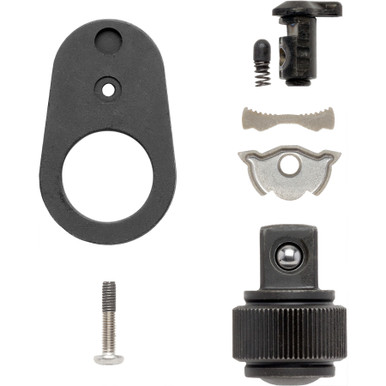
I have a non-quick release 1/2” Koken 4725Z ratchet. Can upgrade to a push button release anvil using this kit?


Or are the ratchet heads different between the two? can’t find the answer.
 
To avoid these ads, REGISTER NOW!
Top Bottom