To avoid these ads, REGISTER NOW!

Koken Surface drive vs Flat drive sockets

Shelbylex

Well-known member
Joined
Jan 20, 2018
Messages
3,105
Location
MA
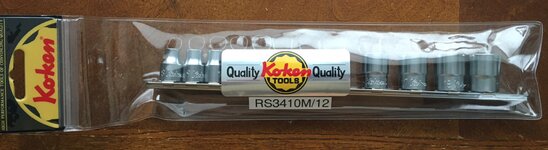
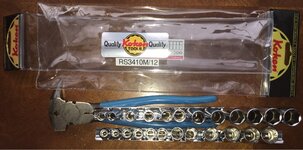
I either received a wrong set or I accidentally ordered wrong type of sockets from Ko-ken. I was trying to get a regular 6 point set. The deep ones on the left are usual "flat drive" and the regular ones on the right are "surface drive"

- Does anybody have any experience with surface drive - is there any benefit of it?
- Is surface drive much more likely to damage/strip the bolts (I live in MA, roads are salted...)


... I am not sure if Koken USA will agree to exchange them or accept the return - just wrote them a letter. Original order was from November 2024, they just came in...


Koken Sockets.JPG
 
Last edited:
To avoid these ads, REGISTER NOW!

neophyte

Well-known member
Joined
Apr 23, 2012
Messages
9,571
Location
Pennsylvannia
I’ve never used them, but in theory, they basically should work like the Metrinch sockets, which tend yo drive the socket nearer to the center of the flats, and which get excellent reviews for rounded-off fasteners.
 

ronkz650

Well-known member
Joined
Oct 29, 2022
Messages
219
Location
Denver, CO
I have the surface drive Kokens, and also a master set of 1/4" surface drive Grey Pnuematic impacts. I like them. They fit real loose, so that turns away a lot of guys before they even give them a try.
Give them a chance. I'll bet you'll like them.
 

BlitzcrankJapan

Well-known member
Joined
Dec 9, 2019
Messages
135
Location
Gold Coast, Australia
I have both. I too received the 'wrong' ones on an order from a USA tool company, and offered to purchase them at a discount to avoid them paying return shipping fees, and they can send me my original order paid for.

Anyway.
They say they are designed for delicate fasteners and are less likely to damage fasteners. They also are suppose to work well on damaged and rounded fasteners.
I have found them to work very well on damaged fasteners.
I do not use them often as they have quite a bit of movement when put on a fastener which can cause them to not sit square and slip off. Consideration must be made when engaging the fastener that they are sitting square before torque is applied.
 

Callelle

Well-known member
Joined
Feb 3, 2022
Messages
636
Location
Depew NY
I use Matco pro non-slip, which is basically surface drive, as my daily driver impacts. I don't worry about damaging fasteners but they work great and I've never chewed anything up, much less to the point of not being able to re-use it.
 

2ndGearRubber

Well-known member
Joined
Mar 24, 2014
Messages
14,185
Location
Pittsburgh
I use Matco pro non-slip, which is basically surface drive, as my daily driver impacts. I don't worry about damaging fasteners but they work great and I've never chewed anything up, much less to the point of not being able to re-use it.

The only annoyance I have with those is getting them stuck on the fastener. I used those as my go-to rusted bolt sockets for several years before FDX snapon sockets came out.

I would assume these surface drive would have the same inherent behavior.
 

Achilleus

Well-known member
Joined
May 30, 2011
Messages
160
I got a small 3/8" set of Koken surface-drive, and my first impressions were they are fantastic - very nicely made.

But then I checked the fit of the 10mm socket onto a 10mm bolt head, and was shocked at how loose it felt. Compared with my Snap-On equivalent, it had about double the play as I wiggled the bolt around. I was very upset about this, and almost sent the set back the same day, as it cost me $200 on Amazon.

Well, still I thought that the Japanese do know about tools and machinery, so I wanted to do an actual test, and give them the benefit of the doubt. I compared the resistance of two different socket brands to rounding over some softer aluminum hex rod.

In the test, I used 13mm sockets (Snap-On and Koken) 6-point shallow. A piece of 1/2" aluminum 6061 hex rod was used as a test material. Now 1/2" is around 12.7mm, so there was a little play in the fit, but it seems reasonable and no different from any real-life fitting of a socket to a bolt when under a car. Again, the play on the Koken was around double that of the Snap-On.

With the hex rod mounted into a deep impact socket on a 3/4" breaker bar, I placed the socket on top of that and then an adapter and finally a 3/4" ratchet on top of that. Gave it a big heave.

The results are as follows - see pic. From left to right are (1) Koken, (2) Koken with a bit more lube, and (3) Snap-On. In both Koken cases, the rod twisted very significantly before it felt like it was about to fracture. No sign of rounding - pretty much a perfect hex when I examined the end. See how much the rod twisted, compared to the Snap-On in the pic.

With the Snap-On, the socket basically rounded over the hex rod with about half the force - see how much less it deformed the rod before rounding it over?

As a final test, I pitched the Snap-On and the Koken directly with each other - Snap-On mounted on the bottom at the breaker bar, and Koken at the top on the ratchet. When turning, something gave way before the rod fractured. You can see from the 4th sample what happened. The Snap-On side (left) rounded over, while the Koken was pretty much unchanged.

The Koken bites into the edge of the 'nut', and even digs a little dip into it there. But the Snap-On just rounds over the corners.

Now to be fair to Snap-On, this was a slightly loose fit. The 1/2" rod fits very precisely into an actual 1/2" Snap-On socket (rather than a 13mm), and I bet that there would be zero rounding in this case. But I did compare like-to-like two 13mm's, and despite being 0.3mm off size, I think the test was enough to convince me to keep the socket set, and to use it in real life scenarios if ever I have a really tough piece.
 

Attachments

  • WrenchesSnapon.jpg
    WrenchesSnapon.jpg
    482.7 KB · Views: 140
  • rodsCropped.jpg
    rodsCropped.jpg
    559.2 KB · Views: 129
Last edited:

Achilleus

Well-known member
Joined
May 30, 2011
Messages
160
Here's a few pics of the actual Koken set I used for the above test. One of the really nice features is the metal case.

The knurling on the extension bars is great - it means with one hand you can twist it with your greasy fingers until it starts to get tight. Try that on a smooth chrome finish :)
 

Attachments

  • k1.jpg
    k1.jpg
    138.3 KB · Views: 115
  • k2.jpg
    k2.jpg
    165.5 KB · Views: 88
  • k3.jpg
    k3.jpg
    103.7 KB · Views: 77
Last edited:

mikey03

Well-known member
Joined
May 17, 2024
Messages
2,054
The only annoyance I have with those is getting them stuck on the fastener. I used those as my go-to rusted bolt sockets for several years before FDX snapon sockets came out.

I would assume these surface drive would have the same inherent behavior.
I saw you mention the fdx ones a few times in a positive way can you talk more about them please I’m not really sure what makes them different and when you’d want to use them and if there just for 1/4 drive I think and why don’t they make them in 3/8 and 1/2?
 

rust in the eye

Well-known member
Joined
Oct 2, 2017
Messages
2,748
Location
Chicagoland
Perhaps the snugness of the Snap On is because it is engaging closer to the corners. This would also explain your test results.
I've been considering buying 1/2" dr. shallow Koken surface drive so am curious to see how they perform for you before I pony up.
 

2ndGearRubber

Well-known member
Joined
Mar 24, 2014
Messages
14,185
Location
Pittsburgh
I saw you mention the fdx ones a few times in a positive way can you talk more about them please I’m not really sure what makes them different and when you’d want to use them and if there just for 1/4 drive I think and why don’t they make them in 3/8 and 1/2?

FDX is the snap-on specialty socket. Much like Koken Zeal, they feature tighter tolerance between the socket and the fastener, and less lead in taper.

FDX was supposedly an every day socket, but in the rust belt it was pretty apparent that wasn't reasonable, they're hard to get onto fasteners. Same deal as matco non slip spline, koken Zeal, etc.

Now with Grip edge extractors, I'm not sure exactly where the FDX sit now. The FDX probably have less lead in still compared to the grip edge, but the grip edge are pretty good. Now they're impact, and have a 6pt drive end, so they're bulkier. But they have the threaded foreign object remover which is pretty nice.
 

mikey03

Well-known member
Joined
May 17, 2024
Messages
2,054
FDX is the snap-on specialty socket. Much like Koken Zeal, they feature tighter tolerance between the socket and the fastener, and less lead in taper.

FDX was supposedly an every day socket, but in the rust belt it was pretty apparent that wasn't reasonable, they're hard to get onto fasteners. Same deal as matco non slip spline, koken Zeal, etc.

Now with Grip edge extractors, I'm not sure exactly where the FDX sit now. The FDX probably have less lead in still compared to the grip edge, but the grip edge are pretty good. Now they're impact, and have a 6pt drive end, so they're bulkier. But they have the threaded foreign object remover which is pretty nice.
Why do sockets have lead in at all? just make it easier to get it on like a flared handgun competition magazine well?
 

BlitzcrankJapan

Well-known member
Joined
Dec 9, 2019
Messages
135
Location
Gold Coast, Australia
Why do sockets have lead in at all? just make it easier to get it on like a flared handgun competition magazine well?
It helps with socket engagement, even for an everyday person. When you have a 90* edge then if you do not engage exactly square, the socket tends to bite in.

A very important consideration I almost never see mentioned is that it increases the sockets resistance to splitting.
Have you ever seen a socket start to split from the middle? I have only ever seen them split from the end.
 

roggy

Active member
Joined
Nov 3, 2025
Messages
25
I got a small 3/8" set of Koken surface-drive, and my first impressions were they are fantastic - very nicely made.

But then I checked the fit of the 10mm socket onto a 10mm bolt head, and was shocked at how loose it felt. Compared with my Snap-On equivalent, it had about double the play as I wiggled the bolt around. I was very upset about this, and almost sent the set back the same day, as it cost me $200 on Amazon.

Well, still I thought that the Japanese do know about tools and machinery, so I wanted to do an actual test, and give them the benefit of the doubt. I compared the resistance of two different socket brands to rounding over some softer aluminum hex rod.

In the test, I used 13mm sockets (Snap-On and Koken) 6-point shallow. A piece of 1/2" aluminum 6061 hex rod was used as a test material. Now 1/2" is around 12.7mm, so there was a little play in the fit, but it seems reasonable and no different from any real-life fitting of a socket to a bolt when under a car. Again, the play on the Koken was around double that of the Snap-On.

With the hex rod mounted into a deep impact socket on a 3/4" breaker bar, I placed the socket on top of that and then an adapter and finally a 3/4" ratchet on top of that. Gave it a big heave.

The results are as follows - see pic. From left to right are (1) Koken, (2) Koken with a bit more lube, and (3) Snap-On. In both Koken cases, the rod twisted very significantly before it felt like it was about to fracture. No sign of rounding - pretty much a perfect hex when I examined the end. See how much the rod twisted, compared to the Snap-On in the pic.

With the Snap-On, the socket basically rounded over the hex rod with about half the force - see how much less it deformed the rod before rounding it over?

As a final test, I pitched the Snap-On and the Koken directly with each other - Snap-On mounted on the bottom at the breaker bar, and Koken at the top on the ratchet. When turning, something gave way before the rod fractured. You can see from the 4th sample what happened. The Snap-On side (left) rounded over, while the Koken was pretty much unchanged.

The Koken bites into the edge of the 'nut', and even digs a little dip into it there. But the Snap-On just rounds over the corners.

Now to be fair to Snap-On, this was a slightly loose fit. The 1/2" rod fits very precisely into an actual 1/2" Snap-On socket (rather than a 13mm), and I bet that there would be zero rounding in this case. But I did compare like-to-like two 13mm's, and despite being 0.3mm off size, I think the test was enough to convince me to keep the socket set, and to use it in real life scenarios if ever I have a really tough piece.

Thanks for the test, it helps a lot.
 

T45

Well-known member
Joined
Nov 20, 2014
Messages
3,250
Surface drive are inferior to flank drive style sockets for BOTH hand-tool and impact use. They are for nut-runners.
 

Steve_P

Well-known member
Joined
Sep 15, 2010
Messages
5,181
Surface drive are inferior to flank drive style sockets for BOTH hand-tool and impact use. They are for nut-runners.

They're not made to replace regular sockets; they're intended for soft material fasteners, damaged fasteners, and for rusted fasteners that are undersized.
 
To avoid these ads, REGISTER NOW!

T45

Well-known member
Joined
Nov 20, 2014
Messages
3,250
They're not made to replace regular sockets; they're intended for soft material fasteners, damaged fasteners, and for rusted fasteners that are undersized.
This is marketing-speak (ie, non-sense).
 
Last edited:

Callelle

Well-known member
Joined
Feb 3, 2022
Messages
636
Location
Depew NY
Because they are designed for nut runners, its a specific application with different priorities.
I disagree. Matco pro-nonslip impacts are my daily drivers for 3/8 and 1/4" shallow and deeps, they haven't let me down and work fine on newer fasteners.
 

Hakeem

Well-known member
Joined
Jan 22, 2024
Messages
1,245
Location
Chicago
Because they are designed for nut runners, its a specific application with different priorities.

Yes, I saw that the first time you posted it.

What specifically makes these surface drive sockets inferior to traditional sockets for hand/power tool use? Am I more likely to round a fastener using these compared to a flank drive socket?
 

T45

Well-known member
Joined
Nov 20, 2014
Messages
3,250
Yes, I saw that the first time you posted it.

What specifically makes these surface drive sockets inferior to traditional sockets for hand/power tool use? Am I more likely to round a fastener using these compared to a flank drive socket?
If you feel like you need more information, Here is a citation to get you started.

1770563057559.png

Secondly, on the topic of hand tools, snap-on sells black-oxide, non-impact power sockets in surface drive...and if they were superior for hand tools...you can be damn well sure they would be selling them too you, too.

I mean who misses an opportunity to sell ice to eskimos at a huge markup...?

So basically Apex is the top of the line for impacts, they sell impacts and surface drive, and tell you not to use surface drive for impacting. Snap-on is the inventor of Flank Drive (which apex uses on their impact sockets) and they also tell you not to use surface drive for impacting.

And snap-on, having invented the FD socket design for hand-tools, thinks they are power sockets, not hand-tool/chrome sockets. If you actualy ask them, I'm 100% sure they will recommend chrome FD sockets for hand use over surface drive.

And if you need FD+ or spline or bolt removal whatever they will sell you that too...
 

T45

Well-known member
Joined
Nov 20, 2014
Messages
3,250
Koken sells a full line of impact surface drive sockets.
Apex also makes them, their website labels them as impact sockets, and tells you not to use them for impacting...

see. eg

1770571701679.png

:censored:


I'll leave to the experts to explain the details, but these sockets are desiged for off-axis initial loading/ tool application, its missing alot of material inside it, acts essentially like a giant chamfer (ie where you remove metail to make the socket easier to place on a fastener).

If you guys have been around a while, its very common to (situationally, with a grinder) make the opposite tool--ie a zero chamfer socket. The zero-chamfer socket is desirable in some applications as it does two things. First, it is less likely to load off axis, since it has no chamber and must go on straight. Secondly, since there is no cutaway material, so it mazimizes contact area (thus minimizing local force application, a/k/a PSI on the fastern). You would do this (more commonly in the field) working on a "low-profile fastener head", since there's less meat on the fasterner, and the chamfer is more likely to reduce the contact area by a significant amount. The lack of surface area to 'grab' on the fasterner, is also likely to come with higher PSI of force application at any given torque / force application (vs a standard thickness bolt head/nut etc).

A deep chamfered mouth will somtimes not have full contact with a low profile fastner. A good example of a high-degree chamfer that you don't want to use on a low-profile bolt head is (ironicallly) a low profile socket. eg the Snap-on 10mm in 1/4 with the external hex...has way more chamfer than a regular 1/4 socket...and doesn't sit that great on low profile hardware.


ETA - I'm not trying to stir the pot, it just seems like there's alot of mis-understanding on the engineering/design concept here, and thus the strengths/weakeness of the design. I mean people can mis-use tools all the want for whatever purpose.
 

General Geoff

Well-known member
Joined
Jan 12, 2013
Messages
3,871
Location
Allentown, Pennsylvania
ETA - I'm not trying to stir the pot, it just seems like there's alot of mis-understanding on the engineering/design concept here, and thus the strengths/weakeness of the design. I mean people can mis-use tools all the want for whatever purpose.
From an end user perspective, if the surface drive socket works where a standard hex socket doesn't, then that's what matters
 

Cruzan80

Well-known member
Joined
Jul 22, 2015
Messages
4,184
Location
Denver, CO
@T45
I don't have these, but your rior post above seems to be talking about two different things. Lead-in chamfer (holding the socket vertically, and seeing how much distance from to top of the "nose" to where the "splines" start) and internal chamfer (how much extra room around the point of the hex, when looking "into" the socket).

From pics posted here, it looks like the lead-in chamfer is not very much (nose-to-spline), which would impact what you are talking about with low profile heads and "zero-chamfer" from a grinder. If they do have a large lead-in chamfer, that would affect the alignment.

The "internal" chamfer is what people are talking about with regards to rounding, due to the lack of pressure near the corners. This is the same "off-axis" that Metrinch, FDX, etc have all been using.

I understand your argument that Snap-On, having made both, and primarily marketing FDX to mechanics, seems to imply that they feel FDX is superior to surface drive, but that, in and of itself, doesn't mean they think it "performs" superior. There are a few reasons that jump to mind why they would pick one over the other. It could be easier/cheaper to produce. It could be easier to try and get a patent on FDX, so as to protect market share, or differentiate (nobody else has FDX, vs lots of "surface drive" competitors). It could be "gut feeling" (mechanics don't like things that "feel loose" even if they perform better). For example, torque wrenches are inherently a worse design now due to the pivot placement (look at the old JO torque thread).

Lastly, just beamcuase they are not "impact rated" doesn't mean they are nut-runners exclusively. You can have hand tools that are used for removing/tightening without power tools. I read your comment as akin to "nut-druvers". If you meant differently, I apologize.
 

superautobacs

Well-known member
Joined
Oct 31, 2008
Messages
3,997
Location
Vancouver, BC
I bought a few many years ago to try them out. 10, 12mm in 1/4sq and 14, 17mm in 3/8sq. I quickly found out I prefer to use a standard 6/12pt profile because of the extra play/rotation that comes with quickly ratcheting a fastener on/off.

That said, when using it on a power tool, like an air/electric ratchet, where you have constant rotational force, these sockets make more sense.

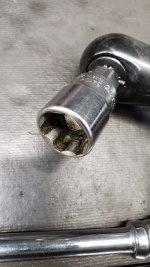
This 17mm has been my dedicated drain bolt socket and its loosened hundreds of drain bolts. Thanks to the surface drive profile, engaging the fastener head becomes easier. Using my cordless ratchet, I free-spin the socket and swiftly pop that socket onto the drain bolt to give me an impact force to break that bolt free. Works like a charm.

I also bought a 19 and 21mm deep-well impact socket to work on cruddy exhaust flange nuts and swollen lug nuts. In hindsight, getting a 21.5mm socket is the better tool for swollen lug nuts.


20220706_162447.jpg20220706_163038.jpg20220706_163010.jpg
 

ronkz650

Well-known member
Joined
Oct 29, 2022
Messages
219
Location
Denver, CO
The surface drive works great, but 95% of users will always diss it as **** because it doesn't fit tight onto the bolt. 95% of users don't understand the concept, and never will so the entire idea is never going to be acceptable.
 

Jack Ryan

Well-known member
Joined
Jun 2, 2022
Messages
339
Location
Adelaide, South Australia
I probably missed it in the discussion but why is the surface drive a sloppy fit?

Why not tighten it up like a spline/universal drive?

I presume the manufacturer has an explanation.

Jack
 

ronkz650

Well-known member
Joined
Oct 29, 2022
Messages
219
Location
Denver, CO
It's hard to describe or understand, but the sloppy fit is necessary by design and works great, but any socket that doesn't fit tight to the bolt is never going to be acceptable to most unfortunately.
 

AEAdam

Well-known member
Joined
May 27, 2023
Messages
2,729
Location
SE PA
Yes, I saw that the first time you posted it.

What specifically makes these surface drive sockets inferior to traditional sockets for hand/power tool use? Am I more likely to round a fastener using these compared to a flank drive socket?
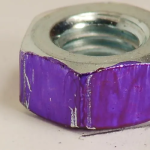
This is probably one of the best GJ threads ever in my opinion. In this thread, the OP put marking dye on a nut and torqued it with sockets from different manufacturers. Where the dye is disturbed is the contact patch for each brand of socket.

Koken 6pt- very near the edge, but not touching. The contact patch is fairly broad and consistent.
image.png

Snap On 6pt. Similar to Koken in location (kinda hard to tell) but maybe a bit lighter.
image.png

Koken Surface Drive
image.png

Think about the distance from the center of the nut to the contact patch along the flat surface of the hex as a lever arm. You want your socket to have the longest lever arm it can have.

Surface drive sockets have thicker walls and greater corner relief to allow the socket to contact further back from the nuts' corners. They allow you to remove damaged hardware. You could use them exclusively if you wanted. But they will be less efficient, harder on both socket and fastener in terms of wear and fatigue.

When people talk about "great sockets" on GJ, the conversation often turns into a beauty contest. Then there are comments from pros who say brand X works where brand Y doesn't etc etc. That thread from 15yrs ago explained WHY. I've gone back and looked at it many times.
 

T45

Well-known member
Joined
Nov 20, 2014
Messages
3,250
I probably missed it in the discussion but why is the surface drive a sloppy fit?

Why not tighten it up like a spline/universal drive?

I presume the manufacturer has an explanation.

Jack

Its designed clearance, not tolerance error.
 

Jack Ryan

Well-known member
Joined
Jun 2, 2022
Messages
339
Location
Adelaide, South Australia
Its designed clearance, not tolerance error.

It's hard to describe or understand, but the sloppy fit is necessary by design and works great, but any socket that doesn't fit tight to the bolt is never going to be acceptable to most unfortunately.

But why, spline drives are not sloppy and achieve a similar result on hex fasteners. The object is to move the contact point away from the corners. I don't see how sloppy is required for that.

I'll try the manufacturer

Edit:

All I can find is that the shape (sloppiness) aids in nut capture (engagement), an advantage in automated systems.

Jack
 

AEAdam

Well-known member
Joined
May 27, 2023
Messages
2,729
Location
SE PA
Sloppy is the wrong word. You could increase the corner relief. At the end of the day there's nothing magical to surface drive or splined sockets. The way they work is they provide additional clearance to the bolt corner at the expense of greatly increasing stress inside the socket.

I don't know if this will help or not:

socket freebody.jpg
We apply TORQUE to our sockets via ratchets etc. The socket translates that torque into a force perpendicular to the flats on the fastener. Sockets are kinda like tiny machines.

If I apply 100lbs FORCE to the end of a 12" ratchet, that 100ftlbs TORQUE becomes the NORMAL FORCE shown above divided by the lever arm.

So just for sake of discussion, let's say that lever arm is .20" or .016'. The force exerted by the socket would be 100ftlbs/.016' = 6000lbs/6 flats =1000lbs. So the 100lbs I applied, got magnified into a 1000lbs. It's just like the seesaw with the heavy kid on the short side, and the light kid on the long side.

If that .20" lever arm was reduced even a tiny bit, say 10% or .020" the NORMAL FORCE, or the force the socket exerted on the nut, would go up 10%.

Here's the key:
The torque we apply remains the torque the fastener sees. Changing the LEVER ARM length only increases the internal stress of the socket. It doesn't help turn the fastener at all.

To make a socket that will last a long time, and to prevent cracking at the corner relief where its thinnest, the LEVER ARM has to be tightly controlled to be as near the corner without touching it as possible.

If we want sockets with a smaller LEVER ARMs to allow us to turn damaged hardware, that comes at the expense of more internal load, which means larger ODs on the sockets. Some manufacturers may then make the sockets softer to reduce brittle fracture, which results in sockets that wear faster, but as a non "daily driver" socket, that can be okay.
 

Jack Ryan

Well-known member
Joined
Jun 2, 2022
Messages
339
Location
Adelaide, South Australia
Sloppy is the wrong word. You could increase the corner relief. At the end of the day there's nothing magical to surface drive or splined sockets. The way they work is they provide additional clearance to the bolt corner at the expense of greatly increasing stress inside the socket.

Thanks, but at the end of the day, every man and his dog makes sockets that engage off corner. One makes them with a sloppy fit.

I assume the sloppiness has a purpose and that is probably what the manufacturer suggested - it aids in nut capture (engagement), an advantage in automated systems.

Jack
 

terrific

Well-known member
Joined
Nov 22, 2021
Messages
329
...every man and his dog makes sockets that engage off corner. One makes them with a sloppy fit.

I assume the sloppiness has a purpose...
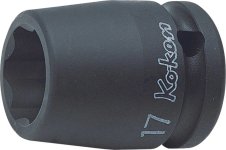
I think it will become obvious if you look at a picture of the profile.
4410M-17_1.png
The amount of material they remove during manufacturing determines how far a socket has to rotate before contacting a fastener.
With this type of socket, they remove a lot of material from the corners of the socket so that it engages much further back from the corners of the bolt. The benefit is that the socket is very unlikely to round the corners of a fastener. The consequence is that there is more empty space through which you must rotate before turning the fastener.
It's a kind of bitter consequence, too, because unless your ratchet has zero backdrag, you have to travel through the empty space once as you ratchet back, and then again as you start to turn. Not as big a deal if you hold the socket the entire time, but you can't always do that.
 
Last edited:
To avoid these ads, REGISTER NOW!
Top Bottom