To avoid these ads, REGISTER NOW!

Lathe Bench Design

xtremek

Well-known member
Joined
Apr 13, 2012
Messages
11,603
Location
St. Johns, Mi
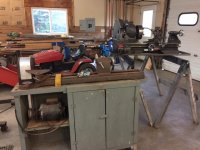
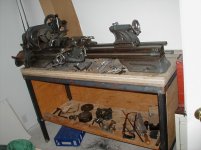
I just bought a small Craftsman lathe. So, if you were going to build a bench for your lathe, how would you lay it out? What features would you include? I already know I want to have a place to hang chuck keys. What about the big drill bits and taper adapters? Here’s what I have to start with, but I expect the tooling to grow. Also, someone said that carbide inserts won’t work with this lathe. Can anyone tell me why?
 

Attachments

  • my wife loves me.jpg
    my wife loves me.jpg
    107.8 KB · Views: 391
  • lathe tooling.jpg
    lathe tooling.jpg
    127.4 KB · Views: 342
  • his & hers lathes.jpg
    his & hers lathes.jpg
    104.1 KB · Views: 387
To avoid these ads, REGISTER NOW!

Thumper68

Well-known member
Joined
May 16, 2013
Messages
5,134
Location
Duluth MN
I just bought a small Craftsman lathe. So, if you were going to build a bench for your lathe, how would you lay it out? What features would you include? I already know I want to have a place to hang chuck keys. What about the big drill bits and taper adapters? Here’s what I have to start with, but I expect the tooling to grow. Also, someone said that carbide inserts won’t work with this lathe. Can anyone tell me why?

From my understanding carbide insert tools like higher speeds and heavy cuts, so your lathe will not react well to them. That being said I have seen many people get great results anyway.

I am working on a design for a new bench for my sheldon lathe and have been wondering what features it should have as well.

A few things that I will be adding, a back shield and real chip tray to contain fluids and chips, a old 5 drawer CM box under for tooling. Lots of lighting, an over head 4 foot led centered over the lathe and a light on a compound arm for task work. A place on the back for quick change tools, chuck keys, drill chuck, file, live center, wrenches so they are all in easy reach.

I'm sure there are more things I will add as it gets built over the next few weeks.
 

Boilerhouse

Well-known member
Joined
Mar 20, 2012
Messages
1,320
Location
Muskoka
Mine is against a wall, and I have shelving behind the tailstock end that holds the things that I reach for the most. The bench has drawers which holds heavier things like chucks. I have a back splash to catch any cutting oil that flings off the work. Still need to get a better chip/drip tray to put under the bed. As far as carbide, it will work, just not real well. It needs higher rpm's to get best results and that lathe won't turn up fast enough.
 
OP
X

xtremek

Well-known member
Joined
Apr 13, 2012
Messages
11,603
Location
St. Johns, Mi
Thumper, thanks for answering the question. I'm guessing I'm all over the backsplash and real chip tray. For the tooling, I figure an old Kennedy or something similar. But I'm really interested in the drill chuck, live centers, chuck keys, etc.. I'd really appreciate it if you shared your design when you get it going.
 

larry_g

Well-known member
Joined
Apr 28, 2007
Messages
16,885
Location
oregon
A couple of things to think about. It looks like your in an open shop where the machine will be exposed to the dust and sawdust of other projects. It is in a non-heated building? Then I would suggest that you get as much tooling as you can in drawers and cabinets to keep it clean and rust free. In a production shop where the lathe is used everyday then tooling at hands reach is good, but this is not a production shop.

As for the bench, you want rigidity and mass. On a small flexible lathe like this chatter is a problem and a solid mount will help keep the chatter down. I started with a Logan lathe of similar sise and it had a tube frame and the whole thing would start dancing on a bad cut so that is why I recommend some mass in the frame. Wood works as it has a low resonate frequency that will damp out the chatter.

As for carbide; I don't use it much, mainly because I don't know enough. I was reading that some of the newer technology's in making inserts lends it to a better, sharper edge and the idea of not using carbide on light machines is becoming less true.

lg
no neat sig line
 

Falcon67

Well-known member
Joined
Jun 11, 2009
Messages
18,371
Location
Merkel, TX
Here's what I use for my 9x20 - Seville @ Sams, $399. 20" deep x 72" long x 37" high - which for me - 6' 1" - puts the spindle at a nice working height. It's stiff enough for that use, but you could easily layer the top with a cap of 1/8" steel or some such.

LatheBench.jpg


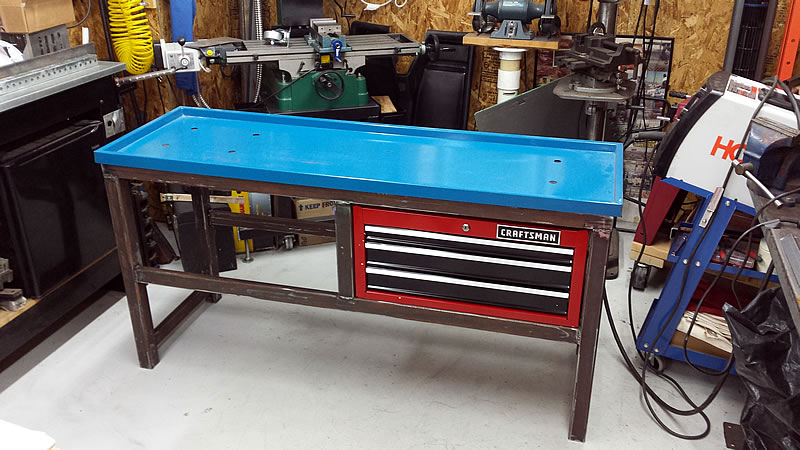
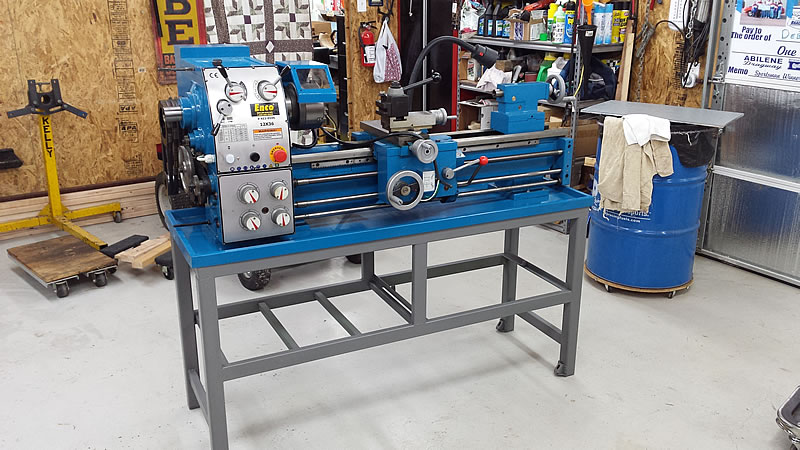
For the 12x36 that needed a heavy duty platform, I rolled my own

12x36Stand_006.jpg


12x36Stand_010.jpg
 
Last edited:

isb cornbinder

Well-known member
Joined
Nov 3, 2010
Messages
7,073
Location
Pacific South West, BC, Canada
Carbide will work just fine. High speed steel is less expensive and will be your go-to cutter for most jobs. You will need to learn how to grind the tool bits so they will work properly. You Tube has made great contributors and you can learn from them. South Bend lathe has a great book called, how to run a lathe. Get it on Amazon, Abe 's Books and eBay.
Carbide will be the material you will use for the tough materials. I use carbide on most jobs, including plastics.
I have 3 lathes and a milling machine. I've been making chips for almost 40 years.
Check out Mister Pete 222 on You Tube. He is a retired shop teacher and knowledgeable.
Have fun.
I will be installing a second Myford Super 7 on a Waterloo 48 inch lower roller toolbox. I got this Waterloo off Craigslist for $40. This could be your solution for a table and drawers plus some portability. I will be adding a piece of 1/4" steel plate to the top of the Waterloo box.
The best chip trays and back splash are large aluminum baking pans from a restaurant supply. At $4-5 each good deal.
 
Last edited:

ssdave

Banned
Joined
Apr 11, 2015
Messages
2,913
Location
Eastern Oregon
I have a very similar machine.

My stand is made of 2" steel tubing, with 2x2x1/4" L angle framing, welded together and bolted to the 2x2 posts. The 2x2 have large nuts welded to the bottom, with adjuster bolts for leveling, which were then set in concrete. I then bolted in plywood panels as fill-ins to the steel to further brace it. I'll attach a picture.

I keep my tooling in a Kennedy stack toolbox nearby, and in a kennedy machinists chest right next to the lathe. I only put one shelf in the unit, and use it to hold chucks, steady rest, etc. I don't always use a chip pan, but just use a baking sheet when I do.

The most important thing in a lathe stand is absolute strength and rigidity. Vibration makes for poor surface finish when turning. My top is about 3 inches thick, made of laminated layers of particle board, OSB and plywood.

I don't have any fancy hanging storage or anything, the general disorder you'll see in my picture, along with storing the tooling in the Kennedy boxes works for me.

Carbide cutters will work, but take more pressure to cut, and usually cut better with heavy cuts. The Atlas lathe isn't powerful enough to do that well, so although they work, they don't always work as well as HSS. HSS if properly sharpened will cut faster and give a better finish on this light weight lathe.
 

Attachments

  • P1019131.jpg
    P1019131.jpg
    133.6 KB · Views: 189

Falcon67

Well-known member
Joined
Jun 11, 2009
Messages
18,371
Location
Merkel, TX
I have some carbide, usually tend to hurt it - amateur metal smith. Only on the 12x36, the 9x20 is a bit flexible for carbide and hard material. Your C-man is very likely stiffer.
99% I use HSS and grind out a cutting tip. Mess that up, just back to the 6" grinder to fix it. I do mostly aluminum and crappy home center steel rods that machine more like a cucumber than steel.

> Here’s what I have to start with, but I expect the tooling to grow.
You will spend 1~10x the cost of the machine on tooling over time. More if you got a buy on the machine. I could get a "decent" chinese B-port type mill for around $8K. To set it up to do cylinder head work on just SBF heads, that's easily another $8K in tooling.
 
Last edited:

kbs2244

Well-known member
Joined
Nov 11, 2006
Messages
14,065
You really need to visit a lathe site.
That said, I have seen some very good ones made from the old "tanker" desks.

But they have started to become "restore" fodder.
 

isb cornbinder

Well-known member
Joined
Nov 3, 2010
Messages
7,073
Location
Pacific South West, BC, Canada
A stable bench is more important than level. Flat is more important than level. Some of the skinny tube and plywood structures I have seen are inviting vibration witness marks on the piece being turned.
Level becomes an important consideration when a person installs a "big-boy-lathe". Little hobby metal scratchers may not require level.
My 16X120 inch South Bend sits on the concrete floor and is reasonably level.
 
Last edited:
OP
X

xtremek

Well-known member
Joined
Apr 13, 2012
Messages
11,603
Location
St. Johns, Mi
Ok, so a heavy bench is needed. The tubing I have is pretty thin wall, but I have some 1/4" plate I can use as a top and bracing for the sides. I also have some 3/4" plywood that I could put over the 1/4", probably enough to double it up. What do you think. I really appreciate everyone's advice. I admit i'd have made a chatterbox if left to my own devices.
 

isb cornbinder

Well-known member
Joined
Nov 3, 2010
Messages
7,073
Location
Pacific South West, BC, Canada
I like the steel to be the top face for easier clean-up. I had a local fabrication shop fold the 3/8 inch bench top for my first Myford Super 7 lathe. Smaller lathes can struggle with stability. My thought was, make the top heavier and this may hold the lathe firm.
I would like to get a South Bend Heavy 10 or a small Monarch, but, maybe in my next life. I took a few pictures this PM and I will edit them in here, later.
 

matt_i

Well-known member
Joined
Mar 14, 2008
Messages
10,728
Location
SE Michigan
Couple of ideas. Cross-bracing, X-bracing, welded, even down to 1/4 x 1 flat bar will work well for a tube-frame bench to keep it rigid.

Inserted carbides (the triangle or diamond shapes) in positive rakes like a rigid setup, same as in a milling machine. Otherwise the edges chip due to the flexing they can't handle. The downside of inserts is they can break, which is like lighting a $5-10 bill on fire....eventually economics will take over. HSS toolbits take a little bit of training but then you have the ability to make a special tool for anything you can think of, and a $5 toolbit will last you 10 years of work. You screw it up, you just go back to the grinding wheel.

In the middle are brazed carbides which are a more ductile material than the inserts, those emulate HSS in that they can be resharpened with a green wheel (that's not to be used on steel)

Consider the insert is a relatively brittle, hard material. That lathe is not super rigid. I'm not trying to criticize you, I had the same machine 25 years ago. The biggest improvement I made to it was to replace the cross slide leadscrew and bronze nut. It was expensive, but it made a big improvement in the ability to hit diameters.
 

John in OH

Well-known member
Joined
Jun 2, 2007
Messages
2,444
Location
SE Ohio & Eastern Virginia
All the other folks here have already pretty much described what you need in a table ... stiffness and mass. Objective is to minimize chatter and vibration. Actual weight support isn't that important as your Cman lathe is relatively light.

I've never used carbide as I always had the understanding that it needed higher cutting speeds to be effective and required more power. My guess is your Cman (Atlas) lathe will be short on both those counts. But, since I've never tried carbide I don't know for sure. Have always had fine success with HSS cutters ..... cheap and easy to grind to needed configurations.

Build a stout table and stick with HSS bits and all should be fine. You'll have a blast with your lathe!! Enjoy!!
 

Thumper68

Well-known member
Joined
May 16, 2013
Messages
5,134
Location
Duluth MN
Ok, so a heavy bench is needed. The tubing I have is pretty thin wall, but I have some 1/4" plate I can use as a top and bracing for the sides. I also have some 3/4" plywood that I could put over the 1/4", probably enough to double it up. What do you think. I really appreciate everyone's advice. I admit i'd have made a chatterbox if left to my own devices.

I am going to be using a piece of 1" plate for the top on mine, 1 1/2 - 3/16 wall tube for the structure and lots of gussets, Here is a preliminary sketch up model.
 

Attachments

  • lathe stand.jpg
    lathe stand.jpg
    99.2 KB · Views: 103

matt_i

Well-known member
Joined
Mar 14, 2008
Messages
10,728
Location
SE Michigan
My experience with the carbides is they do slightly better with preventing the built-up edge from messing up your surface. Armed with the rigidity to run them, the higher potential for chip flow (due to the higher thermal capability before the edge breaks down) simply washes the built-up-edge away. If you turn 1018 cold-rolled its hard to get a nice finish due to the tearing.
 
To avoid these ads, REGISTER NOW!

Cruzan80

Well-known member
Joined
Jul 22, 2015
Messages
4,237
Location
Denver, CO
For an idea, the plate-metal frame on my 12x36 CM Commerical (early 70's) stock frame is listed at 200+lbs in the catalog for shipping weight (not counting the lathe, which comes in around 350+). Can take a picture if you would like.
 

isb cornbinder

Well-known member
Joined
Nov 3, 2010
Messages
7,073
Location
Pacific South West, BC, Canada
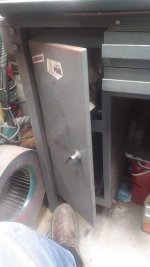
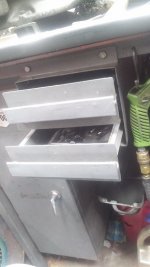
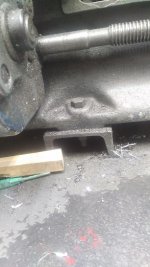
Here are a few pictures. I hope there is something that will show a few ideas.
These inexpensive toolbox side cabinets are perfect for my under lathe needs. I plan on hanging the red side cabinet to keep it off the floor. There will be just over an inch of clearance.
I welded the risers to the table to then bolted the lathe to the risers. The table top has a drain for flood coolant. I have never used flood coolant.
I bought the red side cabinet. It was on sale.
I used to build side cabinets when I was still working and had access to a big box and pan brake and shear. If I had room and opportunity, I would buy a Brown-Boggs B&P brake in a second.
 

Attachments

  • MYFORD SIDE CAB INET DOOR.jpg
    MYFORD SIDE CAB INET DOOR.jpg
    52.7 KB · Views: 110
  • MYFORD DRAWERS.jpg
    MYFORD DRAWERS.jpg
    50.2 KB · Views: 110
  • MYFORD BENCH SIDE CABINET WITH DRAWERS.jpg
    MYFORD BENCH SIDE CABINET WITH DRAWERS.jpg
    64.7 KB · Views: 121
  • MYFORD BENCH RISER.jpg
    MYFORD BENCH RISER.jpg
    69.5 KB · Views: 112
  • MYFORD BENCH FORMED TOP.jpg
    MYFORD BENCH FORMED TOP.jpg
    51.3 KB · Views: 116
Last edited:

lis2323

Well-known member
Joined
Dec 25, 2016
Messages
3,234
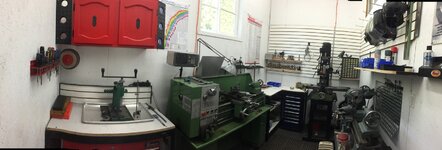
Here's a few pics of a stand I fabbed up for a small Clausing lathe I picked up. 2"x2"X11/8" square wall tubing and 1/2" plate were used. I pedestal mounted it for easy cleanup. I bent up a removable chip pan out of 10 gauge material.

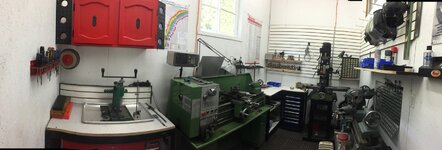
The pano shot is of my 8'x12' "mini machine shop".

31c45b92e13942a2a6927a19033a310b.jpgf37822104c6c193935c7aada955a4445.jpg

This is a bench I built with roll cab for storage.

752b8e14181f46d96ded39c25b81cd65.jpg

73ff5abd6409131fd2e75651d2d37162.jpg


And a temporary bench for this mini lathe
7c318747265e1cec83a6a88369dc57ac.jpg
 

Attachments

  • 73ff5abd6409131fd2e75651d2d37162.jpg
    73ff5abd6409131fd2e75651d2d37162.jpg
    538.7 KB · Views: 20
  • 31c45b92e13942a2a6927a19033a310b.jpg
    31c45b92e13942a2a6927a19033a310b.jpg
    618.1 KB · Views: 18
  • f37822104c6c193935c7aada955a4445.jpg
    f37822104c6c193935c7aada955a4445.jpg
    328.2 KB · Views: 18
  • 752b8e14181f46d96ded39c25b81cd65.jpg
    752b8e14181f46d96ded39c25b81cd65.jpg
    77.2 KB · Views: 16
  • 7c318747265e1cec83a6a88369dc57ac.jpg
    7c318747265e1cec83a6a88369dc57ac.jpg
    150.2 KB · Views: 16

fergus

Well-known member
Joined
Oct 4, 2009
Messages
1,620
Location
Yolo County CA
My lathe bench top is 2x4s I laminated. Pretty solid...got it reasonably straight with a large hand plane...a jointer plane. Still haven't run my lathe yet though [emoji849]


Sent from my iPhone using Tapatalk
 

AngryBeaver

Well-known member
Joined
Jul 12, 2017
Messages
1,705
Location
Lake Milton Ohio
Here's what I use for my 9x20 - Seville @ Sams, $399. 20" deep x 72" long x 37" high - which for me - 6' 1" - puts the spindle at a nice working height. It's stiff enough for that use, but you could easily layer the top with a cap of 1/8" steel or some such.

LatheBench.jpg

you're the only person I've even seen to have one of those other than me... got mine from work when a shop closed down. it makes a nice reloading bench
 

493mike

Well-known member
Joined
Jul 24, 2015
Messages
148
Location
mid Michigan
I have a factory stand for my 12 x 36 but I did fab a cabinet/storage/light mount for it. I did get a little carried away with the 2 x 2 tube steel frame construction!
Mike

NO. I do not wear a tie when I use the lathe!
 

Attachments

  • IMG_1582.jpg
    IMG_1582.jpg
    139.5 KB · Views: 150
OP
X

xtremek

Well-known member
Joined
Apr 13, 2012
Messages
11,603
Location
St. Johns, Mi
I knew the GJ crew would come through for me, and you have in spades. I'm not a total newb to a lathe, but this is my first personal one. I have experience with carbide inserts (running production CNC lathes/mills, and student machine shop), but I've never used HSS. Sounds like I'm going to get to learn a new skill. I take it I should pick up another bench grinder just for sharpening my tooling. Thanks again for your help. When I get a design figured out, I'll post it here for your review/critic.
 

pepi

Well-known member
Joined
Mar 27, 2013
Messages
2,883
Location
Woodstock, GA
Repurpose an old Craftsman storage cabinet, plenty of room.


Was:

attachment.php


Is:

attachment.php


BTW: nice one, you will never be sorry having that machine...... opens so many doors

Greg
 

Attachments

  • 222.jpg
    222.jpg
    128.2 KB · Views: 571
  • 111.jpg
    111.jpg
    140.6 KB · Views: 567

niget2002

Well-known member
Joined
Oct 2, 2012
Messages
11,137
Location
Josephine, TX
Don't know anything about metal working lathes, but just wanted to say I have that exact same woodworking lathe. It's been a great little machine.
 

Socket Pounder

Well-known member
Joined
Feb 7, 2017
Messages
329
Location
Santa Clarita
Don't know anything about metal working lathes, but just wanted to say I have that exact same woodworking lathe. It's been a great little machine.

I had one and used it for a couple years. Converted it to variable speed with a treadmill motor. I like my modern lathes better but it was a good lathe after taking it apart and cleaning up the insides.
 

astroracer

Well-known member
Joined
Jun 22, 2005
Messages
3,001
Location
Mid_Michigan
HF US General 44" roller. Cut a piece of birch plywood for the top and set my Smithy Combo on it. Best thing I ever did for tool and accessory storage. Everything is out of sight and out of the dust.
photo2-vi.jpg
 

alfazer

Well-known member
Joined
Nov 1, 2011
Messages
393
Location
N. Ireland
The stand needs to be stiff enough, not just to minimize vibrations but to get the lathe bed level enough so you can turn a long workpiece to a consistent diameter so it doesn't end up tapered.
If you try to level the bed of the lathe accurately with a stand that is less rigid than the lathe bed, then the stand will twist and you be not be able to level the lathe accurately.
 

ssdave

Banned
Joined
Apr 11, 2015
Messages
2,913
Location
Eastern Oregon
The stand needs to be stiff enough, not just to minimize vibrations but to get the lathe bed level enough so you can turn a long workpiece to a consistent diameter so it doesn't end up tapered.
If you try to level the bed of the lathe accurately with a stand that is less rigid than the lathe bed, then the stand will twist and you be not be able to level the lathe accurately.

Bingo!

And, the best way to measure if the bed isn't twisted is to have the surface of the stand you bolt it to level both ways. It needs to also be flat, so that it is level at all points. Then, you can use a precision level to level the bed, shimming as needed, and know it is not twisted when you finish.

If you just make a flat top for your stand and don't level it, it's nearly impossible to check if the bed of the lathe is actually flat also. If your stand top is neither level nor flat, it's an almost hopeless task to get the lathe to cut accurately.
 
Last edited:

matt_i

Well-known member
Joined
Mar 14, 2008
Messages
10,728
Location
SE Michigan
Its kind of splitting hairs but the level isn't the exact requirement. The lathe ways have to be in the same plane. The classic example is the lathe on a Navy repair shop on a ship which can be on any random state of level at sea and expected to perform as designed. If the ways are on skewed planes then the carriage doesn't track a consistent alignment. A master precision level (.0005"/ft graduations) is the tool of choice to assess it in both directions.

A flat way lathe like the Atlas is easy to level front-back but when you get into a classic flat-and-vee bed design or a special way design like LeBlonds for example, its not apparent what feature should be leveled front-back. Leading back to placing the ways in the same plane.
 

John in OH

Well-known member
Joined
Jun 2, 2007
Messages
2,444
Location
SE Ohio & Eastern Virginia
I knew the GJ crew would come through for me, and you have in spades. I'm not a total newb to a lathe, but this is my first personal one. I have experience with carbide inserts (running production CNC lathes/mills, and student machine shop), but I've never used HSS. Sounds like I'm going to get to learn a new skill. I take it I should pick up another bench grinder just for sharpening my tooling. Thanks again for your help. When I get a design figured out, I'll post it here for your review/critic.

That's what I did. I picked up a relatively inexpensive 6" bench grinder and fitted it with very fine grit wheels. Its purpose in life now is exclusively limited to grinding HSS tool bits.
 

ssdave

Banned
Joined
Apr 11, 2015
Messages
2,913
Location
Eastern Oregon
matt_i, we are talking about an atlas lathe here that has flat ways. So, the easy way to make sure it is true is to level it both ways. It is easier, but not essential, to have the stand level to assist in that. The Atlas is a relatively light, flexible lathe. It is easy to get it off square/true fastening it down to a bench.

How would you readily true the lathe if you don't use a level? Turn a cylinder, measure taper and shim the lathe bed until it cuts true? You have to account for tailstock alignment and offset as another variable in doing that.

I'm sure there's a lot of old tricks to setting up a lathe to cut true. I learned to use a level, and have done that the half dozen times I've set one up for myself. I'd be interested in learning other ways to do it also.
 
OP
X

xtremek

Well-known member
Joined
Apr 13, 2012
Messages
11,603
Location
St. Johns, Mi
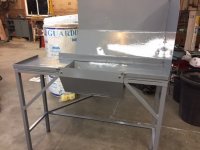
Here’s my finished lathe bench. It’s as flat as I could make it. I used a bubble level and it seems that the bubble settles in the same place every place I put it. It is fairly light weight, made out of 1 ¼ “ square tubing. The top is 3/8” plywood covered with 1/8” plate. Do you think it’ll be heavy enough to work? Any suggestions on what to do to make it work better? Would adding weight help any vibrations?
 

Attachments

  • lathe bench 9.jpg
    lathe bench 9.jpg
    90.4 KB · Views: 98

kbs2244

Well-known member
Joined
Nov 11, 2006
Messages
14,065
I would think about keeping an old "Army blanket" around to throw over it.
Just to keep out the general "road dust."
 

My Old Tools

Well-known member
Joined
Jun 4, 2014
Messages
5,440
Location
Hamrick Lake, TX
I would start with a HF 44" and a Steevo style base. My SB 13 is the pedestal style and I wish I had storage underneath. I run mostly AR Warner HSS insert tooling. Just like carbide but the inserts are HSS and easy to sharpen. Very forgiving, don't chip easily.
 
Last edited:
To avoid these ads, REGISTER NOW!
Top Bottom