To avoid these ads, REGISTER NOW!

Leaky threaded pipe fittings

MushCreek

Well-known member
Joined
Jan 14, 2015
Messages
9,768
Location
Upstate South Carolina
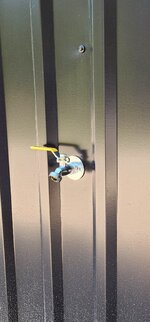
I've always had trouble getting threaded pipe fittings to seal, and now have a dilemma. I'm finishing the inside of the shop, and have a new external hose bib. Of course, the pipe fittings leak. I can fix it- eventually. Here's the problem: I know I'm going to be replacing the exterior siding where it penetrates the wall, but I can't do it right now. When I redo the exterior, I'll have to disassemble and re-assemble the pipe fittings. If it leaks (it probably will) I'll have no access on the inside to work on it. I'm actually considering a small access panel inside just so I can work on it.

As I said, this has always been a trouble spot for me. I've done research on proper torque for pipe fittings. I've tried teflon tape. I've tried pipe dope. I've tried pipe dope AND teflon tape. I've tried Permatex. When I built our house, I had ten threaded pipe fittings. Four of them would not seal, no matter what. I bought new parts for the four, and got them to stop leaking. I know a lot of it is cheap Chinese fittings, but that's what is readily available. I'll take any ideas I can get!
 
To avoid these ads, REGISTER NOW!

PCustoms

Well-known member
Joined
Jul 23, 2011
Messages
22,769
Location
VT
Leaving an access hatch, especially where this is a shop, is a great idea.

Depending what you (post pics) you could convert to PEX and do a service loop in an accessible spot...
 

cmandp

Well-known member
Joined
Dec 22, 2011
Messages
1,277
Location
New Jersey
Not sure how your using the NPT fitting(s) for the hose bib. But the only one i would have would be where the bib connects to the building plumbing.

The building plumbing i would do in PEX.
It is always good to have access to hose bibs from inside for when they go bad and need replacement.
 

Junkman

Well-known member
Joined
Dec 18, 2006
Messages
6,626
Location
Northeastern CT
In the old days, plumbers used pipe dope and cotton thread to seal the threads. Every time a threaded joint is taken apart and put back together, the threads are worn a bit more. When Teflon tape was first introduced, it was designed to address the wear problem, but it wasn't intended for new threads, as their sharp edges would cut through the tape. In the 1960s, we used Rectorseal #5 and "plumbers thread" on the black iron fittings. I guess that you could use some heavyweight cotton thread from your wife's sewing box. Color isn't important, so find a color you like and won't get lost in the shop.
 

CraigStu

Well-known member
Joined
May 22, 2014
Messages
4,027
Location
Blacksburg, Va
You mentioned chinese fittings. How about chinese pipe? 25 yrs ago my brother took back $1000 of black iron chinese pipe because he could not end up w/ nice threads. The die (original one and a new one) tore at the pipe vs cutting. Of course US pipe was about $1500 but it threaded nicely.
 

nadogail

Well-known member
Joined
Jan 23, 2009
Messages
31,949
Location
Coronado, CA
Unfortunately, Quality and low price seem to be diametrically opposed. Plumbing Supply houses don't want to disappoint their customers by providing low quality parts that cause their customers to have to forgo profits because they have to rework jobs.

It has been my observation that many people are shopping and selecting based on price. Big Box Stores generally feature low prices without regard to quality. Those who make all their purchasing decisions on acquisition cost are often unpleasantly surprised when they find that their "good deals" turn sour.
 
OP
M

MushCreek

Well-known member
Joined
Jan 14, 2015
Messages
9,768
Location
Upstate South Carolina
Yes, iron pipe, but only where the spigot threads on. I used PEX everywhere else. The local plumbing supply houses seem to only sell to pro's. When I built my house, I ordered pipe fittings from a so-called supply house, and they were no better than the big box stores. The more I think about it, an access panel seems like a good idea. I hate not having access, especially if a leak develops. My basement ceiling is suspended acoustic tiles because all of my plumbing and electrical runs through the ceiling framing. At least I can take panel(s) down to get at it for repair or modification.
 

PCustoms

Well-known member
Joined
Jul 23, 2011
Messages
22,769
Location
VT
Yes, iron pipe, but only where the spigot threads on. I used PEX everywhere else. The local plumbing supply houses seem to only sell to pro's. When I built my house, I ordered pipe fittings from a so-called supply house, and they were no better than the big box stores. The more I think about it, an access panel seems like a good idea. I hate not having access, especially if a leak develops. My basement ceiling is suspended acoustic tiles because all of my plumbing and electrical runs through the ceiling framing. At least I can take panel(s) down to get at it for repair or modification.

Why are you using iron pipe for water?

What is the rest of your plumbing system?
 

mm08822

Well-known member
Joined
Jan 13, 2012
Messages
5,909
Location
NJ
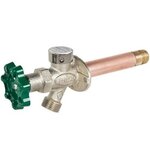
Also, freeze proof sill ***** are needed if exposed to freezing temps.

There should also be an inside shutoff.
 

PCustoms

Well-known member
Joined
Jul 23, 2011
Messages
22,769
Location
VT
Why are you using iron pipe for water?

What is the rest of your plumbing system?

I was occupied and missed you have PEX, and can't edit. Use a PEX barb to male pipe. If you need a rigid section for some reason get a stainless or brass ******/pipe

Best idea I've seen, if you have the geometry:

1754228478872.jpeg
 

yatg

Well-known member
Joined
Aug 16, 2019
Messages
2,793
Location
Southern Oregon
The local plumbing supply houses seem to only sell to pro's.
supplyhouse.com

PTFE tape + PTFE sealer is my formula.
Use real thread tape, not that cheap **** 98cent tape in the display box in the middle of the aisle at the box store.
Even Oatey yellow gas tape is thicker (4mil) and good for water, its just yellow.
Plenty of other brands to chose from.

A dozen years ago I redid my water heater and bought stainless fittings and pipe off ebay. What a PITA that was. Finally got it sealed and its held.

The last couple years for small projects I've been buying brass and stainless fittings from Amazon random name chicoms. I think their quality has improved from 10 years ago. They've finally figured out that NPT threads are tapered!

But last year when I rebuilt my well head, bought stainless fittings from supplyhouse.com. Extra $ but worth it.
 

Codyboy

Well-known member
Joined
Jan 31, 2019
Messages
1,649
Location
S.E. TEXAS
Yes, iron pipe, but only where the spigot threads on. I used PEX everywhere else. The local plumbing supply houses seem to only sell to pro's. When I built my house, I ordered pipe fittings from a so-called supply house, and they were no better than the big box stores. The more I think about it, an access panel seems like a good idea. I hate not having access, especially if a leak develops. My basement ceiling is suspended acoustic tiles because all of my plumbing and electrical runs through the ceiling framing. At least I can take panel(s) down to get at it for repair or modification.
How are you going from PEX to iron pipe? When I did my spigots I used a barbed pex to male MPT brass fitting. Tape and dope. The sillcocks I used were from supply house dot com. They have a flange that can be screwed to the building. If I need to replace one I can do it from outside, as I left enough slack in the pex to pull it out of the wall.
 

Attachments

  • Screenshot_20250803_095641_Gallery.jpg
    Screenshot_20250803_095641_Gallery.jpg
    1 MB · Views: 28
  • Screenshot_20250803_095345_Gallery.jpg
    Screenshot_20250803_095345_Gallery.jpg
    1.6 MB · Views: 28

carlaisle

Well-known member
Joined
May 14, 2022
Messages
373
If the threads aren't visibly deformed - i.e. jagged, torn, etc. - and they're not sealing, you're probably not using enough thread sealer and not tightening the joint enough. NPT threads are basically a compression seal. If you're using that spider web thin PTFE tape you can easily use a dozen wraps or more - it works just fine as long as you use enough of it. The three wrap rule of thumb was for the thick American made stuff from 50 years ago.
 

Jackfre

Well-known member
Joined
Dec 26, 2010
Messages
4,410
Location
N CA
I have a 1/2 & 3/4” MPT tap or thread chaser. I run it up NPT fittings. You can look at ****** threads and see the condition of the threads. Not so on the fittings. We used to use the thread or “candle wicking” on big joints, above 2”. 3” and above, lt’s weld it. Your access panel idea is certainly not the worst. Once you know the joint is made you can close it up.
 
OP
M

MushCreek

Well-known member
Joined
Jan 14, 2015
Messages
9,768
Location
Upstate South Carolina
I'll have to see if I can find a direct-to-pex sillcock, but it would have to come in at a 90 degree angle, as there isn't room in the wall to bend the PEX that much. What I currently have is PEX-to-male pipe, 1/2" pipe elbow, 1/2" pipe ******, and 1/2" NPT female on the sillcock. So three potential leaks. I don't even know which one is leaking, as I didn't look any further when I saw the leak. Since its an outbuilding, the water is shut off and drained in the winter. I do have a separate shut-off to the sillcock circuit. This spigot is used to wash cars and run my pressure washer. It's not used often, but the alternative is at the house, 150' away.
 

PCustoms

Well-known member
Joined
Jul 23, 2011
Messages
22,769
Location
VT
I'll have to see if I can find a direct-to-pex sillcock, but it would have to come in at a 90 degree angle, as there isn't room in the wall to bend the PEX that much. What I currently have is PEX-to-male pipe, 1/2" pipe elbow, 1/2" pipe ******, and 1/2" NPT female on the sillcock.

Why?

1754249492118.jpeg


1754249527678.jpeg
 
To avoid these ads, REGISTER NOW!
OP
M

MushCreek

Well-known member
Joined
Jan 14, 2015
Messages
9,768
Location
Upstate South Carolina
But there are still threaded connections. Less of them, but they're still there. When I do the outside wall, it won't be significantly thicker, but I still need to be able to disassemble and assemble the fittings to install the sheathing. An aside- I have another thread somewhere about repairing the T1-11 on the outside of the barn, as it's starting to rot at the bottom. I'm going to remove 3 or 4 feet of the T1-11, treat the new cut edge with preservative, install PT plywood to replace what I removed, and cover it with metal siding as a wainscoting. Flashing at the transition and a water table to direct water away. I don't have the money for that right now, and I'm trying to get the interior finished so I can heat it this winter. The aforementioned sill **** will have to go through the PT plywood and metal siding when I get to that phase, maybe a year from now.
 

Codyboy

Well-known member
Joined
Jan 31, 2019
Messages
1,649
Location
S.E. TEXAS
I'll have to see if I can find a direct-to-pex sillcock, but it would have to come in at a 90 degree angle, as there isn't room in the wall to bend the PEX that much. What I currently have is PEX-to-male pipe, 1/2" pipe elbow, 1/2" pipe ******, and 1/2" NPT female on the sillcock. So three potential leaks. I don't even know which one is leaking, as I didn't look any further when I saw the leak. Since its an outbuilding, the water is shut off and drained in the winter. I do have a separate shut-off to the sillcock circuit. This spigot is used to wash cars and run my pressure washer. It's not used often, but the alternative is at the house, 150' away.
Dang that's lot of fittings.
I was thinking about going with barbed pex sillcocks but decided against it if I need to replace one. Because the only way is to cut the pex.
No need for iron pipe at all.

Look at my pic earlier and how I turned the 90.
to go out the wall.
Crimp a pex 90 and stub out. Crimp a male brass barbed fitting onto the stubbed out pex and screw on the female sillcock.
 

Codyboy

Well-known member
Joined
Jan 31, 2019
Messages
1,649
Location
S.E. TEXAS
But there are still threaded connections. Less of them, but they're still there. When I do the outside wall, it won't be significantly thicker, but I still need to be able to disassemble and assemble the fittings to install the sheathing. An aside- I have another thread somewhere about repairing the T1-11 on the outside of the barn, as it's starting to rot at the bottom. I'm going to remove 3 or 4 feet of the T1-11, treat the new cut edge with preservative, install PT plywood to replace what I removed, and cover it with metal siding as a wainscoting. Flashing at the transition and a water table to direct water away. I don't have the money for that right now, and I'm trying to get the interior finished so I can heat it this winter. The aforementioned sill **** will have to go through the PT plywood and metal siding when I get to that phase, maybe a year from now.
I see no other way than a threaded connection (brass NOT IRON ) if you wan to take it apart later.
The way I did mine is one brass male to brass female connection.
 

OccupantRJ

Well-known member
Joined
May 15, 2009
Messages
11,056
Location
Eastern North Carolina
I've always had trouble getting threaded pipe fittings to seal, and now have a dilemma. I'm finishing the inside of the shop, and have a new external hose bib. Of course, the pipe fittings leak. I can fix it- eventually. Here's the problem: I know I'm going to be replacing the exterior siding where it penetrates the wall, but I can't do it right now. When I redo the exterior, I'll have to disassemble and re-assemble the pipe fittings. If it leaks (it probably will) I'll have no access on the inside to work on it. I'm actually considering a small access panel inside just so I can work on it.

As I said, this has always been a trouble spot for me. I've done research on proper torque for pipe fittings. I've tried teflon tape. I've tried pipe dope. I've tried pipe dope AND teflon tape. I've tried Permatex. When I built our house, I had ten threaded pipe fittings. Four of them would not seal, no matter what. I bought new parts for the four, and got them to stop leaking. I know a lot of it is cheap Chinese fittings, but that's what is readily available. I'll take any ideas I can get!

Start out by power wire brushing any male threads to smooth them a bit. You are a machinist so you are sure to be familiar with fuzzy threads. Also would be wise to run a pipe tap into female threads. Chinese pipe was surely different when I plumbed my shop air supply. The old pipe I had around had entirely different threading results. It was like threading 12L14 Ledloy vs. straight up cold rolled.
 

PCustoms

Well-known member
Joined
Jul 23, 2011
Messages
22,769
Location
VT
I love how the thread (no pun) is blaming Chinese threads, thin pipe dope and has now moved onto requiring everything gets tapped ahead of assembly.

The setup is a mismatch of pipes, some of them the completely wrong kind for the application.

Simply the setup down to a few fittings designed for fresh water and move on...
 

PWC Repair

Well-known member
Joined
Dec 27, 2012
Messages
3,179
Location
Arkansas
This may not be 'correct' but I use Versachem "Mega Grey'' silicone. Smear it into the male threads, put it together tight, and DON'T pressureize for a day. I never have a leak.
 

Dig Doug

Well-known member
Joined
Apr 16, 2018
Messages
1,103
Sprinkler pipe fitter told me to dope the threads then at least 3 complete wraps w/ tape - make sure you wrap in the correct direction !

Wrap -
Hold the ******/ pipe in the left hand horizontal, roll the tape towards your body then OVER the top away from you.

use pipe a wrench to tighten
 

u2slow

Well-known member
Joined
Nov 20, 2011
Messages
3,588
Location
BC
I like a canned pasty dope for steel/iron or any larger fittings. (Master's Pro Dope was the flavour today) Brush the dope in good, and run the fittings together by hand to coat the female threads. Repeat a few times. Then the last time, also add teflon tape, and crank it home.
 

DGersic

Well-known member
Joined
Mar 12, 2017
Messages
6,306
Location
DeKalb, IL
I'll have to see if I can find a direct-to-pex sillcock, but it would have to come in at a 90 degree angle, as there isn't room in the wall to bend the PEX that much. What I currently have is PEX-to-male pipe, 1/2" pipe elbow, 1/2" pipe ******, and 1/2" NPT female on the sillcock. So three potential leaks. I don't even know which one is leaking, as I didn't look any further when I saw the leak. Since its an outbuilding, the water is shut off and drained in the winter. I do have a separate shut-off to the sillcock circuit. This spigot is used to wash cars and run my pressure washer. It's not used often, but the alternative is at the house, 150' away.

Post pictures of the area you’re in and what you’re trying to do. Also, are you using crimp or expansion PEX?

Possibly this one would help:


You may find other ideas in my PEX repipe thread:

Thread 'Plumbing Project - Re-Pipe the House'
https://www.garagejournal.com/forum/threads/plumbing-project-re-pipe-the-house.509833/

I used a 90* fitting on the toilet supply routing because of limited space. All of the other 90* corners were bent, with supports, though.
 

u2slow

Well-known member
Joined
Nov 20, 2011
Messages
3,588
Location
BC
Using a proper vacuum breaker spigot right and not a cobbled up boiler valve, right?
So far I'm disappointed with the flow of frost-free spigots with integral vacuum-break. Not sure if that's universal, or just the particular ones I happened to grab. YMMV.
 
OP
M

MushCreek

Well-known member
Joined
Jan 14, 2015
Messages
9,768
Location
Upstate South Carolina
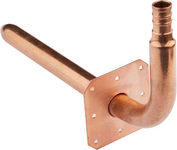
Still requires a threaded fitting. If I put an elbow on that right inside of the wall, I wouldn't be able to pull it out far enough to disassemble when the time comes to redo the outside. I guess I could use a PEX-to-pipe elbow with mounting tabs, then mount it on a block of wood inside the wall. Of course, I'd have to wait until water ran out of the wall to see if it was leaking or not.

I tightened up the leaking fitting (it was the PEX-to-1/2" MIP), and so far it's holding. Fingers crossed. The area on the interior will have a 4' tall wainscot of roofing tin, so I think I could unscrew the panel and ease it out of there in the event it needed service.

I just wish I knew why threaded pipe fittings are such a PITA. I worked my career building plastic injection molds, which are water cooled. Making sure they didn't leak was always a hassle. It's hard to cut clean pipe threads in tool steel, and of course, once it's hardened they can't be recut. Over time, the threads wear out and rust, making them even harder to seal. We had one mold that we packed the thing full of JB Weld around the pipe fitting, and wrote on the mold that that fitting was never to be removed. Normally, the water pipes are removed every time the mold is serviced so that the hardened inserts can be removed and properly cleaned. After it is reassembled, it is pressure test to make sure that there are no leaks. In some cases, we ran a vacuum system which sucked the cooling water through instead of pushing it, but we didn't have enough equipment to do that on all of them.
 

LopezBart

Well-known member
Joined
Oct 13, 2023
Messages
2,539
Location
Lopez Island, WA
Our steamboats use a lot of steel piping. I recommend ordering Ward fittings from SupplyHouse.com; they are made in the US and I've never had a leak on a properly torqued joint sealed w/ Teflon paste (RectorSeal #5 is the good stuff, but isn't really required).

Finding a source of domestic iron pipe can be more difficult, of course.
 
To avoid these ads, REGISTER NOW!
Top Bottom