0.1" is a good travel range for stuff like runout and parallel? I think that makes sense. I imagine a rule would be sufficient to show things are messed up for more than that.
If you had to get 1 mount would you lean towards the flex ones like 278horn and signcrafter linked or the rigid bars with locking hinges type?
Thanks All. This is helpful.
Re: .1" travel I don't think so.
I think the terms you need to know are "Dial Test Indicator" vs "Dial indicator" (or whatever
@RoninB4 calls them). Machinists use crazy terminology that only they can understand (hope that makes Ronin laugh). "Test indicators" have levers and, while they can take absolute measurements, we almost never use them for that. Dial indicators have gobs more travel and can take very accurate measurements if the plunger is perpendicular to the measured surface. Well here are some pics:
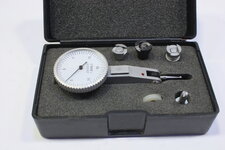
This is a Dial Test Indicator. Notice the little lever. This guy reads 0-.030" but is marked +/- .015 because readings can be taken in either direction. This is an important first lesson. In use, you "preload" the indicator. You don't start in its natural zero. So you need more travel in the indicator, than the range you want to measure.
This specific example came from LittleMachineShop.com. It's a good quality tool. The problem with these Chinese indicators is that they use non-standard dovetails and provide all the studs you don't need. The black one, is the 8mm 5/16" stud all my holders want, filed to fit this stupid indicator (which I subsequently sold).
In general, machinists use these to align things, align our vises to our mills, check runout on lathes etc.
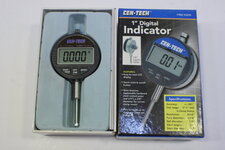
The other kind, I think the kind you are interested in, is the standard plunger type dial indicators. They generally look like this:

This guy (doesn't belong to me) looks like a 1" travel indicator that reads in .001" increments. These longer travel instruments can be easier to setup on something like a table saw that's pretty far out when you start. The re-zeroing can be fiddly (more about that later).
My sense is, the tool itself is less important than the holder for the tool. And the plural on "holder" is intentional. On a table saw, you might want to start with a surface gauge as a holder like this one:

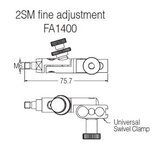
Adapting the indicator to this holder, which is not technically designed to hold indicators, will require specialty hardware, starting with something called a "snug".
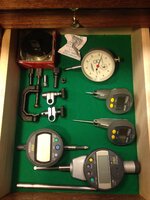
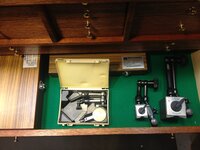
You can see a variety of holding fixtures in this picture. Top left is a "lug back" that attach to standard sized indicators. Different size studs attach to the lug (must be sized accordingly) then provide an attachment stud for the "snugs" below them which basically clamp the indicator to a shaft (mast) of a surface gage or whatever.
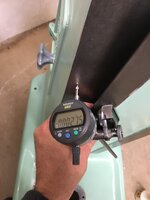
You would use this set up to indicate one surface relative to another and be able to slide the gage along the reference surface as you see me doing below: