To avoid these ads, REGISTER NOW!

Learning to Weld - What Progression of Techniques?

bulletpruf

Well-known member
Joined
Nov 28, 2013
Messages
11,130
Location
San Antonio
Fellas -

So, I have a Miller 211 MIG and an oxyacetylene setup. Now that I'm finally back in the US after 5 years of being overseas, I would really like to learn how to weld worth a darn.

My question - I suspect I will eventually want to master MIG, TIG, oxyacetylene, and arc/stick welding, so is there a recommended progression? I realize that the methods are different, but I suspect some of the techniques/knowledge is relevant to more than one process.

FYI - most of my welding will be garage and automotive related.

thanks

Scott
 
To avoid these ads, REGISTER NOW!

RustyJunk

Well-known member
Joined
Jun 11, 2018
Messages
274
Location
Pasco Fl.
I would find a local welder and have him help you get started with your 211. You can get all types of confusing advice from guys on forms but most of it that I have seen is not much good for a beginner. I have set people up and had them running beads as good as a pro in just a few hours and then it's just a matter of learning to do a proper setup for the application. I do all types of welding but in the shop I use a mig 90% of the time, it's just the easiest way to go most of the time.
 
Last edited:

jhn9840

Well-known member
Joined
Mar 11, 2007
Messages
1,189
Location
Northern Panhandle of WV
I went to welding school back in the late 70's. They started with O/A. Learn the basics there and it holds true to the other processes. They moved on to arc/stick weldlng from there then to mig. If you can arc weld surly you can use a mig. Tig was the last process that was taught.

Things may have changed since way back then. But I doubt that a solid foundation starting with learning the basic fundamentals have. Best of luck to you.

jhn9840
John
 

cvairwerks

Well-known member
Joined
Aug 12, 2016
Messages
7,254
Location
Within hearing distance of Texas Motor Speedway
Start with O/A and you can weld and braze. Master the basics there and TIG comes easy. On the other methods, stick then MIG. MIG is too easy to get good looking welds, but with lousy penetration. MIG and TIG both have lots of things and settings an operator can vary and it takes some decent time to get to know how each item affects the others and how that impacts the weld joint.

If you can dedicate the time, go take the EAA Gas Welding class over in Houston, 1-2 December. It's enough to get you started and making good, basic welds on thin wall materials and is a good starting point.
 

dogdog

Well-known member
Joined
Nov 15, 2011
Messages
12,711
local school or watch the pros and practice / practice and practice with coupons...

MIG/STICK/and O/A I liked Steve Bleile Welding Videos

TIG I liked the welding videos from Ron Covell... they are very good for beginers and a likes...

Worth the every pennies, but having an instructors by your side is a lot better.... Other youtube videos are good, they skip some of the basics sometimes.. or a lot of them are not focus on actually teaching you the basic knowledge, and just boast of "look ma... I am the best dam welder in the whole wide world of Webs"
 

MoonRise

Well-known member
Joined
Nov 5, 2010
Messages
4,031
Location
NJ
At the heart of it, all welding is the same.

Apply heat to melt the item(s) you are welding and melt the joint zone without melting it to the floor, possibly add some filler, and achieve a Zen state of oneness. :D

It's the fine process details that change from process to process. :lol:

Automotive-centric welding?

IMHO, probably MIG (technically GMAW :D ) for most general-purpose stuff. Fussy things (tubing, aluminum stuff, roll cages, etc) might be TIG (technically GTAW). Rarely stick (technically SMAW), unless for 'thicker' brackets or such. Rarely oxy-acetylene welding, although using the oxy-acetylene torch to heat things (aka 'the blue wrench') or to maybe braze something might happen.

YMMV and all that.

If you can find something, some community colleges or adult education schools offer various 'Intro to welding' classes. Look for one geared (Ha!) for hobbyists, and not a 'welder certification class'.

All welding comes down to "puddle control". How big, how deep, how fast to move, how much filler to add, etc, are variations of puddle control.

Oxy-acetylene can teach (or show you how much you need to learn and practice some more :D ) about puddle control. Without dunking the tungsten like in TIG. :lol:

With GMAW (aka MIG), you still need to watch and pay attention to the weld puddle.

The general 'problem' with MIG (more specifically with short-arc transfer mode GMAW) is that one can make what 'looks' like an OK weld (because the weld bead generally 'looks' OK, at least superficially or to the untrained eye) but the weld never melted into or fused into/with the piece(s) being welded. Called "lack of fusion" or "lack of penetration" or "cold lap".

Practice, practice, practice. :D

Want to start practicing with that MM211?

Get some 1/8" thick plain mild steel. Use C25 shielding gas and either 0.023 or 0.030 solid filler wire (I like to stick with a name brand wire, like Lincoln L-56, so that you are not 'fighting' some unknown set of variables with wire 'quality'), RTFM or the parameter door chart for what machine settings to start with, lay one piece of the steel on top of the other to achieve a "lap joint". Start the weld, watch the weld puddle (the molten steel, not the bright arc!) melt into BOTH pieces of steel and the filler wire flow into and build up the puddle to the appropriate bead size without melting away the top edge of the top piece of steel or melting right through the bottom piece of steel (the lap joint configuration helps here by giving you a visible edge to follow and also having two thicknesses of metal where you are welding). Keep practicing.

Welding on the floor *****. Get (make or buy) some sort of 'welding bench/table'. Even the H-F folding one (on sale it runs about $60-$70) and it is actually worth it IMHO.
 

sberry

Banned
Joined
Jun 18, 2005
Messages
35,747
Location
Brethren, Michigan
They invented the 211 and small mig for this crowd. its an ideal c25 030 machine. Its for people wanting to maintain and build some stuff which is different than a desire to be a career welder.
 

kazlx

Well-known member
Joined
Oct 30, 2012
Messages
2,851
Location
Tustin, CA
Start with the mig. Cut some coupons, find the book specs and go to town. Play with things as you go. It's all about hood time. It would probably be the most beneficial for all around garage/hobby stuff.

If you really want to dedicate time, take a college class. Cheap fees for basically unlimited supplies and guidance. But, it's really not that hard to tackle yourself if you're motivated to learn.
 

Marctrees

Well-known member
Joined
Mar 5, 2015
Messages
6,265
Location
TX/LA border - Toledo Bend
I totally agree w finding a local Pro welder that does in shop stuff that is not toooo different than you want to do.

Try to find a Guy that is communicative, not some might as well be technically mute *******.

Pay him $50 - $100 CASH to come and work w you for an hour or two..

Be prepared, with like scraps and everything READY to go.

I garanteeeee you, DO THIS.

Best $ you ever spent.

I learned the hard way, then finally did this.

Night and day improvement in my knowing what / how to do it.

Marc
 

Marctrees

Well-known member
Joined
Mar 5, 2015
Messages
6,265
Location
TX/LA border - Toledo Bend
After I first made a few mobile tool bases.. I welded half way into a 900 lb offset smoker build.

Then I hired a Guy to do good looking proper welding on my 1/2" plasma cut endcaps..

When he came over and started, I immediately learned I was frying my eggs WAY too low, resulting in way less penetration than I thought.

Marc
 

Lassen Forge

Well-known member
Joined
Apr 26, 2014
Messages
15,397
Location
The romantic hills of central Umbria, Italy,
College you get to abuse their equipment, burn their supplies (for IIRC a $20 material fee), and have a good progression from the basics on. Some people take those classes to do projects, but there's nothing wrong with using it to learn and practice until you can turn out 30 ton welds in your sleep with a hangover. Plus you'll get to play with equipment before you sink $$ into it, and know what good work VS not good work looks like.
 

dr_clyde

Well-known member
Joined
Jan 7, 2009
Messages
6,463
Location
Holland, MI
If you want to learn all the basic processes, which will make you a better welder, there is a recommended order to learn them that most welding schools follow.

Oxy-acetylene, stick, TIG, then MIG last.

Oxy-acetylene best teaches heat and puddle control, as well as thermal capacity, and the basic muscle memory that will help with the other processes.

Stick welding is the most basic arc welding, and teaches the effects of arc force, dealing with fluxes, slag, arc length, and travel speed.

TIG refines the lessons learned by oxy acetylene and stick welding.

Mig welding is the hardest, and is why it's saved for last. You can just pull a trigger and it spits out wire and makes a bead. It doesn't care if the machine is set up right or if you know what you're doing. If you don't know what a good puddle looks like, how the arc behaves, what penetration looks like, and how steel is effected by heat it's very easy to make a bad weld.

Welding is a skill, and it takes lots of practice to do well. Start at the beginning and build slowly.
 

sberry

Banned
Joined
Jun 18, 2005
Messages
35,747
Location
Brethren, Michigan
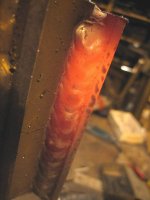
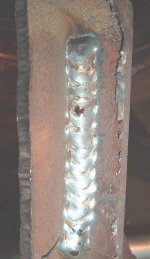
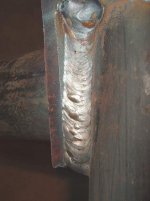
I know guys that don't know squat, couldn't burn a stick well enough to weld themselves inside a box but can actually do basic mig quite well. They don't usually learn very up very well without some instruction though.
I get them to sacrifice a little appearance to start with, hang in as hot as they can and go for fusion first, then make it prettier.
 

Attachments

  • Hot vert 2.JPG
    Hot vert 2.JPG
    35.4 KB · Views: 56
  • hot vert.JPG
    hot vert.JPG
    32.7 KB · Views: 49
  • hob vert 30a1.JPG
    hob vert 30a1.JPG
    42.2 KB · Views: 53
  • hob hot.JPG
    hob hot.JPG
    39.5 KB · Views: 49
Last edited:
OP
B

bulletpruf

Well-known member
Joined
Nov 28, 2013
Messages
11,130
Location
San Antonio
Fellas -

Many thanks for all the input. I would really, really like to take a class, but with my schedule at work and home, it's not a good fit.

I think I'll end up getting started with oxyacetylene brazing and gas welding (class in Houston mentioned by cvairwerks sounds interesting), then stick welding before going to MIG and TIG (although not necessarily in that order). Interesting comment from Dr. Clyde on doing TIG and then MIG; I'll give it some thought, especially since it will be a good excuse to get a TIG machine!

And MoonRise reminded me that I need to get a welding table/bench. HF sounds like the hot ticket here.

Marctrees -- good points on getting an expert to come over to school me a bit. I will start off with youtube and internet but I don't mind dropping a Ben Franklin on private lessons if that is what it takes to get me over the hump.

One question - what are these "coupons" that y'all refer to?
 
Last edited:

MoonRise

Well-known member
Joined
Nov 5, 2010
Messages
4,031
Location
NJ
A "coupon" in this usage is just a 'smallish' piece of metal that you made some practice welds on. Smallish meaning not a 4x8 foot plate. :lol:

Formally, a "coupon" can also be a welded piece that is submitted for evaluation and testing of the weld (s).
 
Last edited:

joeswamp

Well-known member
Joined
Jul 25, 2007
Messages
2,418
Location
Massachusetts
Another vote for starting with oxyacetylene. Not used as much in production anymore, but one of the most flexible ways to weld, and helps you learn all the other processes. Still used on the most high end car restorations (along with TIG) and on aircraft. A good oxyacetylene expert is fun to watch, as they can control distortion and make the metal move where they want it to go.

Learning to TIG is easier once you've mastered oxyacetylene. TIG is the most precise way to weld, it's used on aerospace, bicycle frames, etc. Great for automotive sheet metal but slower than MIG.

MIG is the fastest way to weld, a friend once called it "the metal hose". It seems easier than it really is, as mentioned earlier it's easy to get welds that lay on top of the metal and have no strength. Welds tend to be uglier and require more grinding.
 

matt_i

Well-known member
Joined
Mar 14, 2008
Messages
10,744
Location
SE Michigan
There's a few more support tools if you ask me. You'll want at least one angle grinder (thin cutoff disk, flap wheel, "woven" general purpose wheel).

Now its time for a bandsaw, a 4x6 horizontal is a place to start.

And now you need some steel (usually) which involves sorting out local suppliers' costs, customer service, and breadth of inventory.

The most common problem I get with beginners is that they want to move everything very fast because (?) But you should really try a few times to overheat things by purposefully pouring too much heat into a local area. Don't let any white hot drippy metal balls get into your boots :D To get proper penetration its one step back from that.

If I could have only one process for the rest of my existence I'd choose tig. Then stick after that, for structural stuff. Oxy heat is right up there but I have never used fuel gas to weld.
 

udderlyoffroad

Well-known member
Joined
Aug 2, 2014
Messages
93
Location
Bristol, UK
Ok, I’ll be the dissenting voice:

Thing is, do you want to learn to weld, so you have another skill, or do you want to fix up your car? I get the impression – though I could be wrong – that you’re short on time as it is, due to family and work commitments.

Absolutely nothing wrong with the O/A -> Stick -> MIG -> TIG approach. It’s how professional welders do it, and for good reason. However, this takes time and dedication.

Whereas, most hobbyists looking to rebuild a car would probably be better served by leaping straight into MIG having after taking some professional instruction on machine setup, positioning, how to spot lack of penetration, undercut and so on.

Don’t get me wrong, I wish I’d learned the ‘right’ way, however for 99.9% of what I do MIG will cover it, and a case of beer to my buddy with an AC/DC TIG will cover the remaining 0.1%....

Most importantly though, don't confuse what I've said with not needing to practice. Practice, practice, practice, and then practice some more. Remember, if it sounds like frying bacon, it's probably ok. If it smells like frying bacon, you're on fire! :bounce:
 

bigguns69

Well-known member
Joined
Aug 23, 2011
Messages
411
Location
Iowa
MIG is the easiest, fastest and the one you will use the most. It is the go to for general steel welding. There is nothing wrong with starting there. Being successful at something gives you the confidence to try something more challenging. If you can OA, Stick, or TIG, mig is super easy.

Some other support equipment worth their weight in gold. A good auto-darkening helmet. A portable bright light to see your work well. A few right angle grinders set up with various wheel types. A decent chop saw. A solid heavy weld table. Clamps. C-vise grips.

Try stick welding a patch panel on a car fender. You'll get good or frustrated really fast.

Have fun......
 
To avoid these ads, REGISTER NOW!

RustyJunk

Well-known member
Joined
Jun 11, 2018
Messages
274
Location
Pasco Fl.
I think the folks that say schools will teach you OA welding first must have gone to welding school back in the 60's, I do some brazing on cast iron from time to time but haven't done any OA welding since the early 70's.
 

sberry

Banned
Joined
Jun 18, 2005
Messages
35,747
Location
Brethren, Michigan
Agreed with posts 19/20 and the 99.9 figure. I have and can use them all. If I had only 1 it would be a wire feeder. My neighbor has been over once since he got a 175 15 years ago, that was to weld a piece of aluminum.
 
Last edited:

dr_clyde

Well-known member
Joined
Jan 7, 2009
Messages
6,463
Location
Holland, MI
I think the folks that say schools will teach you OA welding first must have gone to welding school back in the 60's, I do some brazing on cast iron from time to time but haven't done any OA welding since the early 70's.

You are not correct. Oxy-acetylene is used as a teaching tool in modern welding classes. It teaches you things in the beginning steps because everything exaggerated, and it is easier to learn the basics. Most people don't gas weld anymore, for sure, but knowing the fundamentals is key to building successful welding knowledge and skills.

I have a friend who is a welding consultant, degreed welding engineer and teaches at a welding college. They teach welding to hobbyists as well as welding degree college students. They teach, in this order, oxy-acetylene welding and cutting, stick welding, tig welding (steel, aluminum and stainless), and finally mig welding. They do mig welding for maybe a week or two, because once you can do all the rest, mig welding properly is fairly trivial and fast. Then, once you know how to do the basics, they then teach certification test plate welding, pipe welding, robotic welding, and some niche processes like submerged arc and dual shield flux core.

You have to crawl before walking, and walking comes before running.

The OP expressed interest in learning all the basic processes, and that is the generally recognized path to learn the basics of the 4 common processes.

Now, if all you want to do is mig weld brackets and auto body panels, and you have no interest in welding as a trade or you just don't care about the other processes, you can get by with a few hours of instruction.

Having more knowledge is better, so why wouldn't you want to know? Welding is a lot of "wax on, wax off" kind of thing. It takes time to develop the eye for the puddle, the muscle memory to handle an electrode, the skills to handle what happens during a weld. Once you have a handle on the basics, the rest comes easy.
 

Marctrees

Well-known member
Joined
Mar 5, 2015
Messages
6,265
Location
TX/LA border - Toledo Bend
Find a place that does steel fab near you..

Occasionally check their dumpsters for practice pieces, ..

Maybe even larger "usables"..

The small amount you take will only give them 50 cents less when the load is picked up.

So, buy the shop a dozen donuts.

Marc
 

bimmer1980

Well-known member
Joined
Feb 5, 2009
Messages
2,105
Location
York, PA
Lots of good advise already posted.

My two cents to add to that.... ;-)

If you are going to proceed to learning and practicing at home.... You will need a fair number of weld coupons for practicing... In high school, we would use the iron worker to munch thru some flat bar to make coupons about 2" wide by 3 or 4" long. While you could saw all those up with a band saw or a chop saw, you'll spend a fair bit of time... A variety of thickness is also helpful... 1/8", 3/16", 1/4".... other thickness as your skill builds...(and pending what process you are doing)

I would suggest finding a metal fab shop or metal supplier that will cut some pieces for you or allow you to buy a fair number of drops. There should be a bin at the end of the saw, iron worker, shear, etc that would have pieces close to the right size.

For the high school welding shop, we would make a trip to some steel fabricators and either buy or get donated scraps for us to weld into "sculptures"....

Regardless of which process you start with, practice is the key! Don't forget the power of a big hammer to test the bending strength of your weld. You can also cut across the weld to check for penetration....

In your spot, I would try to get some brief intro to Mig welding. Do some practice runs. Get some feed back. Practice some more. Build some confidence. Then learn some on Gas welding to get a better understanding..... Maybe not the BEST method, but it would at least get you to the point of sticking some things together.... which at the end of the day is what you want, I think...

I learned in high school... Gas, then stick (6011, 6013, 7014, 7018, maybe some 7024), then Mig, including dual shield. I learned Tig on an internship at a company...

I recommend at least two grinders: one with a wire wheel and one with a grinding wheel.

I personally have about 4 to 6 grinders set up for various weld prep: Wire wheel, rough grinding wheel, flap disc, cut off wheel, and some times a masonry wheel when there is some concrete work....(p.s. the concrete does not get welded.. ;-)

I second the idea of a HF welding table to get started. I would get a better helmet than the HF auto dimming.... I've been happy with my Kobalt auto dimming...Lots of options.. Being able to clearly see the puddle will go a long ways!!
 
OP
B

bulletpruf

Well-known member
Joined
Nov 28, 2013
Messages
11,130
Location
San Antonio
There's a few more support tools if you ask me. You'll want at least one angle grinder (thin cutoff disk, flap wheel, "woven" general purpose wheel).

Now its time for a bandsaw, a 4x6 horizontal is a place to start.

And now you need some steel (usually) which involves sorting out local suppliers' costs, customer service, and breadth of inventory.

The most common problem I get with beginners is that they want to move everything very fast because (?) But you should really try a few times to overheat things by purposefully pouring too much heat into a local area. Don't let any white hot drippy metal balls get into your boots :D To get proper penetration its one step back from that.

If I could have only one process for the rest of my existence I'd choose tig. Then stick after that, for structural stuff. Oxy heat is right up there but I have never used fuel gas to weld.

I have the Milwaukee corded bandsaw that's set up to be used on the small table that's a popular setup here (can't recall who sells the table).

Have a few angle grinders in the shop.

And a Craftsman block grinder with wire wheel and grinder wheel.

Sold my drill press before I left Italy, but I'm actively searching for a replacement. Have a good drill press vise, too.

And like any good card carrying GJ member, I have various vises in the garage. A 6" Record mounted to my work bench. A 4.5" restored Wilton bullet bolted to my "Portable Dirty Room." And a 2" Wilton bullet, but that's going on my daughter's play work bench.

Thanks

Scott
 
OP
B

bulletpruf

Well-known member
Joined
Nov 28, 2013
Messages
11,130
Location
San Antonio
Ok, I’ll be the dissenting voice:

Thing is, do you want to learn to weld, so you have another skill, or do you want to fix up your car? I get the impression – though I could be wrong – that you’re short on time as it is, due to family and work commitments.

Absolutely nothing wrong with the O/A -> Stick -> MIG -> TIG approach. It’s how professional welders do it, and for good reason. However, this takes time and dedication.

Whereas, most hobbyists looking to rebuild a car would probably be better served by leaping straight into MIG having after taking some professional instruction on machine setup, positioning, how to spot lack of penetration, undercut and so on.

Don’t get me wrong, I wish I’d learned the ‘right’ way, however for 99.9% of what I do MIG will cover it, and a case of beer to my buddy with an AC/DC TIG will cover the remaining 0.1%....

Most importantly though, don't confuse what I've said with not needing to practice. Practice, practice, practice, and then practice some more. Remember, if it sounds like frying bacon, it's probably ok. If it smells like frying bacon, you're on fire! :bounce:

I actually want to learn how to weld. Believe it or not, it's been a lifelong goal of mine. When I signed up for the Reserves when I was 17, I told them I wanted to be a welder. And I was all set to go to Basic Training and then welding school (AIT). However, sometime in 1985 or 1986 they changed the length of welding AIT from 8 weeks to 25 weeks or something like that. And then I was going to miss my first year of college instead of just my first semester so I changed my MOS to something that only had an 8 week AIT.

I also look forward to learning new tasks, having a few options when it comes to joining two pieces of metal together, and, of course, having an excuse to buy more tools.

I guess that's a long way of saying that I would like to learn something besides MIG.

Thanks
 
OP
B

bulletpruf

Well-known member
Joined
Nov 28, 2013
Messages
11,130
Location
San Antonio
MIG is the easiest, fastest and the one you will use the most. It is the go to for general steel welding. There is nothing wrong with starting there. Being successful at something gives you the confidence to try something more challenging. If you can OA, Stick, or TIG, mig is super easy.

Some other support equipment worth their weight in gold. A good auto-darkening helmet. A portable bright light to see your work well. A few right angle grinders set up with various wheel types. A decent chop saw. A solid heavy weld table. Clamps. C-vise grips.

Try stick welding a patch panel on a car fender. You'll get good or frustrated really fast.

Have fun......

Yeah, my auto darkening helmet isn't great. Need a chop saw. Figure I'll go with the HF weld table for now. Have a metric sh*t ton of C clamps and lots of C-vise grips.

I hear you on thin metal. I can join two pieces of metal with my MIG, but the thin stuff gives me fits.
 
OP
B

bulletpruf

Well-known member
Joined
Nov 28, 2013
Messages
11,130
Location
San Antonio
You have to crawl before walking, and walking comes before running.

The OP expressed interest in learning all the basic processes, and that is the generally recognized path to learn the basics of the 4 common processes.

Now, if all you want to do is mig weld brackets and auto body panels, and you have no interest in welding as a trade or you just don't care about the other processes, you can get by with a few hours of instruction.

Having more knowledge is better, so why wouldn't you want to know? Welding is a lot of "wax on, wax off" kind of thing. It takes time to develop the eye for the puddle, the muscle memory to handle an electrode, the skills to handle what happens during a weld. Once you have a handle on the basics, the rest comes easy.

Well said. Thanks for the input.
 
OP
B

bulletpruf

Well-known member
Joined
Nov 28, 2013
Messages
11,130
Location
San Antonio
Find a place that does steel fab near you..

Occasionally check their dumpsters for practice pieces, ..

Maybe even larger "usables"..

The small amount you take will only give them 50 cents less when the load is picked up.

So, buy the shop a dozen donuts.

Marc

Yeah, I need to find a shop nearby. There's a Krispy Kreme around the corner, so that's half the battle.
 
OP
B

bulletpruf

Well-known member
Joined
Nov 28, 2013
Messages
11,130
Location
San Antonio
Lots of good advise already posted.

My two cents to add to that.... ;-)

If you are going to proceed to learning and practicing at home.... You will need a fair number of weld coupons for practicing... In high school, we would use the iron worker to munch thru some flat bar to make coupons about 2" wide by 3 or 4" long. While you could saw all those up with a band saw or a chop saw, you'll spend a fair bit of time... A variety of thickness is also helpful... 1/8", 3/16", 1/4".... other thickness as your skill builds...(and pending what process you are doing)

I would suggest finding a metal fab shop or metal supplier that will cut some pieces for you or allow you to buy a fair number of drops. There should be a bin at the end of the saw, iron worker, shear, etc that would have pieces close to the right size.

For the high school welding shop, we would make a trip to some steel fabricators and either buy or get donated scraps for us to weld into "sculptures"....

Regardless of which process you start with, practice is the key! Don't forget the power of a big hammer to test the bending strength of your weld. You can also cut across the weld to check for penetration....

In your spot, I would try to get some brief intro to Mig welding. Do some practice runs. Get some feed back. Practice some more. Build some confidence. Then learn some on Gas welding to get a better understanding..... Maybe not the BEST method, but it would at least get you to the point of sticking some things together.... which at the end of the day is what you want, I think...

I learned in high school... Gas, then stick (6011, 6013, 7014, 7018, maybe some 7024), then Mig, including dual shield. I learned Tig on an internship at a company...

I recommend at least two grinders: one with a wire wheel and one with a grinding wheel.

I personally have about 4 to 6 grinders set up for various weld prep: Wire wheel, rough grinding wheel, flap disc, cut off wheel, and some times a masonry wheel when there is some concrete work....(p.s. the concrete does not get welded.. ;-)

I second the idea of a HF welding table to get started. I would get a better helmet than the HF auto dimming.... I've been happy with my Kobalt auto dimming...Lots of options.. Being able to clearly see the puddle will go a long ways!!

Good input. Thanks for taking the time to provide details.

I guess a new auto dimming helmet is going to be necessary.

I do have a question on welding different thicknesses of metal -- I guess you start with the easier stuff and then work to the more challenging, right? In other words, with the MIG you probably start off with 1/8" or something like that? Thin stuff being more difficult because you can blow through and thicker stuff more difficult because of lack of penetration?

thanks
 

sberry

Banned
Joined
Jun 18, 2005
Messages
35,747
Location
Brethren, Michigan
The work I do is similar to a lot of guys here. When I reccomend or advise I try to put myself in the position of the guy I am talking to and try not let my own preference and experience corrupt the process.
I have changed my view some along the way. Just cause I have a S.A. 200 doesn't mean everyone needs one. In this line of work alloy is very minimal and even rare. I have 5 miles of aluminum pipe and hundreds of fittings that most do not have. Because I need this doesn't mean everyone does, if I had a specialty shop the view would be different too.
If a guy doesnt have a 200 feeder I can almost bet this is a good start andsomething a guy would want to add anyway. I ran in to a recent retire , bought a 211 and a dyn. Used the 211 a lot and the Dyn 5 minutes, said he would have skipped it.
A Carney I talk to said, the new TB he got is great,, the feeder he got to go with it was expensive freight in the tool box, taking up space.
 

ZRX61

Well-known member
Joined
Aug 15, 2006
Messages
28,716
Location
Solar Blight Valley, SoCal
You're in a big town, check the local community colleges for a welding class.


Books: Hobart Institute of Welding books are what my local college uses. There's quite a few of them (I ended up with 6 different ones).
They won't do anything for muscle memory, but at least give you an idea of what to do & what not to do.
 

e015475

Well-known member
Joined
Jul 24, 2012
Messages
644
Location
Show Low and Mesa Arizona
I'm a car hobbyist and have been TIG welding about 20 years now (I have a MIG machine I've used about 20 min in the last 10 years)

I took a basic course in OA and stick at the CC about 20 years ago, bought a TIG at the EAA Fly-in and taught myself to TIG. It is all I ever use.

I do ok but wanted to up my game, and get much better at aluminum and stainless, so I'm currently enrolled in the local CC TIG class. Cost is about $750 for a three hour class twice a week. The equipment and instruction are first class. It is about 80% supervised practice and 20% classroom, which is mostly videos about technique.

Most attending the class are there because they want to earn a welding certification. All the work is off of 2x6" metal coupons, roughly the same as autobody sheetmetal, or about .035-.040"

You start by running 5-6" stringer in mild steel to get your hand eye coordination established and learn puddle control. Once you can do a 5-6 in continuous weld stringer with good heat and puddle control, you proceed to overlaps and T-joints.

You basically sit down and practice for three hours twice a week. An instructor will come along about once an hour and either critique your welding or demo the technique (or both) Once you've demo'd the stringer/lap/T successfully he moves you on to the next process or material. Started late August with steel, and just finishing up aluminum this month. Next month I will focus on stainless.

Those interested in certification **** weld two coupons together for practice on a fixture that back purges the coupons. They look for consistent penetration through the joint with the bottom bead about a third the size of the top of the bead.

My focus isn't on certification, so I practice on steel, aluminum and stainless coupons for ****, lap and T joints. I find the practice, ability to experiment a little with different techniques and feedback/demos from the instructors to be pretty good learning experience. But it is mostly practice to get the hand eye coordination to become muscle memory. I'm getting older and my hands are less steady than they used to be, and the instructor has suggested several techniques to help both my torch hand and my rod hand.

Equipment wise, I like the 3M Speedglass helmets. I also got a pair of single vision glasses with a focal length of about fifteen inches to wear while welding, and between the Speedglass and the glasses and I can see the puddle pretty well. Now it is just down to practice and muscle memory.

Whether you have time to take a class or have the self discipline to sit down and practice every day, the time commitment is no different. What makes a good welder is the amount of time practicing and perfecting the techniques.
 

MoonRise

Well-known member
Joined
Nov 5, 2010
Messages
4,031
Location
NJ
I have the Milwaukee corded bandsaw that's set up to be used on the small table that's a popular setup here (can't recall who sells the table).

Have a few angle grinders in the shop.

And a Craftsman block grinder with wire wheel and grinder wheel.

Sold my drill press before I left Italy, but I'm actively searching for a replacement. Have a good drill press vise, too.

And like any good card carrying GJ member, I have various vises in the garage. A 6" Record mounted to my work bench. A 4.5" restored Wilton bullet bolted to my "Portable Dirty Room." And a 2" Wilton bullet, but that's going on my daughter's play work bench.

Thanks

Scott

Yeah, my auto darkening helmet isn't great. Need a chop saw. Figure I'll go with the HF weld table for now. Have a metric sh*t ton of C clamps and lots of C-vise grips.

I hear you on thin metal. I can join two pieces of metal with my MIG, but the thin stuff gives me fits.

Metal mini-table to 'convert' a portable bandsaw (aka port-a-band) into a small bench bandsaw?

Usually that is a SWAG Off-road unit. Or a homemade version. :thumbup:

If you have the bandsaw, I'd say skip getting a 'chop saw'. An abrasive cut-off saw, aka chop saw, is loud, sprays grit and sparks (if cutting steel. I set my LAWN on fire one time using the chop saw :lol: ) and swarf all over the place. They certainly have their place (I have one), but unless you are cutting some semi-hard steel pieces and don't want to strip off the teeth from your bandsaw blade, I'd say skip it.

The recent gen auto-darkening helmets are 'better' than older (or cheaper) units. Clearer view, less visual or color distortion across the field of view. But you don't necessarily 'need' one.

That said, the recent Lincoln Viking auto-dark helmets with the 4C lens are pretty nice. :thumbup: Not perfect IMHO, but generally I give it an A-. Decent headgear, awesome view, but the control switches are on the inside of the helmet (can't change setting on the fly). But they are not inexpensive.

And 'thin stuff' is rather tricky to weld no matter what. Burn right through vs no fusion/penetration is a thin zone, and right in between them is where you need to be. :lol: Then there is the distortion. :spit:

1/8" steel is a decent thickness IMHO to start practicing some MIG welds. Thick enough that most 240V machines usually have enough power with MIG to enable you to actually get fusion/penetration (if you have the right settings and some skill) without instantly blowing right through the metal. Thicker than than and the machine might or might not even have enough power to adequately melt INTO the metal (the wire electrode will melt pretty much no matter what, unless you REALLY have something 'wrong' with the settings) and thinner than that and it is really easy to melt right through the metal (parameters AND technique both matter, as always).

And you said that you already have the MM211.

:beer:

Yes, full-up 'learning to weld' is nice. O-A, then maybe stick or TIG, and finally MIG (and FCAW).

I did mention the community college or adult-ed 'welding' class idea in my first post in this thread. A good idea on multiple levels (instructors, hopefully decent and varied equipment to learn and practice on/with, and practice time with critique and correction as part of the course).

But if you get some instruction and practice, you can start learning (and welding) with MIG. IMHO.
 

sberry

Banned
Joined
Jun 18, 2005
Messages
35,747
Location
Brethren, Michigan
While it's ok to know how to oa and I did it a LOT as well as use brass by the # when I was a kid the kit was a Godsend, I ain't torch welded in 25 years . I can turn it down and do little fine work. Sheet is so fast easy and good, just like the hot glue gun. So easy to fill gaps.
 

dr_clyde

Well-known member
Joined
Jan 7, 2009
Messages
6,463
Location
Holland, MI
While it's ok to know how to oa and I did it a LOT as well as use brass by the # when I was a kid the kit was a Godsend, I ain't torch welded in 25 years . I can turn it down and do little fine work. Sheet is so fast easy and good, just like the hot glue gun. So easy to fill gaps.

The thing is, you can do the fine work because you have years of experience with OA and stick, and that translates into being able to run a mig well. You learned in exactly the order you're supposed to.

Some guys forget that their past experiences directly affect their current abilities.

I am the welder I am because I spent years under the hood. But I was only a mediocre welder until I took some classes. I never gas weld, but knowing how and understanding how heat input and travel speed affects the weld is something most easily learned by gas welding.

How to handle a torch is a BASIC skill, so you learn it early.
 

udderlyoffroad

Well-known member
Joined
Aug 2, 2014
Messages
93
Location
Bristol, UK
Fair enough, get learnin’ :bounce:

Believe me, if my local community college offered a proper welding class night school, I’d be all over it like a cheap suit.

I used to work professionally with ‘proper’ welders and fabricators, on everything from exotics and welding together different materials to fabricating large structural steel weldments…so I know what a ‘real’ welder is capable of, and what they earn for doing it too!

If I can be controversial again…hold off on the auto darkening helmet. A lot of professional welders still use a basic flip down hood. Not being able to weld without an auto-darkening hood is a bit like not being able to drive a manual (stick) transmission. Do what we do in Europe (as I’m sure you’re aware from your time in Italy), learn manual first. Then when you’ve mastered the basics, take your time to find a decent auto…

Matt
 

bczygan

Well-known member
Joined
Nov 4, 2009
Messages
22,002
Location
DETROIT! Arsenal of Scrappers
I'm taking a series of Community college classes now.

The first class was OE and Arc. Not much on the OE.

Second one is TIG.

Then MIG and Plasma.

Finally Fabrication.

I'm lucky, in that the instructors are long time pro welders with varied experience. Their hints, tips and tricks are the most valuable part of the course. Some instructors have never welded professionally. So choose carefully.


Bill
 
Last edited:

slodat

ALLIANCE MEMBER
Joined
Feb 6, 2010
Messages
3,682
Location
Central-ish, WA
I had a nice Miller MIG welder that I was able to stick things together with for a few years. I came across a good deal on a Syncrowave and bought it about 8 years ago. My welder (as in that's how he makes a living) suggested selling my MIG and forcing myself to learn to use my TIG welder for anything that came up. I did just that. He'd come over and help me/teach me things here and there. After doing this for several years, I have some confidence in my TIG welding. It's not Instagram gorgeous, but the penetration is good. This worked well for me. I've picked up a MIG welder again for times when it's just faster to use the MIG.
 
To avoid these ads, REGISTER NOW!
Top Bottom