
You are using an out of date browser. It may not display this or other websites correctly.
You should upgrade or use an alternative browser.
You should upgrade or use an alternative browser.
LED Lighting
- Thread starter jw3571
- Start date
I'll be doing the lighting install in a 24 x24 garage in about 10 days. I'm using 6 x 4' LED strip lights. I am running 2 rows of 3 strips from front to back.
http://www.lightingproducts.philips.com/our-brands/daybrite/fluxstream-ez.html
Once up, I'll report back.
http://www.lightingproducts.philips.com/our-brands/daybrite/fluxstream-ez.html
Once up, I'll report back.
ForceFed70
Well-known member
I'll be doing the lighting install in a 24 x24 garage in about 10 days. I'm using 6 x 4' LED strip lights. I am running 2 rows of 3 strips from front to back.
http://www.lightingproducts.philips.com/our-brands/daybrite/fluxstream-ez.html
Once up, I'll report back.
Neat. Please do share when the time comes.
Some information to keep in mind:
- At approx. 4000 lumens of output, these lights produce about 2/3rds of the light of a standard 2 lamp 4' T8 fixture. Hopefully you didn't do your lighting design with an assumption of comparable output as you'll end up with a dimmer workspace than designed.
- At 95 lumens/watt these fixtures are just marginally more efficient than a standard 32W 4' T8 lamp (92 lumens/watt) and are actually less efficient than some of the high efficiency T8 lamps that you can buy. I'm really curious as to the cost of those fixtures. I don't think you'll ever see a return on investment vs T8 but cost isn't everything.
Here's what most people miss when talking about fluorescent lamps....Neat. Please do share when the time comes.
Some information to keep in mind:
- At approx. 4000 lumens of output, these lights produce about 2/3rds of the light of a standard 2 lamp 4' T8 fixture. Hopefully you didn't do your lighting design with an assumption of comparable output as you'll end up with a dimmer workspace than designed.
- At 95 lumens/watt these fixtures are just marginally more efficient than a standard 32W 4' T8 lamp (92 lumens/watt) and are actually less efficient than some of the high efficiency T8 lamps that you can buy. I'm really curious as to the cost of those fixtures. I don't think you'll ever see a return on investment vs T8 but cost isn't everything.
F32T8's produce about 2800 lumens when new. A standard ballast has a ballast factor of .88 (you have to multiply that). And since a fluorescent tube delivers those lumens in all directions, you have to factor in the wasted lumens that go straight up and also the loss of lumens that are reflected downward. The luminaire manufacturers provide this information. A typical fixture will have losses of 20-30%.
So, 2 x 2800 x .88 x .75 = 3696 delivered lumens.
The LED fixture has no ballast, so no ballast factor and there is no uplight or wasted lumens, so all 4000 lumens are delivered lumens. It's actually brighter than the 2 lamp T8 fixture.
80 CRI means better quality light than normal T8's (they are in the 70 range).
50,000 maintenance free hours of operation...even then they are still lit.
No glass lamps to worry about breaking or failing.
Frosted lens to reduce glare.
It's all good.
CD
ForceFed70
Well-known member
Here's what most people miss when talking about fluorescent lamps....
F32T8's produce about 2800 lumens when new. A standard ballast has a ballast factor of .88 (you have to multiply that). And since a fluorescent tube delivers those lumens in all directions, you have to factor in the wasted lumens that go straight up and also the loss of lumens that are reflected downward. The luminaire manufacturers provide this information. A typical fixture will have losses of 20-30%.
So, 2 x 2800 x .88 x .75 = 3696 delivered lumens.
The LED fixture has no ballast, so no ballast factor and there is no uplight or wasted lumens, so all 4000 lumens are delivered lumens. It's actually brighter than the 2 lamp T8 fixture.
80 CRI means better quality light than normal T8's (they are in the 70 range).
50,000 maintenance free hours of operation...even then they are still lit.
No glass lamps to worry about breaking or failing.
Frosted lens to reduce glare.
It's all good.
CD
LEDs are a really neat technology, I'm a big fan myself. However, you are fooling yourself here. Your numbers reflect "Cheap home depot $14 special" T8 fixtures and lamps. You likely paid over $100 each for those LED fixtures, why not compare to a reasonable quality T8 fixture, ballast, and lamp?
Florescent fixtures have ballasts, LED fixtures have power supplies. They both result in similar efficiency loss. Buy a quality electronic ballast and you can easily get that factor up into the mid 90's.
I'd argue that an inexpensive replaceable glass lamp is better than a plastic "unbreakable" lamp that cannot be replaced. Plus - in my experience the rated life expectancy of LED lamps is WAY less than advertised. Least they appear to have dropped their claim to 50,000hrs rather than the standard 100,000hr BS claim.
Sure - if you buy the cheapest T8 lamp you can find it'll have a CRI in the low 70's. Buy a decent lamp and you can get CRI's well in excess of 80 with some lamps hitting the 90's. Same goes with efficiency. The cheapest lamp you can buy puts out 2800 lumens, spend just a dollar more and you are at 3000 lumens with more efficient (and expensive) options still on the table.
As for losses due to reflections - True, but again you compare to the cheapest T8 fixture you can buy and you present like your LED fixtures also don't have losses of that same type. LED's are too focused and doping agents must be used in their design to scatter (aka reflect) that light. And still they tend to suffer from light distribution problems which you've conveniently forgotten to mention.
Frosted lens to reduce glare? You know that also describes every 2nd T8 fixture ever made right?
I notice you still haven't told us how much you spent on these fixtures. Let's be honest here - you will never see a cost savings vs T8. Quality T8 fixtures and lamps would have produced superior light and resulted in a lower total cost of ownership.
I love LED's. They have lots of advantages and useful properties that make them an excellent choice for many lighting applications - it's just that general purpose overhead lighting isn't one of them. Do it for the cool factor, do it because you want to be different - but cost and light quality are not reasons for going LED.
Last edited:
LEDs are a really neat technology, I'm a big fan myself. However, you are fooling yourself here. No I'm not. I know exactly what I'm doing Your numbers reflect "Cheap home depot $14 special" T8 fixtures and lamps. You likely paid over $100 each for those LED fixtures, why not compare to a reasonable quality T8 fixture, ballast, and lamp? My figures are for a "standard" product, not an el cheapo.
Florescent fixtures have ballasts, LED fixtures have power supplies. They both result in similar efficiency loss. I wasn't talking about an efficiency loss, I was talking about Ballast Factor. LED Drivers dont have such a number. Buy a quality electronic ballast and you can easily get that factor up into the mid 90's.Not correct. T8 ballasts come in BF of .88 standard. No one seems to understand this. You can get a high ballast factor ballast that runs at about 1.18, but that's a special order fixture.
I'd argue that an inexpensive replaceable glass lamp is better than a plastic "unbreakable" lamp that cannot be replaced. Plus - in my experience the rated life expectancy of LED lamps is WAY less than advertised. Least they appear to have dropped their claim to 50,000hrs rather than the standard 100,000hr BS claim. Maybe I lead you to think that I was using LED lamps. I'm not. There are no lamps in these fixtures. I agree with you that some company's claims of life were just complete BS. Since testing started in independent labs and life certification testing started, most of these claims have stopped....at least by the legit companies. 50,000 hours at L70 is legit. And no lamp replacement. Ever.
Sure - if you buy the cheapest T8 lamp you can find it'll have a CRI in the low 70's. Buy a decent lamp and you can get CRI's well in excess of 80 with some lamps hitting the 90's. The older 70 series lamps are going to go away. The newer ones are just around 80. 90 CRI T8 lamps are rare and expensive. Same goes with efficiency. The cheapest lamp you can buy puts out 2800 lumens, spend just a dollar more and you are at 3000 lumens with more efficient (and expensive) options still on the table.200 lumens is splitting hairs and with the .88 BF, it's only 176 lumens more. The higher CRI of the LED will negate that.
As for losses due to reflections - True, but again you compare to the cheapest T8 fixture you can buy and you present like your LED fixtures also don't have losses of that same type. LED's are too focused and doping agents must be used in their design to scatter (aka reflect) that light. And still they tend to suffer from light distribution problems which you've conveniently forgotten to mention.The LED fixtures dont have the same issues. Different ones, maybe, but not the same ones. There are no fixture losses. ALL the lumens are delivered. Yes, both fixtures have lenses. In the case of the LED fixture, it's there to help with the beam angle because, as you said, they need help to change direction. The photometrics are on the link I provided. They are very good compared to a typical T8.
Frosted lens to reduce glare? You know that also describes every 2nd T8 fixture ever made right? It's frosted because it needs to reduce the glare of a bare LED. A T8 tube is frosted for a completely different reason.
I notice you still haven't told us how much you spent on these fixtures. Less than $100 each Let's be honest here - you will never see a cost savings vs T8. Quality T8 fixtures and lamps would have produced superior light and resulted in a lower total cost of ownership. Your motivation for buying something might be different than someone else's. In a residential setting, using energy savings as a criteria, it would be very hard to justify LED lighting. The typical homeowner simply doesn't burn their lights long enough to save enough watts. As to producing superior light, that is measured in CRI and the LED is equal to the T8. Factor in other things...
No more glass tubes.
Longer life, no burned out bulbs.
No hot or cold temp issues.
Can be used with motion sensors, which T8 instant start struggles with.
Uses 1/2 the wattage of 2 lamp T8.
I love LED's. They have lots of advantages and useful properties that make them an excellent choice for many lighting applications - it's just that general purpose overhead lighting isn't one of them. Do it for the cool factor, do it because you want to be different - but cost and light quality are not reasons for going LED.
LED technology changes daily. The speed at which improvements are coming out are just crazy. The lamp that sucked yesterday is pretty f'n good today. Less than a year ago, I was telling people the same thing....LEDs are not ready for general illumination. Today, nearly every new bilding project has LED troffers and or high bays specified. The improved products ARE ready. Maybe not for every single application type, but in general...they are ready. The fixture manufacturers even have been surprised at the speed of acceptance of these products.
I will admit, though, that I'm not certain if 6 of these will give me the fc that I want. My point x point is right on the edge. I am also putting in 4 LED "faux-cans", one in each corner, to fill in and to give me a little task lighting.
Happy to report back when they are up.
CD
Last edited:
I've used many fluorescent lights in the past for my shop lighting. The problems I've had with them was poor cold weather start up, periodic winking and/or pulsing, and broken bulbs.
I recently added 2 4' LED lights over my newly installed workbench. They were $65 apiece (HD), appear brighter, are lower profile, and turn on instantly.
Compared to the remaining fluorescent fixtures in the workshop, I'd choose the LED-
No number or statistics or specs, just comparing the two side by side in my workshop.
Sent from my iPhone using Tapatalk
I recently added 2 4' LED lights over my newly installed workbench. They were $65 apiece (HD), appear brighter, are lower profile, and turn on instantly.
Compared to the remaining fluorescent fixtures in the workshop, I'd choose the LED-
No number or statistics or specs, just comparing the two side by side in my workshop.
Sent from my iPhone using Tapatalk
Mickster144
Member
I installed Cree LED's in my garage this spring and love them. I even have a black floor and still get more than enough light. I have the typical 2 car garage and used 4 fixtures.
Last edited:
Please keep us posted Cybrdyke , Im curious as well.
will do. Just got back from a weekend of debauchery in Vegas. I'll get er done on Wednesday.
CD
toddacimer
Well-known member
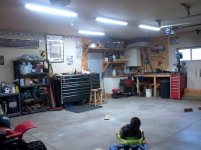
toddacimer
Well-known member
Todd, where did you get your fixtures at?
Lowes for $70 each. They put out 3200 lumens and use 40 watts according to the box. The Lowes.com descriptions seem to be innacurate.
Falcon67
Well-known member
I looked at those Utilitech LEDs for the race trailer. Nice and thin, and thin is good in a box trailer. Ended up buying the $21 T8 fixture - just could not justify the 3.5x cost per fixture.
OJ Bartley
Well-known member
Todd, the LEDs do look really good. Who's your little helper? 
Air_Cooled_Nut
Well-known member
Psst! Todd! Move very carefully in your garage, it looks like you may have a Ninja Turtle snooping around in there.
toddacimer
Well-known member
Todd, the LEDs do look really good. Who's your little helper?
The little guy is 7 months and very active. Pretty sure he will be stealing my tools in no time
OJ Bartley
Well-known member
Good for him. mine's 15 months and all over the place right now. He wanted to walk on all the new tiles I put down this week.
Sent from my HTC One using Tapatalk 4
mine's 15 months and all over the place right now. He wanted to walk on all the new tiles I put down this week. Sent from my HTC One using Tapatalk 4

Any progress cyberdyke ?
Sorry, no. I was just getting started drywalling and the roof on the house sprung a leak. Had to tear out a whole wall and rebuild it. Now that that's done, I should be getting back to the garage early next week. First, drywall has to go up. Then, an attic access. Then the ceiling can start going in. I'll be using soffit panels.
I have 2 of the LED strips up right now, but they are just roughed in. They look and perform great, but it's too early to tell how the 6 of them will look when it's finished.
CD
I have 2 of the LED strips up right now, but they are just roughed in. They look and perform great, but it's too early to tell how the 6 of them will look when it's finished.
CD
jfon101231
Member
- Joined
- Jul 29, 2010
- Messages
- 17
Poke poke...
e36jon
Well-known member
Howdy
I am going through the same challenge for my garage and bought a couple of Cree fixtures to experiment with. I have a thread up here:http://www.garagejournal.com/forum/showthread.php?t=277492 (Apologies in advance for the Fluorescent Industry troll that sort of took over for a while...)
I just hung the lamps today and will second Cybrdykes point on delivered lumens: I hit my target # on my workbench, but my calcs said I would be short by 30%... (I need to repeat my measurement tonight for a more accurate # as I was getting some window-help...)
I also spent more than I would have for equivalent fluorescent fixtures, but not as much as it seems since I would have ended up buying pretty fancy ballasts + bulbs, so maybe 25-30% more for LED.
Cheers,
Jon
I am going through the same challenge for my garage and bought a couple of Cree fixtures to experiment with. I have a thread up here:http://www.garagejournal.com/forum/showthread.php?t=277492 (Apologies in advance for the Fluorescent Industry troll that sort of took over for a while...)
I just hung the lamps today and will second Cybrdykes point on delivered lumens: I hit my target # on my workbench, but my calcs said I would be short by 30%... (I need to repeat my measurement tonight for a more accurate # as I was getting some window-help...)
I also spent more than I would have for equivalent fluorescent fixtures, but not as much as it seems since I would have ended up buying pretty fancy ballasts + bulbs, so maybe 25-30% more for LED.
Cheers,
Jon
falcon64
Well-known member
But in the end will this be worth it? No ballast to go bad. Does the lamp itself have a long life span? If so then you may have spent your money wisely
falcon64
Well-known member
I'll be doing the lighting install in a 24 x24 garage in about 10 days. I'm using 6 x 4' LED strip lights. I am running 2 rows of 3 strips from front to back.
http://www.lightingproducts.philips.com/our-brands/daybrite/fluxstream-ez.html
Once up, I'll report back.
Where did you buy these?
Where did you buy these?
local electrical supply house. Philips Fluxstream EZ. You can google it. Same style fixture as the Cree LS4, just a different manufacturer. Tiny Tiny Tiny.
CD
Electric_Light
Well-known member
- Joined
- Jan 3, 2015
- Messages
- 74
Which is for the cheapest lamps that have been banned since last July.Here's what most people miss when talking about fluorescent lamps....
F32T8's produce about 2800 lumens when new.
A standard ballast has a ballast factor of .88 (you have to multiply that). And since a fluorescent tube delivers those lumens in all directions, you have to factor in the wasted lumens that go straight up and also the loss of lumens that are reflected downward. The luminaire manufacturers provide this information. A typical fixture will have losses of 20-30%.
So, 2 x 2800 x .88 x .75 = 3696 delivered lumens.
I get 4,600. 32W 841/HL 3,100 lumens x 0.88BF x 85%.
What's the ballast factor of a Edison base 23W CFL or does that not have a ballast either?The LED fixture has no ballast, so no ballast factor and there is no uplight or wasted lumens, so all 4000 lumens are delivered lumens.

Probably. LEDs are good for making glare.It's actually brighterthan the 2 lamp T8 fixture.
For lamps that are essentially outlawed. (There might be one or two 700s still meeting standards..)80 CRI means better quality light than normal T8's (they are in the 70 range).
Which has never been verified. 50,000 hours of predicted life to pathetic 30% loss of lumens which is worse than T12 cool white and not even close to <10% depreciation of super T8.50,000 maintenance free hours of operation...even then they are still lit.
No glass lamps to worry about breaking or failing.
Shatter resistant doesn't mean unbreakable. Blue LED pumped solid state fluorescent lamps or UV pumped regular fluorescent lamps both require a power supply of some kind which goes by different names.
+1.LEDs are a really neat technology, I'm a big fan myself. However, you are fooling yourself here. Your numbers reflect "Cheap home depot $14 special" T8 fixtures and lamps.
LED fixtures have a non-standard proprietary driver that is not replaceable or cost more than the fixture to order.You likely paid over $100 each for those LED fixtures, why not compare to a reasonable quality T8 fixture, ballast, and lamp?
Florescent fixtures have ballasts, LED fixtures have power supplies. They both result in similar efficiency loss. Buy a quality electronic ballast and you can easily get that factor up into the mid 90's.
I'd argue that an inexpensive replaceable glass lamp is better than a plastic "unbreakable" lamp that cannot be replaced. Plus - in my experience the rated life expectancy of LED lamps is WAY less than advertised. Least they appear to have dropped their claim to 50,000hrs rather than the standard 100,000hr BS claim.
As for losses due to reflections - True, but again you compare to the cheapest T8 fixture you can buy and you present like your LED fixtures also don't have losses of that same type. LED's are too focused and doping agents must be used in their design to scatter (aka reflect) that light. And still they tend to suffer from light distribution problems which you've conveniently forgotten to mention.
Frosted lens to reduce glare? You know that also describes every 2nd T8 fixture ever made right?
I notice you still haven't told us how much you spent on these fixtures. Let's be honest here - you will never see a cost savings vs T8. Quality T8 fixtures and lamps would have produced superior light and resulted in a lower total cost of ownership.
I love LED's. They have lots of advantages and useful properties that make them an excellent choice for many lighting applications - it's just that general purpose overhead lighting isn't one of them. Do it for the cool factor, do it because you want to be different - but cost and light quality are not reasons for going LED.
LEDs are rated as a fixture and if they're made to produce the same pattern as fairly inexpensive parabolic troffers (with a flat bottom beam pattern) rather than tear-drop pattern of wrap arounds, I bet the lumen per watt rating just goes down.
And warranty is hardly ever adequate. Claims of reduced maintenance and energy over existing technology needs to be warrantied. For expensive as they are, the warranty coverage usually don't include: re-luminairing labor, LED decay rate or going beyond curve, excess wattage escalation rate(for nLight type decay compensating lights).LED technology changes daily. The speed at which improvements are coming out are just crazy. The lamp that sucked yesterday is pretty f'n good today. Less than a year ago, I was telling people the same thing....LEDs are not ready for general illumination. Today, nearly every new bilding project has LED troffers and or high bays specified. The improved products ARE ready. Maybe not for every single application type, but in general...they are ready. The fixture manufacturers even have been surprised at the speed of acceptance of these products.
I will admit, though, that I'm not certain if 6 of these will give me the fc that I want. My point x point is right on the edge. I am also putting in 4 LED "faux-cans", one in each corner, to fill in and to give me a little task lighting.
Happy to report back when they are up.
CD
Till one fails and you have to replace all at once, because you can't find an exact replacement or the replacement do not match adequately in color
Last edited:
Electric_Light
Well-known member
- Joined
- Jan 3, 2015
- Messages
- 74
But in the end will this be worth it? No ballast to go bad. Does the lamp itself have a long life span? If so then you may have spent your money wisely
There's a driver to go bad. For a home grade unit, I'd say you have just as a good of chance as a crappy T8 shop light losing the ballast and it's time for the trash can.
For the super expensive architectural grade stuff, the driver is probably quite expensive.
Which is for the cheapest lamps that have been banned since last July.
70CRI lamps were banned, but they are still available and are still the most commonly purchased, until they are depleted. Although there are many choices, the replacement lamps in the 80 CRI range are also 2850 lumens, with some variants in the 2950 range.
The 3100 lumen T8 you keep spewing about is NOT a standard product, it's referred to as a "high lumen" lamp and is more of a niche product that is not commonly seen in mainstream lighting.
I get 4,600. 32W 841/HL 3,100 lumens x 0.88BF x 85%.
With your specialty lamp and an 85% efficient fixture, that would be correct. But it's uncommon in the real world. The most common, is as I stated, 2 x 2800 x .88 x .75 = 3696
What's the ballast factor of a Edison base 23W CFL or does that not have a ballast either?
This is the kind of comment that makes it crystal clear that you have no idea what you're talking about. There is a ballast in the base of that lamp. But being integrated into the lamp as a single unit makes the ballast factor moot. But, for your information, the same lamp with a 4pin GX24 base that uses an external ballast...that ballast factor is 1.0. mmmmkay?
Probably. LEDs are good for making glare.
Again, a comment that indicates ignorance. ALL light sources are glarey if left undiffused and in the line of sight. These days, nearly all quality LED manufacturers are diffusing the diodes.
For lamps that are essentially outlawed. (There might be one or two 700s still meeting standards..)
There are 700s that meet the standards. And they dont sell much because the 800's are better and they dont cost much more.
Which has never been verified. 50,000 hours of predicted life to pathetic 30% loss of lumens which is worse than T12 cool white and not even close to <10% depreciation of super T8.
This is where you are so totally wrong that it's kind of amazing. 50% of your favorite fluorescents are 100% D-E-A-D after 24,000 hours. I'd say that 30% dimmer beats 100% DEAD every day.
Shatter resistant doesn't mean unbreakable. Blue LED pumped solid state fluorescent lamps or UV pumped regular fluorescent lamps both require a power supply of some kind which goes by different names.
I never said unbreakable. Nothing is unbreakable. But broken LEDs dont have sharp glass, hazardous materials, phosphor dust, etc. Ask a hospital or a school if that's important to them.
+1.
LED fixtures have a non-standard proprietary driver that is not replaceable or cost more than the fixture to order.
B.S. Many do, some dont.
LEDs are rated as a fixture and if they're made to produce the same pattern as fairly inexpensive parabolic troffers (with a flat bottom beam pattern) rather than tear-drop pattern of wrap arounds, I bet the lumen per watt rating just goes down.
All of that information of provided by the lamp or fixture manufacturer. If you are concerned about it, it's there for you to plainly see.
And warranty is hardly ever adequate. Claims of reduced maintenance and energy over existing technology needs to be warrantied. For expensive as they are, the warranty coverage usually don't include: re-luminairing labor, LED decay rate or going beyond curve, excess wattage escalation rate(for nLight type decay compensating lights).
From the name brand companies, the warranties are more than adequate. Many of them are considerably longer than similar fixtures with other light sources. For instance, LED screw in lamps...I've seen warranties up to 3 years. Does an incandescent or CFL offer that? LED tubes...you can find warranties up to 5 years. Does a fluorescent tube offer that?
Till one fails and you have to replace all at once, because you can't find an exact replacement or the replacement do not match adequately in color
You can hate all you want to. You just hang on to those dinosaur reins and ride off into the sunset. The major manufacturers, Acuity, Cooper, GE, Sylvania, Philips, etc...all expect the lighting industry to be over 80% LED products by 2020. That's only 5 years away. And if you look at the figures, they are already way ahead of that prediction.
CD
Last edited:
falcon64
Well-known member
Where I work we have tons of CFL lights. We are constantly replacing the bulbs. The lights never shut off. We have ballast issues all the time. They started replacing them with LED lights. Some of these lights have been on a year straight and have never been turned off for any reason. No issues with any of the lights. These are commercial grade lights 277 volts not for residential use. This is why I started looking into these lights due to there reliability factor. Now just narrowing down which residential light is the best bang for the buck is the problem.
Hey everyone, just stumbled on this site today... I have found my holy land. haha Anyway about a week ago I bought new LED shop lights from Costco for $39 a piece. I posted a review on Amazon for them, just look up Feit LED work light and you should find it. They're great so far, the downside is that each has it's own 3 prong plug so you can't daisy them and there's no on/off switch. I bought a 3 pack remote control outlets to turn each on/off as I like (only have 3 lights). No frills, but economical for if you're looking for LED shop lights.
bigredmf
Well-known member
(Apologies in advance for the Fluorescent Industry troll that sort of took over for a while...)
LOL
Sent from my iPhone using Tapatalk
LOL
Sent from my iPhone using Tapatalk
The major manufacturers, Acuity, Cooper, GE, Sylvania, Philips, etc...all expect the lighting industry to be over 80% LED products by 2020. That's only 5 years away. And if you look at the figures, they are already way ahead of that prediction.
CD
Think that is absolutely going to happen, maybe even quicker than 5 years.
Just like old cars the old lighting fixtures are going to take for ever to go TRUELY obsolete. But.........GOOD Incandescent bulbs are being replaced just based on power used.....so they are likely die very quickly. Remember the fuss when 100 watt bulbs were discontinued............now a non issue.
Today..........I saw CFL 40-60 watt bulbs selling for .37 each. Certainly the beginning of the end. Just think how crappy those first CFL were back in the day.......CRI, flicker and noise to mention a few issues.
Now we just wait for LED prices to come in line and the quality to be proven.