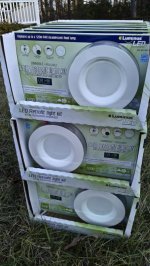
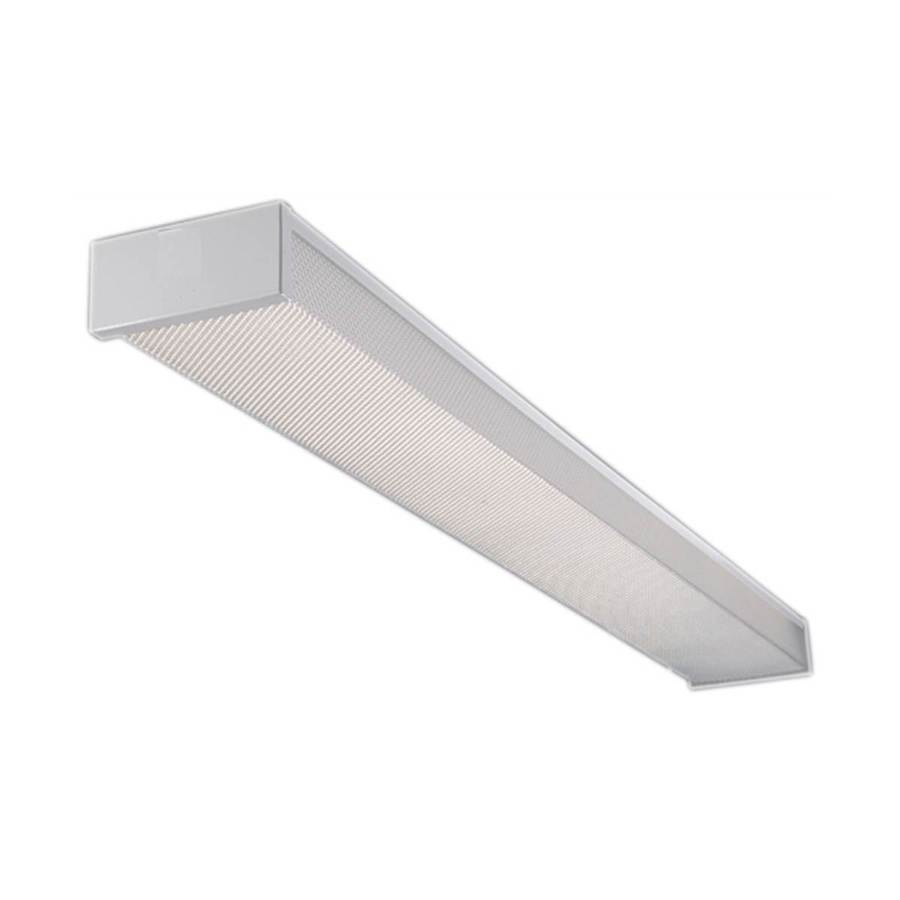
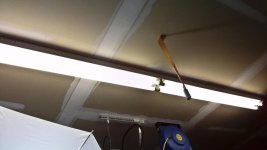
I didn't plan on doing the lighting upgrade in my garage so soon but at Costco today I saw these LED retrofit lights on sale for only $12.89 each! The sale ends on 12/29/13. This is the cheapest I have ever seen these lights for so I figured I better buy more then I need and just return the ones I don't use. I purchased 3 cases of 6 each for a total of 18 lights. Do I need more or do I have too many?
So my question is how many do you need for good lighting. My garage is around 21' x 21' with 10 foot high ceilings.
The problem is, they don't give you the information you REALLY need to definitively answer this question; so any answer you come up with will be a W-A-G at best anyway..
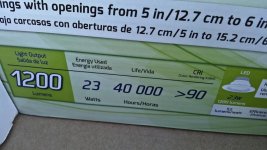
The lights put out 1200 lumens which is the equivalent of a 120 watt R40 bulb. It is bright white at about 3000K. The dispersion beam angle is 90 degrees.
I saw the "1,200 lumen" claim in the box pics you posted. I also saw that they use 23 watts each to produce that output, for 52 lumens/watt -- which is pretty poor by comparison to a standard linear fluorescent tube. I did NOT see anything even remotely resembling a photometrics chart; but
IF you can really count on that "90 degree" dispersion pattern, then you can use basic geometry to figure your minimum fixture spacing:
Assuming a 10-foot mounting height and a 3-foot "working height", you have a maximum of 7 feet for light to spread out from the source; frankly, I'd figure on six feet at most. This distance represents the "adjacent" side of your right triangle, and Sine = Opposite / Adjacent; so Sin(45) = 0.707; so 6 * 0.707 = 4.24 feet.
This implies that the fixtures can be spaced on 8.5-foot centers. HOWEVER, it also assumes that the light fall-off is no greater than 50% at that 45-degree angle, which we can't really count on. For a variety of reasons -- most notably including the language used to make that "beam angle" claim -- I suspect it is really MUCH greater than that, which means much closer spacing will be needed.
I found this calculator online.
http://www.recessedlighting.com/how-many-recessed-lights/
It is saying use 9 lights total. I didn't think that would be enough but I will check around more.
It's not even close.
Typically, using recessed cans will result in the overall average illumination levels GREATLY exceeding the recommended 100 lumens/ft.^2 average, due to the need to space them closely enough to avoid "hot spots" and dim areas. But in this case, 9 x 1200 == 10,800 total lumens (at the sources). Spread that out over 441 ft.^2, and you get less than 25 lumens/ft.^2 -- not nearly enough.
So after more reading I think I may want more then the nine the calculator came up with. I am thinking of four rows of four lights for a total of sixteen lights.
Still not enough.
Based on the above calculation, you're going to need at least 36 of those lights (probably more like 45 or so by the time you account for the source-subject losses) just to reach the needed average brightness levels, before we even worry about coverage patterns, etc.
Around 2.5' from the walls and 5.25' in between the lights. These lights should be very bright.
Not by any definition of "very bright" that I'd accept.
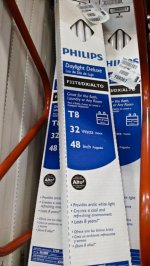
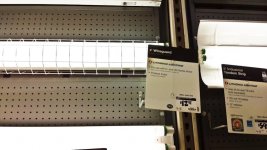
Compare your "bargain" LED kits to a standard F32T8 fluorescent tube: Not only does the latter have a MUCH better (at least for your purposes) coverage pattern, it will (typically) put out about 2,800 lumens, or about 2-1/3 times what the LEDs are claiming; and it does this on a nominal 32 watts, for 87.5 lumens/watt. If your ceilings were higher, you could use F54T5HO tubes, for still more efficiency (typically about 5,000 lumens on a nominal 54 watts, or more than 92 lumens/watt).
I probably will pull one out of the box and test it today.
How exactly are you planning to conduct that "test"? Staring directly at a light source is a very BAD way to determine its output capabilities.
I was reading on higher ceilings you need to space the lights further apart but use higher wattage.
Well, sort of.
The higher the ceiling, the more you CAN space the fixtures out; but there's no law which states you MUST do so. It's all a matter of getting the right amount of light in the right places.
On paper these should be very bright. I guess if it is too bright I could always use a dimmer.
Again, I think your assumptions about "very bright" are highly questionable, at best. So too may be your assumption about being able to dim them, even if that claim is explicitly called out on the packaging. Typically, LEDs are only "dimmable" over a relatively narrow range, and often in a rather "notchy" fashion; and only certain types of dimmer controls need apply.
I will have the lights over the garage door on a separate switch so when the door is open I don't waste electricity lighting up a door.
That's always a good idea; but it's not specific to this type of lighting.