LeeG
Well-known member
I had a thread I did in this forum when I first joined here 12 years ago, but I was using photobucket at the time, and all the links are long gone, so I decided to start a new one. After the photobucket debacle, I started a web site for my shop projects (see signature), but for those who want stay in a familiar place, I'll cross post here. This also allows for comments. I have a thread over in the metal fabrication forum for my existing projects, but I'll be using this thread from now on.
I just updated my shop tour for 2025, and here it is.
My shop occupies a 22’x22′ two-car garage, and I typically work with the main door open. This provides extra space for larger projects and additional tool placement. Some equipment, like my Delta DJ-20 Jointer, needs to be pulled into the driveway for use.
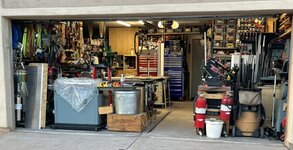
Safety is a top priority in my workshop. I invest in high-quality fire extinguishers and maintain them with regular service. My fire safety setup includes a 2.5-gallon water-only (Class A) extinguisher on the left for common fires, a 10lb CO2 (Class B/C, Model 332) for electrical and liquid fires, and a 20lb ABC (Model B441) that handles most fires but leaves considerable residue. I also keep a 10lb ABC extinguisher at the house-to-garage entrance and a 5lb ABC on my welding cart.
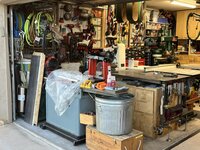
Tucked in on the left side are my jointer and dust collector, a Cox hose reel with a 25′ Flexzilla air hose and attachments, my M18 fans, and an aluminum ramp for moving items over the concrete lip between the garage and driveway. Next to the hose reel is an extendable bar that holds extension cords and hoses. Both the bar and the hose reel are mounted in 2″ hitch receivers attached to the wall, allowing for easy removal when garage door maintenance is needed. The wooden box, crafted by my father many years ago, stores various types of rope, string, and cordage.
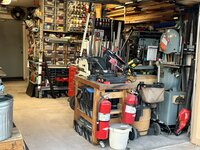
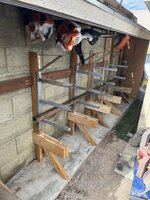
On the right sits my trusty Ridgid 16-Gallon Wet/Dry Vac, one of my earliest purchases that has served me well for nearly 20 years. My Delta 14″ band saw is tucked into the corner, alongside an M18 leaf blower. The leaf blower works perfectly for maintaining our desert landscape and effectively cleans sawdust inside the shop. I’ve replaced all my 2-stroke Stihl yard tools with M18 versions, which are sufficient for our small yard. The small bench supports my Femi Hemsaw 105ABS, an excellent metal cutting saw that has allowed me to make cuts on 2″ solid steel bar with less than 0.005″ of drift.
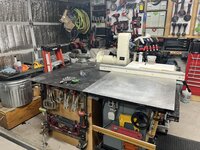
This is my primary work area. The welding table doubles as an outfeed table for my Delta Unisaw. On this edge of the table, I keep commonly used welding clamps: a mix of Milwaukee 2″, 4″, and Torque-Lock pliers, plus four Piher Maxipress-F 12″ clamps—these Piher clamps are my #1 go-to option. I also keep an M12 right angle die grinder nearby for quick cleanup and deburring. Despite criticism from “professional” users, this tool is incredibly handy for almost everything I do, and I rarely need to use my pneumatic die grinder since getting it. A Wilton 4lb hand sledge stays within reach for when I need to “persuade” things to fit properly.
On the side of the table, I’ve mounted a pair of magnetic featherboards and a longer fence for my Incra HD1000 miter gauge. I’ve also installed some 20-amp, 120-volt plugs on an extension cord in this area.
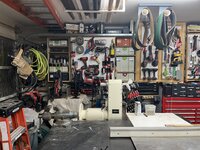
Looking over the welding table, you can see my main Wilton vise and the back of my Jet 6×48/12″ belt/disc sander. On the ceiling, I store my 8′ ladder, spare belts for my sander, and a collection of fishing rods and light plastic tubing that I use to make storage containers.
The far wall is designed to store Tanos Systainers, with a sliding pegboard mounted in front. On this pegboard, I hang various cordless tools—primarily M12 ratchets and saws on 3D-printed holders, along with my M18 heat gun and sheet metal shear. This area also holds my propane torch with its assorted tips. The shelving includes a dedicated bay for storing my collection of pneumatic nail guns.
The lower section of the cabinet houses my Milwaukee batteries, while my Steel City spindle sander sits to the right. Atop the spindle sander rests a portable band saw in a Swag Offroad stand.

On the left stands a cabinet I built for hand tools. It houses my hand planes, chisels, saws, and other quality hand tools. The pegboard doors hold my M18 grinders, impact wrenches and drivers, and large slip-joint pliers (which we always called “channel locks,” though that’s actually a brand name). I also store an assortment of coping and fret saws, chalk lines, scrapers, and my MJ Grr-ripper push blocks.
The right cabinet was my first woodworking project—a three-door pegboard cabinet. It contains various plumbing, painting, and gripping tools inside, while the exterior doors display my M18 oscillating tool, 6″ grinder, squares, levels, and an array of smaller tools.
The black drawers beneath the cabinets primarily store consumables: tape, markers, basic screwdrivers, hinges, and similar items. The air compressor on the left was a great find—I wanted the power of an 80-gallon upright unit without the size. This compressor features the same 2-stage pump and 5HP motor as larger units but with only a 20-gallon tank, making it perfect for a one-person shop. It’s also made in the USA.
The red toolbox contains many of my machinist and metalworking tools: boring heads, reamers, shell cutters, and collets. Its smaller drawers hold multimeters, deburring tools, and other compact implements.
On the floor under and beside the toolbox are my DiAcro Model 1 bender and boxes containing welding blankets, cordless nail guns, and metal saws.
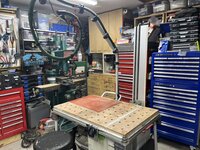
This corner is quite busy. In the foreground sits my Festool MFT, accompanied by two stacks of systainers and a CT-36 dust collector with boom arm. I’ve gotten extensive use from both the MFT and CT-36 and would definitely purchase them again.
Behind, moving from left to right, stands my Burke/Powermatic Millrite MVN mill. While not as substantial as a full-size Bridgeport, it’s significantly more robust than a benchtop mill and delivers excellent accuracy. This area also houses my ultrasonic cleaner, a Hotshot 360 heat treat oven, and a Prusa MK3S+ 3D printer.
The cabinets are a combination of shop-made and factory-built units, containing a wide variety of tools and supplies. The upper wall cabinet primarily stores paints, solvents, and other consumables.
The red Craftsman toolbox was a wedding gift from my father and holds mostly wrenches, sockets, ratchets, and other mechanic-type tools. The blue US General box contains various items, including additional wrenches, 1/2″ sockets, and an extensive selection of 1/4-20 fasteners—my default size for most projects.
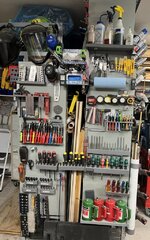
This is the end cap of the shelving that divides my wife’s corner of the garage from my workspace. It holds tools I frequently use during projects and need readily available. Since each item has a designated spot, it’s easy to identify what’s missing at day’s end. The bottom shelf contains Sure-Shot spray cans of WD-40, acetone, mineral spirits, and brake parts cleaner. The pliers holder is my own design and works excellently for organizing pliers and cutters. You can see more detailed information about this end cap in my linked article.
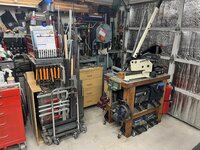
Back near the garage door on the right stands a small bench I built years ago from scrap 2×6 lumber. I constructed it without any fasteners, resulting in a heavy-duty piece. Though originally intended for hand tool woodworking, I added an aluminum top and now use it to store my plate shear, small arbor press, and punch press. The bottom shelf holds various consumables. The entire bench is on wheels, making it easily movable as needed.
In the corner sits my Delta 14″ bandsaw. It’s a solid saw for its size and, though limited to wood only, performs exceptionally well. Next to it is a 20″ Delta drill press, which I’ve upgraded with a high-quality Albrecht keyless chuck—the entire system has performed flawlessly. The cabinet beneath the drill press stores all types of drill bits, vises, and hole saws. It’s mounted on wheels, allowing me to pull it out when I need to lower the drill press table.
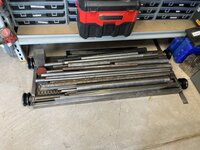
To the left of the drill press is my over-engineered, over-weight materials and tool cart. The right side features 4×4 steel tube storage for various length offcuts, while the left side and top provide tool and clamp storage. I designed it to accommodate my Harbor Freight lift cart underneath, maximizing floor space. This cart is loaded too heavily, restricting its movement to a small section of the garage.
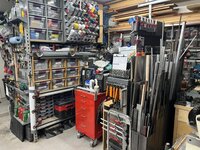
Looking back toward the middle of the shop, you can see my side of the large grey shelves. I’ve standardized on 15-quart Sterilite boxes for storage. Since I dislike having to move items to access what I need, each box has its own dedicated cubby in a grid arrangement. The upper grid features a slider in front for paint can storage, while the lower grid has a slider for lathe tool storage. The bottom shelf houses a collection of 24 storage boxes for small parts and fasteners—these are my go-to containers for organizing hardware. My red welding cart sits in front of the shelves, holding my Miller 211 welder and Hypertherm 45 plasma cutter.
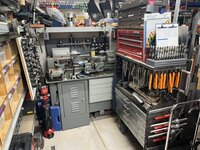
Moving the welding cart aside reveals my Atlas Craftsman 12″ lathe and the other side of my materials cart. I’ve organized a comprehensive collection of lathe tooling on a sliding panel, with additional tooling stored in the toolboxes atop the cart, alongside my 1/2″+ drill bits.
For the lathe, I have three-jaw, four-jaw, and six-jaw chucks, as well as a 5C collet chuck. The drawers below contain specialty materials—brass, Delrin, 4140 steel, stainless steel, aluminum, and bronze—plus various cutoffs of standard low carbon steel. The space above the drawers houses a large assortment of welding clamps.
This shop continues to evolve as my interests and projects change. What started as a basic woodworking space has grown into a versatile workshop capable of woodworking, metalworking, welding, and fabrication. While space is always at a premium in a home garage, I’ve found that thoughtful organization and mobile tool bases allow me to make the most of every square foot. My philosophy has always been to invest in quality tools that will last for decades and to create storage systems that keep everything accessible. Though it’s certainly more crowded than when I started this blog eight years ago, the shop remains a functional and inspiring space where I can tackle almost any project that comes to mind. I hope this updated tour gives you some ideas for your own workshop, and I look forward to sharing more projects made in this space in the coming years.
I just updated my shop tour for 2025, and here it is.
My shop occupies a 22’x22′ two-car garage, and I typically work with the main door open. This provides extra space for larger projects and additional tool placement. Some equipment, like my Delta DJ-20 Jointer, needs to be pulled into the driveway for use.
Safety is a top priority in my workshop. I invest in high-quality fire extinguishers and maintain them with regular service. My fire safety setup includes a 2.5-gallon water-only (Class A) extinguisher on the left for common fires, a 10lb CO2 (Class B/C, Model 332) for electrical and liquid fires, and a 20lb ABC (Model B441) that handles most fires but leaves considerable residue. I also keep a 10lb ABC extinguisher at the house-to-garage entrance and a 5lb ABC on my welding cart.
Tucked in on the left side are my jointer and dust collector, a Cox hose reel with a 25′ Flexzilla air hose and attachments, my M18 fans, and an aluminum ramp for moving items over the concrete lip between the garage and driveway. Next to the hose reel is an extendable bar that holds extension cords and hoses. Both the bar and the hose reel are mounted in 2″ hitch receivers attached to the wall, allowing for easy removal when garage door maintenance is needed. The wooden box, crafted by my father many years ago, stores various types of rope, string, and cordage.
On the right sits my trusty Ridgid 16-Gallon Wet/Dry Vac, one of my earliest purchases that has served me well for nearly 20 years. My Delta 14″ band saw is tucked into the corner, alongside an M18 leaf blower. The leaf blower works perfectly for maintaining our desert landscape and effectively cleans sawdust inside the shop. I’ve replaced all my 2-stroke Stihl yard tools with M18 versions, which are sufficient for our small yard. The small bench supports my Femi Hemsaw 105ABS, an excellent metal cutting saw that has allowed me to make cuts on 2″ solid steel bar with less than 0.005″ of drift.
This is my primary work area. The welding table doubles as an outfeed table for my Delta Unisaw. On this edge of the table, I keep commonly used welding clamps: a mix of Milwaukee 2″, 4″, and Torque-Lock pliers, plus four Piher Maxipress-F 12″ clamps—these Piher clamps are my #1 go-to option. I also keep an M12 right angle die grinder nearby for quick cleanup and deburring. Despite criticism from “professional” users, this tool is incredibly handy for almost everything I do, and I rarely need to use my pneumatic die grinder since getting it. A Wilton 4lb hand sledge stays within reach for when I need to “persuade” things to fit properly.
On the side of the table, I’ve mounted a pair of magnetic featherboards and a longer fence for my Incra HD1000 miter gauge. I’ve also installed some 20-amp, 120-volt plugs on an extension cord in this area.
Looking over the welding table, you can see my main Wilton vise and the back of my Jet 6×48/12″ belt/disc sander. On the ceiling, I store my 8′ ladder, spare belts for my sander, and a collection of fishing rods and light plastic tubing that I use to make storage containers.
The far wall is designed to store Tanos Systainers, with a sliding pegboard mounted in front. On this pegboard, I hang various cordless tools—primarily M12 ratchets and saws on 3D-printed holders, along with my M18 heat gun and sheet metal shear. This area also holds my propane torch with its assorted tips. The shelving includes a dedicated bay for storing my collection of pneumatic nail guns.
The lower section of the cabinet houses my Milwaukee batteries, while my Steel City spindle sander sits to the right. Atop the spindle sander rests a portable band saw in a Swag Offroad stand.
On the left stands a cabinet I built for hand tools. It houses my hand planes, chisels, saws, and other quality hand tools. The pegboard doors hold my M18 grinders, impact wrenches and drivers, and large slip-joint pliers (which we always called “channel locks,” though that’s actually a brand name). I also store an assortment of coping and fret saws, chalk lines, scrapers, and my MJ Grr-ripper push blocks.
The right cabinet was my first woodworking project—a three-door pegboard cabinet. It contains various plumbing, painting, and gripping tools inside, while the exterior doors display my M18 oscillating tool, 6″ grinder, squares, levels, and an array of smaller tools.
The black drawers beneath the cabinets primarily store consumables: tape, markers, basic screwdrivers, hinges, and similar items. The air compressor on the left was a great find—I wanted the power of an 80-gallon upright unit without the size. This compressor features the same 2-stage pump and 5HP motor as larger units but with only a 20-gallon tank, making it perfect for a one-person shop. It’s also made in the USA.
The red toolbox contains many of my machinist and metalworking tools: boring heads, reamers, shell cutters, and collets. Its smaller drawers hold multimeters, deburring tools, and other compact implements.
On the floor under and beside the toolbox are my DiAcro Model 1 bender and boxes containing welding blankets, cordless nail guns, and metal saws.
This corner is quite busy. In the foreground sits my Festool MFT, accompanied by two stacks of systainers and a CT-36 dust collector with boom arm. I’ve gotten extensive use from both the MFT and CT-36 and would definitely purchase them again.
Behind, moving from left to right, stands my Burke/Powermatic Millrite MVN mill. While not as substantial as a full-size Bridgeport, it’s significantly more robust than a benchtop mill and delivers excellent accuracy. This area also houses my ultrasonic cleaner, a Hotshot 360 heat treat oven, and a Prusa MK3S+ 3D printer.
The cabinets are a combination of shop-made and factory-built units, containing a wide variety of tools and supplies. The upper wall cabinet primarily stores paints, solvents, and other consumables.
The red Craftsman toolbox was a wedding gift from my father and holds mostly wrenches, sockets, ratchets, and other mechanic-type tools. The blue US General box contains various items, including additional wrenches, 1/2″ sockets, and an extensive selection of 1/4-20 fasteners—my default size for most projects.
This is the end cap of the shelving that divides my wife’s corner of the garage from my workspace. It holds tools I frequently use during projects and need readily available. Since each item has a designated spot, it’s easy to identify what’s missing at day’s end. The bottom shelf contains Sure-Shot spray cans of WD-40, acetone, mineral spirits, and brake parts cleaner. The pliers holder is my own design and works excellently for organizing pliers and cutters. You can see more detailed information about this end cap in my linked article.
Back near the garage door on the right stands a small bench I built years ago from scrap 2×6 lumber. I constructed it without any fasteners, resulting in a heavy-duty piece. Though originally intended for hand tool woodworking, I added an aluminum top and now use it to store my plate shear, small arbor press, and punch press. The bottom shelf holds various consumables. The entire bench is on wheels, making it easily movable as needed.
In the corner sits my Delta 14″ bandsaw. It’s a solid saw for its size and, though limited to wood only, performs exceptionally well. Next to it is a 20″ Delta drill press, which I’ve upgraded with a high-quality Albrecht keyless chuck—the entire system has performed flawlessly. The cabinet beneath the drill press stores all types of drill bits, vises, and hole saws. It’s mounted on wheels, allowing me to pull it out when I need to lower the drill press table.
To the left of the drill press is my over-engineered, over-weight materials and tool cart. The right side features 4×4 steel tube storage for various length offcuts, while the left side and top provide tool and clamp storage. I designed it to accommodate my Harbor Freight lift cart underneath, maximizing floor space. This cart is loaded too heavily, restricting its movement to a small section of the garage.
Looking back toward the middle of the shop, you can see my side of the large grey shelves. I’ve standardized on 15-quart Sterilite boxes for storage. Since I dislike having to move items to access what I need, each box has its own dedicated cubby in a grid arrangement. The upper grid features a slider in front for paint can storage, while the lower grid has a slider for lathe tool storage. The bottom shelf houses a collection of 24 storage boxes for small parts and fasteners—these are my go-to containers for organizing hardware. My red welding cart sits in front of the shelves, holding my Miller 211 welder and Hypertherm 45 plasma cutter.
Moving the welding cart aside reveals my Atlas Craftsman 12″ lathe and the other side of my materials cart. I’ve organized a comprehensive collection of lathe tooling on a sliding panel, with additional tooling stored in the toolboxes atop the cart, alongside my 1/2″+ drill bits.
For the lathe, I have three-jaw, four-jaw, and six-jaw chucks, as well as a 5C collet chuck. The drawers below contain specialty materials—brass, Delrin, 4140 steel, stainless steel, aluminum, and bronze—plus various cutoffs of standard low carbon steel. The space above the drawers houses a large assortment of welding clamps.
This shop continues to evolve as my interests and projects change. What started as a basic woodworking space has grown into a versatile workshop capable of woodworking, metalworking, welding, and fabrication. While space is always at a premium in a home garage, I’ve found that thoughtful organization and mobile tool bases allow me to make the most of every square foot. My philosophy has always been to invest in quality tools that will last for decades and to create storage systems that keep everything accessible. Though it’s certainly more crowded than when I started this blog eight years ago, the shop remains a functional and inspiring space where I can tackle almost any project that comes to mind. I hope this updated tour gives you some ideas for your own workshop, and I look forward to sharing more projects made in this space in the coming years.
Last edited: