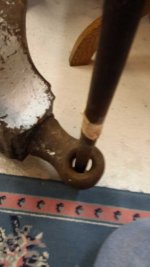
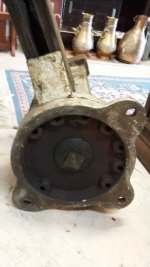
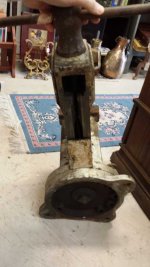
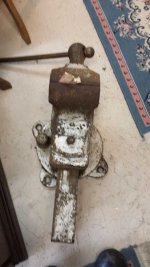
the flat head screws you found that are in under the swivel jaw where pipe jaws are sometimes found are not made to come out and have nothing to do with the swivel jaw that I know of.
I'm not sure exactly what you're talking about here, did I type something wrong to give you the wrong idea? The screws I mentioned were just the ones that hold the jaws on.
they usually did not have removable jaws (i.e. they were cast-in like old Reed's).
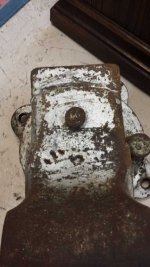
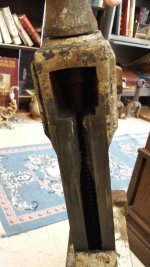
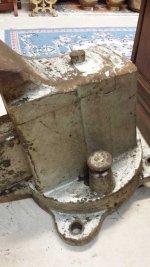
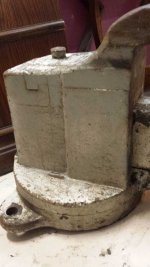
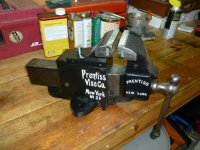
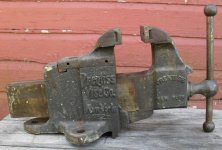
This one was so worn, painted and dirty I wasn't even sure about this myself. I can just BARELY make out a line between the casting and the jaw. I can see faint outline of the jaw screws on the front jaw, but no indication of screws on the swivel jaw. The swivel jaw actually looks like it -might- not be removable because it's really hard to see a defined line where it meets the vice, but I'm guessing it's just years of paint/crud filling those cracks.
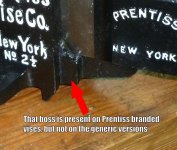
The top part of back of the swivel jaw looks like it has broken off, which is not uncommon (again check pictures). Sometimes that location is where the Prentiss name is located.
I specifically looked there for the name, there is nothing. That lip you mention must be broken off too, there was definitely no lip.
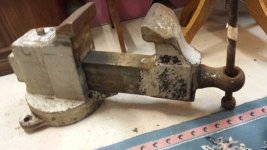
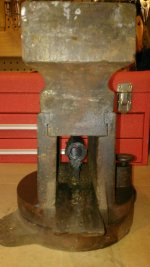
Usually if there is a break / crack, it will be very noticeable on the top-back of the slide. Or it will be around the front of the slide where it goes into the dynamic (check attached picture for example on repair).
The slide looked really good, all things considered. I checked the back of it specifically for a crack and couldn't find anything, but you can definitely tell that the very back of it did get a little more abuse than the part of the slide that's typically "inside" the vise. All in all, it was still in good shape and the vice opened/closed with relative ease.
I didn't see what you were talking about in your pictures, can you (or someone else) circle it??
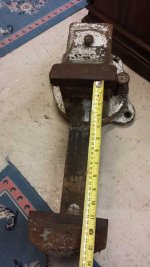
It's a very slight chip, if you go back and look at picture #5 in the first set of pics you can just barely make it out directly under the "3" on the tape measure. It's small, where the casting meets the jaw.
I'm actually ashamed at how poor the pictures came out, my phone usually takes pretty darn good pics.
So here's the deal, I called with the guy after I saw it (it was sitting in an antique shop so he wasn't there). It told him a good bit about the history of the vise and shared a lot of what you guys told me about it as well as what I could dig up. He didn't even know it was a swivel jaw. He also told me that it's been sitting in the back of the shop he works in for over 25 years, basically untouched. The shop he works in opened in 1909. The shop is also very close to the railroad here, so I wonder if at some point it wasn't a rail vise.
I believe it's a #22 based on weight since I could lift it, a #23 weighs 270 lbs and I know I would have strained more to pick that up. I told him that if it had the logo or other identifying marks it would be worth more and I'd pay the $150, no question. In it's state, with so many questions about it, and I don't NEED it I told him that I'd be in it for $80. I figured he'd counter with $100 and make a deal, but he said he wants to wait because there is a street fair coming up. He said if it doesn't sell then, he'll give it to me for $80.
I actually think, based on my conversation with him, that he's going to try and take it home and work the jaw loose to check for that "PVC" logo.
I agree with what you guys have said, it's not a bad price even as it sits. My thing is that I just don't need another vise right now. If I was going to collect them or even refurb and sell it I just don't want to drop $150 on it. That's why I said, if anyone else wants it, get in touch with him directly or ask me and I'll go poke around it again. I just want to see it get to a good home since it's probably almost 100 years old and, from the looks of it, it's been a hard 100 years.