To avoid these ads, REGISTER NOW!

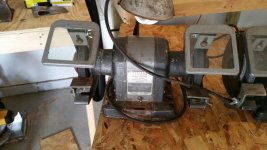
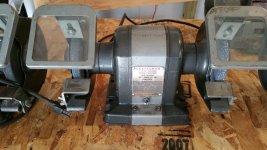
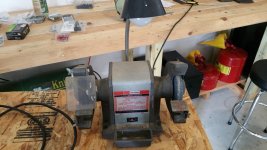
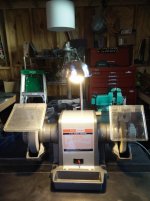
let's see your craftsman block grinders

jransom

Well-known member
Joined
Mar 4, 2015
Messages
135
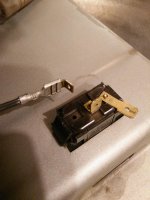
Hey guys, when I was taking it apart and unplugging the leads from the rear of the switch this pin few out. Any ideas how to fix this or what that little copper pin may be called and if it can be ordered somewhere (I doubt it.)? Are these flat paddle switches still available somewhere? I really don't want to replace it with anything else as it's so clean in it's factory form! Thanks. -John
 

Attachments
  • IMG_20151002_211449.jpg
    IMG_20151002_211449.jpg
    143.5 KB · Views: 12
Last edited:
To avoid these ads, REGISTER NOW!

exmaxima1

Well-known member
Joined
Jun 25, 2011
Messages
6,340
Location
Midwest
The capacitor is used to correct the power factor opposite from what the inductor in the motor does. Without a correction to the power factor, starting a motor is difficult.

So where's the capacitor on a 3 phase motor?

If the cap was just for power factor correction it would be plausible to install a capacitor outboard of the motor in the power lines--- but that would not start a single phase motor. AFAIK you need a vector shift in the magnetic fields, which a start capacitor is very useful for.
 
Last edited:

exmaxima1

Well-known member
Joined
Jun 25, 2011
Messages
6,340
Location
Midwest
Exmax, you engineered The Cap?


Sent from my iThingy using Tapatalk

I'm VP of Engineering at Alumapro, and The CAP (Carbon Alloy Power) was the first non-speaker product we developed. There was much controversy about it when we entered the market, but we sold thousands of them up until a few years ago when we discontinued it----the raw materials alone cost more than we could sell it for.
 

exmaxima1

Well-known member
Joined
Jun 25, 2011
Messages
6,340
Location
Midwest
I had my 1 horse running right before I tore it down. I wasn't sure about the cap, so I shorted it with a screwdriver. It threw off a huge snapping spark and a little smoke. I thought I ruined it. The others I've torn down were not operated for a few days and the caps did nothing when shorted.

There may have been a small residual voltage on it depending on the point where the AC signal switched out. It will self-dissipate off in a short time. And even a few volts can make a spark. Ever short the terminals of car battery? Ever get electrocuted from a car battery? Your body's impedance (resistance) is many thousands times higher than a piece of metal, so very little current flows.

I suppose I will retract my statement about potential voltage. I've worked with voltages for so long now that I tend to disregard the smaller stuff. Having spent >20 years in the CRT industry changes your outlook. A huge CRT charged to 30,000 volts will wake you up in the morning! Or a high voltage focus grid sitting at 3000 volts will chomp your teeth. The world of voltages several orders of magnitude lower just seems so tame.....
 

torqueman2002

Well-known member
Joined
Jun 3, 2009
Messages
6,139
Location
SE Michigan
There may have been a small residual voltage on it depending on the point where the AC signal switched out. It will self-dissipate off in a short time. And even a few volts can make a spark. Ever short the terminals of car battery? Ever get electrocuted from a car battery? Your body's impedance (resistance) is many thousands times higher than a piece of metal, so very little current flows.

I suppose I will retract my statement about potential voltage. I've worked with voltages for so long now that I tend to disregard the smaller stuff. Having spent >20 years in the CRT industry changes your outlook. A huge CRT charged to 30,000 volts will wake you up in the morning! Or a high voltage focus grid sitting at 3000 volts will chomp your teeth. The world of voltages several orders of magnitude lower just seems so tame.....
:bowdown:

Even in his 60's, my dad would check for voltage in a house circuit, by wetting his thumb and sticking it in a light socket.

He would caution me to keep 1 hand in my pocket, so a charge wouldn't pass across my chest.

While in the 69th Signal Corp, in WWII, with both hands on the pliers he cut into a live 220V line and couldn't let go. He was a lot younger, and was OK, but he had to force his hands apart with one foot. :scared:
 

torqueman2002

Well-known member
Joined
Jun 3, 2009
Messages
6,139
Location
SE Michigan
Hey guys, when I was taking it apart and unplugging the leads from the rear of the switch this pin few out. Any ideas how to fix this or what that little copper pin may be called and if it can be ordered somewhere (I doubt it.)? Are these flat paddle switches still available somewhere? I really don't want to replace it with anything else as it's so clean in it's factory form! Thanks. -John
Sorry, I added a note to my post above to hold the component's terminal with a 2nd pair of needle-nose pliers.

The small round copper pin is a rivet that connects the male terminal to the inside switch component.

Something like this.
Copper-Rivets.jpg


The switch is n.a. AFAIK; If you find a supplier or replacement, I'd really like to know. I need a couple.

You might be able to repair the switch.

If the rivet fell back inside, perhaps you can reassemble the switch and gently re-form the rivet to hold everything together again. This won't be easy, and a light touch will be key.

If the rivet can't be re-used, perhaps you can find a replacement a HD, etc ...

OR

http://www.rivetsinstock.com/
 
Last edited:

McBrownie

Well-known member
Joined
Mar 27, 2014
Messages
1,827
Location
Cleveland, OH
Hey guys, when I was taking it apart and unplugging the leads from the rear of the switch this pin few out. Any ideas how to fix this or what that little copper pin may be called and if it can be ordered somewhere (I doubt it.)? Are these flat paddle switches still available somewhere? I really don't want to replace it with anything else as it's so clean in it's factory form! Thanks. -John

JR,

Most of these switches are snap together assemblies with springs and contacts and grease. A few little pieces that can be difficult, but definitely not impossible, to disassemble and reassemble. That switch housing may be a thermoset material which was brittle when it was new. Imagine how it is now. My point is that if you try to reset that rivet, you will most likely crack the housing. I would look at still using the rivet, but solder it back onto the contact instead of using any force. Grab a pair of tweezers and/or a small screw driver, take your time, and you should be fine.
 

drivesitfar

Well-known member
Joined
Oct 23, 2013
Messages
36,009
Location
Pacific Northwest
Ex: great posts. sorry to hear you had to discontinue making a great product because of costs.

not to change the subject, but it sort of is on the same topic. i've heard that guys have died working on a microwave because of the charge stored in it. any truth to that and why?

Doc: man your Dad was a MAN'S MAN and pretty smart when he cut that 220. not sure he couldn't have used a meter for the light bulb, but i still lick 9v to test to see if they are good.

ALL: speaking of 9v batteries i've mentioned this before and will mention again. i read that a member threw a screwdriver in his tool bag with his rechargable batteries and tools and it started a fire and out of that conversation another member mentioned almost losing his family jewels by having a 9v explode and start fire in his pants. about a week later i was moving a machine and it had a little counter operated by a 9v that was about to fall out so i put it in my pocket. after i put the machine in the storage unit I put my keys in that same pocket not thinking. about a mile down the road i noticed my pants and leg getting warm and remembered the battery. i pulled over threw the battery out on the floor (luckily rubber mat on it) and it exploded. it didn't start a fire because of the rubber so just missed having a trip to the emergency room.

BEE CAREFUL with even the smallest amounts and you'll live longer.
 

exmaxima1

Well-known member
Joined
Jun 25, 2011
Messages
6,340
Location
Midwest
not to change the subject, but it sort of is on the same topic. i've heard that guys have died working on a microwave because of the charge stored in it. any truth to that and why?

One of the most common failures in a microwave oven is the high-voltage rectifier on the magnetron. The LAST time I repaired a microwave I probed the voltage at the rectifier (while powered) and my Fluke meter exploded! Apparently there is over 2000 volts DC there and that overloaded my meter. Fortunately the explosion was limited to the internal arc suppressor (spark gap) and a nearby resistor, and Fluke was kind enough to send me the repair parts at no charge.

I can't comment if that charge would be there once unplugged, but I would doubt it. Most likely there would be bleed resistors across any storage caps in that circuit. In any case, no more microwaves for me!!
 

torqueman2002

Well-known member
Joined
Jun 3, 2009
Messages
6,139
Location
SE Michigan
JR,

Most of these switches are snap together assemblies with springs and contacts and grease. A few little pieces that can be difficult, but definitely not impossible, to disassemble and reassemble. That switch housing may be a thermoset material which was brittle when it was new. Imagine how it is now. My point is that if you try to reset that rivet, you will most likely crack the housing. I would look at still using the rivet, but solder it back onto the contact instead of using any force. Grab a pair of tweezers and/or a small screw driver, take your time, and you should be fine.
Good suggestion. :thumbup:
 

exmaxima1

Well-known member
Joined
Jun 25, 2011
Messages
6,340
Location
Midwest
:bowdown:

Even in his 60's, my dad would check for voltage in a house circuit, by wetting his thumb and sticking it in a light socket.

He would caution me to keep 1 hand in my pocket, so a charge wouldn't pass across my chest.

While in the 69th Signal Corp, in WWII, with both hands on the pliers he cut into a live 220V line and couldn't let go. He was a lot younger, and was OK, but he had to force his hands apart with one foot. :scared:

I don't wet my fingers first, but I do sometimes swat a wire in a junction box to see if the power is shut off. Not the best advise, but still...

I do like his advise to keep a hand in your pocket when probing live voltages. I do that all the time when repairing old tube guitar amps, as the voltages tend to be rather high and with lots of current capability. ie, an Ampeg SVT bass amp has 700 volts DC on its capacitor banks, and that might end you if you manage to pass current thru your heart. With a hand in your pocket the current path will likely bypass your heart. At least DC does not tend to hold you like AC does: that was Edison's advantage when he was promoting his DC power against Westinghouse's AC system.

BTW, when I magnetize speakers I also keep a hand behind me. The magnetizer is generally charged to around 600 volts DC and when you hit the switch the power is dumped into a coil in a few milliseconds. Wires jump, and the resulting magnetic field finishes a speaker magnet. If your left hand---wearing a watch--is too near the magnetic field you destroy the watch as well.
 

drivesitfar

Well-known member
Joined
Oct 23, 2013
Messages
36,009
Location
Pacific Northwest
EX: thanks for sharing all that. not sure i'll ever repair a guitar or old TV, but anything is possible or maybe i can save another guy from going to ER or worse.

cheers and you and all the blockheads have a great day and stay safe
 

torqueman2002

Well-known member
Joined
Jun 3, 2009
Messages
6,139
Location
SE Michigan
....
Doc: man your Dad was a MAN'S MAN and pretty smart when he cut that 220. not sure he couldn't have used a meter for the light bulb,
Yes, but that wasn't as handy. He might have been showing off a bit too.
but i still lick 9v to test to see if they are good.
:wtf:
ALL: speaking of 9v batteries i've mentioned this before and will mention again. i read that a member threw a screwdriver in his tool bag with his rechargable batteries and tools and it started a fire and out of that conversation another member mentioned almost losing his family jewels by having a 9v explode and start fire in his pants. about a week later i was moving a machine and it had a little counter operated by a 9v that was about to fall out so i put it in my pocket. after i put the machine in the storage unit I put my keys in that same pocket not thinking. about a mile down the road i noticed my pants and leg getting warm and remembered the battery. i pulled over threw the battery out on the floor (luckily rubber mat on it) and it exploded. it didn't start a fire because of the rubber so just missed having a trip to the emergency room.

BEE CAREFUL with even the smallest amounts and you'll live longer.
Thanks for the tip!
 

bagged89s10

Well-known member
Joined
Mar 13, 2005
Messages
4,607
Location
CT
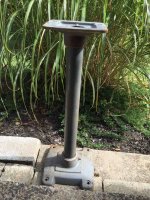
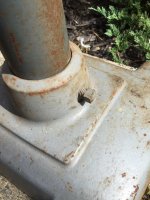
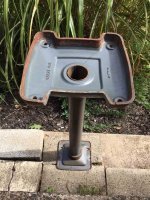
I am selling one of my stands.
Just no space to keep 5 stands. Lol.

ImageUploadedByTapatalk1444063466.727676.jpg
ImageUploadedByTapatalk1444063477.397632.jpg
ImageUploadedByTapatalk1444063486.886023.jpg
ImageUploadedByTapatalk1444063494.606498.jpg

PM if interested before I put it on eBay later tonight.
 
To avoid these ads, REGISTER NOW!

vertguy

Well-known member
Joined
Apr 6, 2010
Messages
1,261
Location
SE WI
Yep as I have regretted not buying 2 stands from TM earlier this year when I bought my first one as these things never seem to pop up in my area.
 

bagged89s10

Well-known member
Joined
Mar 13, 2005
Messages
4,607
Location
CT
Anyone have a good idea for adding dust collection on the commercial grinders? The last thing I want to do is cause a fire from hot metal dust.
 

WWShop

Well-known member
Joined
Aug 25, 2015
Messages
948
Location
MN
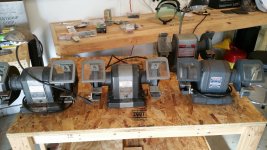
Here are mine. 19580 on left was $55 on Ebay. I used an old trouble light lamp shade for the light bulb. I bought the 19580 on second from left for $30 yesterday on CL, the 19391 I paid $10 for today but the switch doesn't work, so the previous owner just wired it hot, and the pre-block grinder I paid $40 about a week ago. I only had one grinder for the longest time and suddenly the other three popped up on CL. All four run great. One of my 19580s doesn’t have the rubber feet on bottom so it walks a bit when running. Can I get something similar at a hardware store?
 

Attachments

  • 20151006_095635.jpg
    20151006_095635.jpg
    153.3 KB · Views: 37
  • 20151006_095707.jpg
    20151006_095707.jpg
    145.4 KB · Views: 32
  • 20151006_095657.jpg
    20151006_095657.jpg
    148.4 KB · Views: 28
  • 20151006_095645.jpg
    20151006_095645.jpg
    147.8 KB · Views: 30
  • 20151006_095650.jpg
    20151006_095650.jpg
    148.5 KB · Views: 29
Last edited:

drivesitfar

Well-known member
Joined
Oct 23, 2013
Messages
36,009
Location
Pacific Northwest
Bagged and All: one of our members has a small garage and he set up this system for his grinders and other machines to keep the debris and dust contained. http://www.garagejournal.com/forum/showthread.php?t=272678&highlight=ainsley

it's a good read how he organized his small 1 car garage and it looks like this collection system is pretty easy to use and doesn't take up a lot of room.

BEE CAREFUL not to mix sparks with wood or sawdust nearby.

cheers all
 

zkling

Well-known member
Joined
Jan 23, 2007
Messages
16,939
Yep as I have regretted not buying 2 stands from TM earlier this year when I bought my first one as these things never seem to pop up in my area.

Hope you are not disappointed with it. I find them to be a.) very short and b.) very tippy. Just something to think about so your grinder doesn't take a spill. :beer:
 

vertguy

Well-known member
Joined
Apr 6, 2010
Messages
1,261
Location
SE WI
Hope you are not disappointed with it. I find them to be a.) very short and b.) very tippy. Just something to think about so your grinder doesn't take a spill. :beer:

No worries as I have one already and plan to adapt both to a moveable base that will not only raise them slightly, but also add some rigidity:thumbup:
 

torqueman2002

Well-known member
Joined
Jun 3, 2009
Messages
6,139
Location
SE Michigan
Here are mine. 19580 on left was $55 on Ebay. I used an old trouble light lamp shade for the light bulb. I bought the 19580 on second from left for $30 yesterday on CL, the 19391 I paid $10 for today but the switch doesn't work, so the previous owner just wired it hot, and the pre-block grinder I paid $40 about a week ago. I only had one grinder for the longest time and suddenly the other three popped up on CL. All four run great. One of my 19580s doesn’t have the rubber feet on bottom so it walks a bit when running. Can I get something similar at a hardware store?
Nice collection started there. :thumbup:

Those 1/3-HP were Sear's best selling Blocks, judging by the numer of them on CL, eBay, posted here, ....

If those were mine, at a minimum, I'd ring test each stone, and dress them. Several of them have evidence of non-ferrous metal deposits, which can be very dangerous.

For the feet:
http://www.garagejournal.com/forum/showpost.php?p=4687072&postcount=4579

http://www.zoro.com/dayton-rubber-g...iliate&utm_source=ppjtext&utm_content=general

http://www.ebay.com/itm/LAU-38-2209-01-Vibro-Pad-Kit-12PK-/151095957145?hash=item232e055699
 

Toolguybak

Active member
Joined
Jul 9, 2012
Messages
27
Location
Michigan
Sealed bearings work fine. They are routinely used on motors of the same rpm, and rated for >2x that rpm. Their modest drag will not overheat a grinder.

I've run sealed bearings in the Craftsman/Delco aluminum body grinders and the frame gets noticeably warmer to the touch. I switched back to shielded bearings. By design, the grinder is sealed very well so shielded bearings are perfectly adequate.
 

torqueman2002

Well-known member
Joined
Jun 3, 2009
Messages
6,139
Location
SE Michigan
Why would non-ferrous deposits be dangerous?
It is bad shop practice to use the same grinding stone on both ferrous and non-ferrous material.

That's not to say, people can't get away with it, just that it is risky.

I looked for the original article I read on that, but have 'filed' it too well.

Anyway, here's 2 quotes from the links below that talk about Aluminum.
"There are some materials that can cause major problems if you try to grind them. In particular, the big no-no with grinders is aluminum. Aluminum melts easily, and if you were to try to grind down aluminum, it would start to melt and the aluminum would coat the wheel.
The stone would grind the aluminum for a while, but particles would start getting embedded in the pores of the stone. And the next time the stone comes around, there's no grit exposed, only little bits of aluminum. So the aluminum on the piece rubs against the aluminum on the wheel, producing more heat, which produces more melting, and so on.
The natural response of the person at the wheel is to push the piece harder against the wheel. But this will only cause more friction and heat up the wheel faster. If the wheel heats up enough, it can explode."

http://web.mit.edu/course/other/machineshop/Grinder/aluminum.html


"Even if pure, non-ferrous aluminum is used, sparks can occur during an aluminothermic reaction, also called a thermic reaction. Such a reaction occurs when an aluminum particle and a metal oxide, such as rust, are ignited by a heat source and chemically burn as a "Class D" fire (i.e., combustible metal). The reaction is similar to a fireworks explosion, can create 4,500ºF sparks, and can occur when a grinder is used on ferric material (e.g., steel) prior to being used on an aluminum material or vice versa. This type of sparking and associated fire hazard may be eliminated by restricting the use of a grinder to only one type of material. In the absence of that safeguard, if grinding under these circumstances creates sparks, then it is considered hot work and a fire watch would be required under any of the circumstances described in 1915.504(b).

Grinding aluminum also can create housekeeping issues. An aluminothermic reaction can occur in situations where there is an accumulation of powder or dust from the grinding operation. A shipyard environment typically contains metal oxide, in the form of rust, and a heat source, in the form of welding, cutting, brazing, or grinding. If enough aluminum powder is introduced, there is a potential for a significant aluminothermic reaction.

In an Australian Department of Energy "lessons learned" article, "Fireball from Aluminum Grinding Dust," an individual received first- and second-degree bums on his hands and head from a fireball that developed while grinding a piece of angle iron a few days after another individual ground the heads off approximately twelve aluminum pop rivets. This type of accident may be prevented by employing good housekeeping habits in addition to using material-specific tools."

https://www.osha.gov/pls/oshaweb/owadisp.show_document?p_table=INTERPRETATIONS&p_id=27413

Link to my thread on Block Grinders, see the bottom of post #1 for Grinder Safety.
http://www.garagejournal.com/forum/showpost.php?p=4000526&postcount=1

do-not-grind-danger-sign-s-9854.jpg
 
Last edited:

WWShop

Well-known member
Joined
Aug 25, 2015
Messages
948
Location
MN
It is bad shop practice to use the same grinding stone on both ferrous and non-ferrous material.

That's not to say, people can't get away with it, just that it is risky.

I looked for the original article I read on that, but have 'filed' it too well.

Anyway, here's 2 quotes from the links below that talk about Aluminum.
"There are some materials that can cause major problems if you try to grind them. In particular, the big no-no with grinders is aluminum. Aluminum melts easily, and if you were to try to grind down aluminum, it would start to melt and the aluminum would coat the wheel.
The stone would grind the aluminum for a while, but particles would start getting embedded in the pores of the stone. And the next time the stone comes around, there's no grit exposed, only little bits of aluminum. So the aluminum on the piece rubs against the aluminum on the wheel, producing more heat, which produces more melting, and so on.
The natural response of the person at the wheel is to push the piece harder against the wheel. But this will only cause more friction and heat up the wheel faster. If the wheel heats up enough, it can explode."

http://web.mit.edu/course/other/machineshop/Grinder/aluminum.html


"Even if pure, non-ferrous aluminum is used, sparks can occur during an aluminothermic reaction, also called a thermic reaction. Such a reaction occurs when an aluminum particle and a metal oxide, such as rust, are ignited by a heat source and chemically burn as a "Class D" fire (i.e., combustible metal). The reaction is similar to a fireworks explosion, can create 4,500ºF sparks, and can occur when a grinder is used on ferric material (e.g., steel) prior to being used on an aluminum material or vice versa. This type of sparking and associated fire hazard may be eliminated by restricting the use of a grinder to only one type of material. In the absence of that safeguard, if grinding under these circumstances creates sparks, then it is considered hot work and a fire watch would be required under any of the circumstances described in 1915.504(b).

Grinding aluminum also can create housekeeping issues. An aluminothermic reaction can occur in situations where there is an accumulation of powder or dust from the grinding operation. A shipyard environment typically contains metal oxide, in the form of rust, and a heat source, in the form of welding, cutting, brazing, or grinding. If enough aluminum powder is introduced, there is a potential for a significant aluminothermic reaction.

In an Australian Department of Energy "lessons learned" article, "Fireball from Aluminum Grinding Dust," an individual received first- and second-degree bums on his hands and head from a fireball that developed while grinding a piece of angle iron a few days after another individual ground the heads off approximately twelve aluminum pop rivets. This type of accident may be prevented by employing good housekeeping habits in addition to using material-specific tools."

https://www.osha.gov/pls/oshaweb/owadisp.show_document?p_table=INTERPRETATIONS&p_id=27413

Link to my thread on Block Grinders, see the bottom of post #1 for Grinder Safety.
http://www.garagejournal.com/forum/showpost.php?p=4000526&postcount=1

do-not-grind-danger-sign-s-9854.jpg

Thanks for all the great information. Some of that I knew but there is a lot in your post that I didn't know. Thanks!!
 

drivesitfar

Well-known member
Joined
Oct 23, 2013
Messages
36,009
Location
Pacific Northwest
WW: good to hear you might have learned something as we all probably did or needed a reminder if we already knew.

here's a thread i started a while back that has helped a few and still members get hurt so time to refresh our memories here's a link to the thread to let the newer members know what these great grinders can do if not used safely.

http://www.garagejournal.com/forum/showthread.php?p=5176953#post5176953

cheers all

Doc: great posts as per usual and in case anybody forgot to mention it we all thank you for your generosity in sharing what you know and have learned with us.
 

torqueman2002

Well-known member
Joined
Jun 3, 2009
Messages
6,139
Location
SE Michigan
Thank you.

This is my favorite thread. There's always something interesting and fun to read and learn and add.

Not to forget the helpful and friendly Blockheads! :thumbup:
 
Last edited:

jransom

Well-known member
Joined
Mar 4, 2015
Messages
135
Hey guys, does anyone know where I could find (or happen to have one for sale) one of the little black plastic lamp shades and screws to attach it to this guy? Thanks!!

Also, what would be the best course of action in regards to shining up these plastic shields and getting them as clear as possible?
 

Attachments

  • IMG_20151006_074228.jpg
    IMG_20151006_074228.jpg
    135.4 KB · Views: 15

Rileysan

Well-known member
Joined
Sep 11, 2015
Messages
4,298
Location
Milwaukie, Oregon
I saw this thread and am blown away at how many posts there are on this grinder. It's so big, however, that I am having trouble learning what is so great about the Craftsman Block grinder. Would someone be so kind as to point me to a post or thread with details about it and why I should be looking for one?

Brian
 

zkling

Well-known member
Joined
Jan 23, 2007
Messages
16,939
Don't go out of your way to find one, they are not THAT great. BTDT, sorry guys. I had to see for myself, and that is just my OPINION. The 1/2hp + with dust ducts are decent, but again I don't think they are worth the hype.
 
Last edited:

jransom

Well-known member
Joined
Mar 4, 2015
Messages
135
I saw this thread and am blown away at how many posts there are on this grinder. It's so big, however, that I am having trouble learning what is so great about the Craftsman Block grinder. Would someone be so kind as to point me to a post or thread with details about it and why I should be looking for one?

Brian

To me it's that they are made in America, run forever seemingly, bearings are easily replaced and they can be had on CL & EBay for not a lot of money. They are easy to disassemble and clean up as well. I have three different ones and they all run excellent. All of them are 30+ years old and will eventually go to my boys. There is also something to be said for their design aesthetic, which I really love, particularly the "Blocks"!
 

bagged89s10

Well-known member
Joined
Mar 13, 2005
Messages
4,607
Location
CT
Hey guys, does anyone know where I could find (or happen to have one for sale) one of the little black plastic lamp shades and screws to attach it to this guy? Thanks!!

Also, what would be the best course of action in regards to shining up these plastic shields and getting them as clear as possible?


I use a 2 step meguiars plastic cleaner and polish which does a pretty good job.
 
To avoid these ads, REGISTER NOW!
Top Bottom