To avoid these ads, REGISTER NOW!

let's see your craftsman block grinders

torqueman2002

Well-known member
Joined
Jun 3, 2009
Messages
6,139
Location
SE Michigan
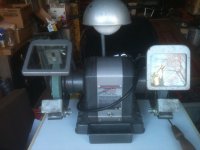
Got this at an estate sale today. I passed it up in the morning as the guy was asking too much and its missing the wheel guards and its 1/4HP. Sale was so good I went back in the afternoon and the grinder was still there. I got more goodies and asked if he would do $20 on the grinder and he said ok.
Nice condition pre-Block grinder!

The 1/4-HP ones I've seen, don't have the wheel guard covers, the guards some times have the un-tapped cast bolt hole bosses.

A couple of interesting things: the lamp's goose neck is attached on the rear RH side, and the flanges are very substantial.
 
To avoid these ads, REGISTER NOW!

Kaervak

Well-known member
Joined
May 12, 2010
Messages
826
Location
Cleveland, OH
I went ahead and bought a couple of the Raptor bushings and got my Norton Gemini wheels mounted. I tried the collapsible bushings that came with the wheels just to see how they'd do and the runout was crazy. Mounted them with the Raptor bushings and the runout was completely gone. A slight bit of truing with a wheel dresser and they're ready to go. The bushings are a bit pricey, but they work extremely well. 1" OD with either a 1/2" or 5/8" ID and they're 3/4" thick so you can use them with 3/4" or 1" thick wheels.
 

Kaervak

Well-known member
Joined
May 12, 2010
Messages
826
Location
Cleveland, OH
What is the OD of the washer or flange?

I didn't measure them, but they looked to be 2.5" They're $18 each + shipping but they are well worth it in my opinion. I should have taken a before and after video to show just how much they corrected the runout.

Edit:
Measured the OD of the washer and flange. 1.951" according to my calipers.
 
Last edited:

sector9

Well-known member
Joined
Jun 17, 2012
Messages
62
Location
PA
Picked up my first block grinder today. Super excited about it. I plan to restore it
Model number 397.19671, 3/4 HP with 8" wheels

Came with a homemade stand that isn't half bad, except for the rust

Listed for $75, picked it up for $55


A couple more pics in my album here http://s1303.photobucket.com/user/jwwsector9/library/Craftsman Grinder

It seems that most people have a Vimco lamp but mine (missing the shade) is branded as Leviton. Not sure if original or not.

This thread is a gold mine of information. Will be looking to replace the lamp, eyeshields, wheels, cord, and wheels at a minimum. Planning to repaint it as well as get a new label printed up.
 

McBrownie

Well-known member
Joined
Mar 27, 2014
Messages
1,827
Location
Cleveland, OH
Picked up my first block grinder today. Super excited about it. I plan to restore it
Model number 397.19671, 3/4 HP with 8" wheels

Came with a homemade stand that isn't half bad, except for the rust

Listed for $75, picked it up for $55

It seems that most people have a Vimco lamp but mine (missing the shade) is branded as Leviton. Not sure if original or not.

$55 is a deal and a half. A 3/4hp cap start is one of the big boys. You are good with the lamp. All you need is the plastic cover that is less than $10, I believe. Look at the links in TM's signature for details. Also, those eye shields can be polished with plastic cleaner/polish. It could probably use a new set of bearings, but other than that, you should be good to go. Nice find and enjoy it.
 

firemanast

Well-known member
Joined
Nov 7, 2014
Messages
275
Location
Bentonville,AR
Picked up my first block grinder today. Super excited about it. I plan to restore it
Model number 397.19671, 3/4 HP with 8" wheels

Came with a homemade stand that isn't half bad, except for the rust

Listed for $75, picked it up for $55


A couple more pics in my album here http://s1303.photobucket.com/user/jwwsector9/library/Craftsman Grinder

It seems that most people have a Vimco lamp but mine (missing the shade) is branded as Leviton. Not sure if original or not.

This thread is a gold mine of information. Will be looking to replace the lamp, eyeshields, wheels, cord, and wheels at a minimum. Planning to repaint it as well as get a new label printed up.
Very nice buy and a great grinder for the price!
 

bulletpruf

Well-known member
Joined
Nov 28, 2013
Messages
10,950
Location
San Antonio
Great find sector9.

For those of you with the dual voltage grinders what voltage are you using and why
(other than no 220 available)?

I think the consensus is everyone is running them on 110. I'm running mine on 220 because that's what we have here. I could run it on 110 like a lot of my power tools, but I would have to plug it into a converter.

If you want to swap yours from 110 to 220, it takes maybe 2 minutes of work, and that's if you're slow. You should have the wiring diagram showing you how to swap it on the underside of the bottom cover. If not, a few are posted in this thread.

Scott
 

gnpenning

Well-known member
Joined
Jan 25, 2015
Messages
2,754
Location
I have more questions than answers.
Bulletpruf your right. The wiring is on the bottom cover and it would only take a a couple minutes including stopping for a beer. I have plenty of 220 outlets if needed. I have one apart for minor clean up and it would be no big deal to swap. Just wondering if anyone is seeing any real advantages in running 220. Thanks Scott I hadn't seen anything in my search of what others are doing so far.
 

drivesitfar

Well-known member
Joined
Oct 23, 2013
Messages
36,007
Location
Pacific Northwest
GN: i think we talked about switching over to 220 a lot with the commercial or industrial 1/2 HP+ blocks, but couldn't see the real advantage of doing so. Pretty sure Scott is the only one to make the switch to 220 so far.

Scott: any difference in the 220 that you notice over maybe a block running on 110 if you had one? also besides the wiring on the inside of the block to change it to 220 don't you need to change plugs or is that the 2 minute change to swap plugs?
 

Bdgjr215

Well-known member
Joined
Oct 21, 2015
Messages
760
Bulletpruf your right. The wiring is on the bottom cover and it would only take a a couple minutes including stopping for a beer. I have plenty of 220 outlets if needed. I have one apart for minor clean up and it would be no big deal to swap. Just wondering if anyone is seeing any real advantages in running 220. Thanks Scott I hadn't seen anything in my search of what others are doing so far.

If a motor is capable of running at 220 and 220 is available by all means use 220
The advantage is electrical efficiency.the motor will use half the amperage when
Its runningon 220 than 110 and still acheive the same horse power
 

alpinewhite

Well-known member
Joined
Aug 4, 2012
Messages
1,315
Location
Orange County, California, USA
1HP is so minuscule that it probably won't be noticeable. On a 3HP air compressor, it would be a lot more noticeable as it draws a lot more current to create a significant voltage drop across the wire to the motor.
 

exmaxima1

Well-known member
Joined
Jun 25, 2011
Messages
6,339
Location
Midwest
If a motor is capable of running at 220 and 220 is available by all means use 220
The advantage is electrical efficiency.the motor will use half the amperage when
Its runningon 220 than 110 and still acheive the same horse power

So where is the efficiency? It still draws the same power (volts x amps).
 

sector9

Well-known member
Joined
Jun 17, 2012
Messages
62
Location
PA
Ok so dumb question but... I wanted to ask before I keep cranking on this. The threads are opposite on the two ends of the arbor, right? One side has right-hand threads and the other left-hand threads
 
To avoid these ads, REGISTER NOW!

alpinewhite

Well-known member
Joined
Aug 4, 2012
Messages
1,315
Location
Orange County, California, USA
So where is the efficiency? It still draws the same power (volts x amps).
Since your current is cut in half, the voltage drop across the wire (which has a fixed resistance) is also cut in half. Be reminded that the voltage drop across the wire is current x resistance (E=IR). A lower voltage drop across the wire means a higher voltage on the motor.

Another way of looking at it is to use the formula, P=(I^2)R. Power lost on the wire is proportional to the square of the current going through it. Thus, the lower the current, the lower the power lost.
 
Last edited:

Pupuhd

Well-known member
Joined
Aug 18, 2011
Messages
346
Location
New Jersey
Since your current is cut in half, the voltage drop across the wire (which has a fixed resistance) is also cut in half. Be reminded that the voltage drop across the wire is current x resistance (E=IR). A lower voltage drop across the wire means a higher voltage on the motor.

Another way of looking at it is to use the formula, P=(I^2)R. Power lost on the wire is proportional to the square of the current going through it. Thus, the lower the current, the lower the power lost.
I'm no electrician, however based on the above statement it will allow you to run the same gauge wire as 110V (lets say 14ga) for a longer distance using a 220V setup. In my tiny 12x13 shop I run 12ga for all 220V setup just to be on the safe side.

On this subject: I've heard running a motor at 220V, is easier on the motor as far as wear and longevity. Any ideas on this statement?

I "see" said the blind man to the deaf man as he picked up his hammer and saw.
 

alpinewhite

Well-known member
Joined
Aug 4, 2012
Messages
1,315
Location
Orange County, California, USA
I'm no electrician, however based on the above statement it will allow you to run the same gauge wire as 110V (lets say 14ga) for a longer distance using a 220V setup.
Yup. This is exactly why transmission lines are high-voltage. More energy gets transmitted with the same wiring.

On this subject: I've heard running a motor at 220V, is easier on the motor as far as wear and longevity. Any ideas on this statement?
I'm not a motor expert but I don't see why it would be. It might be easier only because there is less loss on the wiring on the way to the motor.
 

torqueman2002

Well-known member
Joined
Jun 3, 2009
Messages
6,139
Location
SE Michigan
Picked up my first block grinder today. Super excited about it. I plan to restore it
Model number 397.19671, 3/4 HP with 8" wheels

Came with a homemade stand that isn't half bad, except for the rust

Listed for $75, picked it up for $55

A couple more pics in my album here http://s1303.photobucket.com/user/jwwsector9/library/Craftsman Grinder

It seems that most people have a Vimco lamp but mine (missing the shade) is branded as Leviton. Not sure if original or not.

This thread is a gold mine of information. Will be looking to replace the lamp, eyeshields, wheels, cord, and wheels at a minimum. Planning to repaint it as well as get a new label printed up.
Let's see, .....
3/4-HP rtop, check
Capacitor start, check
Dual voltage, check
Crown top commercial, check
HD base with tool rests and quench tray, check
Complete - except for lamp shade, check


YOU ****! check!

:thumbup:
 

torqueman2002

Well-known member
Joined
Jun 3, 2009
Messages
6,139
Location
SE Michigan
Interesting discussion on the 115 vs. 230 V.

I know I'm late to this party and don't really have anything new to add, just yet.

You see, I was off on a tangent (Block related, for sure :)).

Someone posted a question on a site I visit about a replacement switch for a Block m-397.1949. You know the one - plastic, like the one's below.
Fi%20ftop%20amp%20rtop%20switches%20P1100908.jpg


Fi%20rtop%20amp%20switch%20closeup%20P1100909.jpg


Fi%20ftop%20amp%20switch%20closeup%20P1100910.jpg


OEM replacements are NA through;
http://www.searspartsdirect.com/
http://www.ereplacementparts.com/craftsman-grinder-parts-c-158286_159871.html

I have been hunting for 'snap in' replacements.

A Bunn coffee maker power switch is a close, but not exact fit and <$5.00+S.
1/2-HP 125-250 VAC
10A-250 VAC
20A-125 VAC

1442 R | BU04225.0002 fitted to a 1/3-HP m-397-19581.
Fi%201442%20R%20rtop%20Centeret%20P1100937.jpg


For the complete review and source, use this link. --> http://www.garagejournal.com/forum/showthread.php?t=310418

Thanks for looking. :)
 

exmaxima1

Well-known member
Joined
Jun 25, 2011
Messages
6,339
Location
Midwest
Since your current is cut in half, the voltage drop across the wire (which has a fixed resistance) is also cut in half. Be reminded that the voltage drop across the wire is current x resistance (E=IR). A lower voltage drop across the wire means a higher voltage on the motor.

Another way of looking at it is to use the formula, P=(I^2)R. Power lost on the wire is proportional to the square of the current going through it. Thus, the lower the current, the lower the power lost.

Yeah, I'm an engineer as well and I get your drift but the resistance in the motor is not fixed. When you configure the motor for 220 operation, you wire the motor coils in series, so the wire resistance will be 4 times the 110 (parallel coil) configuration and the copper loss is the same. The only wire loss savings would be in the supply lines from the breaker box, and assuming the wire was already sized appropriately for the circuit it will be a negligible difference.
 

exmaxima1

Well-known member
Joined
Jun 25, 2011
Messages
6,339
Location
Midwest
I'm no electrician, however based on the above statement it will allow you to run the same gauge wire as 110V (lets say 14ga) for a longer distance using a 220V setup. In my tiny 12x13 shop I run 12ga for all 220V setup just to be on the safe side.

On this subject: I've heard running a motor at 220V, is easier on the motor as far as wear and longevity. Any ideas on this statement?

I "see" said the blind man to the deaf man as he picked up his hammer and saw.

Yes, you are correct about being able to run twice the length wire. But in reality, the circuit amperage will dictate heavier wire for a longer run. I see it doubtful that anyone would run a dedicated 220 volt line for a 3 amp motor just to save some copper.

As far as 220 volt making a motor last longer, the only wear item spared would be the switch contacts due to the lower current. But you also need a pair of contacts for 220, so the DP switch is more costly and possibly less reliable. It is arguable that the winding insulation might break down sooner at high voltage, and most certainly the start capacitor (if applicable) so there's that....
 

Pupuhd

Well-known member
Joined
Aug 18, 2011
Messages
346
Location
New Jersey
I don't know. I hooked up my grinder to 220v and look what appeared in my cooling tray. [emoji38]_hitti

So it still remains: To 110V or not to 110V. That's the question.

Don't let the falling casinos near me in Atlantic City see your 220V Block there. You and your Blocks may be "swimming with the fishy" .[emoji43]
 
Last edited:

Bdgjr215

Well-known member
Joined
Oct 21, 2015
Messages
760
Found this at the flea mkt. yesterday.i already own the same one but the price
Was right and it was clean so...
 

Attachments

  • image.jpg
    image.jpg
    72.1 KB · Views: 34

sector9

Well-known member
Joined
Jun 17, 2012
Messages
62
Location
PA
Grinder Safety 101: Never cut off the ground prong, especially on a 6.0 amp 3/4 HP bench grinder... :shocking:
 

alpinewhite

Well-known member
Joined
Aug 4, 2012
Messages
1,315
Location
Orange County, California, USA
Yeah, I'm an engineer as well and I get your drift but the resistance in the motor is not fixed. When you configure the motor for 220 operation, you wire the motor coils in series, so the wire resistance will be 4 times the 110 (parallel coil) configuration and the copper loss is the same. The only wire loss savings would be in the supply lines from the breaker box, and assuming the wire was already sized appropriately for the circuit it will be a negligible difference.

To simplify things, set up your 110v tool (e.g. compressor, grinder, etc). Without powering it up, measure the voltage at the switch relative to neutral. This should be 110v. Let's call this "v1". This is your open-circuit voltage (a.k.a. Thevenin voltage). Now, while the voltmeter is still on these wires, turn on the tool. You will now see a voltage lower than 110v (let's call this "v2") because of the voltage drop across the wire leading to the tool. The wire resistance is your Thevenin resistance. The difference of these two measurements (v1 minus v2) is the voltage drop across the wire leading to the tool. Remember this voltage drop value.

Now, do the same experiment with the same tool after it's been configured as 220v. Let's call this "v3" before power-up and "v4" after power-up. You will notice that "v3 minus v4" is less than "v1 minus v2".

Since a grinder doesn't pull that much current, the difference between v1-v2 and v3-v4 is not as significant as, say, an air compressor that draws more current. That's because of the E=IR formula that says the voltage drop across the wire is current times resistance. Wire has a fixed resistance but the higher current through it causes a higher voltage drop across the wire.

Try using a long extension cord and do this experiment on an air compressor and you will see more noticeable results. The thinner the wire or the longer the run (which equates to higher resistance on the wire), the more noticeable the results will be.
 

torqueman2002

Well-known member
Joined
Jun 3, 2009
Messages
6,139
Location
SE Michigan
To simplify things, set up your 110v tool (e.g. compressor, grinder, etc). Without powering it up, measure the voltage at the switch relative to neutral. This should be 110v. Let's call this "v1". This is your open-circuit voltage (a.k.a. Thevenin voltage). Now, while the voltmeter is still on these wires, turn on the tool. You will now see a voltage lower than 110v (let's call this "v2") because of the voltage drop across the wire leading to the tool. The wire resistance is your Thevenin resistance. The difference of these two measurements (v1 minus v2) is the voltage drop across the wire leading to the tool. Remember this voltage drop value.

Now, do the same experiment with the same tool after it's been configured as 220v. Let's call this "v3" before power-up and "v4" after power-up. You will notice that "v3 minus v4" is less than "v1 minus v2".

Since a grinder doesn't pull that much current, the difference between v1-v2 and v3-v4 is not as significant as, say, an air compressor that draws more current. That's because of the E=IR formula that says the voltage drop across the wire is current times resistance. Wire has a fixed resistance but the higher current through it causes a higher voltage drop across the wire.

Try using a long extension cord and do this experiment on an air compressor and you will see more noticeable results. The thinner the wire or the longer the run (which equates to higher resistance on the wire), the more noticeable the results will be.
Very good explanation.

I imagine the higher voltages used in commercial applications are employed because of the longer run times and higher loads typically found in non-residential situations. Plus, the safety factor needed in a residential setting, with the DYI factor is a consideration.

Thanks!
:beer: Ooops, :thumbup:. Have the beer(s) after the job is done.
 

exmaxima1

Well-known member
Joined
Jun 25, 2011
Messages
6,339
Location
Midwest
To simplify things, set up your 110v tool (e.g. compressor, grinder, etc). Without powering it up, measure the voltage at the switch relative to neutral. This should be 110v. Let's call this "v1". This is your open-circuit voltage (a.k.a. Thevenin voltage). Now, while the voltmeter is still on these wires, turn on the tool. You will now see a voltage lower than 110v (let's call this "v2") because of the voltage drop across the wire leading to the tool. The wire resistance is your Thevenin resistance. The difference of these two measurements (v1 minus v2) is the voltage drop across the wire leading to the tool. Remember this voltage drop value.

/QUOTE]

Absolutely, and let's go a bit further and put this in perspective.

My basement shop has a 50 foot run from the breaker box to the furthest wall. So 100' of 12AWG wire for the circuit (power and return). 12AWG is 1.588 ohms per 1000', so 100' amounts to .1588 ohms. With that 1/2hp block grinder drawing 6 amps under full load, the IR drop to it is .158 x 6, or roughly 1 volt.
I defy anyone to notice a 1 volt difference, especially when wall voltage varies 5-10 times that amount throughout the day. But of course there will be those that have 200' of run and believe they feel a marked improvement when they configure their grinder to run at 3 amps of draw on a 220v outlet. They might be ignoring the fact that it's different circuits making the difference rather than purely the voltage, or they have underspec wire running the distance.....
I see a 220 volt religion forming here.


EDIT: Bonus question.

Since most of the old block grinders were engineered to yield full power at 115 or 230 volts, and contemporary voltage is actually 120 or 240 volts, how many feet of 12 gauge wire can you use before the grinder drops below its rated design voltage?
 
Last edited:
To avoid these ads, REGISTER NOW!
Top Bottom