Very nice grinder, but 397.21145? I have never seen that model number before. Has anyone else?
Canadian model only I bet! Doesn't come up on searspartsdirect either.

Very nice grinder, but 397.21145? I have never seen that model number before. Has anyone else?
AS: i just saw your block is not only a 1/2 HP commercial version that you can re wire to 220 if you choose to, but noticed the $55 price tag at the ReStore. that is an awesome grinder at an awesome price and nice find. i'll have to figure out how to mail or ship things to a few of you members up there on the island or find a good excuse to go up there every few months because i need to get a Wilton Bullet to Vintage Nut this summer for his 18th birthday present.
It sounds like you have the talent to make the rubber feet, but if we can figure out the mailing thing i'll pick some up next time i go by Lowes and try to find 4for you.
McB: maybe TM's data base will say if AS's block is unique or maybe a Canadian numbering on his model.
Also as said before a couple minutes on the wire wheel for the tool rest holders and bolts and a little Johnson paste wax would do wonders for the look of the awesome paint job you did. i might even go so far as to dig out a few stainless bolts and bar stock if i had any to replace them with.
I need a label for a dual-voltage 3/4 HP. The one I got from Jack is for a 3/4 horse but not dual voltage. Does anyone have a pic of one I can print?
Thanks.
My 3/4 HP:

Label from Jack Olsen:

Since mine has a capacitor on the start winding, I guess what I need is a label for a dual-voltage, capacitor-start 3/4 HP. I'm not sure if it's "commercial". How can I find out? It takes 8" stones.Yes! Nice find on that commercial capacitor start 1/2HP. Same one I have.
~Veeps
If you run on 220v, the motor would only use half the amperage as if running on 110v. Thus, there would be less voltage drop across the wires leading to the motor. Less voltage drop on the wire means the motor will get more power that it's due.Do you gain significant grinding power by wiring them for 220v vs 110v?
~Veeps
If it didn't come with the HD base it would've had mounting holes in the inner guard bells.
If you run on 220v, the motor would only use half the amperage as if running on 110v. Thus, there would be less voltage drop across the wires leading to the motor. Less voltage drop on the wire means the motor will get more power that it's due.
So, yes, it should be noticeable just just 110/220v compressors run so much better when rewired to 220v.
Welcome.This place is just bad. I am in the market for a drill press and maybe a second grinder, and now I will of course settle for nothing less than something old and vintage because of all you Craftsmen hoarders!

X2Very nice grinder, but 397.21145? I have never seen that model number before. Has anyone else?


X2
It is probably a grinder specific to Sears' Canadian only brand, Simpson Sears.
Jake,
More pics below. For some reason I missed taking pics BEFORE I started the refurb. So here's the story on this grinder and then the pics.
My friend James brought over his Dad's old grinder for us to use in our home shop. It was covered in 2-3 coats of paint (a red and a metallic blue) and tons of gunk. Had a 6 inch buffer on one side and what had once been a 6 inch grinding wheel on the other, now down to a 3 inch nub. Both of the Outer Guards were M.I.A. and the left inner guard was missing the bottom.
I took apart the grinder and put the Left and Right Frame pieces as well as the outer guards in my electrolysis tank to de-rust and get as much of the paint off as I could. It did a pretty good job and only needed some paint stripper in a few crevices.
While the pieces were de-rusting, I found this thread and a few others on old craftsman grinders. Well, this of course got some ideas flowing in terms of doing a nicer job of cleaning up the grinder more than I originally planned.
The next day at our local recycling store I found what seems to be an old Craftsman grinder stand for $15. SOLD! Figured it had to be fate.
So far I've primed all of the outer pieces and ordered new bearings, switch and capacitor and will try to make this little guy as nice as I can.
In terms of the model, as I noted, the model number is 397.19511 The castings of the frame pieces are
Inner Frame Pieces
SR 3169221 6
SR 3169223 6
Right Outer Frame piece
6218706-SR5
I'm still finding it really interesting that I haven't seen one other matching grinder in all of the forums or just in general. Curious.
At any rate, here are the pics of the primed pieces ready for paint, the motor parts and the new mockup of the nameplate that I will see if my friend can laser engrave a decent reproduction of..
-Juke
I will definitely post the results.
-Juke
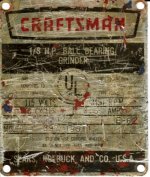

Jake,
Here is my friend's first try at a laser-engraver reproduction of my grinder nameplate. I haven't gotten it in my hands yet (will pick up this week) but from the one pic, I think that if it ain't perfect, it's darned close.
Some notes I made and already changed for the next version:
1) I had inadvertently made the circle around the UL logo too thick. Will rectify in next try.
2) Model and design numbers painted instead of stamped. Will probably leave blank for stamping in next versions.
3) Need a few adjustments to spacing and bottom black box graphic.
Other than those minor issues, I think it looks pretty good!
Here are pics of my original and the reproduction:
-Juke
AS: i just saw your block is not only a 1/2 HP commercial version that you can re wire to 220 if you choose to, but noticed the $55 price tag at the ReStore. that is an awesome grinder at an awesome price and nice find.
YW.Thanks TM. This grinder is a 3/4hp Commercial, but not dual voltage. Do they not do 220 up north?

That is impressive.Jake,
Here is my friend's first try at a laser-engraver reproduction of my grinder nameplate. I haven't gotten it in my hands yet (will pick up this week) but from the one pic, I think that if it ain't perfect, it's darned close.
Some notes I made and already changed for the next version:
1) I had inadvertently made the circle around the UL logo too thick. Will rectify in next try.
2) Model and design numbers painted instead of stamped. Will probably leave blank for stamping in next versions.
3) Need a few adjustments to spacing and bottom black box graphic.
Other than those minor issues, I think it looks pretty good!
Here are pics of my original and the reproduction:
----
-Juke

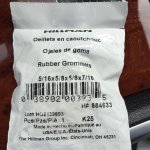
Stopped at lowes on my way home and only found 1 of the Hillman grommets. I needed 5. It looks pretty darn close to the original. I'll try it out when I get home.
~Veeps
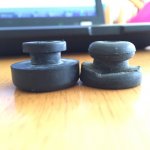

That is impressive.
I'd be interested in having 1 or 2 made up for future projects.

Orange County block heads.
http://orangecounty.craigslist.org/tls/4955896579.html
Here's a 1/2 commercial grade flat top in Chicago. On original stand $70. Have this model and have spent plenty on blocks this month or I'd probably email. I'm interested in eye shields I'd someone picks it up and apwants to throw me a bone.
http://chicago.craigslist.org/nwi/tls/4956348022.html
And a 1/3 commercial in Portland.
http://portland.craigslist.org/yam/tls/4956214593.html
Not sure what this one in fl is, since pics appear to taken by a two year old.
http://lakeland.craigslist.org/tls/4955162985.html
$18 flat top in Detroit. Maybe just make it an even $20.
http://detroit.craigslist.org/mcb/tls/4956381509.html
I'm looking for the bracket (circled) for a grinder attachment. It's possible that someone had one attached to their grinder when they bought one.
Thanks,
FL

Thanks TM. This grinder is a 3/4hp Commercial, but not dual voltage. Do they not do 220 up north?
The Detroit listing raised their price to $75. The seller must have found this thread lol
EX: thanks again for the tutorial on the power. do you have a commercial block that you could rewire to 220 to let us know if it's worth the effort to change it? once i get my own shop and can have several 220 outlets i'm sure i'd change my 1/2 to 220. for now I'm saving the only 220 plug for the compressor.
Yes, I have several dual voltage blocks, but I'm also an engineer and can do the math. If you're running only 15amp circuits on a long 14 gauge wire run, and want to run multiple machines at once, then maybe it would make sense to convert to 220v. But don't expect any significant difference in grinder power in any case. Bench grinders aren't typically loaded very much, compared to a table saw or wide belt sander, so I really can't see any reason for 220 home use.
Yes, I have several dual voltage blocks, but I'm also an engineer and can do the math. If you're running only 15amp circuits on a long 14 gauge wire run, and want to run multiple machines at once, then maybe it would make sense to convert to 220v. But don't expect any significant difference in grinder power in any case. Bench grinders aren't typically loaded very much, compared to a table saw or wide belt sander, so I really can't see any reason for 220 home use.
Ex,
Thanks for providing an engineer's input on the voltage topic. I would be much more interested in adding variable speed to block grinder rather than upping the voltage or horsepower. As far as I understand it, as a non-engineer, variable speed is not an option. Any input on that?
Exmax, I'm not sure I follow that. I've loaded grinders to stalling many times, even bigger 1 horse grinders. Rarely done that with a belt sander and the only time I've really loaded a table saw, is if the wood closes and it binds, (not good!...)
I had one big 8" Taiwan that started life 120, and I converted it to 220 and the difference was noticeable.
With a big braided wire wheel, i stalled that puppy regularly, which was why I switched to 220.
One test I use on a grinder I'm buying (with permission) is to load it with a piece of wood and see what it takes to stall it.
Ex,
Thanks for providing an engineer's input on the voltage topic. I would be much more interested in adding variable speed to block grinder rather than upping the voltage or horsepower. As far as I understand it, as a non-engineer, variable speed is not an option. Any input on that?
Exmax, I'm not sure I follow that. I've loaded grinders to stalling many times, even bigger 1 horse grinders. Rarely done that with a belt sander and the only time I've really loaded a table saw, is if the wood closes and it binds, (not good!...)
.
