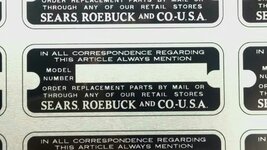
PUP: if you do a thread or even post it here on the best way to remove and replace rivets and the tools you use. like I said the labels look amazing and I bet if you teach us how to remove and replace them there will be a lot more good looking blocks showing up.
thanks again for doing all the work you've been doing.
Thanks drivesitfar. The information is also on post #37 in my thread
Machine Name Plate Tag Reproduction (
http://www.garagejournal.com/forum/showthread.php?t=323165) and also in my signature, however I'll post here also.
First, as far as removing the original rivets in the center band I simply used a grinding wheel to grind the
upset on the back of the rivet. You can use any size grinding wheel from a dremel version to a larger 4-1/2" wheel. Also a grinding stone or Tungsten Carbide Bur Cutting Tool installed on a dremel or 1/4" air die grinder will probably be better control behind the tight confines of the center band. The original rivets are know as either
Semi Tubular or Tubular Rivets, a special tool or machine is needed to pinched the hollow or tubular end over onto the back of the center band.
When I first got the inclination to use actual solid rivets I didn't do my homework too well as far as availability online. The ones used I purchased on ebay for about $4 for 50. They are aluminum domed solid rivets shaft is 1/8" diameter by 1/4" length, head is .25" diameter by .10" height.
However McMasterCarr has a far better selection, mostly $5 for 250. The one similar to above the head height is .064", slightly smaller profile. These I will get next when my current stock runs out.
At that point I did some research and found out that you can use a cheapo Harbor Freight
Medium Barrel Air Impact Hammer for under $10 on sale as a
rivet gun.
Then I purchased on ebay a
Rivet Set AN430 1/8" Round Head($10) to fit a straight .401 shank rivet gun.
Basically those air impact hammers have a .401" diameter female shaft opening the same as those high end expensive rivet guns. Same gun, one is modified to pound rivets all day while mine, well "it does the job" for me for under $25 total cost. Thing to note is the
Rivet Set tip has to match the rivet head profile you intend to use. The concave profile on the tip will fit over the 1/4" diameter dome head on the rivets I have. To keep it on the inexpensive side I used a piece of 1/2" thick steel bar stock as a
Bucking Bar.
Here's my setup, you'll noticed my
Bucking Bar in the vise. Also, it's recommended to use about 40psi pressure. Rest the rivet shaft end up against the
Bucking bar and raise the center band up against the back of the rivet head while holding down the rivet with the
Rivet Tool tip. Three to four quick burst of the trigger will set these aluminum rivets in a couple of seconds. As soon as you pull the trigger let go, this will give about +-6 blows to the rivet head. Just remember it's an aluminum rivet, not steel ones installed on the Titanic. After each trigger pull check your progress. Also make sure the Rivet gun is
perpendicular to the rivet, otherwise you will get a
Smiley cause by the edge of the Rivet Set tip.
TIP: Take a small machine screw and nut and install it diagonally opposite your first rivet to install. This will keep your badge in perfect hole alignment when pounding with the Rivet gun. Once satisfied, install the other two then the last one where the screw and nut were. I made this mistake and used another rivet for alignment and it bounced off while working on the first one. Had the first one done and solid however the other holes fell out of alignment enough that the rivets would not go in the holes, had to drill/file them for proper fitment.
Btw, I'm in no way setting these according to aircraft specs, I believe the rivet shaft end when compressed is called the
Upset: diameter of the
Upset should be 1.5 times the diameter of the rivet shaft and the
Upset thickness .5 times the diameter of the rivet shaft. Heck I just want the badge to stay put.
Back side showing the
Upset of the rivets. Also the same procedure done for the brass etched
Rebuild Badge I created.
Btw, since then I have also purchased
Flat Head Solid Rivets in the same dimensions as the dome head ones.
I will make these available as a choice to ordered CM badges. For my AH Manual Motor Stater switch tag I want to use the flat one for the install, every others I will stick with the dome heads. Also for those that may not be able to set the dome ones with the air hammer setup, these flat ones can be peened on the back with a small ball peen hammer. Just take note that the flat surface you put the head on to act as your Bucking Tool must be smooth, otherwise any imperfections on the surface will transfer to the head when peening the shaft end. Also with this setup you will have to take great care to protect the new badge not to scratch or damage it since it will also be up against your Bucking surface
<---only draw back, you've been warned. My recommendation, choose the dome head solid rivets, I believe this will be a safer install.
Hope this helps - David


 .......Thanks