To avoid these ads, REGISTER NOW!

Let’s talk about multiple 220 needs

To avoid these ads, REGISTER NOW!
OP
O

ovilla

Well-known member
Joined
Dec 18, 2005
Messages
2,342
Location
Plainfield, IL
Can anybody answer the question about setting up multiple 240 30 amp receptacles on the same one 30AMP circuit? Is this how folks wire up multiple receptacles? Is this allowed by code? Just seems like a waste if you really shouldn’t or can’t use 2 machines at the same time. Seems like it would simply eliminate the hassle of having to plug in to a 240 extension cord.


Sent from my iPad using Tapatalk
 

mike93lx

ALLIANCE MEMBER
Joined
Dec 9, 2013
Messages
37,403
Location
Richmond, VA
Can anybody answer the question about setting up multiple 240 30 amp receptacles on the same one 30AMP circuit? Is this how folks wire up multiple receptacles? Is this allowed by code? Just seems like a waste if you really shouldn’t or can’t use 2 machines at the same time. Seems like it would simply eliminate the hassle of having to plug in to a 240 extension cord.


Sent from my iPad using Tapatalk

Here is a recent thread with some answers. Took about 15 seconds of searching on Google to come up with it

https://www.garagejournal.com/forum/showthread.php?t=436126

I think you may have some trouble with the connections. You need a receptacle that can accept multiple 10a wires or you need connectors properly rate for 3 connections, plus a large enough box.
 

sberry

Banned
Joined
Jun 18, 2005
Messages
35,747
Location
Brethren, Michigan
It's done in shops, it's restricted in some residential codes. I don't think the NEC has it but it's likely there just for some of the reasons in this thread. People think every "220" circuit is the same, they change ends, make adapters, all kinds of shat hooked to outlets with the wrong breaker for the equipment.
There is some misconception that the breaker only protects the wire in the wall against thermal,, actually rarely does on these dedicated equipment circuits. It does on multiple outlet circuits.
 

u2slow

Well-known member
Joined
Nov 20, 2011
Messages
3,583
Location
BC
Can anybody answer the question about setting up multiple 240 30 amp receptacles on the same one 30AMP circuit? Is this how folks wire up multiple receptacles? Is this allowed by code? Just seems like a waste if you really shouldn’t or can’t use 2 machines at the same time. Seems like it would simply eliminate the hassle of having to plug in to a 240 extension cord.

It works fine. Just like several 15A receptacles on a circuit in your house.

Box fill and splices will be challenging with #10. I suggest using a dedicated junction box for each splice, so each receptacle/device is an 'end of run'.

It may not be Code, but I don't have a problem with it. For example, seems silly to tie up a whole dedicated 30A circuit for an automotive lift that you only use for seconds at a time.
 

sberry

Banned
Joined
Jun 18, 2005
Messages
35,747
Location
Brethren, Michigan
I share the hoist wire with a welder outlet on it. On their own they could have a derate wire but I have a 10 and the machine I plug in and the hoist can use the same overcurrent. But the hoist is hard wired, it's not a case of moving cords.
 
OP
O

ovilla

Well-known member
Joined
Dec 18, 2005
Messages
2,342
Location
Plainfield, IL
It's done in shops, it's restricted in some residential codes. I don't think the NEC has it but it's likely there just for some of the reasons in this thread. People think every "220" circuit is the same, they change ends, make adapters, all kinds of shat hooked to outlets with the wrong breaker for the equipment.
There is some misconception that the breaker only protects the wire in the wall against thermal,, actually rarely does on these dedicated equipment circuits. It does on multiple outlet circuits.


I think what really adds to things is that manufacturers also don’t include plug ends on what is clearly a “mobile” application/machine, like a welder and to some extent something like a 4 post lift - which many sell with wheels, so it can be moved around. I don’t get why they can’t include the appropriate plug end for these machines, especially since the plug end is already dictated by the amperage need of the machine itself. Why leave the plug end decision to the consumer. This would eliminate folks using the wrong plug end or setting it up to use a 50amp plug because that’s the only 240 set up currently in their shop.


Sent from my iPad using Tapatalk
 
OP
O

ovilla

Well-known member
Joined
Dec 18, 2005
Messages
2,342
Location
Plainfield, IL
Here is a recent thread with some answers. Took about 15 seconds of searching on Google to come up with it

https://www.garagejournal.com/forum/showthread.php?t=436126

I think you may have some trouble with the connections. You need a receptacle that can accept multiple 10a wires or you need connectors properly rate for 3 connections, plus a large enough box.


Thank you Mike93lx! This is exactly what I was looking for.


Sent from my iPad using Tapatalk
 

u2slow

Well-known member
Joined
Nov 20, 2011
Messages
3,583
Location
BC
I think what really adds to things is that manufacturers also don’t include plug ends on what is clearly a “mobile” application/machine, like a welder and to some extent something like a 4 post lift - which many sell with wheels, so it can be moved around. I don’t get why they can’t include the appropriate plug end for these machines, especially since the plug end is already dictated by the amperage need of the machine itself. Why leave the plug end decision to the consumer.

Because horsepower-rated plug ins are $$$. Hardwiring is cheap. Saying "hire an electrician" in the user manual is cheap for their legal department.

One that irks me is small 240v welders with 6-50P cords. You won't see a 2-3hp cabinet saw or compressor with that cord (factory), yet all 3 have similar power requirements, and are portable.
 

mike93lx

ALLIANCE MEMBER
Joined
Dec 9, 2013
Messages
37,403
Location
Richmond, VA
Because horsepower-rated plug ins are $$$. Hardwiring is cheap. Saying "hire an electrician" in the user manual is cheap for their legal department.

One that irks me is small 240v welders with 6-50P cords. You won't see a 2-3hp cabinet saw or compressor with that cord (factory), yet all 3 have similar power requirements, and are portable.

It irks you that a welder uses an industry standard plug for Welders?
 

Negen

Well-known member
Joined
Jul 15, 2015
Messages
1,909
Location
Seatltle WA
If I had my way every room in my house would have 220v. Everything from mini under sink instant on water heaters to computers and shop equipment are all safer and more efficient being run at 220v.

Sent from my ONEPLUS A6013 using The Garage Journal mobile app
 

Norcal

Well-known member
Joined
Mar 16, 2008
Messages
13,752
If I had my way every room in my house would have 220v. Everything from mini under sink instant on water heaters to computers and shop equipment are all safer and more efficient being run at 220v.

Sent from my ONEPLUS A6013 using The Garage Journal mobile app

In places where 220V is used it is a line to neutral voltage, 208V, or 240V as it is used in North America is a line to line voltage, it is not safer then 120V whatever voltage is most common in what part of the world you are in is going to be the one most likely to get you.
 

wyliesdiesels

Well-known member
Joined
Aug 14, 2012
Messages
19,983
Location
Modesto, CA
Everything I specified is from what each machine actually states either on a sticker on the machine or on a plate attached to the motor. I have to wonder though if these are just minimum amperage ratings or if they take any startup amperage spikes into account. Actually I’ll do a quick test and hook up my amperage meter to each one to see what they are drawing at startup and while in use.

What brand and model clamp meter do you have?

Unless its specifically designed to measure inrush current, you wont get an accurate reading.
 

wyliesdiesels

Well-known member
Joined
Aug 14, 2012
Messages
19,983
Location
Modesto, CA
If I had my way every room in my house would have 220v. Everything from mini under sink instant on water heaters to computers and shop equipment are all safer and more efficient being run at 220v.

Sent from my ONEPLUS A6013 using The Garage Journal mobile app

How is 240v (220v doesnt exist in the US anymore) safer and more efficient?

Its still 120v to ground and there is no efficiency gained as the wattage is the same regardless that the current is halved. Remember electricity is billed in kilowatt hours not amperage.
 

rattle_snake

Well-known member
Joined
Jun 25, 2015
Messages
5,151
Location
Chandler, AZ
residential code is clear that anything over 20A must be dedicated. Adherence to code is up to you.

I needed four 6-50 receptacles far away from panel. Instead of four #6 runs ($$$$) I did one ($) and put in a sub panel with 4 50A breakers. Each is dedicated and not a cluster f@#k inside the receptacles box, to code. A panel and breakers is cheaper than one short run (20') of wire.

I'll admit that I added a 6-50 receptacle on my lift that is not dedicated, and can use a 6-50 40' extension cord to reach outside.
 

mike93lx

ALLIANCE MEMBER
Joined
Dec 9, 2013
Messages
37,403
Location
Richmond, VA
residential code is clear that anything over 20A must be dedicated. Adherence to code is up to you.

I needed four 6-50 receptacles far away from panel. Instead of four #6 runs ($$$$) I did one ($) and put in a sub panel with 4 50A breakers. Each is dedicated and not a cluster f@#k inside the receptacles box, to code. A panel and breakers is cheaper than one short run (20') of wire.

I'll admit that I added a 6-50 receptacle on my lift that is not dedicated, and can use a 6-50 40' extension cord to reach outside.

Can you provide that clear code reference?
 

jeepxj

Well-known member
Joined
Mar 2, 2008
Messages
17,832
How is 240v (220v doesnt exist in the US anymore) safer and more efficient?

Its still 120v to ground and there is no efficiency gained as the wattage is the same regardless that the current is halved. Remember electricity is billed in kilowatt hours not amperage.

TIL less amps = more safe. :shocking:
 

wyliesdiesels

Well-known member
Joined
Aug 14, 2012
Messages
19,983
Location
Modesto, CA
residential code is clear that anything over 20A must be dedicated. Adherence to code is up to you.

I needed four 6-50 receptacles far away from panel. Instead of four #6 runs ($$$$) I did one ($) and put in a sub panel with 4 50A breakers. Each is dedicated and not a cluster f@#k inside the receptacles box, to code. A panel and breakers is cheaper than one short run (20') of wire.

I'll admit that I added a 6-50 receptacle on my lift that is not dedicated, and can use a 6-50 40' extension cord to reach outside.

The NEC has no such code.

The IRBC does however not all AHJs adopt the IRBC.... YMMV
 
To avoid these ads, REGISTER NOW!

sberry

Banned
Joined
Jun 18, 2005
Messages
35,747
Location
Brethren, Michigan
Yup. It's allowing use of too large a circuit in most cases - with the small machines.

They are designed to run on this circuit. Just like other equipment, wall wart phone charger, 200MA on a 20A circuit. Like all the equipment listed to plug in to common circuits.
 

sberry

Banned
Joined
Jun 18, 2005
Messages
35,747
Location
Brethren, Michigan
I think what really adds to things is that manufacturers also don’t include plug ends on what is clearly a “mobile” application/machine, like a welder and to some extent something like a 4 post lift - which many sell with wheels, so it can be moved around. I don’t get why they can’t include the appropriate plug end for these machines, especially since the plug end is already dictated by the amperage need of the machine itself. Why leave the plug end decision to the consumer. This would eliminate folks using the wrong plug end or setting it up to use a 50amp plug because that’s the only 240 set up currently in their shop.


Sent from my iPad using Tapatalk

Reason is that they may be wired to different voltages, some even phases.
 

u2slow

Well-known member
Joined
Nov 20, 2011
Messages
3,583
Location
BC
They are designed to run on this circuit. Just like other equipment, wall wart phone charger, 200MA on a 20A circuit. Like all the equipment listed to plug in to common circuits.

No, the small welding machines aren't. Take a Millermatic 180 mig for example. Manual clearly indicates a 25-30A max OCP. That doesn't agree with its 50A cord plug, or the standard 50A 'welding circuit' commonly installed for a welder.

Why is it not using the 6-30P? Why not put 5-50P cords on a 3HP compressor or 2HP table saw?

I don't like dumb rules. Conflicting rules are proof of the dumb.
 

sberry

Banned
Joined
Jun 18, 2005
Messages
35,747
Location
Brethren, Michigan
The instructions leave some to be desired. The 30 breaker is when the minimum (14) wire size is used, 12 or better and it can be 50A. The mvp have a 14 cord, special adapter to allow 50. Note that the old 240 180 class and new ones of its type use a 12 cord to meet short circuit of 50A. Hobart used the same cord they used on the old stickmate. If the thing comes 50 end means it's allowed on a 50 circuit.
 

sberry

Banned
Joined
Jun 18, 2005
Messages
35,747
Location
Brethren, Michigan
No, the small welding machines aren't. Take a Millermatic 180 mig for example. Manual clearly indicates a 25-30A max OCP. That doesn't agree with its 50A cord plug, or the standard 50A 'welding circuit' commonly installed for a welder.

Why is it not using the 6-30P? Why not put 5-50P cords on a 3HP compressor or 2HP table saw?

I don't like dumb rules. Conflicting rules are proof of the dumb.

They assume a couple things. This is why they say,, qualified electrician. I The instructions assume that's who they are talking to, they are not conflicting once they are understood.
They don't use that end factory on other equipment because it would mean it would need to be designed for 50A, some of it must be current limited for short circuit. Well all of it really but there is a limit. Reading about cooking, tops and ovens sheds a little light on this.
 
Last edited:

sberry

Banned
Joined
Jun 18, 2005
Messages
35,747
Location
Brethren, Michigan
The minimum wire size for a 180 is 14 even though it comes with a 12 cord. 14 is too small for short circuit at 50, it needs 12. So, the 30 breaker is for the small wire. Personally think they should simply list 12 wire and get rid of the 30 but there is a reason they do it this way that is over my head.
The advent of the MVP has allowed them to pull all the wire for many models off the same spool. I remember when the customer wired on the end of the first units, they have come a long way with this. Some with autoline still do.
I am nor sure what skin loss to the company would be if they simply listed a larger wire?
 
Last edited:

sberry

Banned
Joined
Jun 18, 2005
Messages
35,747
Location
Brethren, Michigan
They hired a new bunch of engineers for the inverters, they are a bright bunch but I suspect electronics types and a couple I talked to from white and blue didn't seem to be familiar with code details from this end. They got them, just didn't meet them.
 

Negen

Well-known member
Joined
Jul 15, 2015
Messages
1,909
Location
Seatltle WA
2500 watt @ 240 is close to 10 amp and 2500 watts @ 120 is about 20 amps. Most 120 volt circuits I have seen are max 15 amps and running that for extended period of time is probably not safe.

Items like mini instant on portable water heaters are normally 220-240 volts.
High end computers run 1500 watts.
Yogurt machine I have is 240 volts.

Not sure other stuff I have as many is 110-240 input voltage. But seems to me that lower amps/current result in lower temps in the wires. Which seems to me to result in lower risk of fire.

My old house had aluminum wires and not copper this resulted in me only able to use my computer which was 1500 watts in the winter or at night because the breaker box was heating up quite a bit. At first I had the breakers replaced , then the breaker box , then the whole house got rewired in copper wouldn't put 240 in my office not sure the exact reason. But running that PC on 240 in the garage and checking the temp of the breaker box vs 120 temps were about 50% less on 240 than 120.


At work I have some computers running on 214 volt lines not sure how or why but marked multiple times with 214.
How is 240v (220v doesnt exist in the US anymore) safer and more efficient?

Its still 120v to ground and there is no efficiency gained as the wattage is the same regardless that the current is halved. Remember electricity is billed in kilowatt hours not amperage.

Sent from my ONEPLUS A6013 using The Garage Journal mobile app
 

wyliesdiesels

Well-known member
Joined
Aug 14, 2012
Messages
19,983
Location
Modesto, CA
2500 watt @ 240 is close to 10 amp and 2500 watts @ 120 is about 20 amps. Most 120 volt circuits I have seen are max 15 amps and running that for extended period of time is probably not safe.

Items like mini instant on portable water heaters are normally 220-240 volts.
High end computers run 1500 watts. Yogurt machine I have is 240 volts.

Not sure other stuff I have as many is 110-240 input voltage. But seems to me that lower amps/current result in lower temps in the wires. Which seems to me to result in lower risk of fire.

My old house had aluminum wires and not copper this resulted in me only able to use my computer which was 1500 watts in the winter or at night because the breaker box was heating up quite a bit. At first I had the breakers replaced , then the breaker box , then the whole house got rewired in copper wouldn't put 240 in my office not sure the exact reason. But running that PC on 240 in the garage and checking the temp of the breaker box vs 120 temps were about 50% less on 240 than 120.


At work I have some computers running on 214 volt lines not sure how or why but marked multiple times with 214.

Sent from my ONEPLUS A6013 using The Garage Journal mobile app

no way does a high end computer run at 1500w.

I have an HP tower server gen 8 with dual xeon 6 core CPUs, 7 10K rpm drives and dual 750watt power supplies (DC wattage) and Eaton enterprise grade 5PX UPS with load monitoring and my server pulls 140w. This is corroborated with iLO power monitoring internal in the server that says the same thing. My dell tower pulls less than 100w.

your numbers are way off. way way off.

BTW 240v is NOT more efficient than 120v. You know why? because its the same wattage.

you proved this yourself with your 2500w example. When its the same wattage at 120v and 240v there is no efficiency gained.

BTW if youre breaker box is heating up from 1500w youve got issues with a bad breaker box NOT the 1500w load.

My 125a service sees way more than 1500w running through it (2 ACs, 2 electric stoves, 1 dryer, 1 water heater; all at the same time as my meter feeds a studio in the back) and my breaker panel does not heat up.

your example falls flat on its theory...
 
Last edited:

Negen

Well-known member
Joined
Jul 15, 2015
Messages
1,909
Location
Seatltle WA
I build my own computers and have so for quite some time and when you dual socket CPU and two or more gpu's wattage can run quite high. Let alone 5+ 1000-1350 watt asic miners. Ant miner s9 type stuff wattage gets high. Let alone dedicated graphics work stations where some single images can take 12-24 hours to render. The miners ran off of dual 750 watt sever PSU or what ever I could find. Total wattage was from the wall was around 4000 watts.

My dual Xeon ran dual 980ti gpus that was liquid cooled the 1500 watt psu was older style which was really two 750 watts connected together. 260 watts for the CPUs plus 500 watts for the GPU. Already maxes out a 750 watt PSU. Problem here is current on 12 v rails.

A 1500 Watt silver stone for example has 7 12 volt rails at 25 amps max. This totals out to be 2100 watts alone. Not all 7 will run at full current. A 1500 watt power supply is generally 800-900 watts at the wall. But multiple high current rails are needed.

Hard disks run at very little current compared to CPU under 24/7 100% loads 1366

X5675 running at 4.2 GHz @ full load for 24/7 is not energy efficient at all compared to modern rigs.
Your 750 watt power supply probably rarely sees over 400-500 watt at the wall. Mine was consistently @ 825 watts at the wall. T

At the time I was running this stuff it was said that bit coin mining was something around 66 Twh currently 76 Twh which is more than the entire country of Israel.

Also not sure if hp made anything "high end" in the last 25 years.

Probably efficiency is the wrong term but with my units the are gold or platinum rated for efficiency.
When used on 240 outlets the efficacy in terms of wattage from wall ac to DC seems to increase less loss of power. Not in terms of efficiency when it comes to bills or anything 800 watts from wall is still the same but the 800 watts from wall to PC with less loss is what I meant.

Yes I had all the power and breaker boxes replaced at that house.
no way does a high end computer run at 1500w.

I have an HP tower server gen 8 with dual xeon 6 core CPUs, 7 10K rpm drives and dual 750watt power supplies (DC wattage) and Eaton enterprise grade 5PX UPS with load monitoring and my server pulls 140w. This is corroborated with iLO power monitoring internal in the server that says the same thing. My dell tower pulls less than 100w.

your numbers are way off. way way off.

BTW 240v is NOT more efficient than 120v. You know why? because its the same wattage.

you proved this yourself with your 2500w example. When its the same wattage at 120v and 240v there is no efficiency gained.

BTW if youre breaker box is heating up from 1500w youve got issues with a bad breaker box NOT the 1500w load.

My 125a service sees way more than 1500w running through it (2 ACs, 2 electric stoves, 1 dryer, 1 water heater; all at the same time as my meter feeds a studio in the back) and my breaker panel does not heat up.

your example falls flat on its theory...

Sent from my ONEPLUS A6013 using The Garage Journal mobile app
 
Last edited:

Negen

Well-known member
Joined
Jul 15, 2015
Messages
1,909
Location
Seatltle WA
Probably the wrong term. In some electronic devices that have 100-240 input voltage the power loss (my understanding is efficiency) is less when 240 is used. Not efficiency in terms of lower bill but in terms of ac being converted to dc and having less wasted power consumption. 5-10% loss vs 2-8% loss. Normally heat is considered loss. So with computers heat is considered wasted energy. Now 240 will not lower the consumption of computers but the power supply can become less wasteful when delivering the requested wattage. This is why many power supply units get higher wattage rating when running off of 240 than running off of 120. Temperature is the main thing that kills power supply units.

How is 240v (220v doesnt exist in the US anymore) safer and more efficient?

Its still 120v to ground and there is no efficiency gained as the wattage is the same regardless that the current is halved. Remember electricity is billed in kilowatt hours not amperage.

Sent from my ONEPLUS A6013 using The Garage Journal mobile app
 
Last edited:

u2slow

Well-known member
Joined
Nov 20, 2011
Messages
3,583
Location
BC
BTW 240v is NOT more efficient than 120v. You know why? because its the same wattage.

I disagree. On a given wire size, the supply circuit is more efficient at delivering power at the higher voltage. I^2 x R losses. Less conductor heating with the lower current.
 

wyliesdiesels

Well-known member
Joined
Aug 14, 2012
Messages
19,983
Location
Modesto, CA
That efficiency does nothing for you though. Tthe net result is the same because the wattage draw is the same. Less conductor heating does not lower the electric bill. So it is not more efficient on the electric bill.
 

Negen

Well-known member
Joined
Jul 15, 2015
Messages
1,909
Location
Seatltle WA
Efficiency is not always about bills. Many ac/DC power supply Less amps, less resistance, less heat, less worries.

A 1000 watt gold rated power supply may for example draw 6.5 amps on 120 rather than 6.0 using 240. But it's been years since I ran tests like that never tested on platinum rated PSU. In an PSU the main bridge rectifier and the PFC boost converter are where the gains on 240 volts are every other component runs the same on 120 or 240 volts. In ac to DC capacitors will be charged to 240 volts when using a 240 volt outlet. And this will improve rectification.

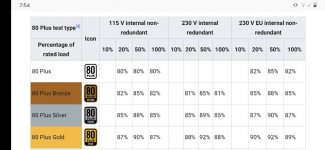
Titanium rated power supply is 94% efficient on 120 volts and 96% efficient on 240 volts.


I know little about the fine details of this but in ac to DC 240 is more efficient. I will stop talking and post an chart from energy Star.
That efficiency does nothing for you though. Tthe net result is the same because the wattage draw is the same. Less conductor heating does not lower the electric bill. So it is not more efficient on the electric bill.
Screenshot_Fennec_F-Droid_20200608-195411.jpegScreenshot_Fennec_F-Droid_20200608-195437.jpeg

Sent from my ONEPLUS A6013 using The Garage Journal mobile app
 
Last edited:

u2slow

Well-known member
Joined
Nov 20, 2011
Messages
3,583
Location
BC
That efficiency does nothing for you though. Tthe net result is the same because the wattage draw is the same. Less conductor heating does not lower the electric bill. So it is not more efficient on the electric bill.

Lets not confuse efficiency with consumption. :)
 

u3b3rg33k

Well-known member
Joined
Dec 18, 2017
Messages
4,047
2500 watt @ 240 is close to 10 amp and 2500 watts @ 120 is about 20 amps. Most 120 volt circuits I have seen are max 15 amps and running that for extended period of time is probably not safe.

Items like mini instant on portable water heaters are normally 220-240 volts.
High end computers run 1500 watts.
Yogurt machine I have is 240 volts.

Not sure other stuff I have as many is 110-240 input voltage. But seems to me that lower amps/current result in lower temps in the wires. Which seems to me to result in lower risk of fire.

My old house had aluminum wires and not copper this resulted in me only able to use my computer which was 1500 watts in the winter or at night because the breaker box was heating up quite a bit. At first I had the breakers replaced , then the breaker box , then the whole house got rewired in copper wouldn't put 240 in my office not sure the exact reason. But running that PC on 240 in the garage and checking the temp of the breaker box vs 120 temps were about 50% less on 240 than 120.


At work I have some computers running on 214 volt lines not sure how or why but marked multiple times with 214.

Sent from my ONEPLUS A6013 using The Garage Journal mobile app
sounds like someone's 208V Y is tapped a bit hot.
Probably the wrong term. In some electronic devices that have 100-240 input voltage the power loss (my understanding is efficiency) is less when 240 is used. Not efficiency in terms of lower bill but in terms of ac being converted to dc and having less wasted power consumption. 5-10% loss vs 2-8% loss. Normally heat is considered loss. So with computers heat is considered wasted energy. Now 240 will not lower the consumption of computers but the power supply can become less wasteful when delivering the requested wattage. This is why many power supply units get higher wattage rating when running off of 240 than running off of 120. Temperature is the main thing that kills power supply units.


Sent from my ONEPLUS A6013 using The Garage Journal mobile app
as mentioned above some power supplies are more efficient with higher input voltage.

higher wattage ratings on 200v class power are often because of the amperage limits of 120V circuits.
 
To avoid these ads, REGISTER NOW!
Top Bottom