Thanks Sundowner,
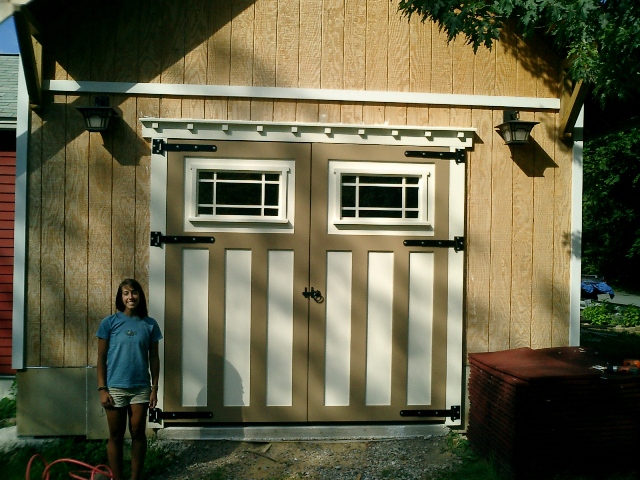
I thought I looked at all the hinges on Mcmaster's site but I missed those. Very nice building you have. Doors really stand out. How do they work? Smooth movement with no bearings? They say 5/16 bolts, seems kinda small for all that weight. Did you through bolt them or use lag screws? If lag screwed have the hinges stayed tight or do they tend to loosen up with repeated openings? Lotsa questions I know, but want to do this only once since it means putting holes into the exterior. My openings should be able to support the doors without a problem. All the sites are recommending a 24 inch hinge for my application. Wonder if increasing from 3 to 4 per door would make up for the shorter hinge and my taller doors? Thanks for the link and info.
the hinges are very smooth. I originally wanted ball or bronze bearing hinges, too but the prices on those were not justifiable to my wallet. I figured these are intended to be used on semi truck doors, which are about the same size and environmental exposure, so I used them.
I owuld use as many hinges as you can comfortable fit on the door, but that's me.
The hinges are lag-bolted through the trim and into the 6x6 posts. I wanted to use through-bolts, but they would have been overly long, and to be honest, probably overkill. To date, they have not loosened or moved. I do reccomend that you either carefully pick lags that fit closely inside the bolt holes, or upsize to 3/8" lags and ream the bolt holes to *just* fit the lag bolt shanks. The hinge to the door is through bolted. I built the doors with 2x6 framing lain flat between the exterior and interior layers just to carry those bolts. I was worried about eccentric loading egging out the backside holes where the nuts attach, so I used Tee-nuts, also from McMaster that I hammered into the back layer and they now distribute the weight better from the bolts.
two tips on installation:
1) put the hinges on the door, first. that way you can control the placement better, and make sure the hinge pins end up in exactly the same plane and centerline. If they aren't then they will bind and make it difficult to operate the door.
2) set the door on a floor shim to carry the load while you tinker with the exact clearances to the jambs. You only get one shot to drill the holes and hang the door, you can't adjust the alignment after that, so you have to get it right the first time.
3) bonus tip: buy a laser level/plumb. when you have two opposing doors, you have to be dead nuts square and your jambs have to be exactly in-plane. I mean EXACTLY. Think about it: if you're jambs are eack off 1/8" from plane and the same from plumb, then those errors will be telegraphed through the doors to where they meet in the middle, and there the cumulative 1/4" will look like total ****, or even keep the doors from operating. A cheap $80 laser tool makes life so much easier, it's not even funny.
4) second bonus tip: be very careful about the distance between the doors. my doors are 4 1/4" thick so the distance between them had to be made wide enough to allow the doors to swng apart without hitting. when closed, my doors are about 1/2" apart. when the open and that trailing edge of the opening door sweeps past the static face of the closed door, there's only about 1/16" of clearance.