Great info…thanks! I def need to do a roll-on application for my project. My application is mostly vertical so I may not thin at all. I may try a few different tints, maybe in the silver and gold hammered colors as bases, to explore the possibilities. I also may try mixing two different rustoleum hammered colors, like copper with silver or gray, to tone it down a bit…
Do you think it would be better (stay mixed better, have a more predictable color once dried) to mix 2 rustoleum hammered colors together rather than adding a tint?
I would assume keeping with the manufacturer's mixes is always the best policy, although without knowing you can't be absolutely certain.
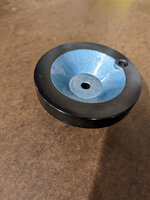
I think a roller would work well. I used a brush and a foam brush, but I have another project lined up that a roller would be better. It did flow out unthinned, but if you let it sit for a bit and try to play with it, it does seem to disturb the pigment mix and the flow out. Pretty much have to put it on, make any adjustments while wet, and then walk away. It sets up pretty fast, but then stays somewhat soft for most of a day. I put that washer in my pocket the next day after painting and later in the day noticed it had the impression of the material in it (although it didn't adhere to the material). Next day, though, it was rock hard. I still plan on thinning just a bit, although with a perfectly flat surface (I was painting a cast iron edge), it may not be needed with a roller.
Possible if sprayed the tint may react differently, and I have nothing large enough to justify hauling out a spray gun, experimenting with the settings and then having to clean it multiple times.
I did some experiments with little mixing cups. When I do the next project, I'll mix up most of the quart based on scaling up the cups and then do some test bits to adjust the color, and then use the entire mixed batch from then on so I keep it consistent. That said, I haven't tried mixing and then letting the paint sit in the can - it's always possible the tint will act as a catalyst and harden everything. Unlikely, but I'm not a chemist.
I can't speak for the longevity, and I've never used hammered paint before, but I'm very happy with the results so far.
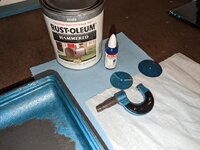
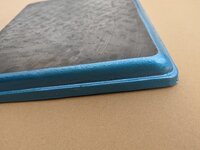
I don't know if this helps any. Pics are an inspection plate I painted after the washer and then the following day. I used it as an experiment, plus the underside was very rusted, so after evaporusting it, it was raw cast iron. Sides were previously painted but still rough and there is casting flash. I sorta wanted to take more time with it and grind off the flash, but at this point I just want to stop it from rusting again. So all the roughness is the surface and not the paint.
This has two coats mixed at different times but in some spots I tried to go over after it had started to set and maybe in the pics you can see how those areas are more silver and left some brush strokes. The washer I just painted and put it down and it came out much nicer.
It's overcast today but that's the best light source I have...

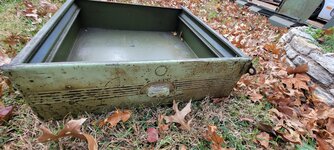




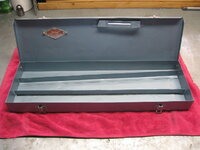


 I don’t have the vise, nor plan to get one, unless opportunity presents itself, but if it comes, I can’t wait to try.
 wanted to make sure you saw ckucia’s solution, and one may scroll for the results.