To avoid these ads, REGISTER NOW!

Log Builder’s - Timber Framer’s - B&B Gang - Mallets

2oolhound

Well-known member
Joined
Dec 18, 2010
Messages
5,918
Location
BC Canada
January was Mallet Month for me. I've almost got this bad boy completed so I thought I'd post the procedure. Eventually I'll make a couple more smaller ones so I have a set to select from.

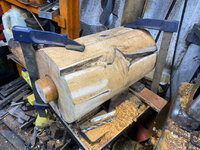
Something I always wanted when I was building log homes was a giant mallet. When you needed to move a 50' log a few fractions of an inch to get it to seat properly in it’s notches a solid tap with something heavy would do the trick. We used to grab a 20” x 20” round of log and smash it into the stubborn log and that would seat it. I decided I’d make a proper mallet out of a 10” round x 14” long piece of yew wood. I originally envisioned it as a rough unpeeled round but realized I’d need to cut the grooves for ferrules on my lathe if I wanted a nice job. I had to skim the log heavily with a chainsaw to get it to clear on my 10” atlas metal lathe.
MalHdSm_1068.jpg

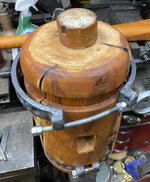
I decided to attach the handle to the head using a mortise and tenon. I drew plumb lines on each end and snapped a line across the top and bottom between the plumb lines. Using a 12” 3/8” drill and building a cradle on the DP table to hold the log plumb I bored through just catching the center point on the bottom (1/4” out only). Using a 1 1/2” drill from the top I went as far in as I could then rolled the log to drill from the bottom. It was easy to get back on center and finally the 2 holes met. A long blade on a recip saw cut relief cuts to the edges of the 1 3/4” x 3” mortise which were then chiseled out.
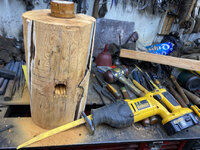
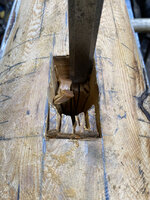
MalHdSm_1088.jpg


MalHdSm_1092.jpg

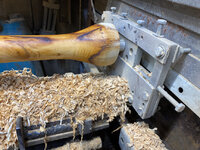
Using a piece of drill rod and a large C clamp I fashioned a steady rest along side the log and cut the grooves for the ferrules.
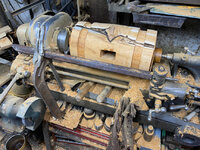
MalHdSm_1104.jpg

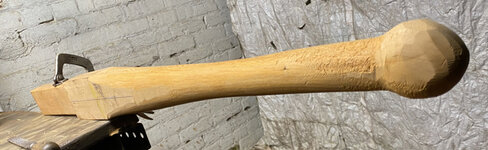
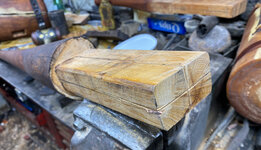
I used a stave, quartered and split from another section of the yew log. You can just see one in the top left corner here. Plumb lines were drawn on the ends and snap lines marked to those points across the length. It was then just chain sawed to the board you see in the foreground with the tenon started.
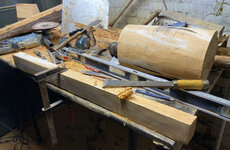
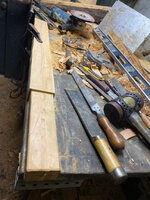
YewHandle_1057.jpg

YewHandle_1067.jpg

I used my 4X6 metal band saw to rough the rest of the handle shape in.
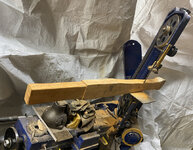
YewHandle_1112.jpg
 
To avoid these ads, REGISTER NOW!
OP
2

2oolhound

Well-known member
Joined
Dec 18, 2010
Messages
5,918
Location
BC Canada
Then a rasp.

YewHandle_1172.jpg


Next came the grizzly realization that I’d measured the handle length off a sledge hammer not realizing that head was only 4” thick. This one is over 9” which eats 5” of the length up. The mallet looked very odd because looking at the 25 lb head you just knew it wasn’t just a one handed mallet, you’d need 2 hands to swing this baby. Time to step away and work on the ferrules.
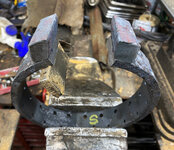
The trouble with collecting junk yard steel is you don’t know what kind it is. I thought this was 1 1/4” x 3/8” hot rolled flat bar but it turned out to be some kind of high carbon steel that was tough to bend. I had to drill my signature hole pattern along the length to help with this and then anneal it in my forge. I drilled and tapped lugs to weld on the ends so it could be tightened for the next years to help prevent checking of the wood over time.

Ferrule_E1204.jpg

This came in handy when it came to opening these ferrule rings up to slip them over the ends of the head and seat them in their grooves. Ready rod was used to force open the rings.

Ferrule_1215.jpg

I wanted to **** the handle up into the head rather than just flare out the end of the tenon with wedges to hold the head on. I cut some oak wedges from some solid book shelves I’d scored at the swap meet and in addition I’ll use a 1/2” lag bolt screwed in from the top to **** the handle up into the head.
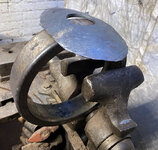
I took a piece of 4” x 6” X 1/4” hot rolled steel and drilled a 1 1/2” hole in the center then forged it down to 1/8” all around the edges and shaped it to fit the top curves.

Cap_1310.jpg

A piece of flat steel was welded below the center hole and drilled for the 1/2” lag bolt so the bolt head would not stick up higher than the cap. This cap was hammered smooth and trimmed around the edge to a perfect oval. A large bearing shell the circumference of the mallet head was used to shape the cap and a 1/8” deep oval was cut into the head to counter sink the cap into the head. (will try to get photos of this later)

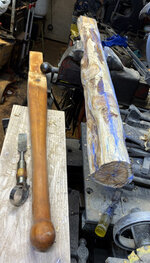
I’ve decided not to laminate an extension to the handle so I’ll make a new one. I’ll make a 15LB head to use with the old handle. I found a long enough yew limb the right thickness.

YewHandleSm_1225.jpg

The custom tailstock I’d made earlier was just what was needed to fit the longer handle to the atlas lathe.

TailStock_1231.jpg

2YewHandle__1235.jpg

Horizontal and vertical cuts were sawed into the tenon for the wedges. The lag bolt will screw right in the center. (you can see the 15lb head I've started to use the 1st handle with on the right side of the photo)

WedgeCuts_1303.jpg

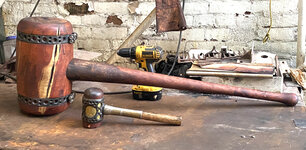
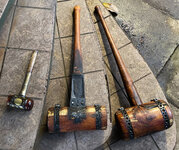
Here it is with my small hand mallet, almost ready to shake things up!

Mallet25_1328.jpg
 
Last edited:
OP
2

2oolhound

Well-known member
Joined
Dec 18, 2010
Messages
5,918
Location
BC Canada
Damn, that’s a mallet! Wow.
Yes, it's quite a chunk of wood. There's a certain sacrilege about cutting a live yew tree. They have been very highly regarded for centuries world wide. I'd been gifted a 3' section over 50 years ago but it disappeared on me while my belongings were in storage not so long ago. While camping in the out back in 2022 I got chatting with some loggers at their logging show and asked if they ever have to take out any yew and they knew where one was taken out and told me to come by their landing in a few days and they'd try to locate it and yard it in for me. Sure enough a 35' one was waiting there for me but it had grown in a place where it was blocked from sunlight so it grew in a spiral as it fought for light. This is why I justified using it for the mallet and kept it in it's full round form. Another piece is the stand for my anvil. The 1st handle was also made from this tree but instead of saw milling boards straight from end to end I split the section along it's grain so the same fibers were in each end (still twisted about 30 deg. over the length of the handle). Then I squared the board out of that so most of the grain remained constant but twisted (some loss but strong enough for this use).

In the 1980's it was discovered yew bark contained a type of tannin that could cure cancer in humans so for about a decade it was collected for it's bark. After that the tannin was produced synthetically in abundance and the bark from the tree was no longer needed. It's a softwood but with extremely tight fine grain and is harder than many hardwoods. It was used for propeller shaft bearings in many boats about 100 years ago among other uses.

I used hand peeled logs for the log buildings I built so when the bark was removed you saw the natural shapes and contours of each log. If you hurled a large round at a log to seat it you'd aim for a knot so you didn't dent or mar the natural beauty of the log but usually one edge of the round would hit the surface and break into the softer sapwood creating a blemish. A mallet will give you control over that so you can strike a knot and not let the head turn where the edge will hit also.
 
OP
2

2oolhound

Well-known member
Joined
Dec 18, 2010
Messages
5,918
Location
BC Canada
What a cool project
Well done 2ool

Royce
Thanks Royce! I thought of you and your projects often as I was working on this:)
Very nice!
Thanks LXCam, I'm gratified by your comment. I've become familiar with many of your projects. You're a talented craftsman.
Now that's a mallet.
I like your signature rings. very cool.
Thanks rmack898, I think the 1st time I made holes like that was in the small mallet you see in the last photo. I didn't want to cut grooves into the head like on this big one but got the idea to use a piece of pipe that spanned from end to end. I found it made the head too heavy so I turned a waist into the center of the pipe to reduce weight but it wasn't enough. Then I drilled the holes and counter sunk their edges in a pattern. It reduced the weight perfectly and I like the looks too. I next used this procedure on my cant hook parts so now I'm calling it a signature look but it'd not really mine. I'm sure it's been used by others before (racing motorcycles come to mind as a weight reduction method). It's really public domain I guess.
 
OP
2

2oolhound

Well-known member
Joined
Dec 18, 2010
Messages
5,918
Location
BC Canada
Updating this thread to include my new 15LB mallet. It was made just so I could use the 1st handle I'd made for the 25LB mallet but discovered it was too short when I put it on. (I'd copied the length off a regular sledge hammer not taking into account that the 9" diameter mallet head would swallow up 5 more inches of the handle than my sledge hammer.

In this photo you can see how much tenon is not needed below the head. I'm glueing pieces of yew wood in there to "fill in" the wood that was cut out for the original 9" long tenon.

MalletComparSm_1447.jpg

Here's the handle with the tenon built back up.

TenonBuildupSm_1490.jpg

Knowing this fudged repair wouldn't be as strong as if I'd never cut the tenon that long I decided to add some thin 10" oak wedges over top of this repair.

OakTenonBitsSm_1504.jpg

This results in a handle that flares out below the head which I was getting ideas on how a tight fitting tapered metal sleeve that attaches to the head would be an awesome method of attaching the head so it wouldn't come loose. (what can happen when you design as you build rather than design then build:).

Handle2Sm_1523.jpg


I made a metal sleeve from 1/8" plate and then welded 1/8" strips along the top, bottom and 4 corners. Then it was heated and peened all over to give it an old appearance. You can see it in the final photos. This turned out to be kind of a bad idea as it had to be heated red hot and banged on to get it to fit right to the top.

The 2"x3" mortise was cut straight through then the top hald was tapered 1/8" on all sides creating a 1/4" flare N-S & E-W. This alone would hold the head on securely but I found the head could still move off the curved shoulder of the handle you can see in the above photo about 1/16". This didn't sit well with me and so why I did the whole metal sleeve thing. I'd need to strap it down which brings us to the next shot.

I didn't like the long tubular look of the head next to the 25LB mallet so ended up going fancy with this maple leaf strap set up which fills up a lot of the vacant area of the long tubular looking head. I tried to impart autumn colours to these leaves by melting brass and copper on the surface but that failed. Then I damn near inlaid the veins of the leaves with copper wire but brighter heads prevailed and I decided to just get the job done and call it good enough. The one thing I still might do is stamp "NOT MADE IN CHINA" on the base of the leaves because I'd rather spend weeks doing something like this than buy some cheap mass produced alternative.

MapleLeafSm_1544.jpg


The ferrule rings were made similar to the 25lb head. I shaped 3/4" bar into a diamond shape so they would meet squarely on the surface of the round rings. They were then tapped and torqued into their grooves on the head.

MalletRingSm_1462.jpg


I think I'm out of picture space but I'll post a couple of finished shots next.
 
To avoid these ads, REGISTER NOW!
OP
2

2oolhound

Well-known member
Joined
Dec 18, 2010
Messages
5,918
Location
BC Canada
Thanks gba2331, while I've used similar patterns in the past usually to reduce weight as much as for looks this one was done because the salvaged steel I had was so tough I could barely bend it and the holes were drilled to weaken the steel bands enough that they could be expanded over the high ends and then tightened into the grooves where they can be tightened as the wood shrinks over the years (to prevent cracking).

The medium or maple leaf mallet rings were once used as a track for some mechanical apparatus. The groove must have been machined in to keep something on track. These tracks I'd salvaged were spaced about 8" apart, about 8' long and joined by a strut of the same material every 16" so looking kinda like a ladder. Found at an old mine site in the back woods.
I love finding usable junk like this in the out back. I knew I'd find a use for them ;).
 
OP
2

2oolhound

Well-known member
Joined
Dec 18, 2010
Messages
5,918
Location
BC Canada
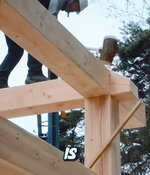
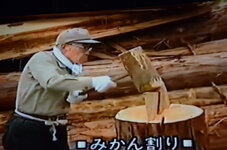
Coincidentally I was poking around on youtube and came across some craftsmen using some big mallets. I snapped a few shots off my big screen. One is a Korean timber framer and the other is a Japanese bowyer splitting rounds to make arrows. Both of these craftsmen are using mallets comparable in size to my mid sized maple leaf mallet. It was re-enforcing to see others with similar ideas. Both of these mallets were more crude like I had 1st envisioned mine, just a disposable unpeeled round with a hole for the handle but when it came time to make one I wanted one that would last which meant a beefy handle specially where the tenon is and I wanted ferrules to prevent splitting over time. I think I ran across these videos on "Business Insider" where they show 1 hour long films of different trades around the world. It's an interesting channel on youtube.

MalletKoreaSm_1032 copy.jpg

MalletKoreaSm_1036 copy.jpg

MalletJapSm_1224 copy.jpg
 
Last edited:

LopezBart

Well-known member
Joined
Oct 13, 2023
Messages
2,552
Location
Lopez Island, WA
In the 1980's it was discovered yew bark contained a type of tannin that could cure cancer in humans so for about a decade it was collected for it's bark. After that the tannin was produced synthetically in abundance and the bark from the tree was no longer needed. It's a softwood but with extremely tight fine grain and is harder than many hardwoods. It was used for propeller shaft bearings in many boats about 100 years ago among other uses.
Here's a story on that discovery.


Yew sawdust can affect some people; the tree (all portions) is poisonous if eaten.


four.cycle

Well-known member
Joined
Oct 19, 2015
Messages
28,953
Location
Tacoma, Washington
^ nice work.
I had a local turner make one up for me to use with my froe.
He used a piece of laurel. It was so pretty when he got it done, I've never used it for its intended purpose - I just grabbed a chunk of limb to bang on the back of the froe.
 
OP
2

2oolhound

Well-known member
Joined
Dec 18, 2010
Messages
5,918
Location
BC Canada
Thanks Bart,
that's good info. I'll have to make sure to wear a respirator when working with it. I try to save the sawdust and bark and every little stick to make stuff from. I had a bunch of shavings and curly sawdust in a stainless pan where some rain water leaked on it. It sat for months before I looked at it and found it had made a deep wine/purple dye that stained a small block of the wood that was in the tray also a very deep dark wine colour. I'll try to make more of this dye with the shavings I collect.

I was watching a logging video on youtube by a west coast faller named Bjorne Butler last weekend. He was describing how he was going to lay some wood down I saw a small yew tree as he swooshed the camera by. Then where he set his camera down to capture his falling activities the Yew tree was in the forground and I was freaking out that it wasn't being even discussed and was fearful it would be slashed down for safety or to get a cleaner video shot. Then he looks at it and says "there's a yew tree. We're supposed to cut them" but then he says " they're kind of rare, I'm going to leave it and talk to my boss and see if we can leave it". I was elated to see the respect he had for the trees.
 
OP
2

2oolhound

Well-known member
Joined
Dec 18, 2010
Messages
5,918
Location
BC Canada
Thanks four.cycle. I'm with you on that. No way do I want to mangle a nice mallet on the edge of a froe.

I can't believe the cost of boiled linseed oil these days. It's skyrocketed out of control. I was pushing my cart down the maple syrup isle at the grocery store but when I got up to the oils I almost fell over.

LinseedOilSm.jpg

Check it out NO I mean don't check it out at these prices, $21.79 for a liter. That's 33.81 oz. for blo!

LinseedOil2Sm.jpg

Big surprise when I got to the maple syrup though, $3.59 for 540 ML, that's about $7 per liter!!! 1/3 the cost of blo!!!

No need to twist my arm on this deal, I bought it all, 46 cans!

MapleSyrupSm_7167.jpg

I can afford to hook up an intravenous drip at these prices! (love this stuff)

MapleSyrupSm_7169.jpg


So back at home I still have to treat my small mallet with a protective finish and figure maple syrup is actually sap from a sugar maple tree right, so why not throw a coat of it on the mallet. It's cheaper than blo by 2/3s.

I like to soak my wood tools in it for a week or so why not:

MalletSyrupCoatSm_8084.jpg


It's turned out to be one sweet mallet!

YewMalletSm_8238.jpg


OK, before someone calls bs on this I did score 46 cans of maple syrup but the intravenous drip is bs. I also ended up with a lot of empty maple syrup cans in the shop and used one to soak the mallet head in blo as it used very little this way and that's where the idea came from to call it a maple syrup soak. He He.
 

four.cycle

Well-known member
Joined
Oct 19, 2015
Messages
28,953
Location
Tacoma, Washington
Olive Oil is cheaper at Trader Joes than the same size bottle of Boiled Linseed Oil at ACE Hardware.
Maple Syrup is cheaper at "Big Lots!" than the same size bottle of Boiled Linseed Oil at ACE Hardware.

I think I just used some "Minwax" maple-colored stain and a couple coats of polyurethane on the beast.
(The two at right were turned by Dave Feist, one of the former co-owners of Lincoln Hardware)
 

Attachments

  • hammers.jpg
    hammers.jpg
    783.6 KB · Views: 4
OP
2

2oolhound

Well-known member
Joined
Dec 18, 2010
Messages
5,918
Location
BC Canada
I was in Princess Auto (think HF) recently. blo = $60 - 3.8 liters. I'm still using old stuff bought at swap meets but I'm getting low.

I like the big mallet.
 
To avoid these ads, REGISTER NOW!
Top Bottom