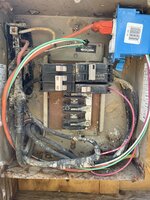
While that's total hack work I'm confused by your question.
What would you do?
Zim
The hold down requirement has not always been in place, this one may have been installed prior to the requirement.While that's total hack work I'm confused by your question.
Do you need whatever that extension cord? If not, remove it and plug the hole. If you need it, add a ****** to the hole, and exterior box and put a GFCI in.
As for the RV outlet there looks to be plenty of room.
As for the main breaker, the breaker in the upper right is marked "main" and feeds this panel. Technically it needs a hold down kit.
Did you take the cover off for the picture, or is the cover missing?So I need to install a RV plug and found this. This is why I hate people LOL
And to make it harder I think there is no breaker for this sub panel. This junk is outside where the garage (carriage house) used to be.
What would you do?
Zim
I'll bet I can throw a rock and hit your house. Allen St.Pull the panel replace it with Weather proof plastic junction box for all the splices for a new panel add a ground rod. Inside where they splice into the main. Hang another sub panel with the correct breaker for the wire size if there's no room in the main panel.
Feed for this box comes from the house. I've tested the breakers and as far as I can tell there is none for this remote panel.While that's total hack work I'm confused by your question.
Do you need whatever that extension cord? If not, remove it and plug the hole. If you need it, add a ****** to the hole, and exterior box and put a GFCI in.
As for the RV outlet there looks to be plenty of room.
As for the main breaker, the breaker in the upper right is marked "main" and feeds this panel. Technically it needs a hold down kit.
Feed for this box comes from the house. I've tested the breakers and as far as I can tell there is none for this remote panel.
I just wanted to know if putting in a 30amp breaker and wiring a RV plug would be okay.
Zim

As far as what I would do: The first thing to do is to address the no breaker to shut it off issue.
If there's more than one breaker to disconnect the entire service, code requires then to be grouped together.
Go back to post #1 and read the third sentence. It's not a main panel, it's a sub panel, or to be technically correct, a feeder panel. Since it's outside, it could be tapped off of a main somewhere, but that main should be able to shut it off. A meter shouldn't have to be pulled to kill a feeder.Why?
This is no different then any typical main panel in a house or shop. You can shut the panel off, but to remove the feed you have to have the meter pulled.
OP should probably figure out where this is fed from, but saying the panel is somehow dangerous because there isn't an upstream breaker has me scratching my head
230.72(A) It's also known as the six throw rule and it's been around longer than I have.Got a citation?
And if so, when was that implemented?
How does that apply here?230.72(A) It's also known as the six throw rule and it's been around longer than I have.
That throw needs to be able to kill the panel and the feeder conductors from close proximity to where the rest of the panels are killed. Everything on that service needs to be shut down from close to the same location. If that one throw is the main breaker for the rest of the service, that's fine but leads to the next question of how is this panel fed if there is no breaker for the feeder? If the conductors are stuck under the lugs of the main, it's double tapped which is more than likely a no no, and the main doesn't kill the feeder.How does that apply here?
One throw kills this panel
Go back to post #1 and read the third sentence. It's not a main panel, it's a sub panel, or to be technically correct, a feeder panel. Since it's outside, it could be tapped off of a main somewhere, but that main should be able to shut it off. A meter shouldn't have to be pulled to kill a feeder.
That throw needs to be able to kill the panel from close proximity to where the rest of the panels are killed. Everything on that service needs to be shut down from close to the same location. If that one throw is the main breaker for the rest of the service, that's fine but leads to the next question of how is this panel fed if there is no breaker for the feeder? If the conductors are stuck under the lugs of the main, it's double tapped which is more than likely a no no, and the main doesn't kill the feeder.
In post #1 he stated it's a sub panel and he can't seem to find a way to shut it off, the location of the meter has nothing to do with it. There's probably some kind of half assed tap going on and since it's an indoor panel mounted outside, the tap is more than likely wrong.It's not clear if the OP knows where this is fed from. See my questions in post #18
That's not a main in your sub, it's a disconnect and shutting it off doesn't shut off the feeder conductors. The real main in the meter/main shuts those off. Same as here, that breaker marked as a main isn't a main, it's a disconnect for the panel.I'm missing something....
I have a meter/main 100' away from my house. My house sub has a main breaker, and ~40 breakers. If I throw the main in the sub, it's dead (below the main).
because the feeder conductors don't get shut off when turning the breaker in the panel off. Everything has to have the ability to be shut off without running all around the property.OP has TBD feeding this panel, some distance away. He has a backed breaker marked as the main. If he flips that, the panel is dead (past that breaker).
Why/how is that different?
because the feeder conductors don't get shut off when turning the breaker in the panel off.
There might not be a need for ground rods. It's outside where the garage used to be, could have been an inside panel for an attached garage on the common wall, then three walls were torn down leaving the panel outside but still on the house. IF that's the case, and the main panel is in or on the house, no ground rods would be needed. If it's detached, ground rods would be needed. Since the panel is fed from the back, the feeder is going through something, if it's not a wall, I'm clueless. I would think if it were a stand alone panel, it would be fed from underground right in the bottom of the panel.Also to add to this mess, anyone see where the ground rods are connected?
I have too. The six throw probably doesn't apply here because there probably aren't six throws, but the grouping of disconnects does. The feeder for this panel has to have the ability to be shut off from wherever the service disconnect is, which should more than likely be a breaker. Apparently you might have some idea of how it's fed, but without a sub panel breaker, I can only come up with non code compliant ideas like tapping off the line side of the main, double lugging off the load side of the meter, some kind of split bolt tap off the service entrance conductors. About the only thing I can think of that would be close to correct is a main panel with feed thru lugs, but that could lead to other things that probably aren't done right either.It's late, I was outside in the sun all day. I'll read again tomorrow and figure out what in overlooking, but I can't see how the 6 throws rule applies here
I can't believe nobody has called out the missing bushing on the feeder.
The plating on a CH panel board's buss is genuine silver, not cadmium.Those are very good panels cadmium plated copper buss.