People use more paint when spraying because they don't know how to paint. If they are not good at spraying, they waste paint and if they **** at brushing and rolling, they use too little and have to push as hard as possible on the roller. The roller should almost be dripping with paint. When I roll fast, it does drip a little and I use a 5 gallon bucket to dip in and only the best frames, covers, and handles. Using too little paint on the roller causes it to splatter. Usually, I will cut in the edges with a 3" or 3.5" thick sash brush and then roll. Completely dip the roller and roll the wall top to bottom or 8' at a time if doing tall walls. When the paint doesn't slide on the wall well anymore, dip again and continue rolling out a section 3-5 feet wide. Just get the paint on the wall and don't worry about spreading it perfectly. After the wall is wet, I reroll that section from the direction I started to the direction I am working to. On this pass, I only dip if needed and I work out the paint evenly in long strokes. The roller cover should still be wet and relatively quiet with little or no splatter. Move to the next section and continue while keeping a wet edge.
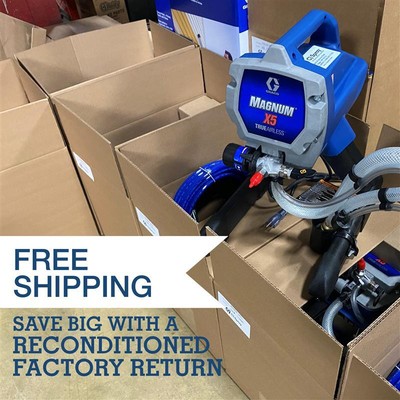
The small graco airless sprayers are ok. Use one with a flexible hose and work from a 5 gallon bucket or 2 gallon for small jobs. Fine finish tips are good for spraying oil on garage doors, man doors, or trim (when we used to use oil for kitchens, baths, and interior trim). In 2000 or so, I bought the graco 190es which was the smallest contractor grade airless. I use 100 feet of hose and a whip on the end with the swivel sg2 or sg3 gun. My uncle used the contractor gun when I worked for him, but it is harder on the hand to use two fingers vs. four, especially when spraying hours on end or days on end. I like Behr paint from home depot (using paint stores was a PITA) and will thin 5 gallons of paint with 2.5-3 quarts of water. For brushing and rolling, I run it straight. A 413 tip works nicely for average eves of a house where you have many angles to get without laying the paint on so thick that it runs. The standard 515 tip is ok for walls, but if your airless puts out enough paint, you can bigger. The 515 is 10" of fan at 12" from the surface and 15 thousands hole. Something like a 619 would be a 12" pattern and more paint.
Take the airless gun apart....remove the tip, holder, the handle with the filter in it, and the filter in the airless. Clean them very well with wire brushes and scotch bright pads and run water through the airless until it is clear. My uncle taught me to clean the handle attached to the hose, the gun, and front end parts so they were spotless. My old guns look near new. If you don't care about the outside of the gun and the feel of the tools in your hand, at least clean the insides that matter. So many people do a half assed job cleaning and don't take the gun apart. Once in a while, I totally dissassemble my guns and clean the insides becuase the needle, seats, and springs get build up on them and they can get rusty. It isn't very often, but it isn't hard to do either. My pump gets build up as well and I should have torn it down and cleaned it but instead just rebuilt it a couple times. It has packings so it isn't a major ordeal. The cheaper pumps are made as a throw away but the newer ones are a cartridge style pump assembly that you can pull out and slip a new one in, keeping the motor and everything else. Same goes with brushes.....the ferules are completely clean and I force water inside the center of the bristles, comb and wire brush them and clean the heavy paint of the wood handles, and hand them to dry. They go back in the sleeve the next day or after a few days. I almost always use lambs wool roller covers and they get washed and spun with a roller spinner then put on end or on a hook to dry. My tools go into a bucket of water as soon as I'm done or if I'm taking a long break so they are easier to keep clean.
HVLP is better for oil paint if you are doing smaller areas. Thinner is expensive and it is a pain to clean an airless with thinner, although I used to spray oil, shellac primer (alcohol clean up), and sometimes lacquer through an airless.
I do have a pressure roller but have not used it that many times. It is very heavy and it is awkward. I did use it for a large interior ceiling that was 10 or 12 feet high. It kept me from dipping all the time and allowed me to get it done faster so I could keep a wet edge. With the right techniques and tools, I can do a better job easier and faster without it. When I could spray, I would spray and back roll, often times by myself but it works great with two people. Spraying gets the paint on quickly without requiring a lot of skill or care and the person doesn't have to dip very often. On new drywall or other surfaces, I sprayed the first coat of primer without rolling since it gets sucked up too quickly. The second coat of primer/pva sealer or the paint would get backrolled. Backrolling creates a thicker film and works the paint in while leaving a little roller texture. It is more forgiving than just spraying.
Wooster green roller handles and wooster sherlock handles are the best and the hex version with the latch is better than the threaded version since they don't twist. A good roller pole gives you leverage and reach so you can work the paint in and roll an 8' tall wall in one swipe. Ignore the "W" pattern the paint can tells you to use......it is **** advice. You don't mow your lawn in a W pattern, instead you probably do long strips and overlap a little or a lot. When spraying and rolling I will overlap by up to half, depending on the conditions and job. At the end of a stroke, I let go of the trigger of the spray gun, or on a conventional gun, release the fluid portion of the trigger and then pull again for the next pass, otherwise paint builds up where you start and stop.
With enough practice, it is faster, easier, and the job looks better to not mask every edge when you brush and roll. A narrow brush is the worst for cutting in. The brush acts like a straight edge, so the bigger the better. If you pull the brush with the long edge parallel to the corner or trim you want to cut in, you get a long line of bristles that you can work up to that edge. When cutting in along a ceiling, I will cut in a strip 3 to 4 inches tall, but I first make the strip between the 1 inch and 4 inch section and don't get paint right in the corner. Using the long edge perpendicular to the ceiling, or long edge vertical, I can quickly slap paint on a 3 foot long section then turn the brush parallel to the ceiling and guide the bristles into the corner. When the corner is filled in, I will turn the brush perpendicular again and tip off that section to even out the paint and get any runs and to have a consistent brush pattern. It goes very fast once you get the hang of it. I have taught others to paint and got them moving along pretty quickly just by showing them more efficient techniques. If you do it long enough or are luck enough to be ambidextrious, you can brush or spray with your weak hand to cover more area or get better angles. I'm not gifted, so it took me plenty of years to lean to paint left handed but I still can't dip the brush with my left hand, even after 17 years of it being my primary trade and then occasional paint jobs/projects after that.
When spraying, you have to mask and tape very well, or use spray shields very carefully. It gets EVERYWHERE. For baseboards, I would tape the top edge of the base and flare the tape out to catch drips and keep the paint off the base and then pull the tape and paint the baseboards freehand ensuring I rolled the paint onto the wall a little and then go back and cut in (freehand) with the wall color to make the line straight. For vinyl cove base, I taped carefully and tried not to have to touch up the wall since it has an edge that shows paint badly. When painting doors, I will slap the paint on with a 1/4" nap roller and then get the channels of a paneled door with my brush and tip the paint with the brush. The hard part is doing paneled doors fast and in sections to keep a wet edge. Slab doors are best done with a 1/4" nap mini roller that is 6-9" wide. I always paint facia boards with a brush, but use a mini roller and a roller pole to paint the bottom edge after doing the face. On a small house, I can walk around and do the bottom edge all at one time.
I would never bother with one of those cup gun airless sprayers and I hate fixed pickups on an airless. Even my big one has a short pipe with a flexible hose that can go inside a 5 gallon bucket. Use a smaller bucket inside a 5 gallon bucket for a smaller project. I did use one of the mid level graco airless machines from home depot when I painted a bunch of pit toilet bathrooms that we built. Since I had my small machine torn down for a rebuild, we bought one on the companies dime (we had a 2 million dollar remodel job on a campground all of 2020 and our company usually supplies the tools for our environmental and infrastructure work) and I used my long hose, gun, and extensions. It worked fine for spraying clear preservative on the natural wood and primer and paint on the block walls and concrete siding. It was a bit temperamental sometimes and it HAD to be pressure flushed with a garden hose. My higher end little airless (pumps on up and down stroke and moves more volume and pressure than the cheaper ones) will clean out just fine with 5 gallon buckets of water. I don't bother with the pump preserver but it isn't a bad idea. I have not used an hvlp very much as my guns are conventional style, but I recently sprayed some rustoleum with a cheap gun my brother had and I was surprised at how clean I stayed even with blue paint. There was certainly overspray, but the conventional is worse. The cheap (maybe harbor freight) gun did the job, although it was torture using a nail gun compressor to do it......my brother isn't a painter and I would have brought my own compressor and even gun if I knew what he was dealing with. I have always used binks 18 or 19 cup guns and 2001 and model 85 2 quart pressure pots. A pressure pot is the way to go for larger volumes of solvent paint, or maybe water based if you have the right setup and paint (I rarely used water based in a conventional since it had to be thinned too much for the tips I have).
That is probably already 4 times as much as most people want to read. Hopefully that helps some people out.