To avoid these ads, REGISTER NOW!

Looking at picking up a Bridgeport mill

Grant Gunderson

Well-known member
Joined
May 17, 2013
Messages
2,319
Location
Bellingham, WA
Cleaning up a used Bridgeport mill advice needed

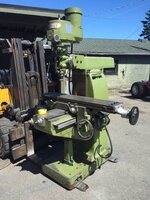
Hey guys I'm looking at picking up a used Bridgeport Mill. Its a J head, has a DRO and a VFD to convert to single phase. I haven't run a mill since college 20 years ago. This is going to be for a home hobby shop and its going to take a while to refresh the mind from the machining courses I had years ago! If it all checks out well, my plan is to rent a drop bed trailer and use a pallet jack to move it into my place.

So my question is, what things would you guys want to inspect / watch out for when buying a used mill? Table backlash, etc? Whats the best method for inspecting those items? I'd love to hear any tips on inspecting / buying / moving /setting up a mill.

The mill does include some tooling, and a kurt vise. Grizzly industrial is just 5 minutes down the road from me, so I'll probably pickup any new tooling that I need there as I need it. Of course I'll be keeping an eye out for any used tooling / starrett stuff.
 
Last edited:
To avoid these ads, REGISTER NOW!

lis2323

Well-known member
Joined
Dec 25, 2016
Messages
3,234
Make sure you strap it well to the pallet if using a jack.

I used a forklift....carefully.

b0e6aae02cc0c8bdd7bbaf728dc7d937.jpg

Enjoy your new tool


Sent from my iPad using Tapatalk
 

Attachments

  • b0e6aae02cc0c8bdd7bbaf728dc7d937.jpg
    b0e6aae02cc0c8bdd7bbaf728dc7d937.jpg
    92.7 KB · Views: 61

MushCreek

Well-known member
Joined
Jan 14, 2015
Messages
9,748
Location
Upstate South Carolina
Table backlash is simply a matter of locking the table and seeing how much you can turn the handle before meeting resistance. Check it in the middle, and at the extreme ends of travel. Most likely, there will be a lot more wear in the middle. If it's similar throughout, you might be able to adjust the nut to minimize the play, or replace just the nut. That's a lot cheaper than new lead screws. That being said, backlash (within reason) doesn't really matter with a DRO. If it's a lot, like a quarter turn, the lead screws and/or nuts are pretty bad. My '65 only has .010" backlash, the tightest B'Port I've ever seen.

Lock the knee and saddle, unlock the table, put it in the middle, and try to rotate the table with your hands. A lot of movement indicates that the ways are loose or worn. Again, there will likely be a lot more play in the middle than at the ends. If it's really loose in the middle but tight at the ends, the ways are worn, which is really bad for anything other than really rough work. You can get by with partially locking the ways, but you won't get accurate work out of it. Usually, I can look at the ways and see if it's really worn out. There should be a pattern of 'flaking' visible. If it's completely worn away in the middle of travel, but fresh out on the ends, it's probably pretty worn out. Look for professional flaking, too. I've seen old machines where someone attempted to add flaking to badly worn surfaces. Pro flaking will be very consistent and even.

I like to clamp an indicator to the spindle and see if I can shake the quill around when unlocked. Hopefully, it's under power. The spindle should be smooth and quiet. The old step pulley models are quieter than the variable speed ones, but there also very durable.

I've moved a number of B'Ports with an engine hoist, if you have one. I nod the head all the way back, remove the four bolts at the ram turntable, and pick the ram off with an eyebolt on the top of the ram. I then wrap a sling around the bottom of the knee, with the saddle all the way into the column, and move the base separately. Taking it apart this way makes the weight more manageable, and much less top-heavy on the trailer. My engine will lift (barely) a whole B'Port, but it's scary, so I only pick it up an inch to move it around the shop, not high enough to load on a trailer.
 

matt_i

Well-known member
Joined
Mar 14, 2008
Messages
10,724
Location
SE Michigan
I'd just check out the readout to make sure its working, under power, etc.
You can run the table to the extreme ends and see if its loose in the center and tight at the ends. Looking at the flaking on the ways gives some indication of whether its worn down or looks relatively consistent across.
The backlash check is about as good as it gets. If it has a 1 shot oiler,that's excellent. Hopefully the previous owners used it...that you'll probably never know for sure.

Drop deck and pallet jack sounds good. Imo, important to block the bottom of the machine so it can't slide in transport. Use of the 5/8-11 hole in the ram is a good way to tie it off up-top.

My bridgeport sits on stacks of 2x6s which serve to 1) easily move it with the pallet jack if required and 2) give me a more comfortable working height. I'm not anticipating any earthquakes....

The 5/8-11 hole in the ram is acceptable to move the entire machine should you have an effective prime-mover. It seems scary but that's how Bridgeport, Inc moved the machines around their plant when it was in CT.
 

alexb2000

Well-known member
Joined
Feb 7, 2010
Messages
664
Location
Fort Worth, TX
Re: Looking at picking up a Bridgeport mill advice needed

Hey guys I'm looking at picking up a used Bridgeport Mill. Its a J head, has a DRO and a VFD to convert to single phase. I haven't run a mill since college 20 years ago. This is going to be for a home hobby shop and its going to take a while to refresh the mind from the machining courses I had years ago! If it all checks out well, my plan is to rent a drop bed trailer and use a pallet jack to move it into my place.

So my question is, what things would you guys want to inspect / watch out for when buying a used mill? Table backlash, etc? Whats the best method for inspecting those items? I'd love to hear any tips on inspecting / buying / moving /setting up a mill.

The mill does include some tooling, and a kurt vise. Grizzly industrial is just 5 minutes down the road from me, so I'll probably pickup any new tooling that I need there as I need it. Of course I'll be keeping an eye out for any used tooling / starrett stuff.

The only thing I really care about on a BP is way wear because having one rescraped just isn't viable given the prices of these mills. Look at all the sliding surfaces and check the condition of the factory flaking especially in the middle of the Y-axis (wipers are neglected and swarf gets underneath). The backlash can be fixed along with any head problems. Even the spindle can be rebuilt at home.

Moving them with a forklift I usually just slide the ram forward so that each fork can contact the bottom of the ram. I put a little piece of cardboard between the forks and the ram and lift away. This seems more solid to me than suspending the mill from an eye bolt on top of the ram. If you have a skid under the mill then a pallet jack works fine, although I like to strap them down to the pallet if I am moving it very far.
 

dr_clyde

Well-known member
Joined
Jan 7, 2009
Messages
6,429
Location
Holland, MI
Re: Looking at picking up a Bridgeport mill advice needed

I'd just check out the readout to make sure its working, under power, etc.
You can run the table to the extreme ends and see if its loose in the center and tight at the ends. Looking at the flaking on the ways gives some indication of whether its worn down or looks relatively consistent across.
The backlash check is about as good as it gets. If it has a 1 shot oiler,that's excellent. Hopefully the previous owners used it...that you'll probably never know for sure.

Drop deck and pallet jack sounds good. Imo, important to block the bottom of the machine so it can't slide in transport. Use of the 5/8-11 hole in the ram is a good way to tie it off up-top.

My bridgeport sits on stacks of 2x6s which serve to 1) easily move it with the pallet jack if required and 2) give me a more comfortable working height. I'm not anticipating any earthquakes....

The 5/8-11 hole in the ram is acceptable to move the entire machine should you have an effective prime-mover. It seems scary but that's how Bridgeport, Inc moved the machines around their plant when it was in CT.

The only thing I really care about on a BP is way wear because having one rescraped just isn't viable given the prices of these mills. Look at all the sliding surfaces and check the condition of the factory flaking especially in the middle of the Y-axis (wipers are neglected and swarf gets underneath). The backlash can be fixed along with any head problems. Even the spindle can be rebuilt at home.

Moving them with a forklift I usually just slide the ram forward so that each fork can contact the bottom of the ram. I put a little piece of cardboard between the forks and the ram and lift away. This seems more solid to me than suspending the mill from an eye bolt on top of the ram. If you have a skid under the mill then a pallet jack works fine, although I like to strap them down to the pallet if I am moving it very far.

This is all very good advice. Bridgeport mills are pretty simple and straightforward machine tools, they can just be a bit intimidating to a home shop guy who doesn’t know any better.

Make sure it’s not totally clapped out, check backlash and way condition. The rest can be easily fixed with some basic know how and tools.

As far as rigging goes, rent a forklift and be done with it. Much safer than trying to jimmy it off a trailer with a pallet jack or whatever. Like above, I position the ram so I can get a fork each side of the column and make sure you put cardboard or plywood between the forks and the load. Metal on metal can and will slide off the forks. Lost a bandsaw doing that once in my youth.
 
OP
G

Grant Gunderson

Well-known member
Joined
May 17, 2013
Messages
2,319
Location
Bellingham, WA
Thanks guys. Checked it out today. About a ¼ turn of black lash on the x axis maybe an ⅛ of a turn on the y. The machine feels really tight and in decent shape otherwise. Ways seem to be in good shape but it’s also an older model so no chrome. Decided to rent a forklift and drop bed trailer tomorrow to get it home. I’ll post some pics once i get it.

Thanks!
 

ClappedOutBport

Well-known member
Joined
Mar 30, 2016
Messages
998
Table backlash is simply a matter of locking the table and seeing how much you can turn the handle before meeting resistance. Check it in the middle, and at the extreme ends of travel. Most likely, there will be a lot more wear in the middle. If it's similar throughout, you might be able to adjust the nut to minimize the play, or replace just the nut. That's a lot cheaper than new lead screws. That being said, backlash (within reason) doesn't really matter with a DRO. If it's a lot, like a quarter turn, the lead screws and/or nuts are pretty bad. My '65 only has .010" backlash, the tightest B'Port I've ever seen.

Lock the knee and saddle, unlock the table, put it in the middle, and try to rotate the table with your hands. A lot of movement indicates that the ways are loose or worn. Again, there will likely be a lot more play in the middle than at the ends. If it's really loose in the middle but tight at the ends, the ways are worn, which is really bad for anything other than really rough work. You can get by with partially locking the ways, but you won't get accurate work out of it. Usually, I can look at the ways and see if it's really worn out. There should be a pattern of 'flaking' visible. If it's completely worn away in the middle of travel, but fresh out on the ends, it's probably pretty worn out. Look for professional flaking, too. I've seen old machines where someone attempted to add flaking to badly worn surfaces. Pro flaking will be very consistent and even.

I like to clamp an indicator to the spindle and see if I can shake the quill around when unlocked. Hopefully, it's under power. The spindle should be smooth and quiet. The old step pulley models are quieter than the variable speed ones, but there also very durable.

I've moved a number of B'Ports with an engine hoist, if you have one. I nod the head all the way back, remove the four bolts at the ram turntable, and pick the ram off with an eyebolt on the top of the ram. I then wrap a sling around the bottom of the knee, with the saddle all the way into the column, and move the base separately. Taking it apart this way makes the weight more manageable, and much less top-heavy on the trailer. My engine will lift (barely) a whole B'Port, but it's scary, so I only pick it up an inch to move it around the shop, not high enough to load on a trailer.

This is good advice. I won't agree with 100% of the post though, as you can still make pretty good parts on a very worn machine as long as your finish cuts are light and you work around the wear. I started on one of the most worn machines I've ever seen. Over 1/4" of end play on a 32" table if you really rocked it, no flaking anywhere on the table saddle, or knee ways. I could still usually get parts with 1 or 2 thousands, which is good enough for most homeshops. Now that machine has a newer table from a seconds mill, and a knee from a third, and a table leadscrew from a 4th. It's much better now that received. Eventually if it makes it to a bigger shop, I'll get the matching table and saddle put on.

Thanks guys. Checked it out today. About a ¼ turn of black lash on the x axis maybe an ⅛ of a turn on the y. The machine feels really tight and in decent shape otherwise. Ways seem to be in good shape but it’s also an older model so no chrome. Decided to rent a forklift and drop bed trailer tomorrow to get it home. I’ll post some pics once i get it.

Thanks!

Regarding backlash. You can't get much adjustment out of the nuts from the factory. Buuuut, if you take and saw them all the way in half, you can adjust all the backlash out. We went from 0.070 in the y and 0.050 in the x to 0.015 in the y and 0.005 in the x. It's all screw wear now. It tapers off to 0 at the ends. Highly recommended modification and very easy. A good time to get the grease out the machine as well if it has the alamite fittings on it.
 

MushCreek

Well-known member
Joined
Jan 14, 2015
Messages
9,748
Location
Upstate South Carolina
That's cool that your getting it- good luck! One more thing about backlash- sometimes they're not set up correctly, so that the backlash is in the thrust bearings. If you look closely at where the dial meets the fixed part, you may see movement there, which is adjustable. You could even check it with feeler gauges. Some of that 'backlash' might just be poorly adjusted thrust bearings.

It is true that you can do usable hobby work on a worn out machine. I'm a retired tool maker, so I'm fussier than most people. I've run plenty of machines with the table partially locked to keep it from jumping around.
 
OP
G

Grant Gunderson

Well-known member
Joined
May 17, 2013
Messages
2,319
Location
Bellingham, WA
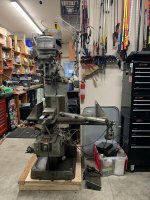
Got it home today! Moving was a ***** as the rental company didn’t have the forklift I ordered. So manhandled it with an engine hoist on to a home made pallet then moved it with a pallet jack and a drop bed trailer.

It came with a full set of tooling, a vfd, Kurt vise, etc. all the ways have flacking still. So not bad for $1k! Going to clean / lube / paint over the winter to get it ready to go for next summer when I’m off work again.
 

Attachments

  • A848A921-EC94-4DFF-BCF1-91BB828080CF.jpg
    A848A921-EC94-4DFF-BCF1-91BB828080CF.jpg
    135.4 KB · Views: 408

spoon671

Well-known member
Joined
Aug 31, 2014
Messages
403
Location
SFCA
Re: Looking at picking up a Bridgeport mill advice needed

Damn dude that vise is worth half what you paid. Mother f*****z

Sent from my SM-G973U using Tapatalk
 
OP
G

Grant Gunderson

Well-known member
Joined
May 17, 2013
Messages
2,319
Location
Bellingham, WA
Once off of the pallet, roll it around on some 1/2" black pipe lengths.

Lifting it once without a forklift was scary enough so I’m not planning on lifting it again.

The “pallet” I built is more like a platform out of 4x6 and 2x6 lumber. I lag bolted the mill to it. I plan on keeping it on this so I can move it around with a pallet jack when needed. If when we move at a distant time from now I can just rent another drop bed trailer and it will be way easier to manhandle now.
 

Ign

Well-known member
Joined
Jul 7, 2006
Messages
12,769
Location
Butte Peak ND
Just order up a shouldered 5/8-11 eye bolt in case you ever need to pick it. A good fastener house will just stock one, too.

Just zip tie it to the hole in the back of the ram or something if your DRO arm is using that hole now.

CHEAP insurance the next time you're trying to move it on a Sunday....
 
OP
G

Grant Gunderson

Well-known member
Joined
May 17, 2013
Messages
2,319
Location
Bellingham, WA
Just order up a shouldered 5/8-11 eye bolt in case you ever need to pick it. A good fastener house will just stock one, too.

Just zip tie it to the hole in the back of the ram or something if your DRO arm is using that hole now.

CHEAP insurance the next time you're trying to move it on a Sunday....

That’s exactly how I did it with the engine hoist. Except this mill used a ½ thread for it. Apparently the mills use two different sizes. Not sure on why or the age ranges for each.
 
To avoid these ads, REGISTER NOW!

jmarkwolf

Well-known member
Joined
Jan 15, 2013
Messages
1,810
Location
Southeast Michigan
One mistake I believe people often make when moving heavy things, is not considering how slippery steel-on-steel can be, such as a Bridgeport on hilo forks or on pallet jack forks.

I always add some friction between the two, like thin masonite or wood.

I bought a Bridgeport once where someone had picked it up with a hilo under the ram without any wood cushion. Chipped the $hit out of the dovetails.
 
OP
G

Grant Gunderson

Well-known member
Joined
May 17, 2013
Messages
2,319
Location
Bellingham, WA
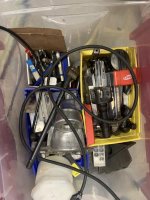
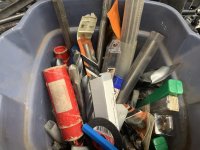
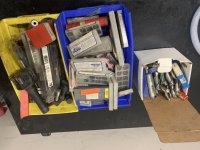
I ended up having to leave for a work trip in Japan the day after I picked the mill up. Just got home and am pretty het lagged so figured time to pop a melotonin and start on the cleaning process. Figured the task of cleaning / organizing the tooling combined with the melotonin would help me sleep.

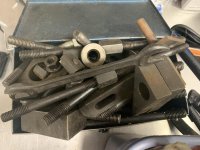
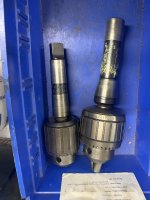
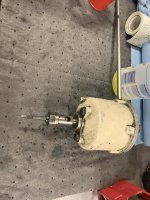
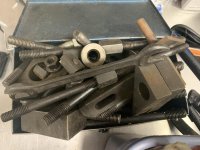
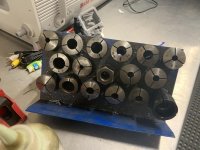
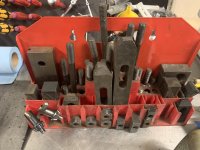
Buckets and buckets of tooling.

74BDBA63-0AD0-467D-BE87-C4CD1A3CBF30.jpg

A0E39B44-DC2C-4EDA-A0AA-C210760409AD.jpg

8186B06D-57F5-4B60-8379-895743B57190.jpg

B92A6EC6-4AAB-4643-8D2A-290ACD945781.jpg
 
Last edited:
OP
G

Grant Gunderson

Well-known member
Joined
May 17, 2013
Messages
2,319
Location
Bellingham, WA
I found a bunch of collets, hold downs etc. going to toss them into my ultra sonic cleaner to mock the grime off. The ultrasonic cleaner I use is heated and with a little simple green works great on my mountain bike drive train so figure it would help speed up the process.
 

Attachments

  • 5A8E2DAA-85ED-42F3-BC21-EF7F0A601E1C.jpg
    5A8E2DAA-85ED-42F3-BC21-EF7F0A601E1C.jpg
    142.4 KB · Views: 77
  • D185D98D-B700-4B50-84BF-4402B88A9B2B.jpg
    D185D98D-B700-4B50-84BF-4402B88A9B2B.jpg
    145.7 KB · Views: 74
  • 808881DD-F415-4E66-985B-40BF552DA72B.jpg
    808881DD-F415-4E66-985B-40BF552DA72B.jpg
    111.1 KB · Views: 75
  • A18C5F8E-D05D-43F4-B86B-C7B90CE0D355.jpg
    A18C5F8E-D05D-43F4-B86B-C7B90CE0D355.jpg
    148.6 KB · Views: 77
OP
G

Grant Gunderson

Well-known member
Joined
May 17, 2013
Messages
2,319
Location
Bellingham, WA
You got a fantastic deal on that machine and tooling. The tap head looks like a Procunier brand. Great for production work, but not so much for general projects. You could sell it and recoup some cash.

I need to research it a bit. I’ve only done hand tapping in the past. I am planning on making a bunch of custom camera mounts / brackets at some point for use in my day job, so it might be handy for all of the tapping required for different mounting configurations.

looks like the tooling alone would have been worth the grand. Nice job.
Still sorting it all but looks like the vast majority of it was never used. I really need to figure out a way of storing / organizing all of the end mills, remembers and drill bits. My previous drill organization was already getting out of hand so this is going to force me to do something about it sooner than latter as I’ll need to do that to have the work bench space for testing the mill down for cleaning/ paint / new lube, etc.
 
OP
G

Grant Gunderson

Well-known member
Joined
May 17, 2013
Messages
2,319
Location
Bellingham, WA
Finally got all of the tooling cleaned up. It’s amazing how well an ultrasonic cleaner works for this. Going to have to buy a new tool box to store it all. All but gave up finding a used lists / vidmar. Looked at the ones from Grizzly, Lowe’s, Home Depot and Horror Freight. Oddly enough it seems like the Horror Freight option might be the best built for reasonable money. I pretty much hate everything they sale but the tool boxes.

The procuneir tap head felt a bit rough and I was couriering how it work so tore it apart and fave it a good cleaning / lube. It’s super smooth now. I cleaned the grime off of the cork clutch with alcohol to make sure it didn’t get contaminated with grease.

Next step is to start on cleaning the mill up. The previous owners wiring was sketchy at best. So I’m planning on rewriting it to the vfd once it’s all cleaned up and painted. Disconnected the switch / vfd and labels the wires with permasleve to keep them straight.

Anyone got any good ideas for cleaning up a 50 year old electric motor?
 

Attachments

  • E1E2A853-66CB-41F7-B300-4248C8C37176.jpg
    E1E2A853-66CB-41F7-B300-4248C8C37176.jpg
    131.9 KB · Views: 80
  • 62A4867F-FA45-48B6-BD69-56EE65567617.jpg
    62A4867F-FA45-48B6-BD69-56EE65567617.jpg
    151.7 KB · Views: 77
  • 8F52CB1C-7FC2-4C98-A5F2-36EE52B2840F.jpg
    8F52CB1C-7FC2-4C98-A5F2-36EE52B2840F.jpg
    129.3 KB · Views: 68
  • 005A07AE-565A-4CA7-BCA4-EDCF2535FA4B.jpg
    005A07AE-565A-4CA7-BCA4-EDCF2535FA4B.jpg
    100.4 KB · Views: 70
  • F34CEE48-FFBE-4F9D-ABFB-947C23FCAD43.jpg
    F34CEE48-FFBE-4F9D-ABFB-947C23FCAD43.jpg
    83.9 KB · Views: 68
  • CE6D6EFD-732E-4166-996A-D4E958B44120.jpg
    CE6D6EFD-732E-4166-996A-D4E958B44120.jpg
    88.6 KB · Views: 68
  • 25879498-CD66-45D4-A5E5-79F573EFC3D0.jpg
    25879498-CD66-45D4-A5E5-79F573EFC3D0.jpg
    98.7 KB · Views: 73
OP
G

Grant Gunderson

Well-known member
Joined
May 17, 2013
Messages
2,319
Location
Bellingham, WA
Speaking of sketchy wiring. The guy had the vfd wired to the switch then the motor. From everything I’ve read about vfd hookups you don’t want the switch between the vfd and the motor you want a separate control loop. Not to mention I’m afraid that chord will burn the place down!
FEF05443-ED7A-4CE4-BC5E-7C0E0B004068.jpg

5599E06A-FEFF-4324-8882-62A97C2316ED.jpg

A49D9C67-65F8-4967-9F34-7DC892FA4701.jpg

ED1BB6ED-4EC0-41F5-BD33-A63E22BD1E84.jpg

I fully expected to find a few surprises once I got the mill home and it turns out I got way more play in the x axis then it seemed to have when I originally looked at it. Looks like it’s missing the lock screw for the backlash adjustment and the nuts have never been split. So hopefully that will be an easy fix. The screw cleaned up really well. So hopefully it’s got minimal wear.


92A8ADD8-B3AD-46C7-B81E-53EBCD7F0F80.jpg

5E47A6D4-5F69-42C4-9103-E3F65AAEB030.jpg

24C53684-B615-46E7-AB47-8BE31444B4D1.jpg

The power feed has seen better days. We will see how well it works after I clean it up and replace the wiring. If I end up having to replace it, it won’t be the end of the world.
 
OP
G

Grant Gunderson

Well-known member
Joined
May 17, 2013
Messages
2,319
Location
Bellingham, WA
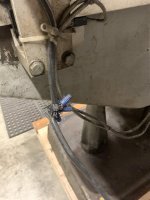
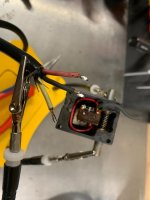
Fixed the wiring for the power feed. There wasn't a lot of room to solder new wire in!
So I tinned the end of the wires, used a third hand tool and a set of tweezes and got them soldered on. The limit switch only uses the backplate pressure to clamp the wire sheathing, and its loose at best, so I applied black silicone around the cable. Seems to be ok. Worst case I'll order a new switch down the road if need be, but at least the powered works now.
IMG_0729.jpg
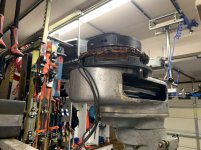
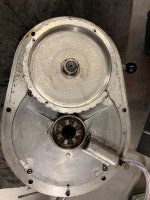
The belts where on their last legs. So I ordered new replacements. I also noticed they had started to wear a grove in the top of the gear box.
IMG_0733.jpg

I gave the main wheel a spin, and it spins very uneven. I hope its not a bent shaft. I'm really hopping its just a bad bearing.
IMG_0768.jpg

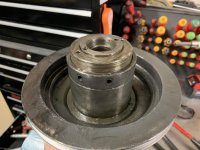
Getting the lock nuts out was a real pain in the ***. The pins on my cheap pin spanner bent, so had to go buy a USA Williams at the local hardware shop...60 bucks was tough to swallow for such a cheaply made wrench that will probably never get used again, but at least the pins are hardened. Which was good as I had to tap the pin spanner with a small sledge to get the nuts to lock rings to break loose.
IMG_0761.jpg
I don't have an arbor press, so used copper soft jaws in my vise and tapped the shaft out.
IMG_0763.jpg

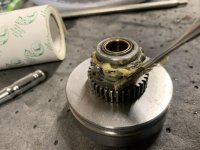
Original *** 6207ZS shielded bearings. They don't feel horrible, but after almost 60 years of service, I'm going to try to replace them with sealed bearings.IMG_0767.jpg

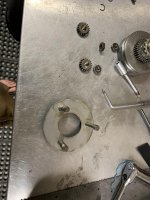
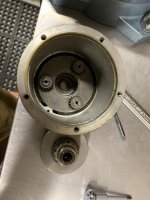
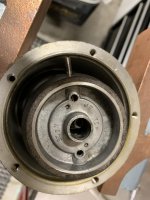
Got the gear select shaft out. Once I got the cover off I could feel a lot of play in the shaft. The top bearing wasn't horrible but it wasn't great either. The bottom bearing required a bering puller and when I finally got it out it was clear it was completely done. So pretty optimistic that was the source of the wobble for the belt pully and the cause of the belts wearing on the housing.
IMG_0811.jpg

I'm planning on using this mill for both metal and wood work. So I'm leaning towards converting it from the totally loss oil system to all sealed bearings and grease as the last thing I want is for it to drop oil on an exotic piece fo wood mid cut.
 
Last edited:

gtr1999

Well-known member
Joined
Jun 25, 2012
Messages
151
Location
CT
Looks like a nice machine. My first job out of trade school was rebuilding Bridgeports for the local CT dealer. I spent plenty of time in the factory too.

If you look at the ways expect to see wear in the center where all the work is done but sometimes you will get one that still shows the factory scrapping. We would set the lash to 007-010 on new mills. You can adjust the lash if the lead screw bronze nut isn't too worn. For the X axis you go in under the LH side of the table, there will be a large screw and a small locking screw on the nut bracket. Loosen the small one and tighten the large one. Don't expect to take out a lot of lash but it may help. To get to the Y axis you have to remove the lead screw assembly then make the same adjustment.

The power feed is an aftermarket made by Servo and they are pretty good. There is a nylon gear on the bottom that sometimes strips out but that was pretty rare. I installed 100's of those and they were better then the Bridgeport supplied feeds.
Make sure the quill feed is disengaged unless you are going to use it. It has a bronze gear that will strip out if you leave it engaged and go to high speed.

I have a 1955 Round ram J head machine I bought for $300 delivered and I had already rebuilt the head on it years before. People say it's junk because of the round ram but I have used it a lot. Yeah I would like a V ram but the price was right, the machine works good and it even has a riser block installed for more room under the spindle. I machine 100's of corvette differentials with it.

Black pipe works great to move and position it, a long rigger pinch bar would make it easy- just don't pinch your fingers or you will lose them.

I use a 7.5 hp Rotary Phase converter and really like it. I sized it for my mill, lathe, and grinder and can run all three if need be. I picked up a free 3 ph GE breaker panel, boxes, and twist locks so it didn't cost much to setup.
 
Last edited:
OP
G

Grant Gunderson

Well-known member
Joined
May 17, 2013
Messages
2,319
Location
Bellingham, WA
Looks like a nice machine. My first job out of trade school was rebuilding Bridgeports for the local CT dealer. I spent plenty of time in the factory too.

If you look at the ways expect to see wear in the center where all the work is done but sometimes you will get one that still shows the factory scrapping. We would set the lash to 007-010 on new mills. You can adjust the lash if the lead screw bronze nut isn't too worn. For the X axis you go in under the LH side of the table, there will be a large screw and a small locking screw on the nut bracket. Loosen the small one and tighten the large one. Don't expect to take out a lot of lash but it may help. To get to the Y axis you have to remove the lead screw assembly then make the same adjustment.

Thanks! I noticed the backlash locking screw on the x-axis was missing. I am planning on taking the table off to clean / paint the machine so I ordered new nuts as I figure it’s best to replace them while I got it all apart VS having to remove the table again down the road.

The power feed is an aftermarket made by Servo and they are pretty good. There is a nylon gear on the bottom that sometimes strips out but that was pretty rare. I installed 100's of those and they were better then the Bridgeport supplied feeds.
Make sure the quill feed is disengaged unless you are going to use it. It has a bronze gear that will strip out if you leave it engaged and go to high speed.
I originally was worried a gear was stripped so I tore the unit down and gave it a really good cleaning. It appears the issue I had with it only working in one direction was due to the writing I fixed. Thanks for the tip about making sure it gets left in neutral.

I have a 1955 Round ram J head machine I bought for $300 delivered and I had already rebuilt the head on it years before. People say it's junk because of the round ram but I have used it a lot. Yeah I would like a V ram but the price was right, the machine works good and it even has a riser block installed for more room under the spindle. I machine 100's of corvette differentials with it.
I hear thE round rams with the m heads are actually preferred for wood as they have faster spindal rates? Not sure if that’s true or not but regardless it seems that all of the Bridgeport’s are so overbuilt they are more than adequate for most things. At the very least I have no doubt any Bridgeport will be far more capable than my limited machining experience from a fool tool and die making classes 29 years ago in college. Regardless I look forward to learning more and it’s already given me a new appreciation for all of the machinists that built so many things before the days of CNC!


gtr1999;a Black pipe works great to move and position it said:
That scares the **** out of me. I plan on leaving the mill on the pallet I made out of 4x6 lumber so I can move it around with a pallet jack if need be.

I use a 7.5 hp Rotary Phase converter and really like it. I sized it for my mill, lathe, and grinder and can run all three if need be. I picked up a free 3 ph GE breaker panel, boxes, and twist locks so it didn't cost much to setup.
I was curious about going that route but the machine came setup with a VFD so I’ll probably stick with that after I fix the wiring.

Does anyone got a recommendation for replacing the stock bearings with sealed versions?
 
OP
G

Grant Gunderson

Well-known member
Joined
May 17, 2013
Messages
2,319
Location
Bellingham, WA
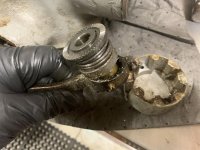
I managed to get the quill housing mostly dissembled today. The dog bone linkage for the auto reverse was a real pain in the *** to get out as it had broken at the neck. Ended up having to center still it and use an easy out. At least the replacement part is cheap. 8CBFF689-8CA1-47B2-965C-717C866897D9.jpg

BC84D888-5D82-4F11-A7F4-6C97F8DA0755.jpg
The screw for the reverse knob is broken off in the shaft. No idea how I’m going to get it out. There isn’t enough of it protruding time use my engineer screw remover pliers. So I might have to replace the unit. I’ll have to tear that assembly down to know for sure.

052ABD1B-3D07-4B21-AD7E-F93313975CA8.jpg
It looked like a hand grenade went off inside the clutch! When I first removed the clutch I thought it was toast but then found that one of the two retaining screws inside of it had fallen out and was resting in the bottom of the housing. Put it back in and it feels good now. I’ll probably disassemble it just to make sure it’s intact. Really hoping that rusty gunk is dwarf that found its way in over the years.
 

gtr1999

Well-known member
Joined
Jun 25, 2012
Messages
151
Location
CT
I don't think you need to use sealed bearings as long as you use light spindle oil for the spindle bearings and lower clutch bearings. You certainly can but we always used what Bridgeport did, the APEX rating on the spindle bearing did change from a 7 to 5 or 3 over time if I recall.

I had an M head I gave away years ago. My machine was originally fit with a J head. I rebuilt that head 30 years ago and we used the machine in a toolroom up till 2 years ago when I bought and setup my home shop. Still runs great, I use the quill feed all the time when boring.

Some of the housings will distort once the 4 bolts are loosened up. You can polish the bare quill in a lathe with 180-240 emery. For those that were tight we bolted the bore housing to a steel plate and torqued the bolts to 40 ft/lb and hand lapped the quill to the housing using Clover lead AAA compound. Wash them good and oil them and the quill should be smooth and free.

Be careful with the clockspring. We used to install the springs into the spring cover but they are sold as one now. With the housing on the bench, wind up the spring and then engage the quill.

Those power feed shafts broke all the time, if I recall there is a roll pin in them that shears.

I don't know what parts cost anymore, I haven't rebuild a J or 2J head in a long time. The last one, mine from 30 years ago, cost over $2000 in parts to rebuild. More then the whole machine was worth but we used it and continue to so for us it was worth it.
 

OccupantRJ

Well-known member
Joined
May 15, 2009
Messages
10,962
Location
Eastern North Carolina
I have done a lot of wood machining on a Bridgeport. One issue you will run into is super fine wood dust drifting into the quill bore of the head, getting in through the slot behind the depth adjustment. If you look in that area you can see the quill move as you move the spindle up and down. If dust drifts into this area it will tighten up on the ability to move the quill freely, and will have to be flushed out. After my first experience I used WD40 to flush the clearance while moving the spindle up and down, then oiled the area. It is wise to temporarily seal off the area while machining wood.
 
Last edited:

81turbota

Well-known member
Joined
Oct 29, 2019
Messages
260
Location
USA
Looks good. Last year I got a great 1.5hp BP from a storage auction. I ended up rebuilding the head and adding a DRO.

I’m sure by now you’re familiar with H&W machine and their videos. They helped me through a few tricky situations.

Congratulations on an excellent addition!
 
OP
G

Grant Gunderson

Well-known member
Joined
May 17, 2013
Messages
2,319
Location
Bellingham, WA
I don't think you need to use sealed bearings as long as you use light spindle oil for the spindle bearings and lower clutch bearings. You certainly can but we always used what Bridgeport did, the APEX rating on the spindle bearing did change from a 7 to 5 or 3 over time if I recall.

I had an M head I gave away years ago. My machine was originally fit with a J head. I rebuilt that head 30 years ago and we used the machine in a toolroom up till 2 years ago when I bought and setup my home shop. Still runs great, I use the quill feed all the time when boring.

Some of the housings will distort once the 4 bolts are loosened up. You can polish the bare quill in a lathe with 180-240 emery. For those that were tight we bolted the bore housing to a steel plate and torqued the bolts to 40 ft/lb and hand lapped the quill to the housing using Clover lead AAA compound. Wash them good and oil them and the quill should be smooth and free.

Be careful with the clockspring. We used to install the springs into the spring cover but they are sold as one now. With the housing on the bench, wind up the spring and then engage the quill.

Those power feed shafts broke all the time, if I recall there is a roll pin in them that shears.

I don't know what parts cost anymore, I haven't rebuild a J or 2J head in a long time. The last one, mine from 30 years ago, cost over $2000 in parts to rebuild. More then the whole machine was worth but we used it and continue to so for us it was worth it.

I had a local bearing shop price out all new sealed bearings.... it was going to be over $400 not counting the spindle bearings so I’m just going with shielded this time. If it’s an issue I can always open it back up now that I’ve done it once.

My power feed shaft looks good. However when I pulled the clock spring assembly out of the ultrasonic cleaner I noticed a major crack in its sun housing that was buried under all of the award so ordered a new unit for $40

I have done a lot of wood machining on a Bridgeport. One issue you will run into is super fine wood dust drifting into the quill bore of the head, getting in through the slot behind the depth adjustment. If you look in that area you can see the quill move as you move the spindle up and down. If dust drifts into this area it will tighten up on the ability to move the quill freely, and will have to be flushed out. After my first experience I used WD40 to flush the clearance while moving the spindle up and down, then oiled the area. It is wise to temporarily seal off the area while machining wood.

Thanks for the advice. I’ll try to remember to tape the slit when running wood. One of my first projects when I get up and running will be to make a holder for the spindle to hold my festool vacuums nozzle. Hopefully that will cut down on the dust issues. I currently have a full festool woodworking system and I sure don’t miss the dust from my old tools!

Looks good. Last year I got a great 1.5hp BP from a storage auction. I ended up rebuilding the head and adding a DRO.

I’m sure by now you’re familiar with H&W machine and their videos. They helped me through a few tricky situations.

Congratulations on an excellent addition!
H&W is amazing. Great source of info, reasonable parts prices and fast shipping. I’m already a big fan of them. I also have been using the renovation guide book by Ilion industrialist services. It’s interesting to see two different approaches. I have been using both as resources and have ended up taking a hybrid approach of the two. Guess there is always more than one way to skin a cat... or in this case a mill.

I finally finished cleaning every part from the head unit, down to the last screw in my ultrasonic cleaner and got everything sorted into ziplock bags and have ordered the various parts I ran into that needed replacement after inspection.

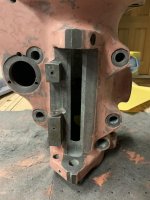
Got all of the paint stripped. Lacquer thinner did a great job of removing all of the old paint layers but left the old filler mostly intact. I intended to use Bondo for the major fill repairs but the styrene was too much for me after the first batch. Guess I’m pretty sensitive to it after all of the hours in the composites lab back in college. So I ended up using the Bondo skim fir the repairs. That stuff doesn’t have anywhere near the styrene content of the normal stuff and is way easier to form. Hopefully it’s hard enough to hold up. We will see. I used automotive panel clips to keep most of the holes in the head clean of Bondo. It worked great as the clip assortment I had on hand just so happened to be perfect matches for all of the small and medium sized openings. Hopefully that doesn’t bite me in the *** next time I need an automotive clip for one of our vehicles.

8773AFE1-2176-4AEB-8FF0-7A777A593FB1.jpg


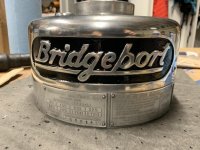
While waiting for what I hope is the last skim coat to dry so I can sand it. I started in on the belt housing. I started off using my festool orbital sander with 100 grit paper to remove most of the major scratches and casting defects. I then proceeded through every grit up to 800. Then I switched over to automotive graded orbital wet sanding pads. Turns out these work great on Festool sanders and the vacuumed still pulls a lot of the dust through the felt backing. I didn’t have any aluminum polishing compound on hand so I just wiped a thin coat of Sheila Shine on the aluminum between each grit from 1000 all the way up to 4000 grit. Was a bit surprised it was that easy to get a mirror finish. I wiped it all down with lots of denatured alcohol and painted the background on the name.

28AF4EFA-2F75-4C33-B69B-9ECDFFC3C87E.jpg

I’m not sure what to do to keep it from oxidizing. Clear coat it? I’m a bit worried that won’t look great in a few years...otherwise do I just keep it wiped down with Sheila Shine or Never Dull? Would love some suggestions for finishing the polished aluminum.
 
Last edited:
To avoid these ads, REGISTER NOW!
Top Bottom