To avoid these ads, REGISTER NOW!

Lug nut thread lubrication - what do you use?

Bigblockyeti

Banned
Joined
Feb 1, 2018
Messages
2,550
Location
Upstate, SC
This.

Modern studs and nuts have a factory coating... which is engineered for proper clampload at the given torque spec. Definitely don't want to mess with that. If you have old rusty ****, antiseize is probably a good bet... IF you aren't able to replace with new... but you are totally guessing about clamp load.

The problem isn't old rusty stuff, it's new rusty stuff from a variety of manufacturers who are just try to sneak out of the warranty period without having to pay anything and still let the vehicle deteriorate quickly so as to bring in another sale.
 
To avoid these ads, REGISTER NOW!

gorilla

Well-known member
Joined
Dec 13, 2007
Messages
1,652
If we only knew the amount of stretch our lug bolts needed we could tighten by turn of the nut and the lube wouldn't matter.
 

king nero

Well-known member
Joined
Dec 27, 2010
Messages
1,469
Location
Belgium
Not at all, but what we are dealing with here is in fact a very simple bolted connection. And what I said about the math being simple for knowing how much to back off the torque value for a wheel stud lubed with anti seize is in my opinion very simple.

So, lets say you reduce the friction of the threads by 50% (or whatever value/estimation you want to use), how would that affect the torque value to attain the same preload?
 

matt_i

Well-known member
Joined
Mar 14, 2008
Messages
10,725
Location
SE Michigan
I just brush on a very light coat of copper/graphite anti seize.

The final torque comes from the much larger radius of the flank of the conical nut in contact with the matching tapered recess in the wheel (talking aluminum wheel, steel nut on 4 of my newer vehicles) and not the threadform itself binding to a stop in equalization with friction.

So the way I see it as long as I don't lube the OD of the conical nut, I haven't affected the friction characteristic which creates the final torque.
 

Blickus

Well-known member
Joined
May 4, 2018
Messages
91
Location
Eastern, PA
As with all of the other countless threads on this topic, there is an engineering solution based on the clamping load generated in a bolted connection. Solve the equation for the fastener preload dry, use that value and change the lubricant's k factor and resolve for the new torque (hint: the reduction ratio is the lubed K factor divided by the dry):

The torque required for a bolted joint design comes from a long string of calculations, but boils down to a simple equation.

T = Wp x K x dn
Where T=torque; Wp=fastener preload; K=torque coeff; dn=fastener diameter

The factor that changes with dry vs lubricated fasteners is the "torque coefficient" and is published for a variety of cases. Tables of values exist, mine are taken from DuPont Engineering Specification (10 pages of calcs). Examples:

Dry steel fasteners: K=0.20
Lightly oiled steel: K=0.15
Cad Plated: K=0.14
Anti Seize on steel: K=0.13 (as published by Bostik for their Never Seez products)
Graphite & mineral oil: K=0.10

Using Never Seize versus dry uncoated steel, multiply the specified torque by 0.65.

A very light coating on the threads only to prevent corrosion and/or galling is all that's needed. As is the case with most Anti Seize applications, a little goes a long way.
 

macgee

Well-known member
Joined
Jan 11, 2014
Messages
2,834
Location
Sepulveda Pass, CA
Loctite LB 8008 Copper Anti-Seize Lubricant.

71Z6yrMRdEL._SL1500_.jpg
 

kwb

Well-known member
Joined
May 1, 2009
Messages
1,771
Location
PNW
Not at all, but what we are dealing with here is in fact a very simple bolted connection. And what I said about the math being simple for knowing how much to back off the torque value for a wheel stud lubed with anti seize is in my opinion very simple.

If that offends you I apologize, I have been posting to get my 10 posts and am now at 11, So I am now done and you guys can go back to being right. Matters not to me.

Spoken like someone that has never actually done the analysis of the scatter in clamp load over a series of bolts that is supposed to be identical. Even with DC nutrunners to run down fasteners for consistency in torque application the spread in clamp load is actually a bit scary the first time you go through this.

Even for most people using a torque wrench properly to get what the engineering spec is trying to do is a challenge. I am sure there are plenty of guys here that know how to use a torque wrench but, this site is a specific subset of the population and I bet that the numbers that really get it right are at best a slight majority.

Bolts and nuts are a PITA. The good news is that usually the engineers take that into account and have a lot of wiggle room for shadetree guys to disassemble and reassemble and still be reasonably safe.
 

sberry

Banned
Joined
Jun 18, 2005
Messages
35,747
Location
Brethren, Michigan
All this **** is too complicated and too messy,,, spray, liguid wrench. I read up on the scatter stuff,,, its math over my head, all I care about is its not stuck and goes together smooth.
 

dagofast

Well-known member
Joined
Oct 15, 2006
Messages
411
Location
The QC in AZ
I apply a thin film of unicorn tears to the studs AND the nuts using the tail feather of a tetradactyl. I've never had a wheel fall off but once had a sidewall punctured by a dragons claw. But that probably would have happened even if I put the tire on with dry threads.
 

Adam R

Member
Joined
Nov 14, 2017
Messages
22
I only use anti-sieze on bolts that I intend to remove at some point in the future....My 8oz jar is getting pretty low these days. It has only lasted 25 years. Time to get another, and probably my last, bottle of the stuff.
 

meathooker

Well-known member
Joined
Dec 10, 2013
Messages
254
Location
Iowa
I’ve always put a small dab of something on the threads ... grease, WD, motor oil etc.

Back in 2012 I started racing RZR’s with a couple guys. We were swapping wheels multiple times a day (3-4 wheels per guy per day for 6-8 races a summer) plus a fresh set before the weekend. A lot of the swapping was in less than ideal conditions (dust, mud). I would spritz my lugs with WD before throwing mine together then torque. My team mates thought it was crazy to do it as they incorrectly thought it would make the lugs loosen.

We all shared the same torque wrench at the same setting.

They each broke several lug studs over the next 3 years. I never had one break or loosen.
 

skulldrinker

Well-known member
Joined
Dec 25, 2011
Messages
1,171
Location
Bolingbrook, IL
If you rotate your tires like you're suppose to theyy don't have time to seize.

Sent from my SM-N960U using Tapatalk
3d4df26ec0387f52400c53b9a19ec18a.jpg
 

Attachments

  • 3d4df26ec0387f52400c53b9a19ec18a.jpg
    3d4df26ec0387f52400c53b9a19ec18a.jpg
    371.1 KB · Views: 2

logical

Well-known member
Joined
Aug 31, 2005
Messages
2,449
Location
Northern fringe of the Motor City Suburbs
Spoken like someone that has never actually done the analysis of the scatter in clamp load over a series of bolts that is supposed to be identical. Even with DC nutrunners to run down fasteners for consistency in torque application the spread in clamp load is actually a bit scary the first time you go through this.


Even for most people using a torque wrench properly to get what the engineering spec is trying to do is a challenge. I am sure there are plenty of guys here that know how to use a torque wrench but, this site is a specific subset of the population and I bet that the numbers that really get it right are at best a slight majority.


Bolts and nuts are a PITA. The good news is that usually the engineers take that into account and have a lot of wiggle room for shadetree guys to disassemble and reassemble and still be reasonably safe.
Do you have data to show that using lube leads to more and not less variation? Obviously it changes the torque reading that results in the desired elongation but does it improve or degrade variation.

Are you measuring resultant torque, elongation or actual strain values?

Sent from my SM-T830 using Tapatalk
 
To avoid these ads, REGISTER NOW!

DeeKay

Well-known member
Joined
Nov 25, 2020
Messages
448
Location
Colorado
If you rotate your tires like you're suppose to theyy don't have time to seize.

Sent from my SM-N960U using Tapatalk
3d4df26ec0387f52400c53b9a19ec18a.jpg

Mileage doesn't always equate to time. Takes me two years to drive 5000 miles; plenty of time for stuff to get stuck.
 

Attachments

  • 3d4df26ec0387f52400c53b9a19ec18a.jpg
    3d4df26ec0387f52400c53b9a19ec18a.jpg
    371.1 KB · Views: 1

coljar

Well-known member
Joined
Sep 26, 2010
Messages
6,243
Location
Belpre, Ohio
I've got 5 pt. cans of copper anti-seize that I need to use on something. Years ago, we had to get a pass at work and bring it home or throw it in the dumpster. Nickle anti-seize is the only kind allowed there now. All my friends have plenty. I use it sparingly, because we all know what a mess it makes.
 

andyvh1959

Well-known member
Joined
Feb 15, 2020
Messages
2,592
Location
Green Bay WI
A torque wrench, clicker style, beep style, digital style, only reacts to the setting applied or torque applied. Variations in the treads, such as lightly rolled threads may have higher friction causing the wrench to react, but at a reduced clamping force result. Lubed threads does not alter the actual torque wrench setting, just alters the point when the torque wrench clicks, beeps, lights, or shows the torque achieved. Torque wrenches are simply torque sensing devices. Set a torque wrench at 80 ft-lb and torque a dry or wet connection and it clicks at the setting. But the "wet" connection result is higher holding force applied, or the fastener can be over-stressed/failed.

Got that from a Snap-On engineer years ago. Other factors; always back off the torque wrench to zero when done, torque wrenches are only good for 80% of the wrench range, so a 100 ft-lb wrench is really only accurate from 10 ft-lb to 90 ft-lb. He actually said a quality beam/swing needle style calibrated is very consistent and accurate.

Some other info here: https://www.boltscience.com/pages/faq.htm#11
https://www.hotrod.com/articles/ctrp-1111-torque-wrench-myths/
https://engineerdog.com/2015/01/11/10-tricks-engineers-need-to-know-about-fasteners/

That last one is interesting, as it has a chart to show the variation of feel versus torque wrench versus positional tightening. Actually a "feel" variation of only 35% is surprising.
 
Last edited:

LS6 Tommy

Well-known member
Joined
Dec 27, 2013
Messages
26,162
Location
Northern NJ
This right here is a prime example of why I don't post.

The manufacturer of the lube of choice dosen't need to know anything about any fastener it is put on. The simply need to know the coefficient of friction for their product. the math is simple and universal.

Every product that I have used or looked up lists this in the PDS.

My post is not irrelevant simply because you don't understand what I am posting. I deal with fasteners that are torqued to 1,000's of foot pounds on a daily basis and they are all lubed.

Would you install a stainless steel stud and lug with no lube?

Sorry, Munice, I apologize. I misread what you posted and for some reason I thought you were talking about using K factor for the torque spec, which can be very inaccurate if it's used in conditions outside of the original lab measurements, which is pretty much what you have with all used fasteners.:beer:

If anyone out there is dead set on using a lube on a lug and stud even though
wheel lug and stud manufacturers advise not to, the coefficient of friction calculation Muncie uses is in fact the is the way to do it "right":

T=F×[(0.159×P)+(0.577×d×μ)+(D_f×μ/2)]

Where T = Torque Applied (Nm)
F = Tension Generated in Fastener (N)
P = Thread Pitch (m)
d = Pitch Diameter (m)
Df = Nut Friction Diameter (m)
μ = Coefficient of Friction

Oh, I also wouldn't install any SS fasteners without lube, all SS fasteners require it. On that note, I don't know of any OEM lugs or studs that are SS...:lol:

On a separate note, for the guys asking about torque sticks or "dogbones", they're all ****. The do not (actually, they can not. It's impossible unless it physically separated from the gun at the rated torque) limit torque accurately, if at all. Read the instructions they come with. They require specific model impact guns, used at specific settings and at a specific air pressure and CFM. I can all but guarantee almost none of those requirements are ever checked/applied properly in the field.

Tommy
 
Last edited:

mrvm

Well-known member
Joined
Feb 12, 2014
Messages
3,839
Location
PA
If you rotate your tires like you're suppose to theyy don't have time to seize.

Sent from my SM-N960U using Tapatalk
3d4df26ec0387f52400c53b9a19ec18a.jpg

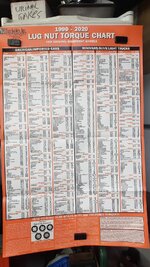
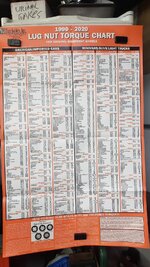
That chart is very handy for proper lug nut torque specs. Curious question: When replacing several lug studs with aftermarket lug studs from the local auto parts store do these same lug nut torque specs still apply? For example lug studs from different auto brands may use the same aftermarket lug studs but have different torque specs from this chart.
 

Attachments

  • 3d4df26ec0387f52400c53b9a19ec18a.jpg
    3d4df26ec0387f52400c53b9a19ec18a.jpg
    371.1 KB · Views: 2

skulldrinker

Well-known member
Joined
Dec 25, 2011
Messages
1,171
Location
Bolingbrook, IL
If you onlybdrivev5000 miles and your lug nuts get stuck ask your the girl next door to do it for you. What a sally.

Sent from my SM-N960U using Tapatalk
 

Jlbc212

Well-known member
Joined
Dec 7, 2013
Messages
1,530
Location
Northeast MA
As I've been reading through this thread I've been wondering how many people here still take their vehicles to a tire shop or a dealer to get their tires replaced and/or rotated. And if you do, do you check to see if you can get the lug nuts loose before you get a flat on the highway or you decide to rotate your tires or do a brake job yourself? And if you did check and found that a lug nut was over-torqued, do you replace the stud(s) because the threads on the stud may have been overstretched and damaged with the potential of having the lug nuts shear off while driving? What's worse - placing a bit of lube on the lug nut threads and tightening with a quality torque wrench or having some monkey with an impact gun tightening the lug nuts for you?
 

MikeF2316

Well-known member
Joined
Dec 29, 2012
Messages
9,605
Location
Thornhill, ON
...
On a separate note, for the guys asking about torque sticks or "dogbones", they're all ****. The do not (actually, they can not. It's impossible unless it physically separated from the gun at the rated torque) limit torque accurately, if at all. Read the instructions they come with. They require specific model impact guns, used at specific settings and at a specific air pressure and CFM. I can all but guarantee almost none of those requirements are ever checked/applied properly in the field.

Tommy

Torque sticks do limit torque. I can't speak to their accuracy, but they're fairly consistent. I use a 45 ft lb torque stick when I tighten my lug bolts with my Milwaukee M18 high torque impact. I then finish up with a click type torque wrench. Always they are under torqued with the stick, and all move about 1 flat before the torque wrench clicks.

Note I run them up fairly slowly with the impact, it seems that inertia at high speed can get you much more torque than running them up slowly.
 

andyvh1959

Well-known member
Joined
Feb 15, 2020
Messages
2,592
Location
Green Bay WI
Comment about stainless steel threaded connections, galling is the issue. I work with hydraulic circuit connections, and anytime we use stainless steel connections it requires the use of anti-seize to avoid galling in the threads. When making a 37 degree flare connection we require anti-seize on both the threads and sealing surfaces.

https://www.essentracomponents.com/...w-to-prevent-galling-on-stainless-steel-bolts
 

DeeKay

Well-known member
Joined
Nov 25, 2020
Messages
448
Location
Colorado
If you onlybdrivev5000 miles and your lug nuts get stuck ask your the girl next door to do it for you. What a sally.

Sent from my SM-N960U using Tapatalk

Did someone not get what they wanted for christmas? Comon man name calling on the internet? Go home.

I said it takes two years to put 5000 miles on the truck which means my tires don't get rotated within that two years. Miles aren't what gets things stuck, it's time.
 

Wakefield

Well-known member
Joined
Aug 26, 2010
Messages
5,132
Location
Arlington VA (but would like to get out to country
I don't like my lug nut threads dry/rusted and that grab/go/grab/go feel whether you're torqueing or losing lug nuts. I typically use a drop of motor oil, or even anti-seize compound... haven't lost a wheel in forty years.

So.. what do the GJ's say?

Have a good day!

Been doing it for years on my cars and never had a problem.
Try not to get it on the seat too much.
I use the minimum torque in the owner's or service manual. Like if 80 to 100 I use 80.

I know that you aren't supposed to do it but the people at the tire shops that I avoid know that they aren't supposed to go full gorilla with the air gun but they still do.

Also seen professional mechanics do it. (use a drop of oil or even caliper slidebolt lube) also where the wheel seats
 

Wakefield

Well-known member
Joined
Aug 26, 2010
Messages
5,132
Location
Arlington VA (but would like to get out to country
As I've been reading through this thread I've been wondering how many people here still take their vehicles to a tire shop or a dealer to get their tires replaced and/or rotated. And if you do, do you check to see if you can get the lug nuts loose before you get a flat on the highway or you decide to rotate your tires or do a brake job yourself? And if you did check and found that a lug nut was over-torqued, do you replace the stud(s) because the threads on the stud may have been overstretched and damaged with the potential of having the lug nuts shear off while driving? What's worse - placing a bit of lube on the lug nut threads and tightening with a quality torque wrench or having some monkey with an impact gun tightening the lug nuts for you?

:3gears::3gears::3gears::3gears::3gears::3gears::3gears::3gears::3gears::D:D:D:D:D:D:D:D:thumbup:
 

Wakefield

Well-known member
Joined
Aug 26, 2010
Messages
5,132
Location
Arlington VA (but would like to get out to country
Exactly ^^^^^^^^^
Few modern wheels have exposed threads, if they do add the grease to the threads after nut and torque is completed.

As for the debate:
Just because it’s been hashed and rehashed a dozen times does not change the specification, facts and certainly opinions are well Entrenched.

I believe automobile threads when tight still contain space that water and saltwater can wick into unless something else is already in there. Thread systems used in plumbing might be different.
 

LS6 Tommy

Well-known member
Joined
Dec 27, 2013
Messages
26,162
Location
Northern NJ
Torque sticks do limit torque. I can't speak to their accuracy, but they're fairly consistent. I use a 45 ft lb torque stick when I tighten my lug bolts with my Milwaukee M18 high torque impact. I then finish up with a click type torque wrench. Always they are under torqued with the stick, and all move about 1 flat before the torque wrench clicks.

Note I run them up fairly slowly with the impact, it seems that inertia at high speed can get you much more torque than running them up slowly.

When I say they do not and can not limit torque, I meant unless they are used in a VERY narrow set of conditions. If they're hammered past the rating of the stick, they stop twisting and overtorque. That's what happens in the majority of shops. The tech hammers until it stops turning.

That being said, they can be used successfully when operated the way you do. You're being very cautious and not just ramming away. AFAIC, in a commercial shop, they're ****.

Tommy
 
Last edited:

jsaw

Well-known member
Joined
Oct 11, 2008
Messages
1,784
Location
Geneva, N.Y.
When I say they do not and can not limit torque, I meant unless they are used in a VERY narrow set of conditions. If they're hammered past the rating of the stick, they stop twisting and overtorque. That's what happens in the majority of shops. The tech hammers until it stops turning.

That being said, they can be used successfully when operated the way you do. You're being very cautious and not just ramming away. AFAIC, in a commercial shop, they're ****.

Tommy

I have torque sticks but do not use them much I have a an Aircat compact impact . when tightening truck wheels I use a 140 ft lb stick. The only way that I can keep from over torquing the lug nuts is to set the gun on its lowest setting and run the nuts down very slowly then I can give it one quick squeeze of the trigger.
We run some other trucks that the torque spec is 175 ft lbs. To install those I use the 140 ft lb torque stick but set the gun on the 2nd setting . that gets the nuts close to spec. Yes , a 140ft lb torque stick will tighten the nuts to 175
We always final tighten with a torque wrench
So I do not find torque sticks to be accurate
 
To avoid these ads, REGISTER NOW!
Top Bottom