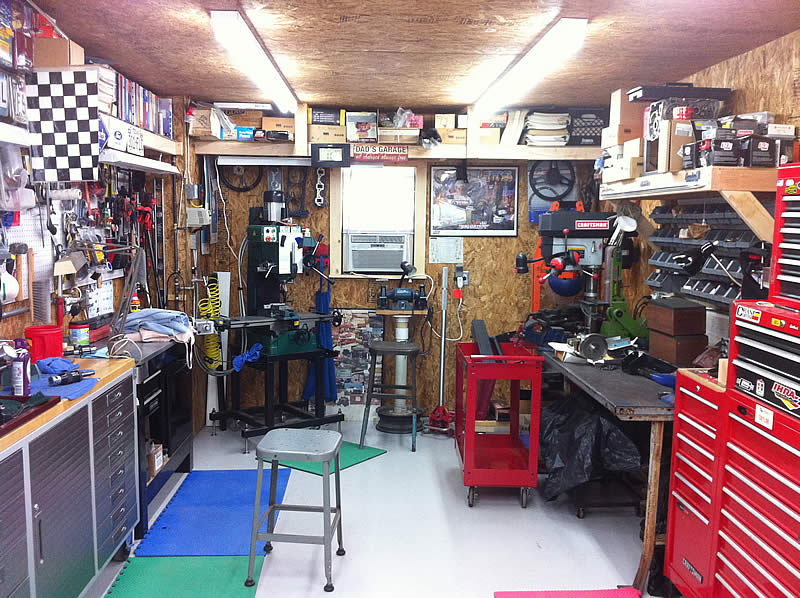
As much as possible, try to create a flow of work through your space.
Materials should come in the door and be immediately stored in racks, shelves and bins, readily available for pulling for jobs. Organization and labeling of cutoffs and good lighting is critical here.
The first thing you will do is to plan the job. This can be in an office area, or at a desk in the middle of the shop. I like working off the granite in a central area. I can take the part drawing and go right to the materials. I like a stool here.
Next is rough cutting the materials. Bandsaws do most of this work, chop saws too. Work should next flow through these machine positions. A roller stand at the horizontal bandsaw for long stock is necessary. Next to the bandsaws should be your disc sander to remove burrs from edges of cut stock and a bench grinder with wire wheels for cleaning up stock. Left over stock is put back on the nearby rack or shelf or bin.
Then you get to your main machining area.
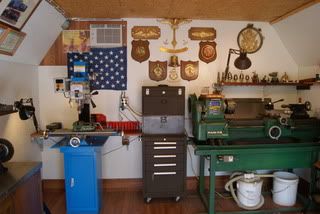
Your major machines are the Bridgeport, Lathe and surface grinder.
I have found that if you set up things properly, you can run 2 or even three machines at the same time. I put the lathe across an aisle from the Bridgeport and surface grinder.
The aisle is wide enough that a short table can hold often used tools. I can set up the lathe to work a part, the Bridgeport to do an operation and go to the grinder to complete some work.
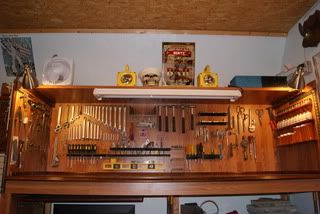
Nearby is shelving with supplies and tools and materials. And a fluids cabinet is also close at hand.
Well placed fans and trash cans serve to keep the shop clean and air moving.
Close to the center of activity should be a bench grinder on a pedestal with green and fine wheels for sharpening tools and bits.
After machining, the part is often welded or finished and sometimes assembled with other parts. These operations are done in separate spaces.
Each major and even minor machine needs certain tools and materials close at hand.
Let's start with the Bridgeport.
To me, the single most important thing is lighting.
After that, a place for what I'm actually working on right at the machine. This includes the part, setup and holding items, measuring equipment, cutters and coolant/fluids.
Usually I will start at the granite with the drawing, grab a caliper and scale and go to the materials rack for the material, the setups shelf for T-nuts and bolts and clamps and dump that on the machine's table. A rack on the machine has most of the regularly used collets. Behind me is a table with often used things, like a drill chuck and commonly used mills and drills. Somewhere nearby is a chest with the full selection of mills. I grab the right one when needed. The same goes for drills.
Another thing I need nearby at the Bridgeport is shields for the hot chips. I also keep the following close at hand. An air hose with an air gun attached, a squeeze bottle of coolant, a cheap paintbrush for chip removal and machine cleaning, a caliper, a couple of mics, scale, super spacer, a few gauge blocks, parallels, tapping equipment, etc.
More machines later...
Bill