Wolf did make a mistake they should have kept up the quality and they could possibly still be around!
AFAIK Wolf ceased being family controlled at the end of 1981 (confirmed by Companies House search) when they merged with another famous London firm, Kango. I guess it might have been on the retirement of Geoffrey Wolf, but I haven't done much research on that yet.
Kango was part of a larger group, the Dobson Park Group and on the face of it it was a good match with relatively little product overlap. Amongst other things Dobson Park (a mining industry supplier) at the time owned Dowty, who were a major supplier of hydraulic roof props for the UK's National Coal Board. As you are no doubt aware the 1980s were a period of industrial and economic turmoil in the UK during which time we saw major closures in the UK coal mining industry (something like 90% of deep mine capacity went in less than 6 years) together with major closures in the manufacturing sector. At the same time Sterling fluctuated wildly - never a good thing for manufacturers wishing to export. For a firm like Wolf, and later Kango-Wolf, it can't have been a good time, especially as the City of London seemed remarkably reluctant to invest in whole swathes of our indiginous manufacturing sector. Even so they did continue to turn out some pretty good tools, but I suspect that K-W weren't big enough to afford the development of parts of their range which they'd been buying in (belt sanders, planers and later jigsaws and cordless drill/drivers). Wolf had never developed their own planers and gave-up on making their own belt sanders in the mid- to late-1960s, preferring to buy-in those products from Makita instead. When the Grinderette was delayed into production they bought-in a Makita grinder to cover the gap in the range until they could get the in-house product onto the market. When they finally introduced 43mm collar drill attachments (jigsaw, circular saw, right angle adaptor, grinding wheel, etc) the attachments were all sourced from Makita in Japan. They even abandoned the Wolf jigsaw in favour of a bought-in product from Perles in the mid- to late-1970s, possibly because their in-house product lacked a tilting base and orbital motion facility (which would have necessitated a full redesign).
After the merger with Kango most of these bought-in products continued for a few years but eventually Kango-Wolf formed a new relationship with Holz-Her in Germany and began to source jigsaws, planers, belt sanders and cordless drill/drivers from them instead. A possible factor in that decision was the ever increasing presence of Makita in the UK during in the 1980s, culminating in Makita opening a new factory in Telford in 1991. With the sale of Stanley Power Tools to Bosch in 1981 Bosch came into the UK market much more strongly. Further inroads were also being made in the UK market at that time by Elu, but other firms such as Hitachi, Ryobi, AEG, etc also became more prominent as well. I think the loss of the NCB contracts throughout the 1980s must also have hit Dobson Park quite badly and they eventually sold out their power tool division to Atlas-Copco of Sweden in 1993. A-C were on an acquisition trail at the time which saw them take-over AEG of Winnenden (Germany) and with AEG came Milwaukee, some of whose tools were actually AEG designed and made.
Duplication in the ranges (together with some products being bought-in from rival Holz-Her) meant that something had to go and unfortunately as many of the in-house manufactured Wolf designs were older and were presumably coming due for replacement or revamping, it meant those. In addition with Germany being a more stable manufacturing environment at the time (currency stability being all for an exporter) much of the Wolf range together with the lighter Kangos were simply replaced wholesale by "Atlas-Copco" tools (rebadged AEGs). In a few cases AEG tools were made in yellow and branded "Kango" (e.g. the 200 and 240 SDS drills). The only things then remaining at Peterborough by that stage were the Kango 430 and 750/760 medium hammer drills, the 900 and 950 breakers and the 2500 heavy (road) breaker - so they moved production of them to Germany and shut Peterborough down. I believe that some of the engineering staff transferred to Germany as well
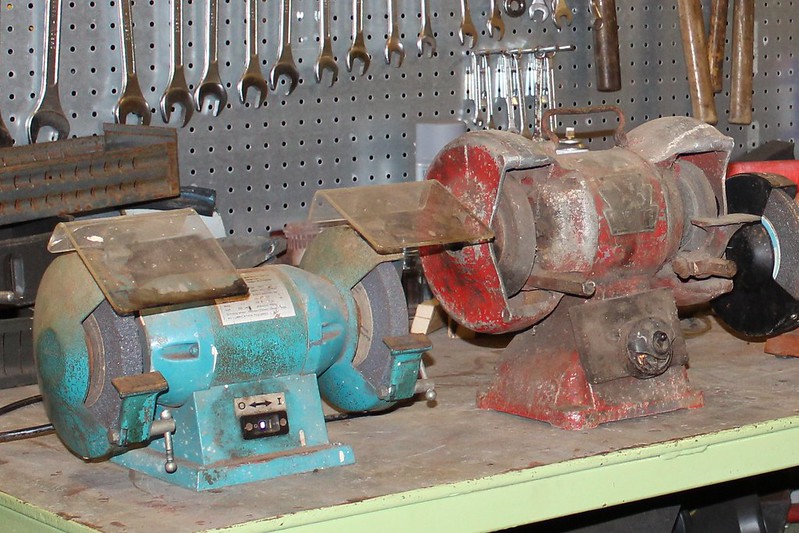
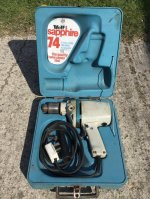
Edit: More research into the company papers appears to point to the designs, tooling, equipment and business being sold to A-C, but the premises remaining with Dobson Park. This would have given A-C a range where all of the ex-Wolf designs were duplicated by existing (and often newer) AEG products. For example by 1993 the mk.4 Sapphire-type pistol grip drill family was one on the newest product ranges at 12 years of age, the 7in and 9in circular saws, orbital sander and the "gut buster" drills (which appeared in the early-1970s) were 22 or so years old as were the D-handle drills which appeared around 1971. The grinders I'm less certain about, but I reckon that they also appeared in the mid-1970s. Such old designs are not trend setters in the market and the tooling would possibly also be approaching the end of its life. Similarly on the Kango side of the business only the 430, 750, 2500 and the wall saw were up too date products - the big 900/950 breakers that the firm was famed for were basically mid-1960s designs
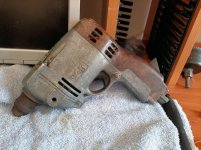
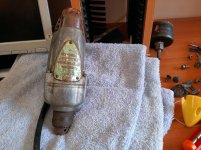
So I think the demise of Wolf and later Kango-Wolf had nothing to do with quality. The last Wolf Cubs I can recall were orange plastic ones made in the late 1970s (at the same time as the teal/ivory industrial/trade range drills) and after that Wolf didn't seem to bother much with the DIY market other than having some 43mm attachments (AFAIK dropped shortly after the Kango merger). But judging from the number of old Wolf Cubs, Cubmasters, Quartermasters, Safety Masters, Challenge drills and the like still kicking about they must have been big in the DIY market in the fifties and sixties - good enough to give Black & Decker and Bridges (bought by Stanley in 1961) a run for their money
So I really don't see the DIY market or quality drop as having killed Wolf. It was just the times
And as you've probably guessed, I am indeed a bit of a collector of these things and always happy to talk tools
Note: A lot of the foregoing has been gleaned from studying scraps of literature, old magazines, etc as ell as an amount of personal recollection. That means I may well be wrong on some of the pertinent points and my dating is also a wee bit hazy - so if you know better, get in touch and we can correct what I've written and leave it for posterity. I'm especially interested in the production dates for various tools