To avoid these ads, REGISTER NOW!

Malco Eagle Grip pliers

2ndGearRubber

Well-known member
Joined
Mar 24, 2014
Messages
14,185
Location
Pittsburgh
I know several hundred people with locking pliers.

One of those likely has a Snap On.

The rest don’t GAF. Most probably don’t even know what brand they have, or where to by SnapOn.

What most here don’t understand is that tools and brands aren’t important to most people.

Look outside of your immediate circle. It’s a big world

Sad world, but it's true.

I love these Malco and the snap-on rebrands. Shame the rest of the world wouldn't appreciate the excellence.
 
To avoid these ads, REGISTER NOW!

Maddog1337

Well-known member
Joined
Dec 6, 2019
Messages
84
Location
Plainfield, IL
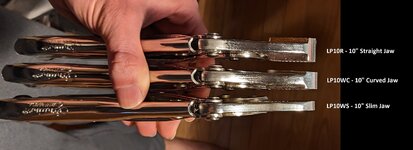
Slim jaw model is on the bottom:
PXL_20230422_130848659 - Copy - Copy.jpg

Yes, cleaning the stud helps. I think that getting the nut started with a wrench and then running it off the rest of the way with an impact backed up by a good pair of vise grips is faster and easier. Keep in mind this is a car that's been through ~10 New England winters.

I'm also confused by the slim jaw, I don't see those listed anywhere on Malco's website or in Malco's marketing materials (was referencing an Eagle Grip catalog on Malco's site). But they're obviously real and sold on Amazon and Zoro, so am I completely missing these somewhere or were these quietly launched I wonder.
 

GeoBruin

Well-known member
Joined
May 5, 2018
Messages
3,733
I'm also confused by the slim jaw, I don't see those listed anywhere on Malco's website or in Malco's marketing materials (was referencing an Eagle Grip catalog on Malco's site). But they're obviously real and sold on Amazon and Zoro, so am I completely missing these somewhere or were these quietly launched I wonder.
I speculated a while back that these were mid-production when Malco announced they were closing down the line. They never made it on Malco's site and the ones I have heard about making it to customers (including me) didn't come in the fancy box like the other models but rather just had the little plastic tag on them.

It seems like they knew it was over so they didn't want to invest in any of the fluff you do for branding and customer experience and instead just boxed them up and unloaded them on a couple resellers.
 

dnschmidt

Well-known member
Joined
Oct 3, 2014
Messages
7,261
Location
Phoenix, AZ
Wouldn't cheap/cheaper locking pilers/locking clamps do just as well for welding?
My point exactly. Welding is what I use Vice Grips for and I think this is true for many people. For things other than welding I use Cobra Pliers, Swedish Pipe wrenches, pipe wrenches and other **** that grabs round stuff. For stuff that's not round I use Pliers Wrenches.
 

Mr_B

Well-known member
Joined
Nov 21, 2016
Messages
5,373
Location
Reading
Sad world, but it's true.

I love these Malco and the snap-on rebrands. Shame the rest of the world wouldn't appreciate the excellence.
part of problem is rest of the world had little insight on Malco Eagle Grips as marketing was USA and only few would of sourced them off likes of Amazon for global shipping .
The 2 main issues was too slow build a proper pliers product range and not making use of global market and modern media/marketing ... shockingly sloppy business/brand concept from Malco ruined a good product .
 

dutchgray

Well-known member
Joined
Sep 28, 2014
Messages
6,461
Location
Dorset. England.
There are some manual machine tools that would be worth having.
Harrison M400 16 by 60 lathe for a start.
As usual the majority of chucks and accessories are separate lots.
 
To avoid these ads, REGISTER NOW!

American Locomotive

Well-known member
Joined
Jan 8, 2017
Messages
10,929
Location
Rhode Island
"Brand new state of the art production line" using harbor freight tool boxes, 15 year old CNC machines, 25 year old welders, and 50 year old forging equipment.

It's really starting to seem like Malco only made a half-hearted attempt at this. I can't imagine it's great for employee morale to be starting up a new production line on old, clapped out equipment. I can't imagine it's good for one's bottom line to making locking pliers the same way they did 30+ years ago, either.
 

dnschmidt

Well-known member
Joined
Oct 3, 2014
Messages
7,261
Location
Phoenix, AZ
I've told this story before. My cousin in Germany sells forges and metal presses and all of the metal working equipment which would be used to make Vice Grips. All of his sales are in Asia and Europe. His view of the American market is to quote: "A DEAD ZONE." "Americans haven't installed any new equipment since WWII" is a phrase he often uses.
 

neophyte

Well-known member
Joined
Apr 23, 2012
Messages
9,537
Location
Pennsylvannia
"Brand new state of the art production line" using harbor freight tool boxes, 15 year old CNC machines, 25 year old welders, and 50 year old forging equipment.

It's really starting to seem like Malco only made a half-hearted attempt at this. I can't imagine it's great for employee morale to be starting up a new production line on old, clapped out equipment. I can't imagine it's good for one's bottom line to making locking pliers the same way they did 30+ years ago, either.
Still, that seems like a hell of a lot of equipment to produce 6 or 8 separate models of locking plier.
The startup costs must be way higher that the average person imagines, especially if the starting goal is to produce huge quantities of the same model with high precision.
As for old equipment, plenty of high quality items where made in vast quantities 100+ years ago using way simpler equipment.
The old drop forge and Steelworker hammer would probably be somewhat straight forward for an intelligent worker to figure out.
I honestly wonder how much of the equipment was there to produce the pliers, and how much was there yo service the large equipment.
 

matthew

Well-known member
Joined
Dec 4, 2009
Messages
1,345
Similarly I recall reading a story (possibly apocryphal) of an American steel company exec complaining about Japanese mills having been rebuilt after ww2 and having to compete with them, and being rebuffed and told “you’re still using your same equipment and we’ve replaced ours 3 times since then”

I won’t totally fault using old equipment - some of it is productive. But it’s not always competitive - at some point you can **** a few more bucks of production out of it, but milking the asset won’t let you compete long-term without reinvesting. And protectionism can make it worst by encouraging further stretching of those assets.
 

neophyte

Well-known member
Joined
Apr 23, 2012
Messages
9,537
Location
Pennsylvannia
Similarly I recall reading a story (possibly apocryphal) of an American steel company exec complaining about Japanese mills having been rebuilt after ww2 and having to compete with them, and being rebuffed and told “you’re still using your same equipment and we’ve replaced ours 3 times since then”

I won’t totally fault using old equipment - some of it is productive. But it’s not always competitive - at some point you can **** a few more bucks of production out of it, but milking the asset won’t let you compete long-term without reinvesting. And protectionism can make it worst by encouraging further stretching of those assets.
One thing that gets pointed out about old firearms, is that one reason it’s hard to produce reproductions, is because the methods of manufacture are completely different nowadays.
The old method was toGave a jig fir each cut, or a row of machines set up, with each machine producing a different operation in sequence.
With newer production lines, the goal is to clamp a piece, or multiple pieces in a CNC machining center, and have the machine setup move the cutter automatically, possibly combined with the clamped part/s also being moved automatically at the same time.
This results in the machining process needing to be thought out completely differently.
Tolerances and particularly flex in the machining of each part would also need to be calculated differently.
The CNC could presumably be used to a certain extent like a “dumb” machine for individual cuts, but for a product which was developed when “dumb” machines were the norm, a dumb machine may be better suited to production.
If Malco wanted to machine more complex jaw shaped, such as screw head gripping jaw tips, a CNC would have advantages, but plenty of the other production stages could provably be done in a 1970s high school shop.
 

General Geoff

Well-known member
Joined
Jan 12, 2013
Messages
3,867
Location
Allentown, Pennsylvania
The old method was toGave a jig fir each cut, or a row of machines set up, with each machine producing a different operation in sequence.
With newer production lines, the goal is to clamp a piece, or multiple pieces in a CNC machining center, and have the machine setup move the cutter automatically, possibly combined with the clamped part/s also being moved automatically at the same time.
This results in the machining process needing to be thought out completely differently.
This is why FN discontinued the original Hi-Power and totally redesigned it. They were still using manual machines from the 1930s to manufacture pistols up until 2018. The new one is basically all CNC and metal injection molding. As a result, the new ones are far more automated in the production process while also having a superb fit/finish with far less hand-fitting of parts in the final assembly steps.
 

American Locomotive

Well-known member
Joined
Jan 8, 2017
Messages
10,929
Location
Rhode Island
Still, that seems like a hell of a lot of equipment to produce 6 or 8 separate models of locking plier.
The startup costs must be way higher that the average person imagines, especially if the starting goal is to produce huge quantities of the same model with high precision.
As for old equipment, plenty of high quality items where made in vast quantities 100+ years ago using way simpler equipment.
The old drop forge and Steelworker hammer would probably be somewhat straight forward for an intelligent worker to figure out.
I honestly wonder how much of the equipment was there to produce the pliers, and how much was there yo service the large equipment.
No one is doubting that you can't produce quality items using old methods and machinery. No one is questioning that you can produce a lot of items quickly using old methods and machinery.

The issue is producing a lot of quality items quickly and cheaply is very difficult with old equipment.

...and don't get me wrong. When making forged hand tools, there's still a lot of "manual work" involved. But it's never a good look when your production line is starting out using tooling and machinery that's already multiple decades old.

From what I remember, the Dewitt factory was completely gutted before Malco moved in. They were starting with a clean slate.
 

F-22

Well-known member
Joined
Jan 23, 2022
Messages
1,830
part of problem is rest of the world had little insight on Malco Eagle Grips as marketing was USA and only few would of sourced them off likes of Amazon for global shipping .

This is true for mostly anything made in USA. In my central European country, it's really rare to see a USA product anywhere. Most common USA thing here may be Zippo lighters. Tools? Never... I might be able to buy Channellocks online, but it would likely end up costing similar to knipex.

I can't imagine it's good for one's bottom line to making locking pliers the same way they did 30+ years ago, either.
90's production could've been very automated (practically just as much as today for a product like that). Even 80's or 70's with some minor additions. For forging, a purpose made mechanical machine can be as fast or even considerably faster than a modern machine. Nowadays, modern approaches allow such machines to be versatile and you're able to repurpose them a lot more. Makes it easier to make a big investment if you know you can use it for other stuff too.

But old mechanical production automation is a thing of beauty. I don't know how the vise grip production looked, but if old machines were really well thought out they can certainly be more efficient than new ones. Old all-mechanical industrial equipment was ridiculously reliable and fast.

For an example, I know my company bought some bending machines for making little sheet metal parts for electrical switch fuses. I forgot the name (it's a totally different part of the company), but they had three "modern" machines that used lots of pneumatics and smart controllers and servos to bend the little sheet metal pieces. They cost about 300000€ each. But, for the type of sheet metal folding that is used the most, they ordered an all mechanical machine. No servos, no pneumatics. Every bending movement is done with huge camshafts. I think there's only one main motor and the transfers are all fixed gear transfers purpose made for every cam movement. To re-purpose it requires remanufacturing of a lot of gears and camshafts. That machine cost around 1.500000€, they could buy 5 "smarter" machines. But the mechanical one works 24 hours, 7 days per week, and is only stopped one week in the summer and one week for new year, when all regular employees have vacation and the maintenance crew has inspections. It does not really work a ton faster than the pneumatic machines. But it has practically no downtime and next to no maintenance.

My point is - such machines existed 100 years ago in very specific large volume manufacturing. E.g. manufacturing screws is typically all mechanical and crazy fast. CNC and other modern approaches aren't the ultimate solution if you only need it to do one specific task over and over.
 

Mr_B

Well-known member
Joined
Nov 21, 2016
Messages
5,373
Location
Reading
Enjoying this discussion as I finally contemplate dropping a few pairs of Malcos in my Amazon shopping cart before they disappear.

GJ is great for learning how stuff is made, not so much for financial or marriage advice :)
buy at least one of every type available, they worth the verbal abuse from the wife if she sees the purchase/cost lol ...
 

Odd-job

Well-known member
Joined
Aug 13, 2017
Messages
2,256
Location
SF Bay Area
Whatever you do, DO NOT buy the narrow nose. I need spares available in the market in case mine ever wear out!
I think Amazon is stocking the narrow nose still. The regulars appear to be out of stock.

edit: just the Malco LP10WC 10 in. Curved Jaw Locking Pliers with Wire Cutter are out of stock.


American Locomotive

Well-known member
Joined
Jan 8, 2017
Messages
10,929
Location
Rhode Island
This is true for mostly anything made in USA. In my central European country, it's really rare to see a USA product anywhere. Most common USA thing here may be Zippo lighters. Tools? Never... I might be able to buy Channellocks online, but it would likely end up costing similar to knipex.


90's production could've been very automated (practically just as much as today for a product like that). Even 80's or 70's with some minor additions. For forging, a purpose made mechanical machine can be as fast or even considerably faster than a modern machine. Nowadays, modern approaches allow such machines to be versatile and you're able to repurpose them a lot more. Makes it easier to make a big investment if you know you can use it for other stuff too.

But old mechanical production automation is a thing of beauty. I don't know how the vise grip production looked, but if old machines were really well thought out they can certainly be more efficient than new ones. Old all-mechanical industrial equipment was ridiculously reliable and fast.

For an example, I know my company bought some bending machines for making little sheet metal parts for electrical switch fuses. I forgot the name (it's a totally different part of the company), but they had three "modern" machines that used lots of pneumatics and smart controllers and servos to bend the little sheet metal pieces. They cost about 300000€ each. But, for the type of sheet metal folding that is used the most, they ordered an all mechanical machine. No servos, no pneumatics. Every bending movement is done with huge camshafts. I think there's only one main motor and the transfers are all fixed gear transfers purpose made for every cam movement. To re-purpose it requires remanufacturing of a lot of gears and camshafts. That machine cost around 1.500000€, they could buy 5 "smarter" machines. But the mechanical one works 24 hours, 7 days per week, and is only stopped one week in the summer and one week for new year, when all regular employees have vacation and the maintenance crew has inspections. It does not really work a ton faster than the pneumatic machines. But it has practically no downtime and next to no maintenance.

My point is - such machines existed 100 years ago in very specific large volume manufacturing. E.g. manufacturing screws is typically all mechanical and crazy fast. CNC and other modern approaches aren't the ultimate solution if you only need it to do one specific task over and over.
The point is, this "new" factory was put together with old equipment. Some of the forging equipment I can give a pass because they can be rebuilt essentially definitely, but to be fair, there has also been A LOT of development in the forging world from how they did things in 1940s. ...but there is no excuse to be kitting out your new factory with 15-20 year old CNC machines. When you look at the auction, I'm not also not seeing any kind of modern secondary/packaging equipment.

It looks like this was a thoroughly old school way of manufacturing the pliers, and likely had a thoroughly old-school high labor cost and high reject rate.
 

neophyte

Well-known member
Joined
Apr 23, 2012
Messages
9,537
Location
Pennsylvannia
This is why FN discontinued the original Hi-Power and totally redesigned it. They were still using manual machines from the 1930s to manufacture pistols up until 2018. The new one is basically all CNC and metal injection molding. As a result, the new ones are far more automated in the production process while also having a superb fit/finish with far less hand-fitting of parts in the final assembly steps.
Metal Injection Molding is one of the main issues with current firearm manufacture.
It inherently makes the firearms Less Durable.
The venerable Austrian Pistol had to change handling procedures, because things like dry firing is not great for the Metal Injection Molded parts.
Sig also had a bunch of parts breakage for the same reason.
MIM temded to be brittle, and the only main advantage is making highly complex parts that might be hard to machine, or producing wear resistant alloys that can be sintered, but not easily machined.
I’m uncertain whether the current firearms manufacturers are simply being chesp, or whether they have less skilled employees, or whether various Militaries want metal injection molded parts for security reasons. (Basically, ship incomplete firearms, used 3D printer to print complex internal part/s on site, if firearms are stolen in transport, thieves have to figure out how to make missing parts)
 

neophyte

Well-known member
Joined
Apr 23, 2012
Messages
9,537
Location
Pennsylvannia
This is why FN discontinued the original Hi-Power and totally redesigned it. They were still using manual machines from the 1930s to manufacture pistols up until 2018. The new one is basically all CNC and metal injection molding. As a result, the new ones are far more automated in the production process while also having a superb fit/finish with far less hand-fitting of parts in the final assembly steps.
Also,
This sight looked up the original cost to produce a Luger Pistol.
The estimate is $19 in 1940.
According to inflation stats, $19 in 1940 should be about $400
Shadow stat inflation rate which is probably high, estimates about $3000
This is about what Lugerman charges for a Luger.
I believe Lugerman now uses CNC machining.

The current list price on a new production Sig P210 is around $2000.
I’m fairly certain this is being made using MIM and CNC machined parts.
The whole point of the original P210 design was yo make an accurate pistol, that was easier and less expensive than the Luger, which was considered too costly to manufacture.
The original P210s were considered highly accurate, but still not as accurate as the Luger (based on original Swiss testing).
If the current MIN and CNC machining were that much cheaper, why does the current P210 cost $2000 ?

I can understand a sub $400 Glock clone using CNC machining and MIM molding to produce pistols cheaply, and I can even understand Glock using the same techniques to remain cost competitive, but if the current techniques are so efficient than the older pistol designs should not be anywhere near as expensive to produce as they are.
 

American Locomotive

Well-known member
Joined
Jan 8, 2017
Messages
10,929
Location
Rhode Island
I have a decent background in manufacturing, and I can promise you that in a modern factory, with modern production lines, and modern CNC equipment, a Luger would not cost anywhere near $3,000 to manufacture. It'd be a fraction of that in quantity. The company I used to work for made a ton of firearm parts for various companies under contract. I remember we made barrel for a popular handgun, it had a lot of intricate and complicated features where it mated to the gun, but our cost to make it was around $10. I'd expect a gun like a Luger could be produced for less than $150 manufacturer cost in a fully-modern facility.

Not all CNCs are the same. "LugerMan" with a Haas CNC Mini-Mill in his small workshop is not the same thing as a major company running a bunch of giant Mazaks with pallet loaders and an army of multi-spindle CNCs cranking out turned parts.
 

neophyte

Well-known member
Joined
Apr 23, 2012
Messages
9,537
Location
Pennsylvannia
I have a decent background in manufacturing, and I can promise you that in a modern factory, with modern production lines, and modern CNC equipment, a Luger would not cost anywhere near $3,000 to manufacture. It'd be a fraction of that in quantity. The company I used to work for made a ton of firearm parts for various companies under contract. I remember we made barrel for a popular handgun, it had a lot of intricate and complicated features where it mated to the gun, but our cost to make it was around $10. I'd expect a gun like a Luger could be produced for less than $150 manufacturer cost in a fully-modern facility.

Not all CNCs are the same. "LugerMan" with a Haas CNC Mini-Mill in his small workshop is not the same thing as a major company running a bunch of giant Mazaks with pallet loaders and an army of multi-spindle CNCs cranking out turned parts.
Please consider this business opportunity .
 

General Geoff

Well-known member
Joined
Jan 12, 2013
Messages
3,867
Location
Allentown, Pennsylvania
I'd expect a gun like a Luger could be produced for less than $150 manufacturer cost in a fully-modern facility.
No friggin way you're machining a fully functioning, all steel Luger for $150, even scaled up to hundreds of thousands in production and even with 95% of the process fully automated with all up-front tooling costs paid-for.

WE_Explode_P08.jpg
 
To avoid these ads, REGISTER NOW!
Top Bottom