In My Garage
Well-known member
I already posted a part of this on the “MaxJax Installs: Post Here” thread. The problem is, who is going to read through countless pages of posts to find specific info?
This MaxJax install would be of particular interest to Porsche 993 owners because spacing and locating my MaxJax is based on that particular car and jack points. This thread goes into detail overkill, so sift through what interests you and skip the rest.
Which lift, scissors or two-post?
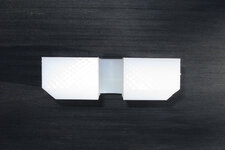
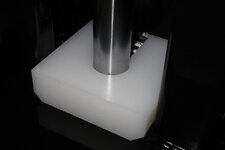
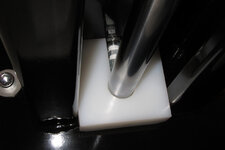
After a couple of years of going back and forth trying to decide between a scissors lift and a two-post lift, I went with the MaxJax Two Post Portable Lift. The MaxJax was chosen because I wanted unobstructed access to the bottom of the vehicles I would be working on. The lifts each have their advantages and disadvantages.
Either choice of lift would have had me do some concrete work.
A scissors lift is too tall to drive over, so it either needs to be placed below grade or driven over by placing 2 x 12 lumber where your track is. The advantage of a scissors lift is that the residential-grade concrete floor would be less of a concern. It along with the 2x12 lumber scenario is by far the easiest & quickest solution.
A two-post lift needs to be anchored into the concrete floor. I didn’t trust my residential-grade concrete floor enough to bet my life on it. And sure enough, after cutting my concrete slab, I am glad I didn’t.
Having decided upon the MaxJax two-post lift, I wanted to see one in action as well as their installation. For what I plan to do and the number of times a year I plan to use my lift, the MaxJax was perfect. As for a full sized two-post lift, another local Porsche 993 owner has one and I wasn't able to stand up straight under it.
MaxJax column spacing.
How far to set the columns apart? The MaxJax manual provides recommendations on column spacing, but I wanted to see how a 993 would fit best. To the outer edges of the MaxJax base plates, one local 993 owner had them at 120 inches apart and another local 993 owner had them at 132 inches apart. Having had the opportunity to measure the arm extensions of the MaxJax at the 132 inch column spacing, they were extended by ~50% with the 993 centered. I ended up choosing 130 inch spacing for my install.
Note, with 130 inch column spacing and with the 993's center-of-gravity point centered about the MaxJax column, the forward arm of the MaxJax is nearly fully extended and the rearward arm of the MaxJax is nearly fully retracted. If I had spaced the MaxJax columns further apart or closer together, that would not have been possible.
MaxJax column location – front to back.
I have a standard sized two-car garage measuring 269 inches deep. Not wanting to use the MaxJax column as a door stopper, I placed the MaxJax columns more towards the front of the garage or 104 inches from the front wall of the garage to the center of the MaxJax column.
With the 993 centered with respect to the MaxJax column, I have two feet from the front wall of the garage to the bumper.
Centering the 993 center-of-gravity-wise, I have a foot between the front wall of the garage and the bumper and lots of space behind the 993 for an engine/transmission extraction.
Based on the above, 993 owners can add to the 104-inch dimension to increase the space to the front wall of the garage.
MaxJax anchoring.
Not that I planned on using them, there seems to be some contradiction between the instructions in the MaxJax manual and the Wej-It Power Drop anchor instructions.
From the MaxJax manual: “The floor on which the lift is to be installed must be 4-¼ inch minimum thickness concrete, with a minimum compressive strength of 3000 psi, and reinforced with steel bar”. My concrete floor may have been 4-¼ inches thick...here and there, but I don’t know of any residential garage floors that are “reinforced with steel bar” unless it was an owner request prior to construction.
From the MaxJax manual: They state, “drill hole approximately 5½ inches deep”, yet my concrete slab only needs to be 4¼ inches thick?
The Wej-It Power Drop anchor instructions list other numbers again.
MaxJax custom anchoring.
The following is the method that I chose for anchoring; I'm not suggesting that anyone else use it though.
I wanted rods set into concrete that were internally threaded. Although my garage does not see water or winter salt, I chose to use 304L stainless steel because I didn’t want to worry about corrosion over time. 304L stainless steel machines and TIG welds easily. I also wanted larger base plates for the MaxJax columns to sit on.
304L stainless steel rod: 1.25” OD x 10.5” long, quantity 10.
Drilled and tapped for an M16-2.0 fastener to a fully threaded depth of 50 mm.
304L stainless steel plate: 18” x 18” x 3/8”, quantity 2.
Drilled for clearance holes for M16 fasteners.
A centerline was scribed on each stainless steel base plate for alignment purposes. Another line was scribed 2 inches in from the outside edge of the stainless steel base plate; the outside edge of the MaxJax column base plates would line up with that line.
The outside edge of the stainless steel base plates were placed 134 inches apart and aligned by running black fishing line along the edge of the stainless steel base plates.
The outside edge of the MaxJax column base plates were placed on the lines previously scribed 2 inches in from the outside edge of the stainless steel base plates. This placed the outside edge of the MaxJax column base plates 130 inches apart. The alignment of the MaxJax columns was verified by running black fishing line along the MaxJax column edges.
Once the MaxJax columns were lined up with respect to the stainless steel base plates, the boltholes in the MaxJax base were transferred to the stainless steel base plates for drilling.


M16 bolts were used to hold the stainless steel rods to the stainless steel base plate for TIG welding. Shim stock was wrapped around the bolts to center the stainless steel rods with respect to the clearance holes in the stainless steel base plates.
The heads of the M16 bolts were drilled and tapped for a M8 bolts. This was done to suspend and level the plate assemblies. More on that later.

Concrete slab preparation.
A 3’ x 12’ slab out of the existing garage floor was to be cut out.
I cut down a 3/4" 4'x 8' plywood sheet to 3', the width of the concrete slab in my garage that I was cutting out.
The plywood template was used as a guide for the Stihl cut-off saw with 14" diamond saw blade. The plywood template was then moved an additional 4 feet to get the 12 foot length needed for the cut concrete slab. In either position, the template was screwed down using TapCon concrete screws to hold it in place.


A couple of bridges were built to get the car into the garage during construction.

And the bridges seemed to have worked.

While excavating, the crushed stone kept caving in which worked out for the good in that it created a cavity under the existing concrete floor for the poured concrete to flow under and lock into the existing slab better.

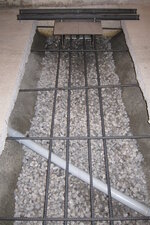
After excavating down to a depth of 18 inches, the sloped sides of the excavated hole were coated with a 1-inch thin layer of concrete to keep the crush stone in place. 4 inches of crushed stone was put back, levelled and compacted for a finished depth of 14 inches.

Suspending, levelling and alignment of the base plate assemblies.
The bolt heads of the bolts holding the stainless steel rods to the stainless steel base plates were drilled and tapped so that angle iron could be attached to the custom MaxJax plates.
The ends of the angle iron were drilled and tapped for a M6 bolt. These four bolts were used to suspend and level the plate assemblies within the cut out concrete slab.
Black fishing line was used to line up the centerlines previously scribed on the stainless steel base plates.

Additional anchoring in the form of half-inch stainless steel rod was welded to the stainless steel rods.

...continued...
This MaxJax install would be of particular interest to Porsche 993 owners because spacing and locating my MaxJax is based on that particular car and jack points. This thread goes into detail overkill, so sift through what interests you and skip the rest.
Which lift, scissors or two-post?
After a couple of years of going back and forth trying to decide between a scissors lift and a two-post lift, I went with the MaxJax Two Post Portable Lift. The MaxJax was chosen because I wanted unobstructed access to the bottom of the vehicles I would be working on. The lifts each have their advantages and disadvantages.
Either choice of lift would have had me do some concrete work.
A scissors lift is too tall to drive over, so it either needs to be placed below grade or driven over by placing 2 x 12 lumber where your track is. The advantage of a scissors lift is that the residential-grade concrete floor would be less of a concern. It along with the 2x12 lumber scenario is by far the easiest & quickest solution.
A two-post lift needs to be anchored into the concrete floor. I didn’t trust my residential-grade concrete floor enough to bet my life on it. And sure enough, after cutting my concrete slab, I am glad I didn’t.
Having decided upon the MaxJax two-post lift, I wanted to see one in action as well as their installation. For what I plan to do and the number of times a year I plan to use my lift, the MaxJax was perfect. As for a full sized two-post lift, another local Porsche 993 owner has one and I wasn't able to stand up straight under it.
MaxJax column spacing.
How far to set the columns apart? The MaxJax manual provides recommendations on column spacing, but I wanted to see how a 993 would fit best. To the outer edges of the MaxJax base plates, one local 993 owner had them at 120 inches apart and another local 993 owner had them at 132 inches apart. Having had the opportunity to measure the arm extensions of the MaxJax at the 132 inch column spacing, they were extended by ~50% with the 993 centered. I ended up choosing 130 inch spacing for my install.
Note, with 130 inch column spacing and with the 993's center-of-gravity point centered about the MaxJax column, the forward arm of the MaxJax is nearly fully extended and the rearward arm of the MaxJax is nearly fully retracted. If I had spaced the MaxJax columns further apart or closer together, that would not have been possible.
MaxJax column location – front to back.
I have a standard sized two-car garage measuring 269 inches deep. Not wanting to use the MaxJax column as a door stopper, I placed the MaxJax columns more towards the front of the garage or 104 inches from the front wall of the garage to the center of the MaxJax column.
With the 993 centered with respect to the MaxJax column, I have two feet from the front wall of the garage to the bumper.
Centering the 993 center-of-gravity-wise, I have a foot between the front wall of the garage and the bumper and lots of space behind the 993 for an engine/transmission extraction.
Based on the above, 993 owners can add to the 104-inch dimension to increase the space to the front wall of the garage.
MaxJax anchoring.
Not that I planned on using them, there seems to be some contradiction between the instructions in the MaxJax manual and the Wej-It Power Drop anchor instructions.
From the MaxJax manual: “The floor on which the lift is to be installed must be 4-¼ inch minimum thickness concrete, with a minimum compressive strength of 3000 psi, and reinforced with steel bar”. My concrete floor may have been 4-¼ inches thick...here and there, but I don’t know of any residential garage floors that are “reinforced with steel bar” unless it was an owner request prior to construction.
From the MaxJax manual: They state, “drill hole approximately 5½ inches deep”, yet my concrete slab only needs to be 4¼ inches thick?
The Wej-It Power Drop anchor instructions list other numbers again.
MaxJax custom anchoring.
The following is the method that I chose for anchoring; I'm not suggesting that anyone else use it though.
I wanted rods set into concrete that were internally threaded. Although my garage does not see water or winter salt, I chose to use 304L stainless steel because I didn’t want to worry about corrosion over time. 304L stainless steel machines and TIG welds easily. I also wanted larger base plates for the MaxJax columns to sit on.
304L stainless steel rod: 1.25” OD x 10.5” long, quantity 10.
Drilled and tapped for an M16-2.0 fastener to a fully threaded depth of 50 mm.
304L stainless steel plate: 18” x 18” x 3/8”, quantity 2.
Drilled for clearance holes for M16 fasteners.
A centerline was scribed on each stainless steel base plate for alignment purposes. Another line was scribed 2 inches in from the outside edge of the stainless steel base plate; the outside edge of the MaxJax column base plates would line up with that line.
The outside edge of the stainless steel base plates were placed 134 inches apart and aligned by running black fishing line along the edge of the stainless steel base plates.
The outside edge of the MaxJax column base plates were placed on the lines previously scribed 2 inches in from the outside edge of the stainless steel base plates. This placed the outside edge of the MaxJax column base plates 130 inches apart. The alignment of the MaxJax columns was verified by running black fishing line along the MaxJax column edges.
Once the MaxJax columns were lined up with respect to the stainless steel base plates, the boltholes in the MaxJax base were transferred to the stainless steel base plates for drilling.
M16 bolts were used to hold the stainless steel rods to the stainless steel base plate for TIG welding. Shim stock was wrapped around the bolts to center the stainless steel rods with respect to the clearance holes in the stainless steel base plates.
The heads of the M16 bolts were drilled and tapped for a M8 bolts. This was done to suspend and level the plate assemblies. More on that later.
Concrete slab preparation.
A 3’ x 12’ slab out of the existing garage floor was to be cut out.
I cut down a 3/4" 4'x 8' plywood sheet to 3', the width of the concrete slab in my garage that I was cutting out.
The plywood template was used as a guide for the Stihl cut-off saw with 14" diamond saw blade. The plywood template was then moved an additional 4 feet to get the 12 foot length needed for the cut concrete slab. In either position, the template was screwed down using TapCon concrete screws to hold it in place.
A couple of bridges were built to get the car into the garage during construction.
And the bridges seemed to have worked.
While excavating, the crushed stone kept caving in which worked out for the good in that it created a cavity under the existing concrete floor for the poured concrete to flow under and lock into the existing slab better.
After excavating down to a depth of 18 inches, the sloped sides of the excavated hole were coated with a 1-inch thin layer of concrete to keep the crush stone in place. 4 inches of crushed stone was put back, levelled and compacted for a finished depth of 14 inches.
Suspending, levelling and alignment of the base plate assemblies.
The bolt heads of the bolts holding the stainless steel rods to the stainless steel base plates were drilled and tapped so that angle iron could be attached to the custom MaxJax plates.
The ends of the angle iron were drilled and tapped for a M6 bolt. These four bolts were used to suspend and level the plate assemblies within the cut out concrete slab.
Black fishing line was used to line up the centerlines previously scribed on the stainless steel base plates.
Additional anchoring in the form of half-inch stainless steel rod was welded to the stainless steel rods.
...continued...


 I doubt THOSE will pull out...