To avoid these ads, REGISTER NOW!

MaxJax Custom Install - Porsche 993

OP
I

In My Garage

Well-known member
Joined
Jul 28, 2011
Messages
315
Location
ON
My MaxJax came in handy today for what I really bought it for.

Part way out...
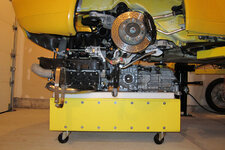
i-g5N69Jj-L.jpg

Fully out...:beer:
i-SSHBC9c-L.jpg
 
To avoid these ads, REGISTER NOW!

N0tt0N

Well-known member
Joined
Sep 26, 2013
Messages
229
Location
DC
Alex, that's looks a little too clean! Well done. Do you need my address so you know where to ship the engine now? ;)
 
OP
I

In My Garage

Well-known member
Joined
Jul 28, 2011
Messages
315
Location
ON
Alex, that's looks a little too clean! Well done.

I only dropped it because there were these two specs of dirt atop the transmission I could not get to. ;)

Actually, I replaced the upper and lower valve cover seals, all 12 spark plugs and all exhaust gaskets and fasteners, the latter while I could still get them off after 14 years, the first winter I had it.

The second winter, I had the whole top of my engine out to clean the engine bay and all engine parts and to replace the spark plug cables and do a dual distributor rebuild.

With the engine out, I have a list of minor things that will get done...more easily: cam chain cover seals, power steering O-rings, seals and belt, SAI valve and SAI port flush, intake manifold seals and rubber tubes...anything with the slightest of corrosion on it...the works!
 

2CRUZ

Well-known member
Joined
Jul 25, 2011
Messages
526
Location
Southern Illinois
Hi fellas
I'm not very smart but my family has been in the concretre business for the last 64yrs. all of my life. I have never seen a patch cut out and poured like that without the patch being anchord to the original slab in some way. Like I said I'm not very smart but I know if you leave any kind of weight on that patch for a legenth of time one side or the other is going to sink some. I wish you all the luck in the world but I would not want to be working under a heavy vehical knowing the base of the car lift was pourd like that.
Respectfully
 
OP
I

In My Garage

Well-known member
Joined
Jul 28, 2011
Messages
315
Location
ON
Like I said I'm not very smart but I know if you leave any kind of weight on that patch for a length of time one side or the other is going to sink some.

Well I'll report back when it does sink. One year later, if the concrete weren't different in color, you could not even make out the cut line. I wasn't going to trust a residential grade of 4" concrete slab and the supplied anchors.

As for any chance of it moving, there are no fore and aft moments to even bother with. There are moments inwards but that is the case with any 2-post lift.

I'm not very smart but my family has been in the concretre business for the last 64yrs. all of my life.

So tell me, do you know where Jimmy Hoffa is?
 

35chevy.com

Member
Joined
May 20, 2008
Messages
12
I'm no expert either but it doesn't look safe to me

If it does fail I doubt you will be in any condition to report back

Gary
 
OP
I

In My Garage

Well-known member
Joined
Jul 28, 2011
Messages
315
Location
ON
An update on the installation.

My 993 at just over 3000 pounds has been on my lift non-stop for over 8 months now with absolutely no hint of anything in the way of my MaxJax mounts shifting, lifting or tilting...or whatever.

So, what is taking so long? Well I am having fun doing what I enjoy doing, taking things to the extreme.

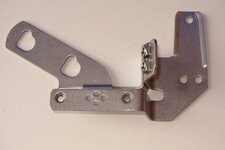
This is one of many yellow zinc brackets that I had re-plated.

Before and original...
Fresh%20Air%20Intake%20System%20Bracket%20-%201-L.jpg

After chemical stripping...looks like new...
Fresh%20Air%20Intake%20System%20Bracket%20-%203-L.jpg

After yellow zinc re-plating...
Fresh%20Air%20Intake%20System%20Bracket%20-%205-L.jpg
 

racerex

Well-known member
Joined
Dec 3, 2013
Messages
345
Location
NY
Hi fellas
I'm not very smart but my family has been in the concretre business for the last 64yrs. all of my life. I have never seen a patch cut out and poured like that without the patch being anchord to the original slab in some way. Like I said I'm not very smart but I know if you leave any kind of weight on that patch for a legenth of time one side or the other is going to sink some. I wish you all the luck in the world but I would not want to be working under a heavy vehical knowing the base of the car lift was pourd like that.
Respectfully

My buddy was over today and I asked him to read this thread and he said the same thing as others regarding pinning to the original slab. He's not an engineer, but he's third generation in the family concrete business. They only do heavy construction (i.e., commercial buildings, bridge supports, elevated road and rail decks, etc.....they just finished a multi-level parking lot and they're also working on a major NY bridge project).
 
OP
I

In My Garage

Well-known member
Joined
Jul 28, 2011
Messages
315
Location
ON
...he's third generation in the family concrete business...they're also working on a major NY bridge project.

Never mind the pinning. You tell him I want to know where Hoffa is.

And I'm not worried about my installation. I trust my work far more that someone in the business which is why I never hire anybody, and the few times I have, it was a total eff up.

Where exactly does he think this is going to go. Is it going to topple over?
 
Last edited:

racerex

Well-known member
Joined
Dec 3, 2013
Messages
345
Location
NY
Where exactly does he think this is going to go. Is it going to topple over?

He said the risk is forward and rear in an unbalanced situation. He did say the risk was very low, if you pay attention to balance. Maybe consider placing a pair of hi-rise jack stands at the front and rear of the car. Derek Weaver makes 2 ton hi-rise jack stands for just this application that extend from 48"-84"...and they're only $80/ea...a small price for added safety...just my $0.02.
 

Jvvmusme

Well-known member
Joined
Sep 25, 2011
Messages
566
Location
Bogota, Colombia
Is the engine of the 993 twin plugged ?

Is it original or one of those outlaw engines I wish I had in my 356 ?

I ve seen them in California in Willhoit, Benton performance and Rob Ida.

Regarding your slab its way better than any other I have seen and I even copied some ideas. I am sure it will not topple over...

Regarding Jimmy Hoffa he hoaxed his disappearance, worked in the concrete business for 35 years, doing slabs for 2 post lifts, and now he is living in Cuba with Elvis Presley and Marylin Monroe. He celebrated his 100 th birthday last year. He usually plays domino every thursday with Fidel Castro. His great great grandchildren are the fourth generation in the concrete business... They are designing a bridge from Key West to Cuba.
 
OP
I

In My Garage

Well-known member
Joined
Jul 28, 2011
Messages
315
Location
ON
He said the risk is forward and rear in an unbalanced situation. He did say the risk was very low, if you pay attention to balance.

My car is as unbalanced as they get and I am not the least bit concerned.

If I had "pinned" it into the so-called existing 4" concrete, it would be no stronger than the 1 foot of concrete that runs under the existing concrete (front and back) and with 8 pieces of rebar running along the same axis that is now part of the pour.

I'm sure if he did a worst case moment calculation in the fore/aft direction and that would be with the lift arms in the fully extended (44") and parked position (and who does that...you can't lift a car that way), with 1500 pounds per arm (the limit) at a maximum height of 45" and then looked at the mount and where it is located with respect to the concrete slab and the size/volume of concrete....well I don't need to get the calculator out.
 
OP
I

In My Garage

Well-known member
Joined
Jul 28, 2011
Messages
315
Location
ON
Is the engine of the 993 twin plugged ?

It is the original "twin plugged" 3.6 liter flat-six.

Regarding your slab its way better than any other I have seen and I even copied some ideas. I am sure it will not topple over...

I know it won't. ;)

Regarding Jimmy Hoffa he hoaxed his disappearance, worked in the concrete business for 35 years, doing slabs for 2 post lifts, and now he is living in Cuba with Elvis Presley and Marylin Monroe. He celebrated his 100 th birthday last year. He usually plays domino every thursday with Fidel Castro. His great great grandchildren are the fourth generation in the concrete business... They are designing a bridge from Key West to Cuba.

Now if they'd just build a highway from Panama to Colombia so that I can ride my motorcycle into South America without having to air or sea ship it.
 

Jvvmusme

Well-known member
Joined
Sep 25, 2011
Messages
566
Location
Bogota, Colombia
Now if they'd just build a highway from Panama to Colombia so that I can ride my motorcycle into South America without having to air or sea ship it.[/QUOTE]

In 1997 I rode an MG TD from Bogota to Cartagena, took a ferry from Cartagena to Panama and from there to Costa Rica.

I heard in the news that next year the ferry from Panama to Cartagena will resume its operation, therefor you will be able to ride your Motorcycle without having it to ship it by air or sea.....

What bike is it ....?
 
OP
I

In My Garage

Well-known member
Joined
Jul 28, 2011
Messages
315
Location
ON
I heard in the news that next year the ferry from Panama to Cartagena will resume its operation, therefor you will be able to ride your Motorcycle without having it to ship it by air or sea.....

What bike is it ....?

Do you have the name of the ferry service or a link to it?

Three BMW GSes (1986, 1990 and 2003) and a Kawasaki KLR650.
 

RecceDG

Member
Joined
Aug 8, 2014
Messages
16
I wound up having to do something very similar - my floor was 3"-3.5" thick - and I heavily referenced this thread.

My concrete guy was 84 years old (!) and had 60 years personal experience with concrete. He was quite the character....

I cut my slab 12' x 4'. I went a foot wider to provide a wider base to help resist fore/aft tipping.

We discussed doweling the slab, but my concrete guy was concerned that the old slab was too thin to do that. So instead, we pounded 1/2" rebar 8" under the old slab on all sides.

Slab was poured 9.5" thick +/- 0.5". I kept the slides of the hole vertical with a little under-keying.

I'm just waiting on the slab to cure before drilling for anchors.

His opinion was that it was WAY overkill for the job.

DG
 

Denwood

Well-known member
Joined
Sep 22, 2014
Messages
4,183
Location
Thunder Bay, Ontario, Canada
I just gave up on my MaxJax install (for now) after discovering a lot of rebar, but in a slab only 3" thick. Alex, thanks for much for posting your solution, as I believe it resulted in some very good information being provided, particularly by wssix99.

We do a lot of finite analysis, usually with Solidworks, in the cinema jib/crane field, as well as stress analysis on everything we manufacture these days to minimize weight and maximize rigidity with our products. I also run an Alaris 30 3D prototyper, but for many of our products, printed prototypes would not be appropriate...so back to finite.

I just finished a roof restructure (8ft raised to 10ft for the MaxJax) but under advise of our architect, and engineered beams spec'd and provided by a local truss manufacturer. The link is in my signature. We have very high snow loads here..so I wasn't going to guess.

One of our close family friends is heading over tomorrow am for breakfast and a consult on my slab issue. Bob is a quality assurance engineer who primarily works bridges, a good gig right now as virtually every major bridge in NW Ontario is being replaced over the next few years. I'll report back once I've had an engineer work something out.

wssix99 is entirely correct in that concrete alone has pretty crappy tensile strength, and in typical construction most of the tensile strength is coming from rebar. We work with a carbon supplier who also does a lot of bridge work..so evidently composites are being used more as well. Once you cut the rebar, there is no longer any strength in tension. If you were to expose rebar at the edges of a cut, and weld to it, then you would "restore" the tensile strength lost in a footing cut. Epoxying rebar in to the cut area would work, but in a 3" slab, you are likely not tying into much. In Alex's case, if we were to run a finite analysis to failure, we'd likely see the new rebar under the old slab simply pulled back by the tilting new slab, and the underpinned edge would break off/deform. This underpinned edge however has rebar reinforcing (albeit it's cut) but in order for the edge to break, the concrete would have to be broken away from the old rebar...or the old rebar would have to stretch. That's ignoring the new slab weight, which in Recce's case above would calculate to around 4700 lbs. If we figure a completely unsecured pad at that weight(just sitting on the ground)...we need about 2350 lbs working upward at the slab edge just to tilt the slab up..and that's assuming it was rotating on a fulcrum..which it isn't. Assuming a lever distance of 7 ft from the jack column, we're talking 671 lbs. In other words, if you balanced a car on Recce's slab on the hoist, you would have to hang a weight at the front bumper of at least 671lbs, to overcome the mass of half of his slab. Because the slab is not rotating at the center point, we'd likely need closer to 900lbs of imbalance. Feel free to check my math!

Alex, you're still here, so apparently your solution has a fail point beyond would you've loaded so far static. Ha. Once you take drop the engine out, and start leaning on a few stubborn bolts, (rocking the car) some dynamic loading would occur, which is why the safety margin on lift design is there. My opinion is that we should all be using lift jack stands regardless, which would take your risk level to zero. With the mass of your slab, and the potential edge/underpin break strength of your old slab, my guess is that you're quite safe. Even with a 1000 lb imbalance, each tower would be resisting 500lbs static. Now imagine how much force it would take to first tilt your slab to overcome its mass, then break out the underpin edge, with it's embedded rebar, and deform your under-driven (but not anchored rebar) to failure...

Because my shop is old, and I have no idea of existing slab reinforcement, my assumption is that Bob (engineer) will direct me to a pier type solution which would essentially ignore the existing slab. My prediction...something like 3 to 4 feet down with a 16" reinforced column, tied to a 3'x3' cap, 8" thick...we'll see how close I am, ha. The soil here is old/fluvial so well drained gravel, large granite boulders..very stable. Zero earthquake risk. Having read the comments here running hydraulics sub-slab, it would make sense to drop some conduit between as well. I'll post back with the result. Again, thanks Alex for the detailed pics and excellent discussion.
 
Last edited:
OP
I

In My Garage

Well-known member
Joined
Jul 28, 2011
Messages
315
Location
ON
concrete alone has pretty crappy tensile strength, and in typical construction most of the tensile strength is coming from rebar.

Exactly, which is why rebar is placed at specific locations.

When I was a kid, I used to drag these 6" x 18" (I think) columns out of the adjacent field. I don't know how they got there or what they were, but they made great supports under the car before I could buy some jack stands. I started doing full servicing when I was 13 which is why I did not have the money for jack stands.

I later found out those columns were concrete test samples.
 
To avoid these ads, REGISTER NOW!

Denwood

Well-known member
Joined
Sep 22, 2014
Messages
4,183
Location
Thunder Bay, Ontario, Canada
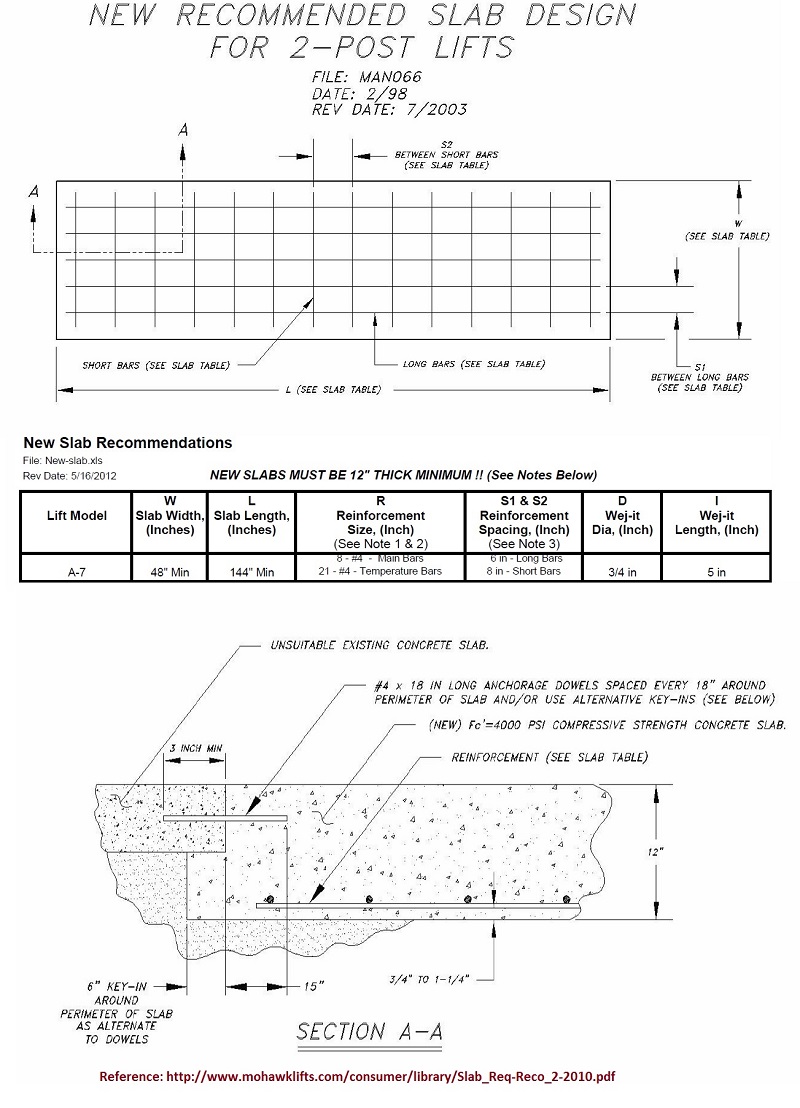
It looks like page 5 of this mohawk pdf describes a typical basic scenario:

http://www.mohawklifts.com/consumer/library/Slab_Req-Reco_2-2010.pdf

The Mohawk A7 is a 7000lb asymetric lift. They're spec'ing bonded anchorage dowels every 18" inches into the existing slab with 3" insertion OR, a 6" key in under existing..and a continuous slab of no less than 12" thick, 48" x 144". So Alex, not so far off, given the MaxJax is not asymetric, has 2ft less lift, and is rated at 6000 lbs. To be honest, I suspect your solution is very close to what the recommended slab spec for the MaxJax would look like, just flying off the A7 spec.
 
Last edited:
OP
I

In My Garage

Well-known member
Joined
Jul 28, 2011
Messages
315
Location
ON
The Mohawk A7 is a 7000lb asymetric lift.

I was looking at one of those. The phone call and price was all it took to decide otherwise.

Besides, I have $4800 in my MaxJax lift and installation. That is all inclusive including new fittings, any extras and taxes.
 

Denwood

Well-known member
Joined
Sep 22, 2014
Messages
4,183
Location
Thunder Bay, Ontario, Canada
I hear you. My cost just went up due to the slab requirements. Add in a raised roof, $700, spray foam ceiling, $1600, drywall $800, the MaxJax itself at $2000, roll up insulated door with remote at $2400 and the hoist isn't even running yet at $8500. ha.
I will have very high quality male bonding with the "back lane crew" next summer though :) The roll up door frees up 64 sq ft over the internal hangar doors I have now, but more importantly keeps the door open with hoist in use.
 
OP
I

In My Garage

Well-known member
Joined
Jul 28, 2011
Messages
315
Location
ON
...and the hoist isn't even running yet at $8500.

I was going to install a Mr Heater and A/C in my garage till someone pointed me to a heat pump, something like a LG unit with a thin wall mounted indoor unit. No vent holes to drill or gas hook-up, etc and a simpler installation.

Add another couple of grand but old age deserves it. ;)
 

Denwood

Well-known member
Joined
Sep 22, 2014
Messages
4,183
Location
Thunder Bay, Ontario, Canada
So after a very long discussion on loads, tension, soil bearing and the lot, a pier based solution would work just fine, but we'd need to run numbers on the moments vs soil and depth. In other words, easier to just use the Mohawk spec, modified a bit. So pretty much the same as Alex here on the 993 install.

For reference, here's a summary of what the Mohawk A7 (7000lbs asym) requirements are, for a retrofit slab. If you already have 4 1/2 inches of reinforced slab, you don't need this. According to Mohawk, if you have a 6" key in under the existing slab, there is no need for anchor dowels, or any rebar tie in to the old slab.

mohawk_slab.jpg
 
Last edited:

wssix99

Well-known member
Joined
Mar 2, 2011
Messages
5,156
Location
Chicago, IL
in typical construction most of the tensile strength is coming from rebar.

If your slab is a slab on-grade, that rebar is most likely to control shrinkage cracking. Some slabs have rebar for bending resistance, but those are typically commercial slabs under very heavy loads. I expect you have a grid pattern of #4 every 8"-16" OC, which would be typical of shrinkage reinforcement.


Once you cut the rebar, there is no longer any strength in tension. If you were to expose rebar at the edges of a cut, and weld to it, then you would "restore" the tensile strength lost in a footing cut. Epoxying rebar in to the cut area would work, but in a 3" slab, you are likely not tying into much.

As you cut your slab, that rebar is still stressed and doing its job to control the physical shape of the slab. The thing you have to worry about, is re-entrant corner cracking. When you cut the hole, additional shrinkage stresses will be concentrated at the four corners of the hole and you could get some diagonal cracks (small) radiating outward from those corners, but hopefully the rebar in the current slab is enough to keep that at bay.


Because my shop is old, and I have no idea of existing slab reinforcement

As long as you don't have cracking, its "good enough" and doing what its supposed to. The aim of pinning the new pad to the old floor (instead of keying the pad to the floor) wouldn't be to tie in to the existing reinforcement, but to provide shear pins to connect the two pieces together.
 

BITRBO

Member
Joined
Dec 9, 2014
Messages
6
Hi Folks,

Newbie here, but I've been stalking the forum for awhile now researching a 2-post lift. Great site! I'll save all the details as to not clutter OP's thread, but even though I also have 8ft ceilings in my garage, I finally went with a Triumph C-7000 over the MaxJax, since I get more lift height and capacity for the money. I was stuck on the principle ; )

Anyway, my lift just arrived last week so I have been studying the post locations, spacing, etc. while trying to decide upon final location. I haven't drilled my slab to determine thickness yet, but I suspect it's 3-3-1/2" like most, so I've been preparing myself for foundation improvements. Hence how I stumbled across this thread... After reviewing OP's build, I too had some concerns as I'm an engineer by profession (dabble in structural and foundations), and I can tell wssix99 and Denwood obviously appear be engineers as well (we know our own kind).

My first thought was the OP's slab was built in the wrong direction, and there should actually be (2) strips beneath either post (i.e. running parallel to the car or length of the load). OP there really isn't that much moment acting inwards towards the car (unless your lifting only one side, as in a motorcycle), as the lift posts/columns are basically restrained/supported in this direction by the arms of the lift and frame of the car. wssix99 is right in that the majority of [potential] movement is fore and aft, which therefore cause moments at the base of the columns and a rotation in the slab in the same direction. This can be exacerbated as Denwood pointed out when the load is shifted front or rear or there is a force acting in one direction or the other. OP you did a nice job of centering the lift on the CG of the car, however, that all went out the window right when you dropped the engine ; )

I also agree with wssix99 that unless the rebar you have extend under the existing slab is encased in concrete (by a sufficient amount), and is not just resting against/under the existing slab, it's not really doing much. If anything the rebar will just bend should any sort of overloading and rotation occur, whereas it would be MUCH more effective inside concrete where it will be forced to STRETCH or SHEAR. Your underpinning "key" should also be squared off as wssix suggested, since the concrete will generally crack/break at the upper, inside corner of the key and shear at a 45* angle downward. This is also happens to be the edges of your slab, which you also want to have square, as a beveled edge reduces the stability of a footer and facilitates overturning. I don't necessarily agree with all the concrete guys on here about the dowels, as you don't ALWAYS have to tie into an existing slab, cause if the slab isn't of a sufficient thickness, the dowels will just break out under load. You also have to consider differential settlement and load trasfer, which will crack an existing slab if [again] it isn't thick enough or has sufficient reinforcing.

I quickly reviewed the slab design from Mohawk and found it peculiar that they recommended a similar approach as OP, but I suspect (without running the numbers myself) that there must be enough concrete "mass" and bearing footprint in between the lift posts/columns to effectively mimic a dual-slab configuration as I suggested above. However, you will notice that they recommended underpinning/keying PLUS doweling into the existing slab, so all of this was taken into account. As Denwood mentioned you're probably going to be fine with the slab as-installed, but it wasn't the most efficient configuration IMO and you did make a few little mistakes. Even though you haven't observed any settling, cracking, etc. yet, I would suggest you buy a pair of high-reach jack/transmission stands to provide extra stability at either end of the car and limit fore & aft moment. That is really the only major weak point IMO.

Lastly, it's very good that you understand gawling and associated issues with stainless, but hope you also realize it doesn't have nearly the strength of A36 steel or higher grades. I wouldn't have chosen that myself for the base plate or anchor inserts and I caution you (an others) when using it for high-strength applications such as this. I also would've have made the dowels smooth, as a threaded rod or deformed bar has much better adherence properties with concrete than smooth bar (i.e. pull-out capacity). Again, it's probably fine but just wanted to mention that for anyone else referencing this thread.

Otherwise, nice job on all the work and I love your 993... I have it's backwards cousin that I will be supporting on my lift very soon (ALSO a very unbalanced load):

250215.jpg
 
OP
I

In My Garage

Well-known member
Joined
Jul 28, 2011
Messages
315
Location
ON
My first thought was the OP's slab was built in the wrong direction, and there should actually be (2) strips beneath either post (i.e. running parallel to the car or length of the load). OP there really isn't that much moment acting inwards towards the car (unless your lifting only one side, as in a motorcycle)...

Oh boy, time for you to go back to engineering school. Check out the manufacturer's calculations on the anchors. If there were no inward moments, they could have placed the 3 mounting bolts on the inside of the plate.

The fact that the ends of the columns tilt inwards from no load (car parked on the garage floor) to lifted fully tells you there are inward moments. I also tilted my columns outward slightly so that at mid-point, they are parallel and at full extension they are equally inward from the no-load position. Hell, I do not even have to see that to know that was going to happen.

Funny though and no surprise, there is no tilt fore and aft. Also the car was positioned accordingly based on the engine out, not that it makes a difference worth talking about or even losing sleep about.

By the way, here are MaxJax's inward moment calculations.
 
Last edited:

BITRBO

Member
Joined
Dec 9, 2014
Messages
6
Oh boy, time for you to go back to engineering school. Check out the manufacturer's calculations on the anchors. If there were no inward moments, they could have placed the 3 mounting bolts on the inside of the plate.

The fact that the ends of the columns tilt inwards from no load (car parked on the garage floor) to lifted fully tells you there are inward moments. I also tilted my columns outward slightly so that at mid-point, they are parallel and at full extension they are equally inward from the no-load position. Hell, I do not even have to see that to know that was going to happen.

Funny though and no surprise, there is no tilt fore and aft. Also the car was positioned accordingly based on the engine out, not that it makes a difference worth talking about or even losing sleep about.

What I meant was in comparison to the fore & aft moments. Of course there is an inward moment, but if you look at the amount of unsupported load cantilevered forward/rear of the CL of the post/column (where the engine sits BTW), as compared to the amount of supported load cantilevered inward, then the problem becomes more obvious.

But it sounds like you've got it all figured out so I'll excuse myself from the discussion.
 
OP
I

In My Garage

Well-known member
Joined
Jul 28, 2011
Messages
315
Location
ON
What I meant was in comparison to the fore & aft moments. Of course there is an inward moment, but if you look at the amount of unsupported load cantilevered forward/rear of the CL of the post/column (where the engine sits BTW), as compared to the amount of supported load cantilevered inward, then the problem becomes more obvious.

The car is not a load bearing part of the structure. If I had a full-sized two post lift, I'd want a solid beam across the top connected to the vertical columns which would decrease the need for stronger anchors for the base plate.

The only way that there would be zero moment on any column is for the car's C of G to be placed atop of it.

As for the base taking a fore or aft moment, only if the car is placed off balance and moving it off 6 inches would have less of a moment than the inward moment.

Anyways, this thread isn't about a load analysis but of "placement" in a commonly sized garage for this particular car. In another month, my car will have been on the lift a whole year and the installation hasn't moved an iota. I highly doubt it ever will. :thumbup:
 

willtel

Member
Joined
Jul 27, 2009
Messages
15
Location
Atlanta GA
So, what is taking so long? Well I am having fun doing what I enjoy doing, taking things to the extreme.

This is one of many yellow zinc brackets that I had re-plated.

Before and original...
Fresh%20Air%20Intake%20System%20Bracket%20-%201-L.jpg


After chemical stripping...looks like new...
Fresh%20Air%20Intake%20System%20Bracket%20-%203-L.jpg


After yellow zinc re-plating...
Fresh%20Air%20Intake%20System%20Bracket%20-%205-L.jpg

Can you tell me what you used to strip the zinc plating off that bracket? I have some 930 parts I need to un-zinc.
 
OP
I

In My Garage

Well-known member
Joined
Jul 28, 2011
Messages
315
Location
ON
Can you tell me what you used to strip the zinc plating off that bracket? I have some 930 parts I need to un-zinc.

Muriatic acid, the acid used to etch and clean concrete. I use it straight and agitate/brush the parts with a 1" pure bristle brush.

It sometimes takes more than a few minutes with the yellow zinc layer washing away quickly and then sometimes a medium grey layer under it that I need to wash away to get to the bare metal. Rinse and thoroughly dry each part immediately and then place in a zip-lock bag with as much of the air pressed out of it...to prevent flash rusting.

WARNING: do not perform this in an enclosed area or indoors due to the gases given off. Use a professional mask with organic vapor filters and wear enclosed eye, hand (rubber gloves for acid) and clothes protection. Have running water available. I also stand upwind if there is any.
 

Denwood

Well-known member
Joined
Sep 22, 2014
Messages
4,183
Location
Thunder Bay, Ontario, Canada
It's interesting to note that maxjax only recommends a 3x3 slab, 12" thick for a retro footing. Alex is well beyond that. Also, the Mohawk document lists the 6" key under as an alternate to doweling (check the diagram I posted). I also did some rough calculations with regard to simple mass vs a localized moment. Remember the slab is 6000lbs or so all by itself :)

The parts look like new Alex. Nice.
 

RecceDG

Member
Joined
Aug 8, 2014
Messages
16
An update a year later. My slab hasn't moved, heaved, cracked, twisted, tilted, pivoted, or in any way misbehaved, even with 3800 lbs of Dodge Stealth on it.

For a little while, the Wedj-it anchors would lose torque (ie, when I'd check torques, 1 or 2 bolts per column would need about a flat to re-torque) but now when I check they are all at proper torques.

I wound up drilling an extra set of safety bar holes at the "wheels just clear of ground" height, and I put a pair of BMX bike grips on the safety bars to provide a better grip/depth stop. Other than that, it's still stock.
 

Trey T

Well-known member
Joined
Aug 3, 2011
Messages
3,749
Location
Houston, TX
It's interesting to note that maxjax only recommends a 3x3 slab, 12" thick for a retro footing. Alex is well beyond that. Also, the Mohawk document lists the 6" key under as an alternate to doweling (check the diagram I posted). I also did some rough calculations with regard to simple mass vs a localized moment. Remember the slab is 6000lbs or so all by itself :)

The parts look like new Alex. Nice.
Which Mohawk lift that's equivalent to the MaxJax?
 

Falcon67

Well-known member
Joined
Jun 11, 2009
Messages
18,371
Location
Merkel, TX
AFAIK, from their web site - they don't offer anything close to the MaxJax. There are several "low ceiling" floor plate two posts with posts in the 9' 3" range.
 

Denwood

Well-known member
Joined
Sep 22, 2014
Messages
4,183
Location
Thunder Bay, Ontario, Canada
The Mohawk lift I referenced is a 7000lb, full height asymmetric. To use that spec for the Maxjax lift would give a very high safety margin as the MaxJax is only lifting 48"...so torque angles are much less. After a very cold winter (February was -20C average) with shop temps frequently below zero, followed by heat cycles, there are zero cracks in my retro slab, and the epoxy anchors have been 100%. I torque them to 70ft/lbs.

I posted the spec here to reinforce the fact that Alex's slab spec had a very high safety margin...well beyond what Danmar recommends for the MaxJax. I decided to error on the side of safety as well with a 4'x12' slab at 14" thick, with a 6" undercut.
 
Last edited:

carreradt

Member
Joined
Mar 27, 2010
Messages
24
Great Post and Install Alex. Nice 993 as well. Do you remove one of the posts at times or do you leave in place? I'm looking at the MaxJax and like its portability and plan to leave one post installed near a wall and the other stored near it until I need it. I do have a question about your attachment point on the floor. Those m16 bolts in post #6 are removed, the post rolled in place and the correct bolts are then installed, correct?
 
OP
I

In My Garage

Well-known member
Joined
Jul 28, 2011
Messages
315
Location
ON
Uh Oh! No more "In My Garage" posts since Feb 15. Yikes!!

No worries (I just got back from the Gold Coast); I just can't think of anything to add. Plus I usually get Private Messages regarding my installation.

As my engineer coworker put it where I used to work before taking early retirement, "this installation will withstand WW III".
 
To avoid these ads, REGISTER NOW!
Top Bottom