To avoid these ads, REGISTER NOW!

MaxJax - unusual problem with dedicated foundation

PatL

Active member
Joined
Sep 25, 2011
Messages
27
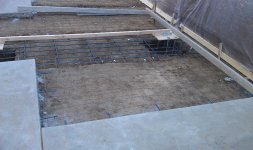
I have a very unexpected and disappointing problem with a dedicated foundation I just poured for my MaxJax. After I determined that my garage floor was too thin for the recommended anchoring system for my MaxJax, I decided to design and pour a dedicated foundation next to my garage outside.

The "grade beam" consists of 12" j-bolts with grade 5 coupling nuts threaded in 1/2" and then welded to the top of the j-bolt to create the female 5/8-11 threads in the concrete. The concrete is 18" deep for a 2' x 2' area around the j bolts. The concrete between the bolt pads is 9" deep and 4' wide with 1/2" rebar cage in it. Ths "grade beam" is 12' x 4' x 9" deep and is tied into the surrounding 6" larger concrete areas.

Here's the problem. I poured the 3,000 psi concrete and let it cure 40 days. I was excited to bolt down the MaxJax units for the 1st time and when I was starting to develop some reasonable torque (probably at around 60 ft-lbs), several of the j-bolt inserts pulled up to the bottom of the metal pad on the MAxJax. I had them set 0.060" below the surface of the concrete so I could install special protective washer/bolt set up to keep the concrete surface flat and holes clean and dry whe the MaxJax was stored and not in use.

There is no way these bolts should be pulling out and the torque loads cannot stretch the j-bolts enough to cause this according to stress calculations I did.

Anyone have any ideas what is causing the bolts to move/stretch?

MaxJax Concrete work 07.jpg
MaxJax Concrete work 12.jpg
MaxJax Concrete work 02.jpg
 
Last edited:
To avoid these ads, REGISTER NOW!

pmiranda

Well-known member
Joined
Jul 15, 2008
Messages
1,504
Location
Austin, TX
My guess is there was a bit of an air pocket in the cement that they're able to move within, although I wouldn't expect all of them to move in the same way if that were the case.
 

OccupantRJ

Well-known member
Joined
May 15, 2009
Messages
10,966
Location
Eastern North Carolina
Looks like your preparation was proper, so I am not sure what is going on, unless the thread tolerance between the rod and coupler was sloppy. However, you could use a counterbore machining tool to cut the couplers below surface again, then bolt the unit down to see if there is further upward movement afterwards.
 
OP
P

PatL

Active member
Joined
Sep 25, 2011
Messages
27
Yeh, I am perplexed. The coupler nut to j-bolt thread was a very nice fit and I welded them all the way around so I doubt that is the problem interface. I will probably put a spacer above the insert for clearance, torque the bolts to the required 90 ft-lbs and see how far they come up. If they don't come up too much, I had the same idea to mill down the coupler nut to clear the plate. It is interesting that I can easily smack the inserts back down to the original position (0.060" under the surface) so it seems that the j-bolt is pulling up through the concrete.(should not be possible)

If they come up too much, I am questioning the concrete itself. If the concrete seems good, another option will be to completely mill/drill out the insert and epoxy in some inserts. Thios is what I qwas trying to avoid in the 1st place.

Frustrating!
 

c4cruiser

Well-known member
Joined
Oct 8, 2012
Messages
359
Location
Lacey WA
Just out of curiosity, where does it say that the attaching bolts are to be torqued to 90 ft-lbs?? The install manual that came with my unit (shown as Revision D 4-13-2012) does not specify any torque figures, just "tighten all 5/8 x 2" anchor bolts tight to the base plate.

This manual in pdf format from Northen Tool (Revision C 2-2012) has the same sentence except it goes on to say to turn the bolts 3 to 3 3/4 turns :willy_nil No way will you get that number of turns; even torquing to 90 ft-lbs will allow a torque wrench to turn much more than 1 full turn.
For my install using WejIt epoxy anchors, I snugged the bolts down and then turned them about 1/2-3/4 turn.
 
OP
P

PatL

Active member
Joined
Sep 25, 2011
Messages
27
My instructions said the same thing as yours. When I was doing the install in my garage a year ago and had problems with the inserts. In fact I had the same problem you did on some of the inserts....there was no way to get 3 turns . I called customer service at GES and talked with a guy named Gabe (seemed very helpful) and I believe he recommended that value. it is consistent with the required pre load on a 5/8 bolt/rod also. I have seen some numbers on the forum but I wouldn't swear to exactly where.

Probably best if you call customer service so I don't accidently mis lead you.

Pat
 
OP
P

PatL

Active member
Joined
Sep 25, 2011
Messages
27
I just found a hand written note I had that says 80 ft lbs from the forums and from their discussions with Danmar.
 

readhead

Well-known member
Joined
Dec 8, 2012
Messages
6,175
Location
Durango, Co.
I have seen j bolts pull right out of the concrete and be perfectly straight. On most of the structural jobs lately the EOR specs grade 50 minimum for J bolts but we are mostly seeing grade 50 anchor rods with two nuts and a large square washer to overcome uplift. 3k concrete isn't very tough when you start pulling on it. It sounds like you were on the right track but when we have built threaded embeds we usually weld a cage of weldable rebar to the anchor rods to reinforce the assembly and to give the form setters something to tie to since they don't want a template in the way when they are finishing.
As to how to fix it now? I would use a spacer and a bolt and crank on them and see just how far they move. If that turns out to be excessive then you might be talking jackhammer time. Just a side note. We recently did a bridge and one of the piers took 78 days to come up to strength but it finally got there. You mix could have been to wet or had to much air.
 
Last edited:

brownbagg

Well-known member
Joined
Mar 20, 2006
Messages
5,208
i dont think they all pull out. maybe compacting the concrete a little around the bolts, if you worry get someone to do a pull test on the bolts, but there really not much force on the bolt from the lift, the force is down, the bolt just keep the columns from moving.
 

readhead

Well-known member
Joined
Dec 8, 2012
Messages
6,175
Location
Durango, Co.
The post is a lever. It depends on the concrete to keep it from tipping over.
The outside bolts have tension on them. Actually they all do to some degree.
 
OP
P

PatL

Active member
Joined
Sep 25, 2011
Messages
27
Thanks redhead. I will let it set for another month or so and try to pull them out with 80 ft-lbs of torque. I am guessing they will come out. Can't believe I went this far and didn't quite get it right.

Any suggestions as to how much excavation I need to do on what I have? Can you tell from my description and pics what I did?

Thanks,
Pat
 

readhead

Well-known member
Joined
Dec 8, 2012
Messages
6,175
Location
Durango, Co.
I wasn't sure from your original post if you were going to leave the posts up all the time. If that is the case why not epoxy some threaded rod into the footing and bolt down the posts.
 
OP
P

PatL

Active member
Joined
Sep 25, 2011
Messages
27
I plan to take the posts down between uses because the space is used for other things.
 

olytdi

Well-known member
Joined
Dec 3, 2011
Messages
2,202
Location
Olympia, Washington
This is indeed perplexing. 80 lbs is the torque. You have nothing to lose now by simply smoking them down and seeing to what extent you have this problem with other bolts.

By your description, these by definition should be fixed without movement.
 
OP
P

PatL

Active member
Joined
Sep 25, 2011
Messages
27
Rather than having the bolts stick up (male threads) I suppose I could follow your suggestion and fabricate some threaded rod with coupling nuts on the ends (to create female threads) and epoxy them in the same manner as you suggested.

Do you see a problem with doing that? I am surprised that the epoxy system works betyter than a j-bolt with a big hook on the end.
 

readhead

Well-known member
Joined
Dec 8, 2012
Messages
6,175
Location
Durango, Co.
That is a good idea. Drill a larger hole to clear the nut then a smaller hole for the rod. I don't see why that wouldn't work.
Did you use form oil? If you did it should only be sprayed on the wood.
 
Last edited:

wssix99

Well-known member
Joined
Mar 2, 2011
Messages
5,156
Location
Chicago, IL
I had them set 0.060" below the surface of the concrete

So, you had the sleeve just 1/16" below the concrete? For a 12" rod to stretch 1/16", that's only .005% elongation which doesn't sound like a lot to me.

What numbers did you use for your elongation calculations?

Do you think that the friction of the bolts against the concrete could be holding them in a stretched position, with the whack being enough to free them to snap back in place? (I would think it unlikely for air bubbles to strike in multiple places and if they did, they should feel loose if you put a bolt in them and tugged on it by hand.)
 

dbabicky

Well-known member
Joined
Dec 30, 2012
Messages
874
Location
NE Wisconsin
For strength I would have used 6 bag mix/4,000 PSI concrete with a 6-8% air entrainment and low slump in the 3-4“range.

Ditto, and use 5/8x8" bolts. Wouldn't have had any problems. Maybe even go with fiber also. I generally always poured full 6,straight cement,(no fly ash),with fiber, for most all slabs and such. (Retired now, owned my own concrete buis. for several yrs.)
 
To avoid these ads, REGISTER NOW!

TommyK

Well-known member
Joined
Mar 29, 2011
Messages
546
Location
CT
Torque all the bolts until they either fetch up or fail. I have a feeling it is either the anchor bolt thread or the coupler nut thread (or both) deforming.

If the embedded anchors can't be used the easiest fix is to move the lift location a little and drill and grout new anchor bolts.
 
OP
P

PatL

Active member
Joined
Sep 25, 2011
Messages
27
OK....today I went ahead and torqued on one of the anchor bolts to see how far it would come out. When I reached around 60 ft-lbs the anchor bolt rose steadily out of the hole for about 2.5 inches and then started to spin. I used a torque wrench so I could monitor the specific toraue and the highest it reached was just under 70 ft lbs. I pictured the "L" on the anchor straightening out as I pulled on it until it was no longer bent and then it rather easily came stratight out all the way. To my surprise, the bolt had failed in tensile. I also measured the "5/8-11" anchor bolt diameter where there was no thread and it measured 9/16" dia rather than 5/8" which isn;t helping the strength.

I believe anchor bolts are supposed to be 60,000 psi in tensile and I was well under that at 70 ft lbs. They are home depot anchor bolts so maybe the material properties are suspect.

I will pull out others to see if it they act the same way.

This puts to bed my concern that the concrete was bad. Now I will likely use the existing holes to epoxy in some "wedge it" inserts unless someone has a better recommendation. At least the hole drilling will be easy since I have a nice 9/16 pilot holes.

Suggestions on inserts and epoxy systems are welcome
 

readhead

Well-known member
Joined
Dec 8, 2012
Messages
6,175
Location
Durango, Co.
I still like the coupling welded to a threaded rod and epoxied in the holes. Good thing you found out now instead of when the car was up in the air.
 
OP
P

PatL

Active member
Joined
Sep 25, 2011
Messages
27
Sounds like you have some professional experience so I wanted to ak a question about epoxied inserts. How is this able to develop such a high strength as compared to just the concrete grabbing onto the threads? The anchor bolts had plenty of exposed threads for the concrete to grab and it sheared right off. Does the expoxy really bond to the concrete drill hole surface so well that the shear strength is high enough to sustain a load of 9,000 on the insert when torqued?

Do you recommend grade 5 all thread or would you go with a different set up?

Thanks
 

readhead

Well-known member
Joined
Dec 8, 2012
Messages
6,175
Location
Durango, Co.
I can't tell you the science but we use it all the time for anchoring columns and beams. Three things are important. The hole must be very clean. Brush and compressed air. The hole has to be the right size recommended by the epoxy manufacturer. Don't use hardware store all thread. Use grade 5 or A36 minimum all thread. I don't like Simpson epoxy. I prefer Redhead brand or Dayton.
 

skulldrinker

Well-known member
Joined
Dec 25, 2011
Messages
1,171
Location
Bolingbrook, IL
Ditto, and use 5/8x8" bolts. Wouldn't have had any problems. Maybe even go with fiber also. I generally always poured full 6,straight cement,(no fly ash),with fiber, for most all slabs and such. (Retired now, owned my own concrete buis. for several yrs.)

I drive a mixer and I deliver concrete all day long to every kind of job imaginable. No one and I mean no one uses 3000#. Joe Blow doing his patio that's only going to support his picnic table will order at a minimum 3500# psi which is 5 bag I think. So that makes 3000# equal to 4 bag mix. The only job I can think of that would use 3000# concrete would be coating a crawl space where strength is not an issue. Or filling in an underground oil tank that's not going to be used ever again.

Hell with what I have at my disposal I would go overboard on the mix just for the simple reason that I'm the one that's going to be working under the lift.

As for fibermesh I'm not a true believer in it. But having it at my immediate disposal (free) I did put in it my fence post footings. LOL I must have some strong fence posts!


PS no body orders by "bags" anymore so the match between 5 bag and 3500#psi is what I think I remember being correct.
 

Attachments

  • IMG_0099.jpg
    IMG_0099.jpg
    134.5 KB · Views: 38
  • IMG_0113.jpg
    IMG_0113.jpg
    146.3 KB · Views: 44
Last edited:
OP
P

PatL

Active member
Joined
Sep 25, 2011
Messages
27
I wish I had gotten better advice from the landscaper who was acting as the general on the job. He was going to use 2500 psi and I asked for stronger stuff and he recommended 3000. I should have done my homework.

I plan to epoxy 5/8-11 grade 5 all thread about 8" deep in 3/4" dia holes. The spacing on the holes are around 6" on the MaxJax base plate. With the redhead epoxy, (not sure whether to use A7, C6, or G5). Looks like the tension loads are somewhat limited and I don't see a way to torque of 80ft lbs on the MaxJax bolts as recommended because that would put around 9,000 lbs of tension into the all thread.

Any additional advice is welcome.
 

readhead

Well-known member
Joined
Dec 8, 2012
Messages
6,175
Location
Durango, Co.
I think this might be a case of questionable anchor bolts and marginal concrete. The owner had to depend on what was offered and got less than he deserved.
 

DonnyT

Well-known member
Joined
Dec 15, 2012
Messages
236
Location
Upstate
I believe you can order the epoxy and hardware from MaxJax. They are aware that guys where having problems and had a hardware kit for sale. Give them a call and ask for Gabe. This guy is very, very helpful.
 

skulldrinker

Well-known member
Joined
Dec 25, 2011
Messages
1,171
Location
Bolingbrook, IL
and what's all this talk about using "glue". Come on now you're going to be under a car beating and shaking an 8000# hunk of death above you. Cut the bad stuff out with a concrete saw and drill rebar into the sides of the slab and dig a hole 3 feet down and repour with some real concrete. Any less and you won't catch me under it. No such thing as overkill when it will be over my head.
 

skamp

Well-known member
Joined
Jul 20, 2007
Messages
644
Location
Cypress, TX
I wish I had gotten better advice from the landscaper who was acting as the general on the job. He was going to use 2500 psi and I asked for stronger stuff and he recommended 3000. I should have done my homework.

I plan to epoxy 5/8-11 grade 5 all thread about 8" deep in 3/4" dia holes. The spacing on the holes are around 6" on the MaxJax base plate. With the redhead epoxy, (not sure whether to use A7, C6, or G5). Looks like the tension loads are somewhat limited and I don't see a way to torque of 80ft lbs on the MaxJax bolts as recommended because that would put around 9,000 lbs of tension into the all thread.

Any additional advice is welcome.

Use this:

http://www.gesusa.com/Epoxy-Grip-Anchor-Bolt-Kit-p/100121.htm

Quite a few people have used this with the MaxJax and have had great results.

Steve
 

ishiboo

Well-known member
Joined
Oct 27, 2010
Messages
9,481
Location
Oshkosh, WI
Sounds like you have some professional experience so I wanted to ak a question about epoxied inserts. How is this able to develop such a high strength as compared to just the concrete grabbing onto the threads? The anchor bolts had plenty of exposed threads for the concrete to grab and it sheared right off. Does the expoxy really bond to the concrete drill hole surface so well that the shear strength is high enough to sustain a load of 9,000 on the insert when torqued?

Do you recommend grade 5 all thread or would you go with a different set up?

Thanks

Concrete does not grab well to smooth surfaces, and its strength is primarily in compression... it has very little "tension" strength alone. So, as you experienced, the smooth j-bolt was primarily held in by the small 90 degree portion, which easily straightened out. Rebar is ribbed for this reason, wire mesh has members perpendicular and welded together to hold everything in place.

Epoxy will do a better job creating a connection with allthread, and also conforms to the concrete and the pores to make a better connection. Wedge anchors may be a better option, but I'd see what MaxJax suggests given that you only used 3000psi.

I wish I had gotten better advice from the landscaper who was acting as the general on the job. He was going to use 2500 psi and I asked for stronger stuff and he recommended 3000. I should have done my homework.

I plan to epoxy 5/8-11 grade 5 all thread about 8" deep in 3/4" dia holes. The spacing on the holes are around 6" on the MaxJax base plate. With the redhead epoxy, (not sure whether to use A7, C6, or G5). Looks like the tension loads are somewhat limited and I don't see a way to torque of 80ft lbs on the MaxJax bolts as recommended because that would put around 9,000 lbs of tension into the all thread.

Any additional advice is welcome.

I think the landscaper provided the best advice from his experiences (landscaping), but that wouldn't be my first choice of a consultation and asking for a structural setup that my life depended on :)

In theory, a 2-post symmetric lift should have very little tension on those bolts. However, a car is front-heavy (unless rear-engined), and many lifts are asymmetric, so there is substantial force on the bolts. Let the pros tell you if this is recoverable or it's time to grab a sledge and start over with advice from a professional. (In that field! :))
 

c4cruiser

Well-known member
Joined
Oct 8, 2012
Messages
359
Location
Lacey WA
When I got my MaxJax lift, I fully expected to have my garage floor match what is listed on the plans: 3000psi mix with a minimum of 4" slab. My house is just over 20 years old and at the time I bought, I had never considered a lift.

What I found when I drilled the first hole was that the floor thickness at that point was just under 2.5":willy_nil Drilled another hole and found a 3" thick area. I knew at that point the existing floor was not going to work with the supplied Wej-It anchors.

So I got a local concrete company to come in and they cut out two 4'x4' sections of the floor. Sure enough, the pieces that came out were anywhere from 2" thick to 4" thick:mad:. They dug down 12" and poured a 6-sack mix and leveled the surface. They also used rebar to connect the old floor to the new pour. The new sections were located so that each post of the lift was centered on the new concrete.

Because the new sections were 12" deep, I decided to go with the Wej-It Epoxy anchors. I let the new concrete cure for something like 60 days. Drilling the holes was easy and I made sure the holes were vertical and very clean. My lift is now up and working and the bolts are torqued to 80 ft-lbs.

Both types of the Wej-It anchors (the wedge style included or the epoxy equivalent) require a 7/8" hole to be drilled. I would think that Dannmar has done their research and engineering to come up with a anchor size that far exceeds the strength requirements for their 6000 lb. load capacity of the MaxJax so going to a smaller diameter anchor doesn't sound like a good idea.

I had to buy a hammer-drill bit from Amazon as HD and Lowe's do not carry that size. Paid about $30 for it but worth the money.
 
OP
P

PatL

Active member
Joined
Sep 25, 2011
Messages
27
c4cruiser,

Quick question to see if your situation ios similar to my planned set up.

Do you know of the tops of the epoxied anchors are contacting the bottom of the base plate or if there is a gap? The reason I ask is if they are not contacting the plate, then the 80 ft lbs of torque is putting shear stress on the epoxy joint and the additional load when a car is liffted will add to the axial load on the system and therefore adds to the shear load on the epoxy/concrete interface. On the other hand, if the insert is contacting the base plate during torquing, then the 80 ft lbs is not loading the epoxy/concrete in shear until a car is lifted and the total shear in use will be much less.
 

c4cruiser

Well-known member
Joined
Oct 8, 2012
Messages
359
Location
Lacey WA
My anchors are about 1/16" down below the floor surface. The install instructions that came with my lift says to install the wedge anchors so that the top is 5/8" below the surface, then tighten the bolt to where the top of the anchor is approximately 1/8" below the surface of the floor. Nothing mentions that the anchors have to touch the lift base plates.

Here's the pdf install manual and the specific anchor instructions are on page 15.

The install instructions for using the Wej-It epoxy anchors that I used can be found here Go to pages 45 and 46 for the install instructions and specs. If you order these anchors, they cost around $175 for a set of 10 and it includes enough epoxy to install them.
 

wssix99

Well-known member
Joined
Mar 2, 2011
Messages
5,156
Location
Chicago, IL
I can't tell you the science but we use it all the time for anchoring columns and beams. Three things are important. The hole must be very clean. Brush and compressed air. The hole has to be the right size recommended by the epoxy manufacturer. Don't use hardware store all thread. Use grade 5 or A36 minimum all thread. I don't like Simpson epoxy. I prefer Redhead brand or Dayton.

Its also important that the epoxy is rated for the purpose. Some epoxies are very weak against pull-out forces - so you'll want to get a hold of the specs from the manufacturer.

I wish I had gotten better advice from the landscaper who was acting as the general on the job. He was going to use 2500 psi and I asked for stronger stuff and he recommended 3000. I should have done my homework.

This isn't necessarily a bad thing. "Stronger" concrete can crack more as it shrinks. It will still maintain its compressive strength, but (depending on the cracking) it could end up weaker against the critical bending forces that a 2 post lift imparts on the slab.
 
OP
P

PatL

Active member
Joined
Sep 25, 2011
Messages
27
Thanks for the feedback. It is very helpful to determine the path I will take to fix my screw up(s)
 

Kevin54

MEMBER EMERITUS
Joined
Jan 12, 2005
Messages
29,341
Location
Urbana, Ohio
Thanks for the feedback. It is very helpful to determine the path I will take to fix my screw up(s)

I wouldn't so much say you screwed up, but the first thought that come to my mind was the grade of the bolts. It was allowing them to straighten out from being soft. :dunno:

Have you tried tightening one all the way down to see if it will come completely out?
 
OP
P

PatL

Active member
Joined
Sep 25, 2011
Messages
27
yes. The first one I torqued to around 70 or 75 ft lbs and it tensiled at the bend (weakest point)
 
To avoid these ads, REGISTER NOW!
Top Bottom