To avoid these ads, REGISTER NOW!

Metal Air Compressor Plumbing

Ferrino

Well-known member
Joined
Mar 30, 2011
Messages
254
Location
San Diego, CA
I recently installed a 220v 60-gallon air compressor and have come to realize that, even in the relatively arid SoCal climate, I need better moisture control, especially if I am going to paint with HVLP. At the moment I simply have a 6-foot 1/2" rubber hose leading into a filter/regulator combo, and then onto a 50-foot retractable reel. I was thinking of putting in 20-30 feet of metal piping between the tank and the filter and have been considering either copper or black steel pipe. I prefer the look and lightweight nature of the copper, as well as not having to deal with threading if I want to customize it later. I have never soldered copper fittings before and although I have a decent understanding of what to do, I am concerned about safety and am wondering if there is any way to screw up the soldering process? I think the maximum pressure put out by my compressor is 155 PSI.

I was thinking of a layout like the following:
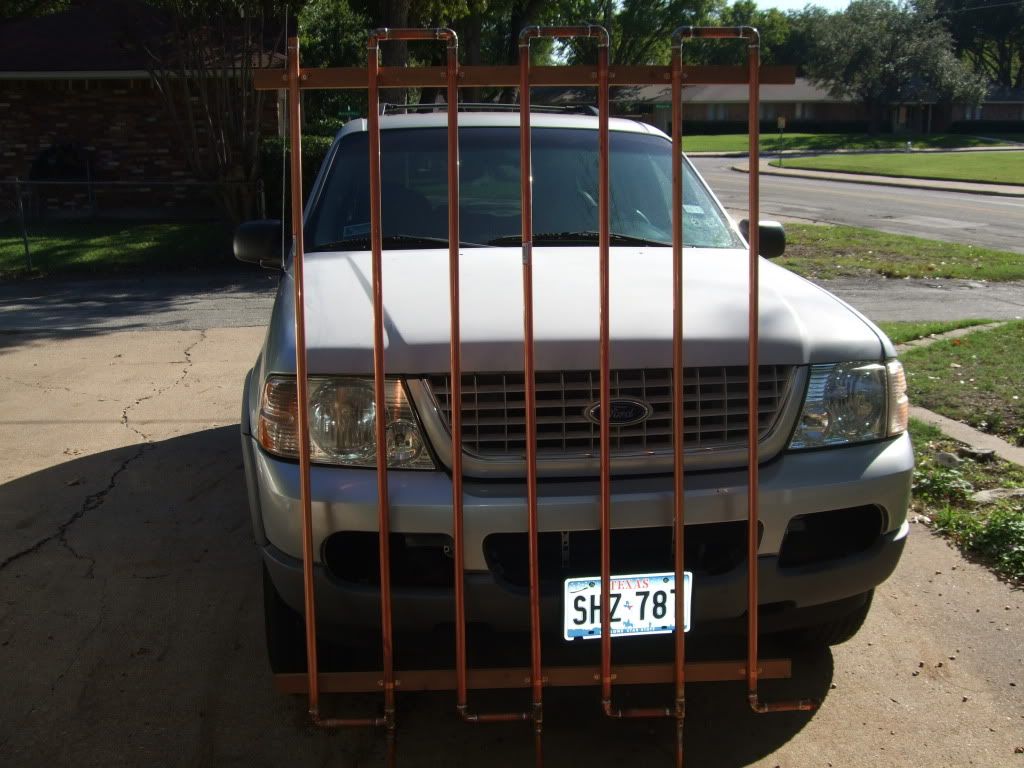

Many thanks.
 
To avoid these ads, REGISTER NOW!

Bondo

Well-known member
Joined
Dec 22, 2007
Messages
2,549
Location
Greenfield, Maine
Ayuh,.... That's alittle Excessive,....


Are ya keepin' the tank drained,..??

No loops or low spots in yer 6', 1/2" rubber hose, Right,..??
It's gotta be uphill, or down, to the tank, or the filter,.....
 

MacMcMacmac

Well-known member
Joined
Oct 21, 2014
Messages
1,583
Location
canada
You might want to check any fire codes for mention of copper air piping. Regular solder will melt in a fire situation and you will then have 60 gallons of compressed air feeding whatever may be burning. Probably a long shot, but insurance companies love a gotcha. We run lots of copper air pipe in our plant, but it's all brazed.
 

Cyberbear

Well-known member
Joined
Nov 23, 2013
Messages
1,524
Location
California
If moisture is the primary concern, then perhaps you should focus on employing a commercial grade filtration unit with easily changed filters, instead of creating a "plumber's nightmare" as a solution. Copper tubing/pipe is easily soldered, just put the flame where you want the solder to flow, only after proper cleaning and fluxing, of course. You may want to check the psi rating for the pipe you will be using. Put your money into a good filter and not the copper pipe. Just my thoughts.
 

CNGsaves

Well-known member
Joined
Sep 26, 2012
Messages
13,233
Location
KS and OK
OP . . . . sorry you're getting boondoggle replies above. :eyecrazy:

Search (using Advanced Search of GJ website above in black line) for FRANZINATOR as what you are planning is perfect solution for taking out moisture from compressed air.

Many GJer's have done similar zigzag pipe runs to capture moisture early from air compressor. Copper is easy to build this part. You could also combine your copper zigzag with long run of black pipe steel to also draw out any moisture.

Put your hose reel as far away from compressor as possible.

For spray painting or sand blasting, you'll still want air dryer like a desiccant canister with drying media (silica pellets).
 

sberry

Banned
Joined
Jun 18, 2005
Messages
35,747
Location
Brethren, Michigan
I have a Franz type unit and it collects a lot of water. As much or more than the comp. I still get a pinch down lines but it seems to clean up thru the right sized filter.
 

LS6 Tommy

Well-known member
Joined
Dec 27, 2013
Messages
26,162
Location
Northern NJ
Fire codes??? Doesnt rubber hose burn??

Exactly. So do all the composite systems like Rapidair. I know of no fire codes that restrict or forbid soldered copper compressed air lines. If you're really concerned, just don't leave your lines charged when the compressor is not in use.

Tommy
 
OP
F

Ferrino

Well-known member
Joined
Mar 30, 2011
Messages
254
Location
San Diego, CA
I have a ball-valve at my tank outlet, which I always turn on when not in use.

Regardless, I guess I should have reworded my post - I am convinced the piping arrangement shown above will work in my garage setup, I am more interested in thoughts on soldered copper pipes versus threaded black pipe, in terms of safety. It seems like, once the copper system is all soldered together, it can be pressure tested in isolation. How would you do that? Are there 1/2" plugs you can buy with some sort of valve/gauge for adding air pressure to see if there are any leaks? Thanks!
 

MacMcMacmac

Well-known member
Joined
Oct 21, 2014
Messages
1,583
Location
canada
There are different grades of copper pipe, and one specifically for high pressure gas, but I doubt anyone ever checks. The only failure of a copper pipe I've seen is where a pipe burst when someone shut off a valve between the compressor and the remote tank with the pressure switch on it. Almost cost a guy his arm.
 

jgorm

Well-known member
Joined
Jan 5, 2015
Messages
463
Location
San Diego
Fire codes??? Doesnt rubber hose burn??
Yup:lol: The other thing to think about is that if the fire is hot enough to melt solder, you're pretty much F'd anyway. I plan to run soldered copper for my airline. If you have extra ceiling height, then run it to the roof instead of the zig zag.
 

Nele

Well-known member
Joined
May 5, 2014
Messages
150
I'd add remote tank drain on the compressor, so you can easily drain it, water will collect there as well without sitting in the compressor tsnk
 

stokefire7

Well-known member
Joined
Oct 5, 2011
Messages
616
Burst pressure of 1/2" L hard drawn tubing with air at room temp is somewhere around 7000 psi.
 

stokefire7

Well-known member
Joined
Oct 5, 2011
Messages
616
Using 95-5 solder with service temps around 100, your'e looking at pressure ratings of about 1000 psi.
 

Bondo

Well-known member
Joined
Dec 22, 2007
Messages
2,549
Location
Greenfield, Maine
I have a ball-valve at my tank outlet, which I always turn on when not in use.

Regardless, I guess I should have reworded my post - I am convinced the piping arrangement shown above will work in my garage setup, I am more interested in thoughts on soldered copper pipes versus threaded black pipe, in terms of safety. It seems like, once the copper system is all soldered together, it can be pressure tested in isolation. How would you do that? Are there 1/2" plugs you can buy with some sort of valve/gauge for adding air pressure to see if there are any leaks? Thanks!

Ayuh,.... If that Monster in yer picture is 6' tall, yer lookin' at 'bout 46' or so feet of tubin',...

Rather than hangin' that Monster on yer wall,....

A single 50' coil of 1/2" or 3/4" or, 'ell even 1" soft copper is just abit over 2' diameter, as it comes outa the box,....
You could go from the tank's outlet, to the soft copper with a single fittin',...
either pipe to compression, or pipe to flare,....

Ya uncoil the roll from the tank's outlet up to where the majority of the coil can be hung on a rubber isolated bracket off the compressor/ belt guard/ whatever, so's the bulk of the coil lives in the air flow, comin' off the compressor's fan,....

The other end of the coil can be joined to the plumbin' of yer garage, again with a single fittin',....
Most likely, that point would be yer 1st, main air drier/ filter,....
so another pipe to flare, or pipe to compression fittin',.....

In doin' so, ya eliminate the rubber hose, 'cause 50' of soft copper hung loosely on rubber mounts takes care of any vibrations,...

The 50' of soft copper cools the air as good or better that the Monster above,....

The coolin' coil, lives in the coolin' air flow that's already there,....

There's No sweat joints,... just mechanical joints,...

'n so long as the loops run down, the tank, or air dryer should catch any water that happens,....
 
Last edited:

Techie1961

Well-known member
Joined
Feb 18, 2014
Messages
1,520
Location
Pickering Ontario Canada
This is what my father-in-law did for his compressor. The tubing is finned 1/2" copper tubing that is used for making custom coils.
16559523662_33e0f02145_c.jpg
 
OP
F

Ferrino

Well-known member
Joined
Mar 30, 2011
Messages
254
Location
San Diego, CA

CNGsaves

Well-known member
Joined
Sep 26, 2012
Messages
13,233
Location
KS and OK
Coil is a compromise as it will hold water if mounted vertically. If coil is horizontal and partially uncoiled so that water must eventually fall to bottom, then coil will work well.

Zig zag above is better design.
 
To avoid these ads, REGISTER NOW!

mark52621

Well-known member
Joined
Jun 13, 2010
Messages
116
Use Stay Brite to solder the copper together. It is a lead free silver solder that is relatively easy to work with.
 

akdiesel

Well-known member
Joined
Aug 8, 2008
Messages
2,617
Location
Wasilla, AK
CNGsaves said it right. You will need a disicant dryer if you have that much water to worry about. The air flow you will be generating while painting will carry the wet air down your lines to your HVLP. Some cooling will take place in the set up you have designed, but the HVLP tip will aid in cooling also and that is where you get water droplets in your paint due to JT effect.
There are better, less expensive ways of cooling the air also that do not take up all that wall space.
 

404

Well-known member
Joined
Aug 23, 2014
Messages
3,463
Location
Mass
Finned tubing and possibly a fan will be a more efficient use of materials and much better performance.. especially the fan.

If using any tubing without a fan be sure to install it horizontal not vertical.


Ideal would be a condenser (high pressure side) from a big AC unit with a fan.
 

bbrz

Active member
Joined
Jun 24, 2014
Messages
39
Location
E. Central IL
Why run the cooling vertical? And why use half or three quarter?
I have soldered thousands of joints and you can too.
Use 1" minimum copper with 5' lengths connected with a 90 and a street 90.
Tink the runs with a block, or something so that the moisture falls back to the tank. Doesn't take much fall, gravity is your friend.
Copper will cool far faster than iron piping. Only takes 25-30 feet to make a huge difference and no drains are required as long as you are above the compressor outlet.
Use the dryers at the hose connections, and also use the type M tube (thinner wall) faster cooling.
I plumbed a body shop 25 yrs. ago with this type of piping, and no failures to date, and clean air.
Insofar as the insurance debate, any one that leaves the air lines charged after use is a fool.
 

akdiesel

Well-known member
Joined
Aug 8, 2008
Messages
2,617
Location
Wasilla, AK
And they are....?

404 stated some good options. Also a knock out drum aka franzinator work well if they are plumbed correctly. Smaller intake pipe than the exit pipe to also create a JT effect.
I feel the best set up second to a desiccant system is to have finned tubing cooled by a fan then enter a knock out drum. And then to help prolong your main air tank have this set up fed straight from the compressor and then dump back into your main tank. Tank should last 20+ years but this could make it last longer.
Take a look at the water separators / traps sold for air systems. They are smaller than what I have mentioned but work the same way as the knock out drum.
 
Last edited:

jvitez

Well-known member
Joined
Nov 30, 2009
Messages
2,429
Location
Big Sky Country, Canada
Techie1961: your FIL must have worked in the nuclear industry: gorgeous, precise work! Is that John Deere colours on the compressor? Do all the drain lines drain down that vertical pipe in the bottom left, and drain through the floor?

404: why run non-finned pipe horizontally instead of vertically? Wouldn't Techie1961"s photo work even with non-finned pipe?
 

RickP

Well-known member
Joined
Jan 15, 2013
Messages
1,549
Location
Annapolis, MD
Regardless, I guess I should have reworded my post - I am convinced the piping arrangement shown above will work in my garage setup, I am more interested in thoughts on soldered copper pipes versus threaded black pipe, in terms of safety. It seems like, once the copper system is all soldered together, it can be pressure tested in isolation. How would you do that? Are there 1/2" plugs you can buy with some sort of valve/gauge for adding air pressure to see if there are any leaks? Thanks!

Both copper and black pipe will be very safe - the choice between them is really just personal preference: cost and ease of installation. You don't really need special fittings for a pressure test to find leaks - just a valve at each end will work. You'll hear the air hissing from any leaks, but you can also use soapy water on the joints to locate a slow leak. Sweating copper joints is pretty easy to learn, and it involves a lot fewer threaded connections compared to black pipe. The black pipe is a little more impact-resistant than the copper, but that's really more of a factor for main lines and branch lines. Copper will work great for what you're planning.
 

404

Well-known member
Joined
Aug 23, 2014
Messages
3,463
Location
Mass
Techie1961: your FIL must have worked in the nuclear industry: gorgeous, precise work! Is that John Deere colours on the compressor? Do all the drain lines drain down that vertical pipe in the bottom left, and drain through the floor?

404: why run non-finned pipe horizontally instead of vertically? Wouldn't Techie1961"s photo work even with non-finned pipe?


<style type="text/css">p { margin-bottom: 0.1in; line-height: 120%; }</style> Has to do with the heat transfer coefficient of the pipe. With finned tube the air needs to pass between the fins and with natural convection "heat rising" that does not happen easily if the fins are horizontal.

With bare pipe the heat rising off the lower part raises the air temp over the upper part so less heat is lost.

Hope that makes sense.
 

fluid power

Well-known member
Joined
May 14, 2006
Messages
47
The correct way to remove water from an air system is lower the dew point. The most efficient way to do this is a refrigerated air dryer. These start at about $600 and go up. The question is how much painting are you going to be doing? If you are making a living, than make the investment. If you want super clean, dry, oil free air make the investment. The proper layout would be compressor with timer drain, bulk water sep, filter, refrigeration dryer, coalescing filter, desiccant filter, after filter (to trap desiccant dust). This is probably over kill for the application, but is the correct way to achieve dry oil free air. If you are just a hobby guy, leaving out the dryer is understandable. While the plumbing will drop out the big water droplets, it won't remove vapor. Like others have pointed out, it will materialize when it exits the gun tip.
 

jvitez

Well-known member
Joined
Nov 30, 2009
Messages
2,429
Location
Big Sky Country, Canada
<style type="text/css">p { margin-bottom: 0.1in; line-height: 120%; }</style> Has to do with the heat transfer coefficient of the pipe. With finned tube the air needs to pass between the fins and with natural convection "heat rising" that does not happen easily if the fins are horizontal.

With bare pipe the heat rising off the lower part raises the air temp over the upper part so less heat is lost.

Hope that makes sense.

So horizontal is best in both cases.

Convection currents, got it. Thanks. :thumbup:

But I assume if you had a fan blowing on vertical piping it would obviate the advantage of a horizontal layout in heat dissipation, correct?

Now what about water drainage? With a vertical arrangement, gravity helps pull condensed water into the drain leg getting it out of the air stream, but with a horizontal arrangement wouldn't water remain in the piping longer with more chance of evaporating back into the air, as the liquid water has a longer distance to drain and less effective force because of the shallow slope of the horizontal pipe? Or this theoretical negative eliminated by the better convective cooling?
 
OP
F

Ferrino

Well-known member
Joined
Mar 30, 2011
Messages
254
Location
San Diego, CA
Thanks for all the suggestions. There's a lot of great theory behind these elaborate designs - how is their performance in controlling moisture being measured?
 

404

Well-known member
Joined
Aug 23, 2014
Messages
3,463
Location
Mass
Convection currents, got it. Thanks. :thumbup:

But I assume if you had a fan blowing on vertical piping it would obviate the advantage of a horizontal layout in heat dissipation, correct?

Now what about water drainage? With a vertical arrangement, gravity helps pull condensed water into the drain leg getting it out of the air stream, but with a horizontal arrangement wouldn't water remain in the piping longer with more chance of evaporating back into the air, as the liquid water has a longer distance to drain and less effective force because of the shallow slope of the horizontal pipe? Or this theoretical negative eliminated by the better convective cooling?

<style type="text/css">p { margin-bottom: 0.1in; line-height: 120%; }</style> With forced air the heat transfer can be 100 times higher and more. Natural convection is very weak over small distances. A nuke plant cooling tower gets to a scale where natural convection can be significant.. Also the weather and forest fires.

The air in the pipe is saturated with water vapor. Only the excess over 100 RH has dropped out. The water will just gurgle along with the air. My own pref would be to put the cooler between the compressor and the tank. The water will dump into the tank and can be drained. Must take care that the cooler will hold the tank pressure.
 

Techie1961

Well-known member
Joined
Feb 18, 2014
Messages
1,520
Location
Pickering Ontario Canada
Techie1961: your FIL must have worked in the nuclear industry: gorgeous, precise work! Is that John Deere colours on the compressor? Do all the drain lines drain down that vertical pipe in the bottom left, and drain through the floor?

He actually was in the military for a bit and then worked with Bell Canada. I have three John Deeres and since I gave him the stuff to do it, I guess he thought it was a nice colour to work with. I think he is fond of Deeres like I am. They do all drain through to the floor. He did a great job on all of the rebuild and work.

He is the one that introduced me to GJ and has been on here longer than me. Hopefully he sees all of the remarks on his great work. He is definitely a good FIL to have.:3gears:
 

jvitez

Well-known member
Joined
Nov 30, 2009
Messages
2,429
Location
Big Sky Country, Canada
<style type="text/css">p { margin-bottom: 0.1in; line-height: 120%; }</style> With forced air the heat transfer can be 100 times higher and more. Natural convection is very weak over small distances.......
The air in the pipe is saturated with water vapor. Only the excess over 100 RH has dropped out.

He actually was in the military for a bit and then worked with Bell Canada. I have three John Deeres.....He is the one that introduced me to GJ.......He is definitely a good FIL to have.:3gears:

Thanks 404. The science behind questions like these always makes things clear.

Techie1961: I thought with your address being Pickering and the quality of his work he must have been piping some of the nuclear plants. +1 on a good FIL, especially if he introduced you to GJ.

BTW, I have some personal experience with fan forced cooling and air compressors. I've got a basic oil-free Porter Cable 25 gal compressor. It's often times too small, but I don't paint or have a blast cabinet so I'm making do for now. I was doing a project requiring a ton of cutting with my air powered cut-off tool, which used way more than the 5 cfm my compressor could produce so the pump was running non stop. After some time I checked the pump: the cooling fins were scalding hot! I thought I was going to burn out my compressor, but I had to finish the project. What to do? I placed my superb Seabreeze Turbo-Aire fan on a saw horse pointing in-line with the cooling fins, ran the fan on on high, and was able to keep going until the job was finished with no untowards effects on the compressor.
 

gearhead1

Well-known member
Joined
Oct 14, 2013
Messages
1,935
Location
NC
<style type="text/css">p { margin-bottom: 0.1in; line-height: 120%; }</style> Has to do with the heat transfer coefficient of the pipe. With finned tube the air needs to pass between the fins and with natural convection "heat rising" that does not happen easily if the fins are horizontal.

With bare pipe the heat rising off the lower part raises the air temp over the upper part so less heat is lost.

Hope that makes sense.

Correct. That is not obvious to everyone. When you look at air cooled engines with cooling fins, they tend to taper to they're big on the top.
 
To avoid these ads, REGISTER NOW!
Top Bottom