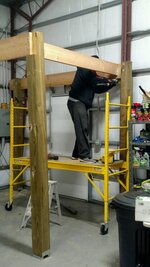
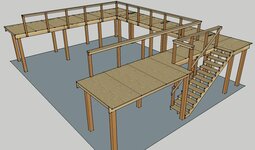
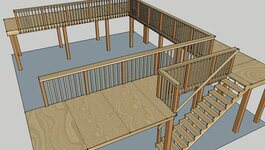
Looking at your plan, I see opportunities to simplify the design and save money, while making it more flexible and adaptable to different uses. Mostly this can be done by removing columns and using LVL's instead of dimensional lumber, for longer beam spans. Also, the load capacity of the joists and beams needed to be balanced.
But to start off with, let's look at what you have right now. The first thing I noticed, was that the 2x8 floor joists were sized for a very large load, while the 2x10 beams weren't even adequate for a standard residential floor loading, much less the load that the floor joists could accommodate. And the columns are way over sized as well, although that can be a benefit, allowing for notching to support beams. In addition, there are a large quantity of columns which, besides adding cost and complexity, impinge on the use of free and open space below the mezzanine.
First, let's size the existing joists. I chose hem-fir, because that is the weakest that is generally sold at big box stores. And I'm using L/360 which means the will deflect 1/360th of their span, or 1/4". Be sure to install with the crown up to compensate for this. This deflection limit is a severe restriction of the allowable deflection that allows the installation of drywall ceilings without cracking from movement. You could also do the calculations at L/240 if no drywall ceilings.
Here is what you have:
2x8 #2 hem-fir joists at 16"o.c. will span 8'0" loaded with a 110#/SF uniform load and figuring 10#/SF dead load (The weight of the structure itself), based on a deflection of L/360.
You could have used these to get a 60# live load capability:
2x6 #2 hem-fir joists at 16"o.c. will span 7'11" loaded with a 60#/SF uniform load and figuring 10#/SF dead load (The weight of the structure itself), based on a deflection of L/360.
Remember that residential floors are 40#/SF live load, so 2x6's support half again as much.
I'm not sure how deep you were planning for the mezzanine at the back of the building (Bottom of the U) to be. I'm thinking it could be 10', to match the side wall column spacing. If so, I could calculate the load capacity for the 2x8's at 16"o.c. that you have, based on that span, just in case. But for now I will assume it is an 8' deep space, just like the sides. So in that case, the calculations above hold for the 2x8's your plan proposes, or 2x6's that could also be used.
And I'm figuring the columns that are out at the juncture of the LVL's to be at this point, so I will size the long ones for a worst case condition, as if this is only 8' deep. This means the beams on the side will have a maximum span of 22'. See those selections below.
Next, let's check the 2x10 dimensional lumber beams that go along the walls. On the side walls they span approx. 10'. The contributing area is 4SF/LF. If you use a LL (Live load) of 40#/SF (Typical residential living areas), and 10#/SF DL, then the total load on these beams is 200#/LF. A 2x10 with a Fb of 1300 spanning 10' will support 185#/LF, so a 2x10 is
inadequate. 2 2x8's or a 2x12 would suffice.
Along the back wall they span 12'. If the depth of the mezzanine here is 8', then the contributing area is 4SF/LF. And as above, a 200#/LF load would need support. 2 2x10's would be needed for this span.
The conclusion is that your 2x10 dimensional lumber beams are way undersized for the load your joist size and spacing will accommodate. They are also slightly undersized for the standard residential living space load of 40# live and 10# dead loads. So you can either up size your beams to match the joists, or downsize the joists for a lesser load capacity. You can also set your loads for the beams you have and just have over sized joists or you can size your beams for a particular load and let the joists be what they are. It all depends on your uses up there. From what you are saying, mostly it will be standard residential loading, which is 40#/SF, but you also mentioned liking the idea of putting a couple of quads up there. Perhaps one area can be designed to accommodate that, and the rest for a more standard
load capability. It's all up to you.
As you may be noticing, You can work things backwards and forwards. You can determine the loads your framing will support, or determine the framing you need for any particular loads that you have in mind. The whole idea of engineering is to not overbuild or under build, but to build what is most appropriate. There is nothing wrong with your design with lots of columns, if you don't mind lots of columns. But it is possible with the beams described
below, to eliminate most of the ones in the middle of the floor. In fact, it would be possible to eliminate some of the ones against the outer wall as well. That's what engineering and design can do, simplify and eliminate excess materials and costs. As it stands now, your dimensional lumber beams are the limiting factor for load capacity. By the way, any lumberyard should be able to check these sizes for you.
Now let's size the two 30' long side LVL's (also called Microllam beams). These beams are figured as 1.9E. They told me they can get in any length and would deliver them all for $150 flat rate in my area.
These 30' long beams have only a maximum effective span of 22' if you use the 6x6 columns under it where the other beam connects to them, and if the rear part of the mezzanine is only 8' deep, so I have sized them for that. For the sizing of these beams, see the beam below.
Now for the 24' long beam connecting between the side beams. By the way, if you are worried about the capacity of the LVL (Or microllam) hangers to support this beam, you could bolt a 2x6 to the side of the 6x6 columns, to serve as end supports for this beam.
Since this beam spans 24', I am picking an LVL for that span, and will use that same one for the beams above, since their effective span is 22'.
The contributing areas and loads for these beams is the same as for the existing dimensional lumber beams, which if based on the 40#/SF LL residential loading, is a total load of 200#/LF. A 1 3/4"x16" 1.9E LVL at L/360 will support 121#/LF at 24' span, so a doubled one will suffice for all three beams.
I will describe how to simplify the perimeter beams in a future post. If you use dimensional lumber, they should be sized as mentioned above for the 10' or 12' spans.
Bill