To avoid these ads, REGISTER NOW!

Microscopic electronic repair. How to?

Grant Gunderson

Well-known member
Joined
May 17, 2013
Messages
2,320
Location
Bellingham, WA
This is a torque sensor assembly out of an electric motor. Replacement board or any parts for that matter are not available from mfg.
IMG_7298.jpeg
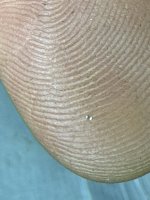
I found it failed due to this tiny part not being fully soldered to the board. Not sure if it’s a resistor or diode or what. Finger print for scale.

IMG_7299.jpeg
Here you can see where it belongs.
IMG_7300.jpeg
And here is one attached to a known good assembly.

How would you go about to identify that part, then how would you re-solder it?

IMG_7301.jpeg
I could also use a recommendation for a much better lighted magnifier setup. As much as I hate to admit I’m getting old my near vision has gone to ****.
 
To avoid these ads, REGISTER NOW!

djbmw

Well-known member
Joined
Jun 20, 2013
Messages
1,142
Location
Ottawa, Ontario, Canada
This is a torque sensor assembly out of an electric motor. Replacement board or any parts for that matter are not available from mfg.
IMG_7298.jpeg
I found it failed due to this tiny part not being fully soldered to the board. Not sure if it’s a resistor or diode or what. Finger print for scale.

IMG_7299.jpeg
Here you can see where it belongs.
IMG_7300.jpeg
And here is one attached to a known good assembly.

How would you go about to identify that part, then how would you re-solder it?

IMG_7301.jpeg
I could also use a recommendation for a much better lighted magnifier setup. As much as I hate to admit I’m getting old my near vision has gone to ****.
If you really want to get into microsoldering you'll need an actual microscope, a hot air station, and a soldering iron with very fine tips. Also... a full set or various tweezers, and flux in a syringe.
 

Attachments

  • 20241204_111345.jpg
    20241204_111345.jpg
    571 KB · Views: 61
  • 20241204_114800.jpg
    20241204_114800.jpg
    334.6 KB · Views: 67
  • 20241204_113647.jpg
    20241204_113647.jpg
    739.6 KB · Views: 66
OP
G

Grant Gunderson

Well-known member
Joined
May 17, 2013
Messages
2,320
Location
Bellingham, WA
If you really want to get into microsoldering you'll need an actual microscope, a hot air station, and a soldering iron with very fine tips. Also... a full set or various tweezers, and flux in a syringe.
Don’t really want to get into micro soldering, but I see this failure enough I’d like to have the capacity to fix them. Bearings fail in these then the tolerances are so close the board hits and it seems to scrape these components off.

I have some pretty small Dumont tweezers from my camera repair days, but they are still too big. Any recommendations? I have a hako fx88 for an iron.
 

PCustoms

Well-known member
Joined
Jul 23, 2011
Messages
22,975
Location
VT
Grant, any chance you can get a better pic of the component?

What's the bottom of the board look like? Is there a hole?

This looks like really odd placement at first glance. Trying to determine what that is supposed to be maybe very difficult...

Do you have the original part to put back on?
 

johnre

Well-known member
Joined
Dec 1, 2016
Messages
1,051
Location
Portland, OR
It says here that fingerprints have a mean ridge to ridge distance of 0.46mm (for 731 measurements on the male subjects). That's about 18 mils, and if your fingerprint is average, we're talking about an S0201 part here (20 mils x 10 mils). This will be a challenge.


Best bet is to get a little more solder paste on the pads, which you might borrow from larger parts on the board, lay the part on the pads with tweezers, and use a hot air gun to reflow the solder. The challenge will be to not blow it away with the hot air stream.

The other option is to use a DVM and probe it for resistance value, assuming that's what it is. Take two measurements, reversing polarity, and if it comes up with the same reading, that's what it is. Then you get a leaded part that you can solder with standard techniques, locate two pads to attach it that are much more robust than this part's pads, and attach the leads there.
 
Last edited:

RTM

Well-known member
Joined
May 13, 2019
Messages
13,188
Location
SF Bay Area
Hire or borrow someone with younger eyes. I’ve had to have coworkers do stuff for me, and it was a bunch bigger than that thing you claim is in the picture. Other than that, I got nothing useful.
 

djbmw

Well-known member
Joined
Jun 20, 2013
Messages
1,142
Location
Ottawa, Ontario, Canada
Don’t really want to get into micro soldering, but I see this failure enough I’d like to have the capacity to fix them. Bearings fail in these then the tolerances are so close the board hits and it seems to scrape these components off.

I have some pretty small Dumont tweezers from my camera repair days, but they are still too big. Any recommendations? I have a hako fx88 for an iron.
At minimum you'll need super fine tips for your soldering iron, flux in a syringe with a needle tip, and some way to magnify what you're looking at (your magnification lense isnt enough,.. you really should have a microscope that provides enough distance from the lense for you to solder). The microscope will also allow you to see if that's a capacitor (along with the value), or a diode. Failing that, you'll need to test the component if replacing with a new one.

As for tweezers, i have a whole bunch that i'll swap between depending on the parts size, location, and my hand position... but with components that small you really need to have a solid grip on the component.
 

MacMcMacmac

Well-known member
Joined
Oct 21, 2014
Messages
1,584
Location
canada
I've seen people use the radiant energy from a halogen headlight bulb to solder components on a circuit board. Perhaps you could flux it, place the component in place and try that.

Maybe you could redneck your own microscope with an overhead projector?
 

LXCam

ALLIANCE MEMBER
Joined
Apr 23, 2013
Messages
19,142
Location
AZ
I know this will probably get me lynched on this forum but....
Have you thought about sending it to a professional for repair?
Blasphemy!!! In pure GJ fashion one must spend thousands of dollars on equipment and hundreds of hours self educating to repair a $10 component 😜

I doubt there is much of a chance of this suggestion happening. But maybe you can identify who manufactured the board and reach out. Problem is almost everyone who private labels a component or assembly is under a strict NDA and won’t do **** for you. But it’s worth a shot, all they can do is say no.
 

WildBill

ALLIANCE MEMBER
Joined
Aug 20, 2021
Messages
2,017
Location
PNW
I would guess its most likely a resister based on looks, can you stick a meter on it and measure resistance? You can get a microscope setup cheap that would let you see and repair it, either stand alone or USB. Also a tweezer set, and a tiny soldering iron. These are all inexpensive examples, I have no idea what you want to spend but these are about as cheap as you can get away with -

Microscope examples -


A cheap tweezer set-

Soldering iron example -
 

Nobody-named-Olli

Well-known member
Joined
Jan 9, 2025
Messages
1,608
Location
North Rhine-Westphalia; Germany
I know this will probably get me lynched on this forum but....
Have you thought about sending it to a professional for repair?

Absolutely no need to lynch you. :) But the way I understand the OP it’s a “regular”/“frequent” issue and therefore he would like to be able to repair/ fix this in house rather than relying on a third party/ asking for a one time favor.

So I guess it’s either getting the right equipment to do it, or enter a business relationship with a third party for which frequency/volume might again not be ideal.

Kind regards,
Olli
 

djbmw

Well-known member
Joined
Jun 20, 2013
Messages
1,142
Location
Ottawa, Ontario, Canada
I would guess its most likely a resister based on looks, can you stick a meter on it and measure resistance? You can get a microscope setup cheap that would let you see and repair it, either stand alone or USB. Also a tweezer set, and a tiny soldering iron. These are all inexpensive examples, I have no idea what you want to spend but these are about as cheap as you can get away with -

Microscope examples -


A cheap tweezer set-

Soldering iron example -
Those "microscopes" are, unfortunately, no good. I bought one of those a few years back and it's dollar store quality with horrific resolution. The lense also needs to be pressed up to the componemt to see.

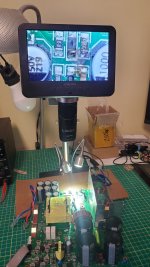
The Andonstar AD246S and equivalent scopes are good. I personally have the JOYALENS JL249MS.
 
  • Like
Reactions: Max

WildBill

ALLIANCE MEMBER
Joined
Aug 20, 2021
Messages
2,017
Location
PNW
Those "microscopes" are, unfortunately, no good. I bought one of those a few years back and it's dollar store quality with horrific resolution. The lense also needs to be pressed up to the componemt to see.

The Andonstar AD246S and equivalent scopes are good. I personally have the JOYALENS JL249MS.
They were examples, I have not tested every cheap microscope but have used that USB one, and it was fine for what it is. I use a $3,500 Scienscope and a $2,000 Metcal soldering iron all day to rework and build stuff like this, but that seemed a little overkill for OPs needs.


djbmw

Well-known member
Joined
Jun 20, 2013
Messages
1,142
Location
Ottawa, Ontario, Canada
Also,... components smaller than 603's are quite tricky. Personally, 603's are the smallest that Im comfortable with. Anything smaller gets reallllyyy frustrating.
Here's an example of some SMD 0603 capacitors under medium magnification
 

Attachments

  • 20251213_123902.jpg
    20251213_123902.jpg
    531.9 KB · Views: 72
  • 20251213_124005.jpg
    20251213_124005.jpg
    406.1 KB · Views: 55
To avoid these ads, REGISTER NOW!

WildBill

ALLIANCE MEMBER
Joined
Aug 20, 2021
Messages
2,017
Location
PNW
@WildBill you'd actually use an iron on something this size?
Yes. How else would you solder it? If you are initially producing the board in an electronic mfg shop you are going to use a stencil printer, a pick-and-place machine, and a reflow oven, but if you are reworking it or doing modifications you have to use a soldering iron. I do this SMT stuff all day and have since the mid 90s.

Production explanation-
 

djbmw

Well-known member
Joined
Jun 20, 2013
Messages
1,142
Location
Ottawa, Ontario, Canada
Yes. How else would you solder it? If you are initially producing the board in an electronic mfg shop you are going to use a stencil printer, a pick-and-place machine, and a reflow oven, but if you are reworking it or doing modifications you have to use a soldering iron. I do this SMT stuff all day and have since the mid 90s.

Production explanation-
Technically one could use hot air if they didnt have an iron... but thats not ideal for OPs case.
 

PCustoms

Well-known member
Joined
Jul 23, 2011
Messages
22,975
Location
VT
Yes. How else would you solder it? If you are initially producing the board in an electronic mfg shop you are going to use a stencil printer, a pick-and-place machine, and a reflow oven, but if you are reworking it or doing modifications you have to use a soldering iron. I do this SMT stuff all day and have since the mid 90s.

Production explanation-

I'm well aware how boards are made and inspected.

If I remember next week I'll check with rework and see what they'd do, I'm 99% sure they have a mini hot air gun for this, but I don't dictate their procedures.
 

WildBill

ALLIANCE MEMBER
Joined
Aug 20, 2021
Messages
2,017
Location
PNW
You use a hot air pen to remove parts. Unless you have a way like a mini stencil to apply solder paste to those tiny pads hot air is not used to replace caps, resisters, etc. And even then its not really used, you can't produce a high quality solder joint using hot air by hand, its too inconsistent, and just doesn't work very well.
 

cleaner

Well-known member
Joined
Dec 22, 2018
Messages
134
Location
At home
IME this rework would require hot air solder/desolder and a microscope. We had a few "super techs" that took care of this in R&D. None of the Engineers in the R&D group were any good at this, we gladly paid the techs OT to do it for us. We were using 10x20 SMT parts back in the 90s and shipping tens of millions of PCBs per year. The main issue is controlling the heat transferred to the PCB and surrounding components.

If you are looking to do this reliably you need these types of tools and some exceptional skill. It requires surgeon like dexterity and hand/eye coordination.

https://www.weller-tools.com/us/en/industrial-soldering/rework
 

WildBill

ALLIANCE MEMBER
Joined
Aug 20, 2021
Messages
2,017
Location
PNW
IME this rework would require hot air solder/desolder and a microscope. We had a few "super techs" that took care of this in R&D. None of the Engineers in the R&D group were any good at this, we gladly paid the techs OT to do it for us. We were using 10x20 SMT parts back in the 90s and shipping tens of millions of PCBs per year. The main issue is controlling the heat transferred to the PCB and surrounding components.

If you are looking to do this reliably you need these types of tools and some exceptional skill. It requires surgeon like dexterity and hand/eye coordination.

https://www.weller-tools.com/us/en/industrial-soldering/rework
I definitely don't have have these qualities and do this type soldering every day for a living. I also do it at home with a used ebay soldering iron and my naked eyeballs. Engineers just **** at soldering:cool:
 
OP
G

Grant Gunderson

Well-known member
Joined
May 17, 2013
Messages
2,320
Location
Bellingham, WA
Grant, any chance you can get a better pic of the component?

What's the bottom of the board look like? Is there a hole?

This looks like really odd placement at first glance. Trying to determine what that is supposed to be maybe very difficult...

Do you have the original part to put back on?
Not without a proper micro scope. Ido have the original part, but I'm certain it needs to be replaced.
Hire or borrow someone with younger eyes. I’ve had to have coworkers do stuff for me, and it was a bunch bigger than that thing you claim is in the picture. Other than that, I got nothing useful.
That is in the plans, but I still need to tool up with the proper tooling and learn to do it myself, so I can train said employees down the road.
At minimum you'll need super fine tips for your soldering iron, flux in a syringe with a needle tip, and some way to magnify what you're looking at (your magnification lense isnt enough,.. you really should have a microscope that provides enough distance from the lense for you to solder). The microscope will also allow you to see if that's a capacitor (along with the value), or a diode. Failing that, you'll need to test the component if replacing with a new one.

As for tweezers, i have a whole bunch that i'll swap between depending on the parts size, location, and my hand position... but with components that small you really need to have a solid grip on the component.
My smallest tweezers are Dumont 5/45 Sa's they are still way too big! Also need smaller probs for my Fluke meter.
Sounds to me like you’re going to need to make some additional floor space grant.

IMG_6399.png
Haha! I'm well aware of those, but a microscope would be better here.
I know this will probably get me lynched on this forum but....
Have you thought about sending it to a professional for repair?
haha. I'm the only guy in N.A. that fixes these motors and one of only 3 guys world wide. this is a very common failure and one of the few that I cant presently fix, so want to keep it in house for a variety of reasons.
Blasphemy!!! In pure GJ fashion one must spend thousands of dollars on equipment and hundreds of hours self educating to repair a $10 component 😜

I doubt there is much of a chance of this suggestion happening. But maybe you can identify who manufactured the board and reach out. Problem is almost everyone who private labels a component or assembly is under a strict NDA and won’t do **** for you. But it’s worth a shot, all they can do is say no.
No luck on sourcing parts, I've hit the NDA issue on every part for these motors. I've even resorted to having my own seals for them custom made for me. MFG's only option is a $2k replacement.
I would guess it's most likely a resister based on looks, can you stick a meter on it and measure resistance? You can get a microscope setup cheap that would let you see and repair it, either stand alone or USB. Also a tweezer set, and a tiny soldering iron. These are all inexpensive examples, I have no idea what you want to spend but these are about as cheap as you can get away with -

Microscope examples -


A cheap tweezer set-

Soldering iron example -
Not sure on the quality of those scopes at that price, and those tweezers are way too big, same with the that iron and tips. I have a Hakko iron, so will look into tips for it.
I love threads like this, really clear who knows and who thinks they know.
thats every thread.
I know what I don't know :)
Same, thus why ?I started the thread. haha. Thats the first part of the battle, most of the time I dont even know what I dont know.
Absolutely no need to lynch you. :) But the way I understand the OP it’s a “regular”/“frequent” issue and therefore he would like to be able to repair/ fix this in house rather than relying on a third party/ asking for a one time favor.

So I guess it’s either getting the right equipment to do it, or enter a business relationship with a third party for which frequency/volume might again not be ideal.

Kind regards,
Olli
I have enough volume of these, that justifies keeping it in house, thus looking to invest in the right gear.
Those "microscopes" are, unfortunately, no good. I bought one of those a few years back and it's dollar store quality with horrific resolution. The lense also needs to be pressed up to the componemt to see.

The Andonstar AD246S and equivalent scopes are good. I personally have the JOYALENS JL249MS.
funny, I already added that Joyless unit to my cart. Any feedback on it, before I pull the trigger?
They were examples, I have not tested every cheap microscope but have used that USB one, and it was fine for what it is. I use a $3,500 Scienscope and a $2,000 Metcal soldering iron all day to rework and build stuff like this, but that seemed a little overkill for OPs needs.

Those looks nice, but damn expensive! What are you using for tweezers?
Also,... components smaller than 603's are quite tricky. Personally, 603's are the smallest that Im comfortable with. Anything smaller gets reallllyyy frustrating.
Here's an example of some SMD 0603 capacitors under medium magnification
wow.
 

djbmw

Well-known member
Joined
Jun 20, 2013
Messages
1,142
Location
Ottawa, Ontario, Canada
funny, I already added that Joyless unit to my cart. Any feedback on it, before I pull the trigger?
I've been very happy with it! I typically use the 90mm-300mm lens for the work I do. Resolution and quality is fantastic - it has all of the features that I want/need. The only thing that isn't "perfect" is the stand/mount. With the included mount base plate, the scope can be tippy at times and larger boards are tricky to position (especially if the component(s) in question are in the middle). Ideally, mounting the scope on an articulating arm would be best. However, for working on smaller boards (10"x10" or smaller) is perfect.

I paid $205 CAD (~$148 USD) several years ago

PS - Joyalens (and Andonstar) make several different models, so choose carefully. The difference between the 246 and 249 is the screen size. I have the 7" screen and it works well - I dont see the benefit of a 10" screen (if anything, it would make it more top-heavy!)


RoninB4

Well-known member
Joined
Jul 22, 2020
Messages
3,564
Location
Under My House
Sounds to me like you’re going to need to make some additional floor space grant.
-Just an FYI for you. An optical comparator is almost useless for what the OP needs to do. They're really for examining/measuring things in profile. Even with objective lens capability the magnification on most comparators will not be enough. Using comparators was part of my daily job and they're not designed for this.
 

Vvmvbb

Well-known member
Joined
Aug 5, 2011
Messages
746
Location
CT
I’d probably use an 0805 resistor of the same value, and connect it to the circuit using 30 gauge kynar wires (‘blue wire’). One wire to the bottom side of where the original part connected and the other to the big pad that connects to the top side. That pad looks like a test pad to me, but if something actually uses that pad trace the circuit and find another place to connect it. You can even scrape the solder mask to expose the trace wherever it’s convenient. Clean up the pads first with solder wick, and tack down the 0805 with , I don’t know, crazy glue?
 
Last edited:

LXCam

ALLIANCE MEMBER
Joined
Apr 23, 2013
Messages
19,142
Location
AZ
-Just an FYI for you. An optical comparator is almost useless for what the OP needs to do. They're really for examining/measuring things in profile. Even with objective lens capability the magnification on most comparators will not be enough. Using comparators was part of my daily job and they're not designed for this.
It was a joke
 

ATW

Member
Joined
Aug 22, 2014
Messages
14
Location
UK
In a former life, heavily involved in PCB/electronic manufacturing I'll second what WildBill said, it was Metcal for soldering and optical stereo microscopes for assembling small items. We did have a couple of the Vision Engineering Mantis 3D viewers for inspection.

Its a few years back, so things might have moved on, the two (major) disadvantages digital microscopes had over optical were:
  • no depth perception (3D) which you get with stereo optical microscope.
  • image update rate / lag - i suspect this has improved over time.
Tweezers - Regine Venus 4A (https://regine-group.com/industries/electronics/ plenty of other to choose from there). They have served me well for over 30 years, used down to 0402 sized components.

Tip for removing smaller two terminal SMD components (but need a good iron - see Metcal) that works well/better the smaller they get - wet both ends/terminals with additional solder alternate heat quickly between ends and it you will quickly (a few seconds) get both ends to simultaneously flow and the component is free. Clean up the excess solder you added with a good quality solder wick - not too much heat/time to avoid lifting pads.

Andy.
 

djbmw

Well-known member
Joined
Jun 20, 2013
Messages
1,142
Location
Ottawa, Ontario, Canada
In a former life, heavily involved in PCB/electronic manufacturing I'll second what WildBill said, it was Metcal for soldering and optical stereo microscopes for assembling small items. We did have a couple of the Vision Engineering Mantis 3D viewers for inspection.

Its a few years back, so things might have moved on, the two (major) disadvantages digital microscopes had over optical were:
  • no depth perception (3D) which you get with stereo optical microscope.
  • image update rate / lag - i suspect this has improved over time.
Tweezers - Regine Venus 4A (https://regine-group.com/industries/electronics/ plenty of other to choose from there). They have served me well for over 30 years, used down to 0402 sized components.

Tip for removing smaller two terminal SMD components (but need a good iron - see Metcal) that works well/better the smaller they get - wet both ends/terminals with additional solder alternate heat quickly between ends and it you will quickly (a few seconds) get both ends to simultaneously flow and the component is free. Clean up the excess solder you added with a good quality solder wick - not too much heat/time to avoid lifting pads.

Andy.
I agree that depth perception is tricky with a monoscope - but you adjust to it relatively quickly.
There is zero noticable lag/delay in the scopes I mentioned - its as real time as any modern camera.

I also agree that, for components as small as OP is working with, quickly alternating the tip from one side of the component to the other every 1 second for a handful of times will get it off the board. No need for soldering iron tweezers or the like.

If he ends up wanting to do reflow work or work with different Integrated Circuits, he'll need a hot air station.

Depending on how deep OP wants to go down the rabbit hole, he will also need solder wick, low melt solder, 99% rubbing alcohol, q-tips, cleaning brushes, alcohol pads, solder mask and UV light, an etching/engraving pen, solder balls and applicator, replacement pads of various sizes, replacement thru-hole gromets, bench top power supply,... a 'third hand' armature.... plastic dental picks... flush cutters... a few GOOD multimeters with ultra fine tips,.. a component tester,.. an osciliscope... and a myriad of replacement components (caps, diodes, resistors, gates, thermisters, etc.).

I think thats all I have hovering around my soldering workbench.
 
OP
G

Grant Gunderson

Well-known member
Joined
May 17, 2013
Messages
2,320
Location
Bellingham, WA
I've been very happy with it! I typically use the 90mm-300mm lens for the work I do. Resolution and quality is fantastic - it has all of the features that I want/need. The only thing that isn't "perfect" is the stand/mount. With the included mount base plate, the scope can be tippy at times and larger boards are tricky to position (especially if the component(s) in question are in the middle). Ideally, mounting the scope on an articulating arm would be best. However, for working on smaller boards (10"x10" or smaller) is perfect.

I paid $205 CAD (~$148 USD) several years ago

PS - Joyalens (and Andonstar) make several different models, so choose carefully. The difference between the 246 and 249 is the screen size. I have the 7" screen and it works well - I dont see the benefit of a 10" screen (if anything, it would make it more top-heavy!)

Thanks. I’ll probably pull the trigger on it. There was a used zeiss stereo microscope listed the other day for $400. Almost bought it, but I think the digital might be better for this. Especially with the option for a wider field of view. If needed I have the capability to machine a bracket in house.
Not only does this guy do repairs, he also does training and I think he also sells equipment

Micro Soldering Electronics Repair Training Workshop
Thanks. I’ll check his vids out.
In a former life, heavily involved in PCB/electronic manufacturing I'll second what WildBill said, it was Metcal for soldering and optical stereo microscopes for assembling small items. We did have a couple of the Vision Engineering Mantis 3D viewers for inspection.

Its a few years back, so things might have moved on, the two (major) disadvantages digital microscopes had over optical were:
  • no depth perception (3D) which you get with stereo optical microscope.
  • image update rate / lag - i suspect this has improved over time.
Tweezers - Regine Venus 4A (https://regine-group.com/industries/electronics/ plenty of other to choose from there). They have served me well for over 30 years, used down to 0402 sized components.

Tip for removing smaller two terminal SMD components (but need a good iron - see Metcal) that works well/better the smaller they get - wet both ends/terminals with additional solder alternate heat quickly between ends and it you will quickly (a few seconds) get both ends to simultaneously flow and the component is free. Clean up the excess solder you added with a good quality solder wick - not too much heat/time to avoid lifting pads.

Andy.
Thanks. I’ll look into those tweezers. I haven’t seen $300 worth of Dumont ones added to my cart, but it’s been so long since I bought tweezers I forget the size scales. Might see if the lady friend has any medical grade ones they want to get rid of at work too.

I do have a HAKKO de solder gun and a full range of tips so I think that might be the ticket for removal from the back side of the board.

I’m building out a brand new shop as my business has expanded and part of that will be a bench dedicated for electronics work.
I agree that depth perception is tricky with a monoscope - but you adjust to it relatively quickly.
There is zero noticable lag/delay in the scopes I mentioned - its as real time as any modern camera.

I also agree that, for components as small as OP is working with, quickly alternating the tip from one side of the component to the other every 1 second for a handful of times will get it off the board. No need for soldering iron tweezers or the like.

If he ends up wanting to do reflow work or work with different Integrated Circuits, he'll need a hot air station.

Depending on how deep OP wants to go down the rabbit hole, he will also need solder wick, low melt solder, 99% rubbing alcohol, q-tips, cleaning brushes, alcohol pads, solder mask and UV light, an etching/engraving pen, solder balls and applicator, replacement pads of various sizes, replacement thru-hole gromets, bench top power supply,... a 'third hand' armature.... plastic dental picks... flush cutters... a few GOOD multimeters with ultra fine tips,.. a component tester,.. an osciliscope... and a myriad of replacement components (caps, diodes, resistors, gates, thermisters, etc.).

I think thats all I have hovering around my soldering workbench.
I already have a scope, picks, flush cutters, etc. once I identify the components in these boards I’ll order a bunch.

Could use a recommendation for good small / micro tips for my Fluke meter and scope.

This board has an antenna in it and it is fully wireless picking up power / data from the main board.
IMG_7209.jpeg
The board rotates with the drive shaft and contains two strain gauges as torque sensors. The grey magnet is for the Hall effect sensor for measuring rotation.

IMG_7128.jpeg
IMG_7129.jpeg
That’s the board that sits over the sensor board and wireless picks up the data. That’s particular motor was F’d as it had been pressure washed so was flooded. Most of the time with these motors it’s an issue with bearings and if those go out one of. The cascade of effects is damage to these two. Parts since the tolerance are so tight.

I’ve been able to fix 90% of them, but if I can take care of these board repairs I can get that ratio up to 95%. Or at the very least it helps me out with salvaging parts to use for other motors. I do have a on of parts I can practice my skills on too.


Part of the challenge with using a bench top power supply with these motors is the battery management system. I can’t just apply power and try to trick the management system by applying power to those leads as well. If it doesn’t get the actual data from one of their brands batteries via the bus system it immediately goes into a safe mode and throws codes. The bus system transmits everything from the batteries power data, charge cycles, firmware version and battery SN. If I could crack that it would make things way easier. For example some of these motors while. Being physically identical are locked out in the firmware to only work with a specific battery.
 

djbmw

Well-known member
Joined
Jun 20, 2013
Messages
1,142
Location
Ottawa, Ontario, Canada
Thanks. I’ll probably pull the trigger on it. There was a used zeiss stereo microscope listed the other day for $400. Almost bought it, but I think the digital might be better for this. Especially with the option for a wider field of view. If needed I have the capability to machine a bracket in house.

Thanks. I’ll check his vids out.

Thanks. I’ll look into those tweezers. I haven’t seen $300 worth of Dumont ones added to my cart, but it’s been so long since I bought tweezers I forget the size scales. Might see if the lady friend has any medical grade ones they want to get rid of at work too.

I do have a HAKKO de solder gun and a full range of tips so I think that might be the ticket for removal from the back side of the board.

I’m building out a brand new shop as my business has expanded and part of that will be a bench dedicated for electronics work.

I already have a scope, picks, flush cutters, etc. once I identify the components in these boards I’ll order a bunch.

Could use a recommendation for good small / micro tips for my Fluke meter and scope.

This board has an antenna in it and it is fully wireless picking up power / data from the main board.
IMG_7209.jpeg
The board rotates with the drive shaft and contains two strain gauges as torque sensors. The grey magnet is for the Hall effect sensor for measuring rotation.

IMG_7128.jpeg
IMG_7129.jpeg
That’s the board that sits over the sensor board and wireless picks up the data. That’s particular motor was F’d as it had been pressure washed so was flooded. Most of the time with these motors it’s an issue with bearings and if those go out one of. The cascade of effects is damage to these two. Parts since the tolerance are so tight.

I’ve been able to fix 90% of them, but if I can take care of these board repairs I can get that ratio up to 95%. Or at the very least it helps me out with salvaging parts to use for other motors. I do have a on of parts I can practice my skills on too.


Part of the challenge with using a bench top power supply with these motors is the battery management system. I can’t just apply power and try to trick the management system by applying power to those leads as well. If it doesn’t get the actual data from one of their brands batteries via the bus system it immediately goes into a safe mode and throws codes. The bus system transmits everything from the batteries power data, charge cycles, firmware version and battery SN. If I could crack that it would make things way easier. For example some of these motors while. Being physically identical are locked out in the firmware to only work with a specific battery.

Interesting. Sounds like there's an eeprom or IC that has a validation check - perhaps you can figure out which chip on the board is responsible for that validation and see if you can read the data, and re-write the data without the validation check in place. That would allow any battery to be used...
 

tool_scrounge

Well-known member
Joined
Jul 20, 2010
Messages
4,193
Location
Southern California
Also,... components smaller than 603's are quite tricky. Personally, 603's are the smallest that Im comfortable with. Anything smaller gets reallllyyy frustrating.
Here's an example of some SMD 0603 capacitors under medium magnification
If I have board space, I like to design with even bigger 0805 sized parts. At least some of them have resistance values printed on them for easier debugging.
 
OP
G

Grant Gunderson

Well-known member
Joined
May 17, 2013
Messages
2,320
Location
Bellingham, WA
Interesting. Sounds like there's an eeprom or IC that has a validation check - perhaps you can figure out which chip on the board is responsible for that validation and see if you can read the data, and re-write the data without the validation check in place. That would allow any battery to be used...
That would be ideal. Just another art of the learning curve and something to investigate. Sure wish I had paid more attention in my EE classes 25 years ago!
 
To avoid these ads, REGISTER NOW!
Top Bottom