So I've been very lucky to have a lot of work this summer. Summer's aren't typically that busy for me but this one, post pandemic, has been. While a lot of my work is shooting at least as much is retouching which means I'm spending a lot of time behind the screen and that really makes me a bit stir crazy. My solution to that is to go out to the shop and work with my hands.
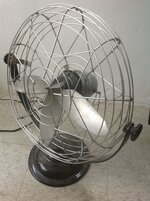
This old Roto-Beam fan fell off a table in the studio in NYC and broke the blade and smashed the cage. It always vibrated a little and an assistant had placed it a bit close to the edge. At the time I'd never seen one of these that large and it was probably the most I'd ever spent on a fan ($250) so it was pretty disappointing when it broke.
I found a person to weld the blade years ago (before I could weld aluminum) but the vibration was so much worse after the fall that it just sat - too rare to get rid of, too complete to part out and too broken to use.
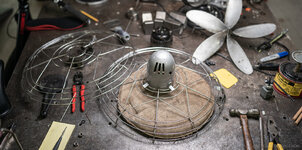
Needing a project to counter endless hours in front of the monitor I thought I'd see if my skills had improved enough to fix it.
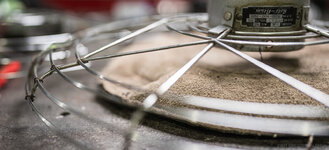
It had always been a project fan even before the fall. The cage had broken and missing wires and many of the tack welds that held them in place had long since failed. Everything about this fan was a low bar so there wasn't much pressure.

I disassembled the whole thing and just started with the cage. I found the missing sections of the cage were close to 1/8" welding wire so I cut and bent sections with stainless 308 filler rod. The quality of these cages is primitive at best and the wire is pot metal so I wasn't concerned with matching the steel and the stainless would not need to be chromed.
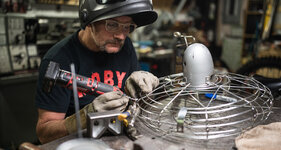
I went around the cage cleaning the rust with a wire brush in a dremmel. Well, not a dremmel - but Milwaukee version.


It take less power to melt the cage than the filler rod and I probably should have used silicon bronze but it felt like a challenge to try to make the stainless work. I found striking my arc on the filler first would give me a small amount of material that I could then pulse and melt into the cage. There was a lot of broken welds all over so I would work on this for 20-30 minutes every time I needed a break.

The next thing I did was to see how far out the repaired blade was. It wasn't bad and I was able to get it within a few millimeters with some gentle bending but with the blade back on the motor it still wobbled...
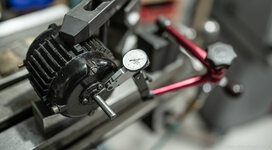
I mounted the motor on a v-block and put an indicator on it and found it was about 10-20 thou out towards the end and only 1-2 out at the point the shaft entered the motor. So clearly it bent the shaft in the fall.
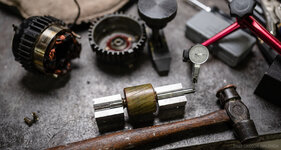
I wasn't sure the best way to attack this so I took the motor apart and tried supporting it with v-blocks and giving it some gentle taps. It was tricky finding ways to support it nearer the rotor but it didn't need to go far and I managed to get it down to only a few thousandths out.

Next I started to work on the blade. Again, these are pretty primitive and built in the late 30's so the castings are rough. I don't know if the blades were always polished on them or if some weren't but this one was a pretty dull finish and since the blade is hands down my favorite part of these I wanted to at least get a bit of polish on them.

I'm late to the party with the 3m Roloc attachments but it's pretty great and far superior to the velcro disks I'd used before - or rather never used because they worked so poorly. The small disks did a good job of getting into most spots...

...but the Dynafile made appearance as it was great at getting into tight spots. I did a bit of sanding but mostly I used the scotchbrite or woven abrasives so as to not remove too much material.
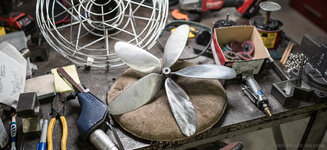
You can't quite see it but there's a faint name cast into the blade on the back and too much sanding would make it disappear.
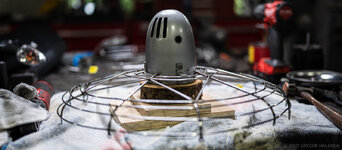
All of this has taken place over the last month in 20-30 minute increments and I didn't really take too many photos because I started without any sense of whether or not I'd be able to save it. It was a very classic mission creep project and once I'd taken it apart and covered the bench I needed to keep going.
With the cage repaired and welded back I started trying to bend and tweak the shape back. It's fairly soft metal so most of it I could do with my hands but some bits I'd tap with the hammer.

I set the motor housing on my v-blocks to get it off the bench and then just kept trying to bend it using a scrap bit of aluminum as my gauge.

I then put the two halves together and continued to tap and nudge the cage to a more round shape. Again, it's not perfect but then even when new these weren't perfect so at some point you need to step back and be okay with it. I want to be able to use this fan - maybe in the shop - and the goal is just to fix it.
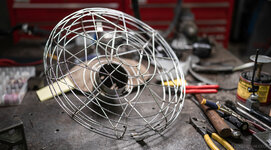
Overall it's round. Because it's a bit organic I made a point of finding the best fit of the two halves and then marked that with some bits of tape so it would go back together.

The base is enameled cast steel and quite heavy and also dirty and scratched but Mother helped me with that.
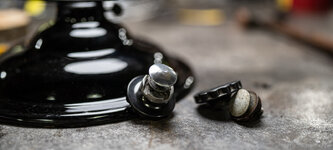
I wire wheeled the fasteners and gave them a light polish on the buffer.

The switch was always loose and I discovered, after buying some locking nuts that were 1/2-20 fine thread that it's actually 1/2-28 and while I do have a lathe and could probably have made and cut my own special locking nuts I opted to make a spacer because cutting threads on the lathe is big hassle.
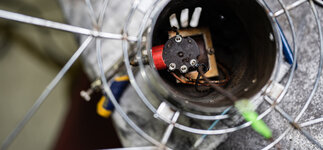
It's not original or correct but I was more concerned with just getting it off the bench. At this point the 890 is home and I have some new hand guards to put on and if I put the fan in a box to clear the bench it will stay in the box forever. I have another fan in a box as a reminder of how that happens. Good enough is better than a box of parts.
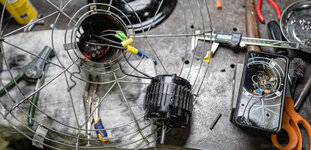
Thankfully I took a photo of the wiring because I couldn't remember how it went. I shored up the original wires with a bit of heat shrink and used wire nuts (original was solder and tape) so that if I want to remove it later I'm not cutting and shortening the wires. The motor works well and is very smooth so it doesn't need to be rewound. Don't worry, the green masking tape isn't being used as electrical tape - it was only to identify which wires went together.

With the motor back in the housing I tested the wiring and it worked on all speeds so I buttoned it back up. These old fans use slotted screws and of course standard fasteners and I've replaced the rusted original fasteners with stainless.

I was tempted to take the cage off the housing and then send the whole lot off to be chromed and maybe some day I'll do that but for now it's going to live in it's original repaired state. Nothing is too far gone so that's a good place to stop.


You can see the weld repairs and the blade was not polished to a mirror finish - I didn't want to over restore it. I think trying to make it perfect would just be frustrating.
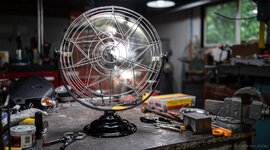
It is very smooth at full speed, it vibrates a bit on medium and it's silky smooth on low speed. I don't have much interest in trying to go back and figure it out. Because the blade doesn't have a through hole I wasn't able to static balance the weight of the blade which might be the issue. It would need some kind of jig to allow the blade to be statically balanced but for now, in the middle of a heat wave, I am going to be satisfied with it.
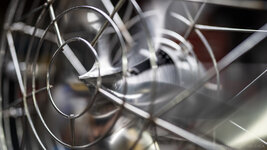
And here is my favorite part of these Roto-Beams - the nose of the blade is always left exposed so you can touch it because we all have that compulsion to touch a spinning fan blade. Of course the center is harmless and so this is a really neat feature dreamt up before we worried about protecting people from themselves.
Touching this point is something you can't really resist and yet my kids still have all their fingers. Remarkable! It's a shame that so much of the design that surrounds us is limited by protecting the stupidest around us. It's yet another reason I love these olds fans so much - they are from an era of personal responsibility and they are more beautiful for it.
Gregor